Cat Carrier Hang Tag: Custom Design
A cat carrier hang tag is specified by stock weight, fastener strength and content compliance: 300-400 gsm coated art board or 350-450 gsm kraft, printed offset or digital at 150-300 lpi, attached with a fastener that withstands a 25 N pull for 10 seconds, and carrying fibre content, country of origin and importer details in text of at least 1.6 mm cap height.
A hang tag is the cheapest component on a pet carrier and the one that carries the most legal weight, which is why it deserves its own specification rather than being left to the artwork agency. It does three jobs simultaneously: it sells on the shelf, it carries mandatory product identification for customs and consumer protection, and it carries the retail barcode that lets the product be scanned and replenished. Those three jobs pull in different directions — marketing wants one panel, compliance needs at least three, and the barcode needs a flat, light, quiet zone — and the resolution is a fixed panel layout rather than a negotiation each season. This page sets out the substrate, print, fastener and content specifications used in production, with the numbers a buyer can put into a purchase order. Commercial terms follow the standard programme: MOQ 500 pieces per colourway, prototypes in 6-10 working days, bulk production 35-50 days after sample approval, final random inspection to AQL 2.5, T/T 30/70 and FOB Xiamen.
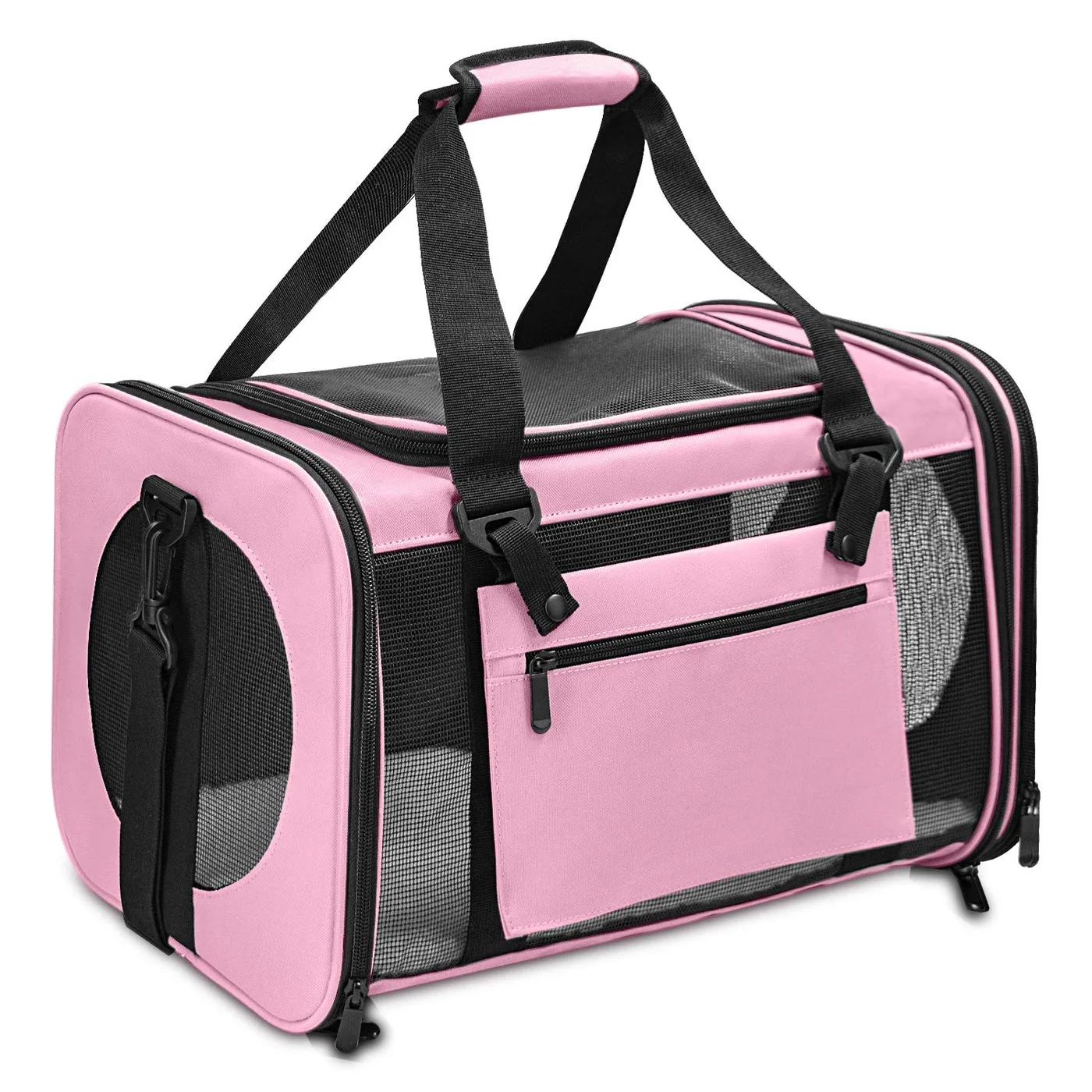
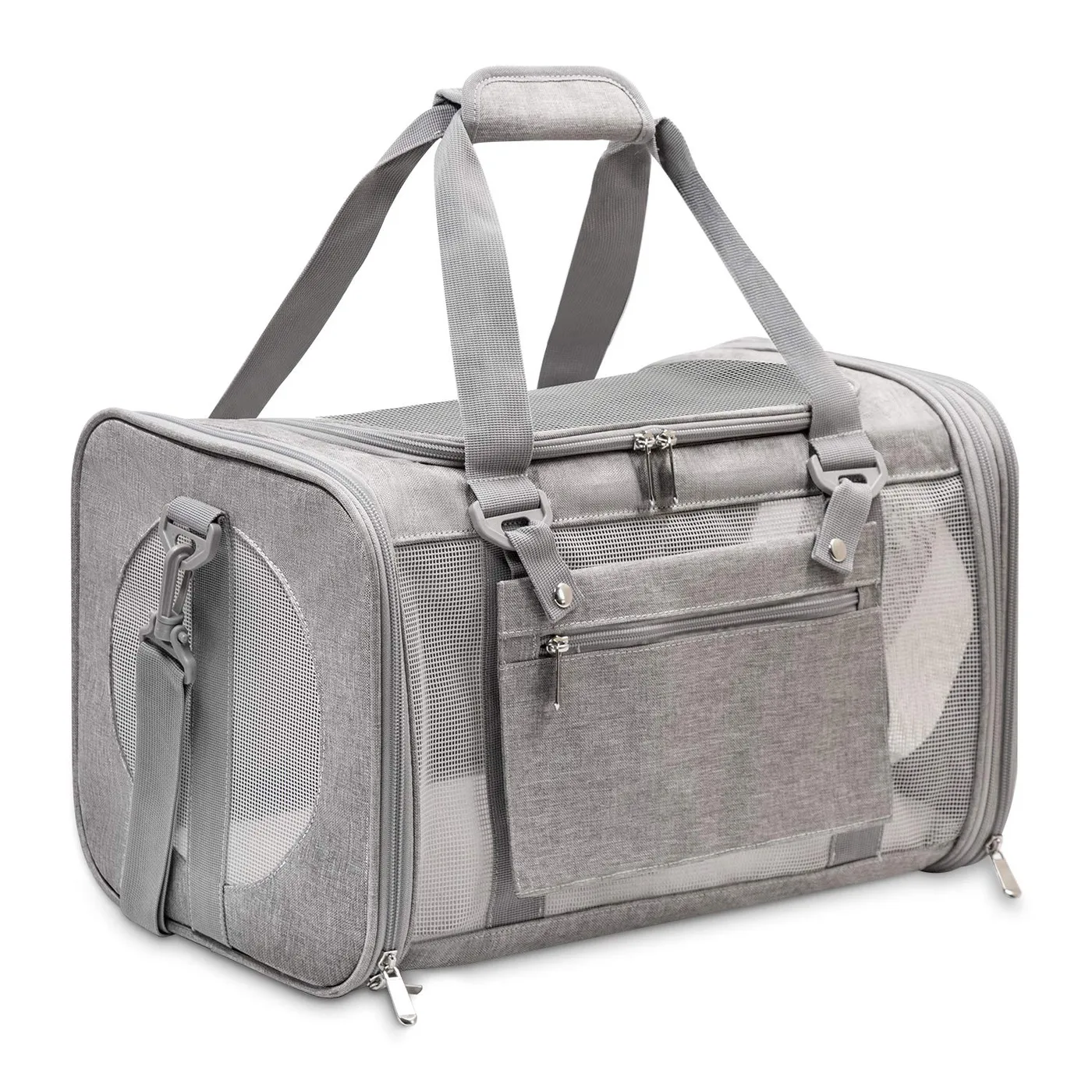
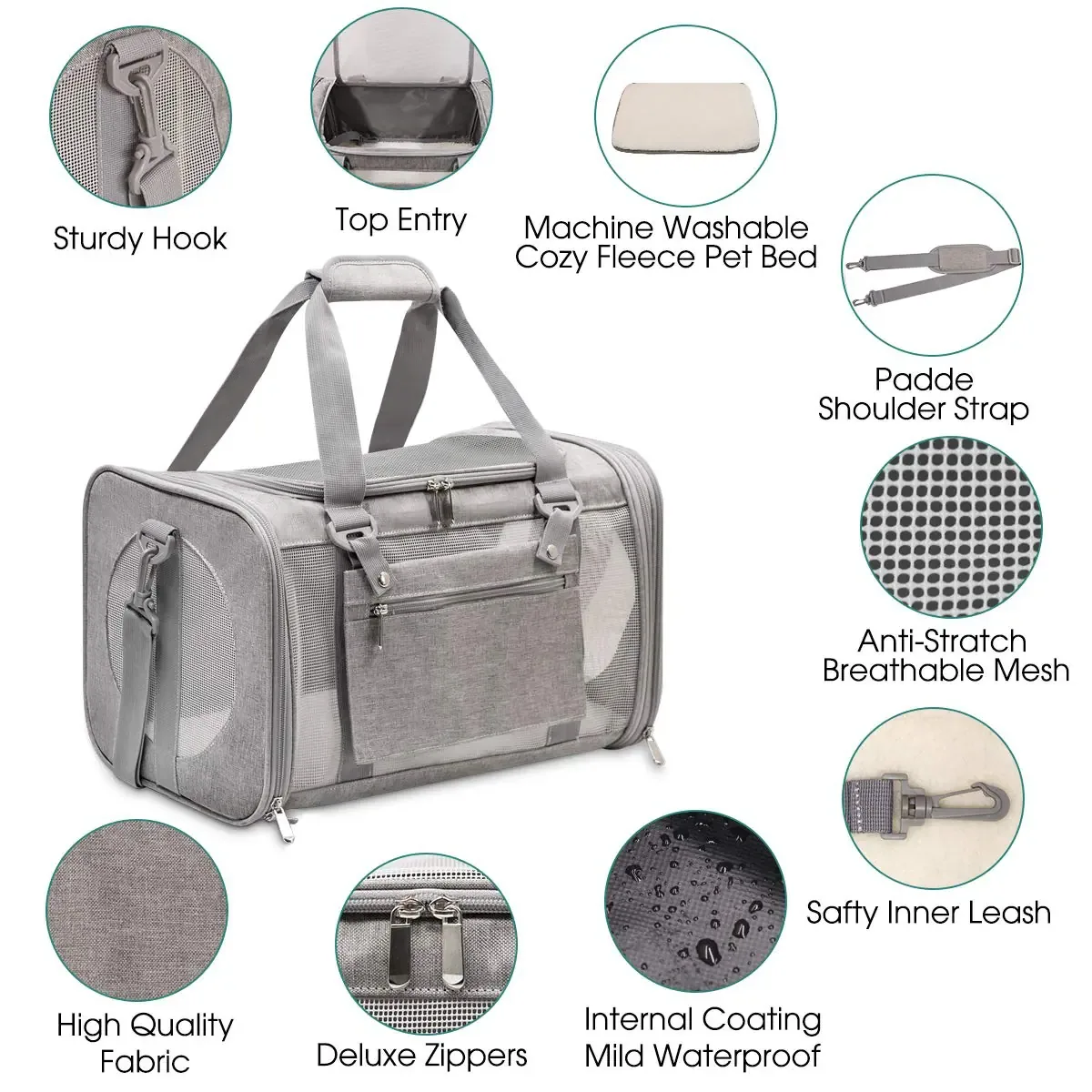
A pet bag supplier running cat carrier orders at 500 pieces per colourway can consolidate several sizes into one cutting window and hold the dye lot across reorders.
The Three Jobs a Hang Tag Has to Do at Once
A hang tag is asked to be a brand asset, a legal document and a data carrier, and the three requirements do not naturally fit on the same piece of board. Programmes that treat it purely as a brand asset end up with a beautiful tag that a customs officer or a retailer's compliance team rejects; programmes that treat it purely as a label end up with a tag that no shopper reads.
The brand job is the front panel: brand mark, product name, size or model, and one claim. The working rule is that a shopper gives a tag 2-4 seconds, so the front panel carries one message in type of at least 8 pt and nothing else. A tag that carries four claims in 6 pt carries none.
The legal job is the back and the inner panels, and it is not optional. Depending on the market, a tag on a textile pet product carries fibre content by percentage, country of origin, importer or manufacturer identity and address, care instructions, and any applicable warning. For the US market the textile labelling rules are administered by the Federal Trade Commission and consumer product safety requirements — including tracking label and substance limits — by CPSC.
The data job is the barcode and the SKU, and it is the one that determines whether the product can be replenished. A tag without a scannable UPC or EAN forces a retail partner to apply its own sticker, which is a cost and a delay, and a tag with a barcode that fails a scan grade is worse than none because it fails at the till rather than in the back room.
The three jobs also have a physical conflict. The front panel wants a large uninterrupted area; the legal panels want text area; the barcode wants a flat light zone away from a fold, a hole, a string and a foil block. Resolving it means fixing the layout once and reusing it, rather than redesigning per SKU.
A hang tag is a compliance document that happens to be visible, and the layout should be fixed by the compliance requirement first and the brand requirement second.
Tag Stock: Weight, Finish and Substrate Choice
Stock choice sets the tactile impression and the durability, and it is the first cost decision on the tag. Too light and the tag curls, creases and looks cheap within days of being put on a shelf; too heavy and it costs money without adding perceived value and it puts more load on the fastener.
Coated art board at 300-400 gsm is the default. It prints sharply, holds foil well and costs least per unit at volume. Below 250 gsm a tag of typical 55 x 90 mm size visibly curls after a week in a dry retail environment; above 450 gsm the tag becomes stiff enough to lever against the fastener and tear the attachment hole.
Uncoated kraft at 350-450 gsm is the choice for a natural or recycled positioning. It costs 0.01-0.05 USD more per tag, it prints with slightly lower contrast, and it needs an aqueous coating if the print is to survive handling. It is the most common choice for programmes with a sustainability claim, and it should carry a recycled-content percentage on the back if that claim is made.
Cotton rag paper at 300-600 gsm, synthetic paper and transparent or frosted film are the premium and speciality options. Synthetic paper at 200-350 micron is specified where the tag must survive moisture or heavy handling; transparent film is used for a minimal-look tag. Both cost 3-8 times coated board.
| Substrate | Weight / gauge | Print contrast | Curl risk | USD/tag at 5k |
|---|---|---|---|---|
| Coated art board, one side | 250-300 gsm | Excellent | High | 0.035-0.075 |
| Coated art board, two side | 300-400 gsm | Excellent | Low | 0.045-0.095 |
| Uncoated kraft | 350-450 gsm | Fair | Low | 0.050-0.110 |
| Recycled board, 100% PCW | 350-450 gsm | Fair | Medium | 0.055-0.125 |
| Cotton rag paper | 300-600 gsm | Good | Low | 0.140-0.380 |
| Synthetic paper | 200-350 micron | Good | None | 0.130-0.320 |
| Transparent film | 150-250 micron | Good | None | 0.160-0.420 |
Grain direction matters more than most buyers realise. A tag whose grain runs across the attachment hole will tear out at the hole under a modest pull; a tag with the grain running along the hole axis resists. The specification is grain parallel to the short edge for a tag hung from a hole at the top.
Hole reinforcement is the cheap fix for the common failure. An eyelet — a metal or plastic ring set into the hole — costs 0.015-0.055 USD and raises the tear-out strength by a factor of three to five. It should be specified wherever the tag exceeds 350 gsm or where the product is shipped on a hanger that takes load in transit.
Chemical compliance applies to the tag as much as to the product, because a tag is handled and chewed. Inks, coatings and the board are declared against the criteria published by OEKO-TEX, and metal eyelets are checked for nickel release. The tag's weight should be set by curl resistance and hole strength, not by the desire to feel expensive — 300-400 gsm is the working range.
Print Method and Finish: What Each Actually Buys
Print and finish are where most of the tag's unit cost sits, and they are also where a programme overspends most often, because finishing operations are priced per pass and each pass adds setup, waste and lead time.
Offset litho is the volume choice. It runs at 175-300 lpi, handles four-colour process plus spot colours, and becomes economic from about 2,000 to 3,000 tags because plates cost 25-70 USD per colour. Unit print cost at 5,000 tags is 0.02-0.06 USD, and the lead time including plates is 7-12 days.
Digital print is correct below about 2,000 tags and for programmes with many SKUs on a shared layout. It runs at 600-1,200 dpi effective, needs no plates, and allows variable data — a different SKU, barcode or language per tag — at no setup cost. Unit cost is 0.05-0.16 USD and lead time 3-6 days.
Letterpress and thermography are the tactile options: letterpress gives a debossed impression at 0.08-0.22 USD per tag and thermography a raised gloss at 0.05-0.14 USD. Both are single or two-colour processes and both suit a minimal brand mark rather than a photographic image.
| Operation | Economic run | Setup USD | USD/tag | Adds days |
|---|---|---|---|---|
| Offset litho, 4/4 | 2,000+ | 100-280 | 0.02-0.06 | 7-12 |
| Digital, CMYK | 200-3,000 | 0-40 | 0.05-0.16 | 3-6 |
| Hot foil blocking | Any | 90-260 per die | 0.04-0.14 | 4-8 |
| Emboss or deboss | Any | 120-340 per die | 0.05-0.18 | 5-9 |
| Spot UV varnish | 1,000+ | 60-180 | 0.03-0.11 | 3-6 |
| Aqueous coating | Any | In-line | 0.005-0.02 | 0-1 |
| Lamination, matte/gloss | 1,000+ | 50-150 | 0.02-0.08 | 2-5 |
| Die cut to shape | Any | 80-220 per die | 0.01-0.04 | 3-7 |
Foil is the finish most often specified and most often misused. A hot foil block adds 0.04-0.14 USD and a die at 90-260 USD, it raises perceived value on a brand mark, and it destroys barcode contrast if it is placed within 5 mm of a symbol. The rule is foil on the front panel only, never on the barcode panel.
Die-cutting a shaped tag costs 80-220 USD for the die plus 0.01-0.04 USD per tag and adds three to seven days. A shaped tag is a genuine differentiator, but a rectangle with a good corner radius of 3-6 mm and a well-set eyelet reads almost as well at a fraction of the cost.
Colour control is the recurring risk across reprints. A tag printed today and reprinted in eight months will drift unless a proof is retained and referenced: the specification should require a match to an approved wet proof within a delta E of 3, checked under D65 lighting. Finishing passes each add setup, waste and days; two passes chosen well beat five chosen for effect.
Fasteners: Type, Pull Strength and Attachment Point
The fastener is the component that determines whether the tag stays on the product until it reaches a shopper, and it is specified as a pull strength rather than as a style. A tag found on a warehouse floor is a product with no barcode and no compliance text, which is unsaleable in most retail channels.
The attachment point matters as much as the fastener. The usual points on a carrier are a webbing loop, a D-ring, a zipper pull or a handle join. A zipper pull is the weakest, because the pull is designed to be moved and a tag hanging from it catches on everything; a webbing loop or a D-ring at the top of the product is the correct point, and it should be specified in the tech pack rather than left to the packing line.
Pull strength is the measurable requirement. The working specification is a 25 N static pull applied for 10 seconds with no fastener failure, no tag tear-out and no deformation of the attachment point. For a product that ships on a hanger or is handled roughly, 40-60 N is specified.
| Fastener | Pull to fail N | Removal by hand | Recyclable | USD/unit |
|---|---|---|---|---|
| Cotton cord, knotted | 35-70 | Easy | Yes | 0.010-0.035 |
| Elastic loop | 25-45 | Easy | Partly | 0.015-0.045 |
| Plastic lock pin, standard | 30-60 | Tool needed | No | 0.008-0.025 |
| Plastic lock pin, fine | 20-35 | Tool needed | No | 0.006-0.020 |
| Ball chain, steel | 80-150 | Easy | Yes | 0.035-0.095 |
| Safety pin, steel | 40-90 | Easy | Yes | 0.020-0.055 |
| Sewn-in label only | Over 200 | None | Yes | 0.015-0.060 |
Plastic lock pins are the volume default because they are cheap and fast to apply with a tagging gun, but they have two problems: they are a plastic component on a product increasingly sold with plastic-reduction claims, and the fine version fails below 25 N. Where a retailer has a packaging-reduction policy, a cotton cord or a sewn-in label replaces them.
A sewn-in label is worth considering as a permanent second identification, because it survives the tag being removed. It carries the fibre content, origin, care and lot code at 0.015-0.060 USD, it never falls off, and it is the fallback when a tag is lost. Most programmes should specify both: a hang tag for the shelf and a sewn-in label for compliance.
Application labour is a real line item at volume. Tagging by hand takes 8-18 seconds per unit, which is 0.008-0.030 USD at the loaded rates used here; a tagging gun reduces that to 3-6 seconds. At 5,000 units the difference is a few dollars, but at 50,000 units it is worth specifying.
Specify the fastener as a pull strength in newtons and the attachment point in the tech pack; the style is the least important of the three.
Panel Layout and Mandatory Content
A tag layout is fixed by the content that has to appear, and the content is fixed by the market. Building the layout from the mandatory list outward avoids the common failure of designing a front panel and then discovering there is nowhere to put the origin.
The minimum set for a textile pet carrier sold in the US is fibre content by percentage, country of origin, and the identity of the manufacturer or importer. Care instructions are required for wearing apparel and are included by good practice on pet textiles. In the EU, textile labelling is governed by the Textile Labelling Regulation, and fibre names must use the designated terminology rather than trade names.
Warnings are the second block, and they are where programmes get into difficulty. A generic "keep away from fire" is not useful on a pet carrier; a specific warning about maximum pet weight, about not leaving an animal unattended, and about securing the carrier in a vehicle is. Warning text should be at least 1.6 mm cap height and should use recognised symbols where available.
California Proposition 65 is the market-specific item most often missed. Where a listed substance is present above the safe harbour level, a clear and reasonable warning is required before sale into California, and the list and safe harbour levels are maintained by OEHHA. The practical approach for a carrier is to screen hardware and coatings and, if nothing triggers, to document that rather than to apply a warning defensively.
| Item | US | EU / UK | Recommended on all | Min type size |
|---|---|---|---|---|
| Fibre content by percentage | Required | Required | Yes | 1.6 mm cap |
| Country of origin | Required | Required | Yes | 1.6 mm cap |
| Importer or supplier identity | Required | Required | Yes | 1.6 mm cap |
| Care instructions | Good practice | Good practice | Yes | 1.6 mm cap |
| Maximum pet weight | Not required | Not required | Yes | 2.0 mm cap |
| Tracking label, lot code | Required | Not required | Yes | 1.2 mm cap |
| Proposition 65 warning | State specific | No | Screen first | 1.6 mm cap |
| Recycled content claim | Substantiate | Substantiate | If claimed | 1.6 mm cap |
Language is a layout driver that is routinely underestimated. English alone is adequate for the US; the EU requires the consumer information to be in the language of the market; Canada requires English and French. A multi-language tag either becomes a folded booklet or carries the additional languages on inner panels, and the layout has to be designed for that from the start.
Type size is the constraint that breaks most layouts. Compliance text at 1.6 mm cap height in three languages occupies 12-22 cm², which on a 55 x 90 mm tag is most of the back panel. The resolution is a folded tag or a second leaf, at 0.02-0.09 USD more.
Design the tag from the mandatory content outward; the brand panel is what is left over, not what the layout starts from.
Barcode, SKU and Variable Data on Tags
The barcode on a tag is a data specification, not a graphic, and it is governed by print geometry. A symbol that looks correct to the eye can fail a scanner, and the failure appears at a retail till rather than in a factory.
The symbol is UPC-A for North America and EAN-13 elsewhere, and it must be printed at a magnification between 80% and 200% of nominal. Below 80% the bar widths fall outside scanner tolerance; above 200% the symbol may exceed the reader's field of view. The quiet zone — the clear margin to the left and right of the symbol — is at least 2.5 mm, and it must be free of print, foil, emboss and the tag edge.
Print contrast is the usual failure. A symbol printed in black on white kraft or in a metallic ink on a coated board fails the contrast requirement; the specification is a print contrast signal of at least 70%, achieved with a solid dark bar and a light substrate or a white underprint. Where a dark or foil background is used, a white barcode panel of at least 30 x 20 mm is reserved.
| Parameter | UPC-A | EAN-13 | Verification | Failure cause |
|---|---|---|---|---|
| Magnification | 80-200% | 80-200% | Caliper check | Artwork scaling |
| Quiet zone | 2.5 mm min | 2.5 mm min | Visual plus scan | Foil or fold nearby |
| Print contrast signal | 70% min | 70% min | ISO verifier | Metallic or kraft ink |
| Scan grade | C or better | C or better | Grade 1.5/660 nm | Ink spread on coated |
| Bar height | 22.9 mm at 100% | 22.9 mm at 100% | Caliper | Truncation by designer |
| Human-readable digits | Below symbol | Below symbol | Visual | Omitted for design |
Variable data is the reason digital print is often the right choice even at moderate volume. A programme with six SKUs, two languages and two retail barcodes has twenty-four tag variants; offset print would require twenty-four plate sets and twenty-four minimum runs, while digital produces them in one run with no setup.
The SKU and the barcode should be reconciled before artwork is released, because a mismatch discovered after printing costs the full tag run. The working control is a SKU-to-barcode matrix signed off by the buyer and checked at first-article inspection, with one tag per variant verified by scan.
GS1 membership is the buyer's responsibility rather than the supplier's, and it is worth stating: a UPC or EAN prefix has to be licensed, and using a borrowed or unregistered prefix is a real commercial risk at retail. Where a retail partner supplies the barcode, they supply the artwork too.
A barcode is verified by a scanner with a grade of C or better, not by looking correct — and the two most common failures are foil nearby and ink spread on coated stock.
Fibre Content, Care Symbols and Traceability Text
The technical content on a tag is short but precise, and it is the part most likely to be written loosely. Fibre content, care and traceability each have a defined form, and a looser form is a compliance exposure rather than a style choice.
Fibre content is stated in descending order by percentage, using the generic fibre name, and it must account for 100% of the textile weight. For a cat carrier that typically means shell, lining, mesh and webbing each declared: for example "Shell: 100% polyester; lining: 100% polyester; mesh: 100% polyester; webbing: 100% polypropylene". Percentages are given to the nearest whole number and a tolerance of 3% is accepted between declared and actual.
Non-textile parts are not fibre content and should be stated separately if mentioned at all. A statement such as "metal parts contain nickel" is not required but, if a claim about hardware is made, it must be accurate, and nickel release is one of the items screened under REACH Annex XVII, administered in the EU through ECHA.
Care instructions are given as symbols with a short text gloss, and the symbols are the part that must be correct. A washing tub with a number is a temperature in Celsius, a triangle is bleaching, a square with a circle is tumble drying, an iron is ironing and a circle is dry cleaning; a bar beneath any symbol means a milder treatment and a cross means do not. For a carrier, the usual set is wipe clean, do not machine wash, do not bleach, do not tumble dry, and do not iron.
| Item | Declared form | Tolerance | Where printed | Verified by |
|---|---|---|---|---|
| Shell fabric | 100% polyester, PU coated | 3% | Tag back, sewn-in label | Supplier declaration |
| Lining | 100% polyester | 3% | Tag back | Supplier declaration |
| Mesh panel | 100% polyester | 3% | Tag back | Supplier declaration |
| Webbing | 100% polypropylene | 3% | Tag back | Supplier declaration |
| Padding | EVA foam | — | If claimed | BOM record |
| Maximum pet weight | 8 kg | Load tested | Tag front or back | Load test report |
| Care set | Wipe clean, no wash, no bleach | — | Tag back | Artwork sign-off |
| Lot or batch code | YYMM plus line code | — | Tag and sewn-in label | Production record |
Maximum pet weight is the one claim on a tag that should be evidenced by a test rather than by a design intent. A claim of 8 kg should follow a load test at 1.5-2.0 times that figure sustained for a defined period, and the report should be retained. An unevidenced weight claim is the most common source of a product liability dispute in this category.
Traceability is closing the loop and moving from a printed lot code to a digital product passport in the EU. A lot code of the form year-month plus line identifier, printed on both the tag and the sewn-in label, costs nothing and makes a recall or a warranty investigation possible.
Every weight, fibre and care claim on a tag should be traceable to a test report or a supplier declaration held on file.
Cost, Quantity and Programme Timing
A finished hang tag costs 0.06-0.42 USD per unit all-in, depending on stock, print, finish and fastener. The build-up on a mid-specification tag printed offset in four colours with a foil block, an eyelet and a cord fastener: board and print 0.045-0.095 USD, foil 0.04-0.14 USD, eyelet 0.015-0.055 USD, cord 0.010-0.035 USD, die cut 0.01-0.04 USD and application labour 0.008-0.030 USD, giving 0.13-0.40 USD.
Quantity interacts with the product MOQ in a way that surprises buyers. Print suppliers work to their own minimums — commonly 500 for digital and 2,000 to 3,000 for offset — so a product programme at MOQ 500 may buy 2,000 tags. Because tags are small and stable in storage, buying 2,000 against an order of 500 is usually correct, provided the artwork will not change: a fibre content change, an origin change or a barcode change makes the surplus unusable.
Lead time is the programme risk. Artwork approval to tag delivery runs 3-6 days for digital and 7-12 days for offset, plus 3-7 days for a die and 4-8 days for a foil die where they are new. Against a bulk production window of 35-50 days, tags can be ordered in parallel with production, but the artwork must be final before that, and artwork is the item most often late because it depends on a buyer's brand team.
Version control is the administrative control worth insisting on. Each tag revision should carry a version code and a date in small type outside the printed area, and the packing line should be issued only the current version. A superseded tag mixed into a shipment is a compliance failure that is expensive to detect and impossible to fix after despatch.
Inspection additions: a pull test of 25 N for 10 seconds on two tags per lot, a scan-grade verification on one tag per variant per lot, a colour check against the approved proof under D65 lighting, and a content check against the signed-off specification sheet on one tag per thousand. Our production team runs hang tag programmes through the SGS-verified production base, with the print supplier audited under the same ISO 9001 system, prototypes in 6-10 working days, bulk production 35-50 days after sample approval, final random inspection to AQL 2.5, T/T 30/70 and FOB Xiamen. A tag costs 0.13-0.40 USD and carries the product's legal identity; it is the worst place in a programme to economise.
Why brands source here
- Pet carrier programs run since 2014; founding team in sewn goods since 2004
- SGS-verified production floor of 4,950 m² with 137 workers across 7 lines
- Monthly capacity of 200,000 units, audited to BSCI and ISO 9001
People Also Ask
What weight should a cat carrier hang tag be?
300-400 gsm coated art board, or 350-450 gsm uncoated kraft. Below 250 gsm the tag curls in a dry retail environment; above 450 gsm it is stiff enough to lever against the fastener and tear the hole.
How strong does a hang tag fastener need to be?
A working specification is a 25 N static pull for 10 seconds with no fastener failure, no tag tear-out and no deformation of the attachment point. Roughly handled product uses 40-60 N.
What must appear on a pet carrier hang tag?
Fibre content by percentage, country of origin, importer or manufacturer identity, care instructions, a maximum pet weight, and a lot or tracking code. The EU additionally requires the market language.
Why do barcodes on tags fail to scan?
Usually poor print contrast or insufficient quiet zone. The symbol needs a print contrast signal of at least 70% and 2.5 mm of clear space, and foil placed within 5 mm of the symbol is a common cause.
Should a tag be printed offset or digitally?
Offset from about 2,000-3,000 tags upward, digital below that. Digital also wins where a programme has many SKUs, because variable data needs no extra plate setup.
Is an eyelet worth the extra cost?
Yes above 350 gsm or on a hung product. An eyelet at 0.015-0.055 USD raises tear-out strength at the hole by a factor of three to five.
How much does a finished hang tag cost?
0.06-0.42 USD all-in. A mid-specification offset tag with foil, eyelet and cord runs 0.13-0.40 USD including application labour.
Why specify a sewn-in label as well as a hang tag?
Because a tag can be removed or lost. A sewn-in label at 0.015-0.060 USD carries the fibre content, origin, care and lot code permanently and is the compliance fallback.
Frequently Asked Questions
What grain direction should a hang tag be cut in?
Grain parallel to the short edge, so it runs along the axis of the attachment hole. A tag with grain across the hole tears out under a modest pull.
What does hot foil blocking add and where should it not go?
It adds 0.04-0.14 USD plus a die at 90-260 USD and raises perceived value on a brand mark. It should never be placed on the barcode panel or within 5 mm of a symbol.
How much does a shaped die cut cost?
80-220 USD for the die plus 0.01-0.04 USD per tag and three to seven days. A rectangle with a 3-6 mm corner radius reads almost as well at a fraction of the cost.
What is a print contrast signal?
A measure of the difference in reflectance between the dark bars and the light spaces of a barcode. A minimum of 70% is specified, verified with an ISO barcode verifier rather than by eye.
Can a UPC be generated without GS1 membership?
No, not legitimately. A UPC or EAN company prefix has to be licensed; using a borrowed or unregistered prefix creates a real commercial risk at retail.
What tolerance applies to declared fibre percentages?
Around 3% between declared and actual, with content stated in descending order using generic fibre names and accounting for 100% of textile weight.
What care symbol set suits a soft carrier?
Wipe clean, do not machine wash, do not bleach, do not tumble dry, do not iron. Symbols must be correct rather than decorative, since a bar beneath means milder and a cross means do not.
Should a maximum pet weight be printed?
Yes, and it should be evidenced by a load test at 1.5-2.0 times the claim sustained for a defined period. An unevidenced weight claim is the most common source of product liability disputes.
What is Proposition 65 and when does a warning apply?
A California requirement to warn before exposing consumers to a listed substance above a safe harbour level. The list is maintained by OEHHA; the practical approach is to screen hardware and coatings and document the result.
How many languages does a tag need?
English alone for the US, the language of the market in the EU, and English and French in Canada. Multi-language text occupies 12-22 cm² at 1.6 mm cap height, which usually forces a folded tag.
What minimum type size is used for compliance text?
1.6 mm cap height for fibre, origin and importer text, 2.0 mm for a weight claim and 1.2 mm for a tracking code. Type size is the constraint that breaks most layouts.
Why buy 2,000 tags for a 500-unit order?
Print suppliers work to their own minimums, commonly 500 digital and 2,000-3,000 offset. Tags store well, so the surplus is fine provided the artwork will not change.
How should tag revisions be controlled?
With a version code and date printed outside the visible area, and by issuing only the current version to the packing line. A superseded tag in a shipment is a compliance failure impossible to fix after despatch.
What inspections run on hang tags?
A 25 N pull test on two per lot, a scan-grade check on one per variant per lot, a colour check against the approved proof under D65 light, and a content check against the spec sheet on one per thousand.
Talk to QUANZHOU JUNYUAN BAGS about a pet carrier program: MOQ 500 pieces per colourway, samples in 6-10 working days, bulk production in 35-50 days under AQL 2.5 inspection.
Get a free quote Request a sample