Cat Carrier Pet Daycare: Daily Use
5,000 closure cycles are a practical qualification target for a pet-daycare cat carrier used at daily check-in and pickup. Combine that endurance with an 8.5 kg working load, 500 sanitation cycles, two-face identity, cubby-compatible recovery, and independent staging for every client animal. Fast queue handling must never replace verified doors, load paths, ventilation, or clean-state control.
Daycare use differs from long-stay boarding because the same congestion repeats twice every business day. Carriers move from lobby intake to cubby, activity or rest areas, owner pickup, cleaning, and immediate reallocation while staff handle messages and multiple arrivals. The specification should translate peak queue rate into quick identity changes, glove-friendly closures, stable handoff geometry, protected mesh, a captured floor cassette, and surfaces qualified for high-frequency cleaning. Multiple cats should travel in independent labelled carriers or, for an assessed same-household pair, in rigidly separated bays with individual doors and lower limits. A procurement program begins with MOQ 500 pieces per colourway. Samples can be delivered in 6-10 working days for check-in queue, cubby, handoff, and sanitation pilots. After the golden sample, artwork, service parts, and inspection definitions are approved, plan bulk production 35-50 days. Final random inspection follows AQL 2.5 for major workmanship, while unsafe closure, exposed sharp components, broken load paths, and incorrect identity or load labels require stricter action. The result should be a fast, repeatable daily asset whose speed comes from engineered interfaces rather than omitted checks.
As a pet carrier manufacturer handling cat carrier programmes, our team quotes MOQ 500 pieces per colourway and returns a sewn sample in 6-10 working days.
Measure the morning and evening queue as an engineering load
A daycare carrier is stressed by synchronized arrivals, not just total daily volume. Observe a representative morning in five-minute intervals: count carriers entering, owner questions, dogs crossing the lobby, identity-card changes, cubby placements, and units awaiting wipe-down. Repeat at pickup, when payment, report cards, and handover confirmation compete for attention. These observations reveal whether staff need two readable label faces, one-hand handle joining, or a different door orientation more urgently than another storage pocket.
Define service life around business events. A target may include 1,000 occupied day cycles, 4,000 cubby moves, 5,000 door operations, 2,500 loaded floor set-downs, and 500 sanitation cycles. Add 10,000 status-card insertions if cards change twice daily. This combination exposes interfaces that a simple static load test misses. Establish an operating target for label-to-cubby placement, but never create a speed metric that encourages staff to skip the closure check.
Separate asset states into CLEAN-AVAILABLE, ASSIGNED, OCCUPIED, PICKUP, TO CLEAN, HOLD, and REPAIR. Pair text with a shape and colour so staff can distinguish states under lobby lighting and at a distance. Permanent asset identity belongs on two recessed labels; client and pet details use replaceable cards under the daycare's privacy process. The inward label faces staff at the cubby, while the outward label supports owner handover.
Conduct a thirty-carrier queue simulation with production-equivalent samples, realistic messages, and two shift teams. Record misidentification, blocked labels, missed closure checks, handle tangles, cubby collisions, and cycle time. Daily-use performance starts with a measured queue in which identity and closure remain correct even when arrivals cluster.
Owner belongings need a parallel but separate handoff. Food, medication, and paperwork should go into the daycare's controlled bins or records rather than being clipped to the carrier handles. Hanging bags change balance, hide labels, and create tangles in cubbies. During the queue study, allocate a labelled counter position for the carrier and another for owner items, then verify that the same guest identity links both. This procedural separation allows the carrier design to remain compact and prevents an exterior pocket from becoming an unbounded storage requirement that changes ventilation and handling.
Design a compact carrier that recovers after every cubby stay
A suggested 46 x 29 x 31 cm outer envelope with an 8.5 kg working load can suit a measured central adult-cat range, but daycare size data and cubby dimensions decide the approved geometry. Preserve a flat 46 x 29 cm base and enough roof recovery for posture. Large cats require a separate coded size instead of forcing every unit to occupy a larger cubby or allowing the standard model to be overloaded.
Build the floor cassette from a 4.5 mm rounded polypropylene board, closed-cell comfort layer, and low-lint washable cover. The cassette locks into a smooth sleeve so it cannot migrate during repeated shelf insertion. A 25 mm polyester webbing cradle continues under the board and up to both handles. Define base deflection at working load, board flatness after washing exposure, and floor-cassette insertion force after 500 removals.
Use flexible roof stays with indexed pockets and a fold sequence that keeps them away from zipper curves. Carriers may be stored erected in cubbies during the day but compressed during delivery or seasonal storage. After a defined compression interval, require tool-free erection in under 15 seconds, a level base, and door diagonal within tolerance. Mesh is recessed behind solid rubbing rails where it passes cubby edges.
Test the complete carrier in the smallest cubby with handles joined, strap stored, status cards inserted, and the bag loaded off-centre. Repeat insertion and removal 4,000 times on a fixture. Inspect rail wear, label scratches, mesh contact, roof set, and base movement. A daycare footprint is efficient only when it preserves animal space, springs reliably into shape, and enters its assigned cubby without damaging functional surfaces.
Dimensional tolerance should reflect both textile variation and furniture clearance. Set maximum and minimum erected length, width, height, base flatness, and door diagonal, then measure the carrier after conditioning for at least twenty-four hours. Do not approve only an average that leaves some units too tight for a cubby. Sampling across fabric rolls and production shifts reveals systematic drift. If cubbies vary between branches, define a common minimum equipment envelope or assign approved carrier revisions by site rather than expecting staff to force a marginal fit.
Give staff fast access without weakening escape control
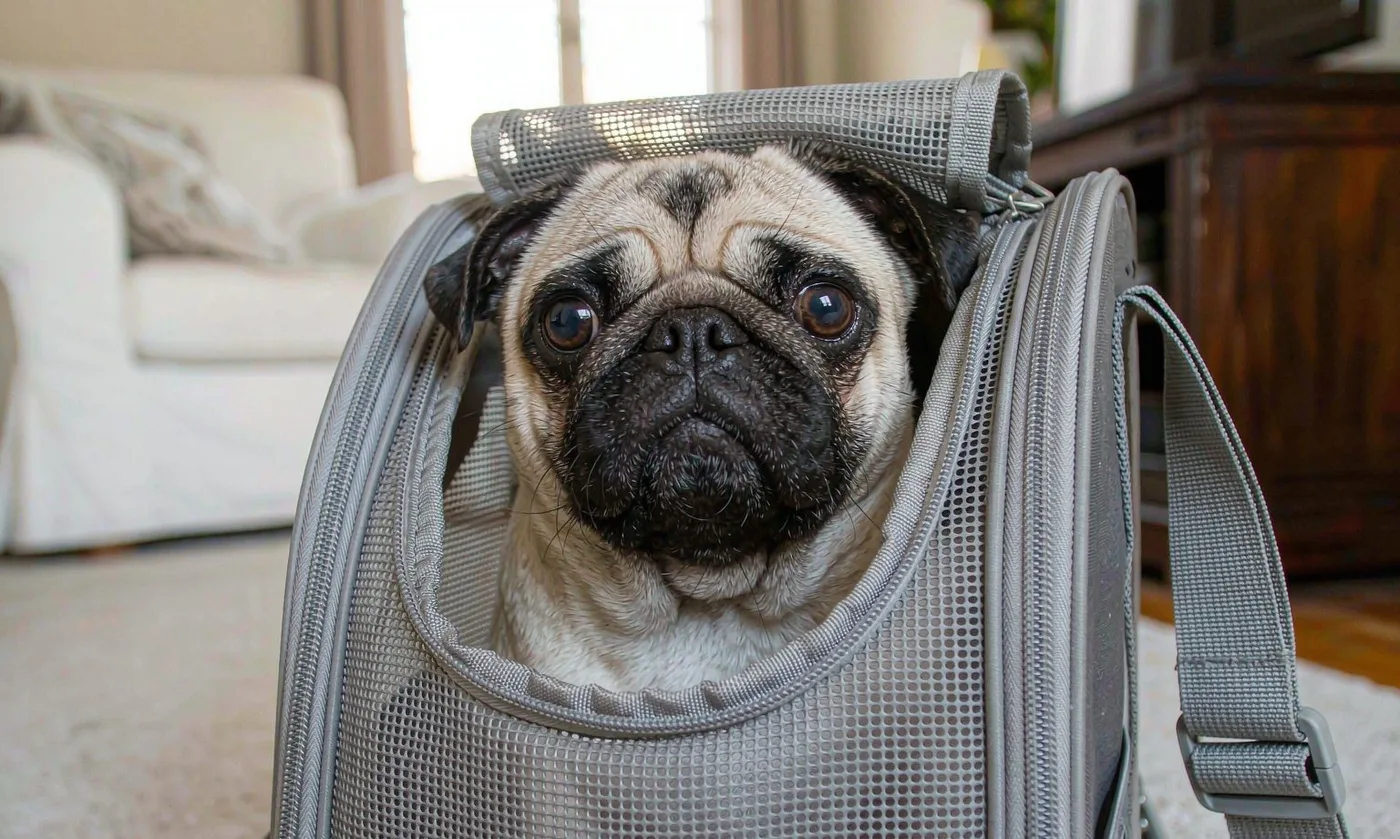
Queue pressure makes closure ergonomics critical. A full end door should open beyond 120 degrees and remain parked against the side so it does not swing into the animal or aisle. Two sliders meet inside a stiffened garage, where a glove-friendly clip provides a visible and tactile confirmation. Avoid tiny metal hooks, long pull cords, or decorative tassels. A contrasting closed-position witness mark lets staff verify alignment before lifting.
Add a limited top service hatch for a brief visual or collar check, not for full loading. Its opening must be small enough to control with the forearm, and its zipper route should not intersect the carry handle reinforcement. When the hatch is closed, the pull parks under a separate cover. Staff should never need to reach over an unsecured full-size opening while operating a room or cubby door.
Test access under realistic distractions. Operators wear the facility's usual gloves, hold a mock report card, respond to a scripted question, and complete a defined load-close-check-lift sequence. Score omitted clips, incomplete slider travel, lining caught in teeth, and hand placement near the opening. The solution may be a better garage shape or clearer witness mark, not simply louder training.
Cycle the main door 5,000 times and service hatch 3,000 times, with scheduled cleaning and synthetic fur introduced into the chain. Measure operating force and inspect stops, tape, stitching, clip retention, and lining clearance. Fast daycare access is safe only when every closed state is visible, tactile, and repeatable under the same distractions found at peak pickup.
Closure clips need a defined inspection limit. Check hinge whitening, spring return, gate alignment, cracks, and attachment stitching before each occupied use. The clip should operate within a specified force range: too light risks unintended release, while excessive force slows gloved handling and encourages staff to omit it. Cycle clips separately and as part of the closed door, because the surrounding garage can change access. A replaceable clip is acceptable only if replacement cannot damage zipper tape and the repaired assembly passes the full closure check before service.
Stage multiple cats in independent, traceable spaces
Daycare intake can bring several clients into one lobby, but efficiency should come from a position-controlled cart, not from combining unrelated animals. Assign one carrier per guest and one numbered cart position per carrier, with mesh clearance and access to each door. Occupied soft carriers must not be stacked. Cart retaining rails contact the solid base perimeter, and every loose shoulder strap is captured away from wheels.
An assessed same-household kitten pair may use an optional two-bay configuration under a written policy. The divider is a padded semi-rigid panel keyed into a dual-board floor and attached at six covered points. Use a lower 7.5 kg combined working load and 4 kg maximum in either bay, subject to complete testing. Each bay needs an independent end door, identity card, and ventilation area. The divider cannot be advertised as medical isolation.
| Daily-use mode | Occupancy rule | Equipment control | Acceptance check |
|---|---|---|---|
| Standard guest | One cat per 8.5 kg-rated unit | Two-face identity and full chamber | Queue and cubby test |
| Assessed household pair | 7.5 kg combined, 4 kg per bay | Keyed divider and two doors | One-sided load and airflow |
| Unrelated clients | Independent carriers only | Numbered cart positions | Handover error drill |
| Pickup staging | No occupied stacking | Visible outward label | Owner confirmation audit |
| Cleaning queue | Empty TO CLEAN units | Separate rack and status | State-transition review |
Run cart trials across thresholds, ramps, corners, and lobby stops with inert shifting loads. Check translation, strap entanglement, label visibility, and ordered unloading. A daycare can handle several cats efficiently only by multiplying independent identified spaces and controlling their positions throughout the queue.
Visual buffers may be useful when adjacent cats react to one another. Use a removable solid flap on the cart-facing mesh, with a controlled open and closed position that never covers all ventilation. Staff should deploy it under the facility's animal-care procedure, not automatically. Test airflow and temperature with the flap in each permitted position and confirm that identity remains visible. A loose towel is a poor substitute because it can slip, block vents, hide labels, and enter a zipper. The designed flap must also survive cleaning and remain captured when not used.
Build a 500-cycle sanitation and drying system
Daily turnover exposes the carrier to disinfectant before material has long recovery time. A practical stack uses 600D solution-dyed polyester on solid outer panels, a 900D coated lower abrasion band, smooth 300D coated lining, polyester webbing, and closed-cell removable cushioning. Keep mesh above the spill zone and protect it from cubby contact. Avoid fleece, raw foam, deep hook fields, and decorative seams inside the chamber because they retain fur and moisture.
List the daycare's exact cleaner, disinfectant, dilution, contact time, rinse, and drying conditions. Screen coupons, then run 500 completed cycles on multiple finished samples from different material rolls. At set intervals, assess colour, gloss, tack, coating folds, seam wicking, zipper force, label contrast, floor fit, odour, and dry mass. Repeat working-load and closure tests after aging to detect functional loss beneath acceptable appearance.
Design the rack interface alongside the product. Remove the board, cover, pad, and divider; open both doors; and support the shell on defined solid rails without stretching mesh. Use timed mass measurements to establish a dry-release threshold under ordinary room airflow. A unit remains TO CLEAN or DRYING until every component is within acceptance. If the queue outpaces drying, the operational remedy is more rotating stock or rack capacity, not reduced wet contact.
For sourcing and chemical-control context, buyers may consult the European Chemicals Agency and translate relevant requirements into tested component declarations. Daycare sanitation durability must be demonstrated on the assembled carrier for 500 complete cycles and followed by functional retesting, not inferred from a single fabric swatch.
Sunlight near lobby windows can alter colours and polymers between cleaning cycles. If carriers spend hours in direct light, add a controlled light-exposure comparison for shell, mesh, status printing, and patches, followed by flex and wipe tests. Set an acceptable shade and embrittlement limit using the signed unexposed standard. This is not an outdoor-weather claim; it addresses the facility's actual storage position. Moving racks away from direct sun may be a more economical control than specifying unnecessary high-performance materials throughout the product.
Coordinate car handoff, lobby visibility, and brand surfaces
Daycare carriers may cross a parking lot or ride briefly in an owner or facility vehicle. Integrate two reinforced belt tunnels into the side structure and connect them to the under-base cradle. Mark the route clearly, but state that routine securement is not a crash certification. Verify fit in the facility's actual shuttle and several representative owner-seat geometries without promising compatibility with every vehicle.
The exterior needs visible identity without looking clinical. A matte mineral, muted blue, or warm grey body can limit glare in lobby photos while maintaining enough contrast to show fur and wipe marks. Use a removable 100 x 55 mm daycare badge on an upper solid panel. Keep status and owner-handover cards in separate, more prominent zones. Two narrow reflective end tabs may aid parking-lot visibility, but test them under phone flash and avoid broad reflective logos.
Photograph the prototype at reception height, in a cubby, on the cart, during a handover, and secured on a seat. Confirm that the brand remains visible without covering the asset code, closure witness, or guest card. Approve physical colour and decoration strike-offs on production fabric. Run cleaning, rub, and flex tests before signing the artwork standard.
General travel-safety context can be reviewed through the Center for Pet Safety, while the daycare defines its own vehicle and supervision procedure. A daycare exterior works when it supports parking-lot recognition and lobby trust without competing with identity, hygiene, or closure information.
For multi-branch operators, keep the primary badge field constant and use a smaller removable location strip. This preserves artwork scale and testing while allowing branch allocation to change. Set print contrast and type size for the expected viewing distance, then check the strip after cleaning and cubby abrasion. Do not assign branch identity through body colour alone; colour batches complicate spare distribution and can become ambiguous under different lighting. A controlled label architecture creates clearer fleet recognition with fewer colourways and less inventory fragmentation.
Manufacture daily-use interfaces for repeatable interchange
Daily-use failure often begins at interfaces: handle reinforcement missing the cradle, a top hatch sewn too close to a load seam, a status window turned inward, or a floor sleeve too tight after coating variation. Define critical dimensions and tolerances for base footprint, door diagonal, hatch position, webbing overlap, label coordinates, rubbing-rail height, and service-part fit. Use fixtures at cutting and assembly rather than relying on visual centring.
Inspect the continuous cradle before lining closure and photograph or stamp the passed stage. Door components require controlled zipper chain, sliders, stops, pulls, garage, and seam allowance. Conduct first-piece cycling after a material, machine, needle, or operator change. Apply needle-fragment control and illuminated interior inspection, especially around floor sleeves and divider attachments where fragments can be concealed.
Interchangeability requires revision-coded boards, covers, pads, straps, status cards, and dividers. Sample parts from each production lot and fit them to carriers from the beginning and end of the run. A nominally correct replacement that curls the floor or blocks the sleeve closure is not acceptable. Pack service kits separately with clear model codes and counts.
The production team should retain the golden sample, approved colour cards, material codes, seam coupons, first-off records, and identity logs under the quality system. Repeat-order review should compare critical material supplier codes and not accept an undocumented substitute because its colour looks similar. Webbing elongation, coating chemistry, zipper compatibility, and mesh abrasion can change while appearance remains close. Flag any substitution before cutting, run the affected performance tests, and update the controlled bill of materials only after approval. Lot traceability then allows the daycare to isolate a genuine component issue without withdrawing older compliant carriers from active daily service unnecessarily across all branches. High-frequency daycare service depends on manufactured interchangeability at every closure, floor, label, and load-path interface.
Carton design should support branch deployment without a sorting project. Pack complete carrier sets in a fixed orientation, with model, colour, revision, quantity, and asset-code range on two carton faces. Service kits belong in separately numbered cartons rather than loose gaps around finished bags. After a defined compression period, sample units from top, middle, and bottom positions, erect them without heat, fit all modules, and run every closure. Record recovery time and any permanent mesh or stay deformation before approving the packing density.
Validate the daily loop and set release limits
For the 8.5 kg working load, use a 12.75 kg one-hour static proof test, 2,500 handle lifts, and 1,000 shoulder carries. Add 2,500 loaded set-downs from 100 mm onto a representative resilient floor, followed by 4,000 cubby insertions. Measure webbing migration, base deflection, rail wear, roof recovery, door diagonal, and label abrasion at intervals. Test a shifting off-centre form as well as fixed ballast.
Complete 5,000 main-door and 3,000 top-hatch cycles, with gloves, synthetic hair, and sanitation aging included. Apply a controlled outward load at closed slider junctions. The divided model receives 300 installation cycles, a 170 N lateral divider load, and unequal-bay handling. Status windows complete 10,000 card changes and wet wipes; codes must remain scannable after abrasion.
Run a thirty-unit morning intake and evening pickup drill after endurance testing, not only with new samples. Measure identity errors, closure omissions, cubby conflicts, cart position mistakes, and handover time. Inspect the units again after the drill. This confirms whether aging changes the human interface. Facility animal-care procedures may draw on resources from the American Veterinary Medical Association.
Final lot inspection uses AQL 2.5 for major workmanship, dimensions, function, appearance, accessories, and packing. Critical handling applies to insecure doors, open load seams, exposed sharp parts, wrong working-load labels, duplicate asset codes, or missing floor parts. A daily-use carrier is ready only when endurance-aged units still pass the same queue, identity, closure, cubby, and sanitation workflow required on opening day.
Add warm, cool, and high-humidity conditioning to represent storage rooms and parked delivery vehicles while explicitly prohibiting unattended live occupancy. After samples return to laboratory conditions, measure zipper force, clip return, coating feel, board flatness, roof recovery, code scanning, and badge adhesion. Repeat one loaded cubby cycle and floor set-down sequence. Report these as empty-equipment storage limits rather than animal comfort claims. Any carrier used with an animal still depends on active environmental control, direct monitoring, and the facility's operating procedure.
Why brands source here
- Pet carrier programs run since 2014; founding team in sewn goods since 2004
- SGS-verified production floor of 4,950 m² with 137 workers across 7 lines
- Monthly capacity of 200,000 units, audited to BSCI and ISO 9001
People Also Ask
What makes a cat carrier suitable for daily pet daycare use?
It needs high-cycle closures, rapid identity changes, cubby-compatible recovery, a captured cleanable floor, protected mesh, and proof after repeated sanitation.
How often should daycare cat carriers be cleaned?
Follow the facility's turnover and contamination protocol after each required use, then complete the validated contact, drying, inspection, and release sequence.
How should multiple cats be staged at daycare?
Use independent labelled carriers in numbered cart positions with ventilation clearance and no occupied stacking; only approved household pairs use divided bays.
What is a useful zipper test for daycare carriers?
This specification uses 5,000 main-door cycles with gloves, synthetic hair, and cleaning exposure, plus outward-load checks at the closed slider junction.
How are daycare carriers stored in cubbies?
Store them erected, complete, and label-out where practical, with rubbing rails contacting the cubby and all straps captured away from edges.
Can daycare branding be reflective?
Use only narrow tested accents if parking-lot visibility requires them; large reflective marks can flare in lobby photos and obscure operational cues.
What should be checked before owner pickup?
Confirm guest identity, asset code, floor kit, both slider positions, closure clip, handles, status, and any handover instruction before release.
Frequently Asked Questions
How many cycles should a daycare carrier last?
Set targets from the business workload. This example qualifies 1,000 day cycles, 5,000 main-door cycles, 4,000 cubby moves, and 500 sanitation cycles.
Can unrelated daycare cats share a carrier?
No. Use independent carriers and controlled cart positions. A divided model is limited to assessed same-household cats under lower verified limits.
Why are identity labels placed on two faces?
One faces staff in the cubby or cart, while the other supports check-in and owner handover without rotating occupied equipment.
Can staff store the shoulder strap loose?
No. It should remain attached or secured in a captured pocket so it cannot catch cubbies, carts, doors, or other carriers.
Is the carrier machine washable?
Only components specifically validated for laundering should enter a machine. The shell, board, stays, and hardware usually follow a documented wipe-and-dry process.
How is a clean unit released?
It completes chemical contact, rinse if required, defined drying, reassembly, closure check, interior inspection, and status change to CLEAN-AVAILABLE.
Can a daycare put its logo over the mesh?
No. Place branding on a solid panel and preserve measured ventilation, visual monitoring, and the protected mesh structure.
What if a cat exceeds 8.5 kg?
Use a separately sized and tested carrier. Do not exceed the declared working load or compromise posture just because the standard unit fits the cubby system.
Do belt tunnels fit every car?
No universal fit should be claimed. Test authorized facility vehicles and representative owner seats, and provide clear routing with limitations.
When should a daycare carrier be retired?
Retire or quarantine units with unsafe closures, open structural seams, warped floors, sharp components, irreparable contamination, or lost identity.
How are replacement floors controlled?
Use model and revision codes, dimensional checks, and cross-fit samples from production lots before adding boards or covers to the service stock.
What should a final inspection include?
Inspect dimensions, structural stitching, doors, labels, ventilation, floor kit, decoration, cleanliness, service parts, pack count, and carton traceability.
Talk to QUANZHOU JUNYUAN BAGS about a pet carrier program: MOQ 500 pieces per colourway, samples in 6-10 working days, bulk production in 35-50 days under AQL 2.5 inspection.
Get a free quote Request a sample