Cat Carrier Rescue Organization: Wholesale Program
500 carriers can support a rescue organization only when the fleet is engineered for repeated foster handoffs. Specify an 11 kg working load, washable removable components, captured asset identification, protected vehicle-belt routes, and a divider option for approved small-cat pairings. Qualification should reproduce returns, disinfection, storage, and volunteer transport rather than a single showroom carry.
A rescue network moves carriers among intake partners, veterinary clinics, foster homes, adoption events, and transport vehicles, often without a central operator at every handoff. The wholesale brief must convert this decentralized workload into construction, marking, maintenance, and inspection controls. Start with a stable shell, replaceable floor kit, tamper-resistant asset label, two-sided loading access, protected mesh, and an optional tensioned divider that cannot collapse onto either occupant. Define volunteer instructions and restraint routing on permanent labels, while using detachable panels for campaign branding. The commercial baseline is MOQ 500 pieces per colourway. Functional and decorated samples are available in 6-10 working days, enabling route trials across several foster vehicles. Once the golden sample, test matrix, and packing schedule are approved, bulk production 35-50 days should be allowed. Shipment inspection follows AQL 2.5 for agreed major workmanship defects, supplemented by zero-tolerance rules for open load seams, insecure doors, sharp interior components, and missing safety labels. This approach produces a maintainable transport fleet whose service history, cleaning state, and replacement parts can be controlled even when volunteers change.
Custom pet carrier development for cat carrier starts with a tech pack: dimensions, fabric weight, hardware finish and the target test standard.
Model the foster network as a circulating equipment pool
Rescue carriers rarely follow a straight issue-and-exit path. One unit may collect a cat from municipal intake, visit a clinic, spend six weeks with a foster, appear at two adoption events, return for cleaning, and begin again with a different volunteer. Map these nodes before discussing fabric. Record average loan duration, weekly transfers, percentage returned without accessories, vehicle types, storage conditions, and the person responsible for declaring a unit ready. If 320 carriers are in foster homes, 80 are moving or awaiting cleaning, and 50 support events, a 500-unit order leaves only 50 units for damage reserve and demand spikes. That calculation makes lost-part prevention as important as unit price.
Set a design service target in complete deployments rather than calendar years. A useful procurement target may be 100 foster deployments, 1,000 loaded lifts, 2,000 zipper circuits, and 150 cleaning cycles. These are qualification values, not a guarantee of identical field life. A captured floor board, tethered identity sleeve, and shoulder strap that remains attached reduce the number of incomplete returns. If a part must be removable for washing, its attachment should be obvious and common across every size in the fleet.
Define states that volunteers can recognize: READY, IN USE, CLEANING, REPAIR, and RETIRE. A two-sided card holder can show status without exposing private foster information. The unique asset code belongs on a recessed, abrasion-resistant label as well as on the floor-board sleeve, so separated parts can be reunited. A QR code may point to the rescue's own instructions, but the carrier should remain usable when a phone or network is unavailable.
Run a tabletop handoff simulation with intake, medical, foster, and transport coordinators. Each participant should identify the bag, check closures, confirm the floor kit, and change status without special knowledge. A wholesale rescue carrier is an asset-management object whose construction must survive both animal transport and repeated custody transfer.
Configure capacity and separation without creating unsafe flexibility
A decentralized rescue sees individual adults, bonded pairs, queens with young kittens, and animals requiring strict separation. One adjustable bag cannot safely solve every case. For the principal fleet, a 48 x 31 x 33 cm outer envelope and 11 kg declared working load can cover the organization's measured adult-cat range while fitting common rear seats. A second protocol, not casual volunteer choice, should govern any multi-animal use. Adult cats that are unfamiliar, medically restricted, or likely to redirect aggression need separate carriers regardless of spare volume.
Where the rescue approves two small compatible occupants, use a tensioned divider that connects to reinforced upper and lower points and has its own breathable panel. A loose fabric curtain is not a compartment: it permits one animal to push under it and concentrates both weights on an unsupported floor. The removable divider should form two approximately 24 cm bays, with independent end doors and no shared zipper opening. Total live load must remain within the carrier's 11 kg rating. Mark the divider with an orientation cue, and make it impossible to install with exposed hook surfaces toward an animal.
Floor stiffness is critical under asymmetric loading. Specify a 5 mm twin-wall polypropylene board with rounded corners, a washable closed-cell top layer, and webbing paths that support both compartment halves. Measure base deflection at the centre and under an offset load; a project limit of 18 mm after thirty minutes can prevent one side from rolling into the other. Flexible roof stays should recover after storage yet resist a cat pressing against the top access.
Prototype review must use instrumented weights before any supervised animal evaluation. Load one bay, then both; carry level, turn through a doorway, set the unit on a vehicle seat, and observe divider tension. Check that either door can open while the opposite bay remains secured. Multi-cat capability exists only when each approved occupant has independent closure, ventilation, floor support, and a documented combined-load limit.
Specify materials around unknown homes and repeated decontamination
Foster environments vary more than a centralized shelter. A bag may encounter carpet cleaner, veterinary disinfectant, rain, vehicle upholstery, litter dust, and storage in a warm garage. Use an 840D polyester outer body with a matte TPU or qualified polyurethane coating for the lower shell, and a tightly woven 420D lining that can be wiped without exposing foam. TPU can offer useful flex and hydrolysis performance, but the actual film, lamination adhesive, and cure must be tested; a generic polymer name does not establish durability.
Ask the rescue to nominate a primary disinfectant and one realistic backup. Conduct separate coupon exposures because quaternary ammonium, accelerated hydrogen peroxide, and diluted hypochlorite can affect coatings, prints, and metals differently. A proposed regime might be 50 primary-chemistry cycles plus 20 backup cycles, each using the facility's wet contact and drying conditions. Inspect colour transfer, film cracking at folds, tack, odour, seam-wicking, and label readability. Completed carriers then receive 100 interior wipe cycles at the lower corners and door binding, where mechanical action is highest.
Choose polyester rather than cotton webbing because lower moisture uptake supports faster drying and more consistent strength. Use moulded acetal hardware where appropriate to reduce corrosion points, while verifying cold-impact performance if transports occur in winter. Any metal D-ring should have a controlled finish and pass a rescue-specific corrosion screen. Interior surfaces must be light enough to reveal soil but not so pale that every cosmetic mark causes premature retirement.
Chemical compliance documentation should match destination markets and supplied components. Procurement teams can use U.S. Consumer Product Safety Commission resources when scoping applicable consumer product obligations, while setting explicit restricted-substance requirements in the purchase specification. A rescue fleet needs material acceptance based on named chemical exposures and environmental variability, not an unsupported promise that one coating tolerates every cleaner.
Integrate vehicle restraint into volunteer transport practice
Most rescue journeys occur in privately owned cars, so the carrier should make correct placement intuitive across sedans, crossovers, and vans. Sew two clearly marked belt tunnels into the lower side structure, connected to reinforcement that wraps beneath the base. A decorative loop attached only to the outer panel is not a restraint path. Keep tunnels accessible when the shoulder strap is removed and wide enough for common seat-belt tongues to pass without twisting. Use contrasting stitched icons rather than long instructions at the routing point.
The product specification must distinguish securement from crash protection. A belt route can reduce movement during routine braking, but it does not justify an untested crash-safety claim. Run a bench pull test on each tunnel and its underlying reinforcement, then a sled or dynamic test only if the program explicitly requires and funds one under a defined protocol. The Center for Pet Safety provides useful context on pet travel product evaluation. Volunteer guidance should still prioritize rear-seat positioning, closure checks, moderate climate, and supervision.
Vehicle fit trials need more than one photograph. Place the loaded prototype on three representative seat geometries, route the belt, tighten it, and measure lateral movement during a controlled low-speed handling exercise on a closed course or appropriate test rig. Ensure the buckle does not press into mesh and the carrier does not roll when the floor slopes. In vans, verify compatibility with the organization's separate tie-down method rather than improvising through carry handles. Add high-contrast asset identification on both ends so carriers remain distinguishable when several are staged together.
Thermal exposure is an operational control. Dark fabric on a sunny seat can heat quickly, while mesh does not guarantee adequate airflow inside a stationary car. Permanent labeling should state that the carrier is not a substitute for climate management and that an animal must not be left unattended. Vehicle-ready design combines a reinforced securement path, honest performance boundaries, and a volunteer procedure that can be followed in unfamiliar cars.
Design replaceable modules and restrained rescue branding
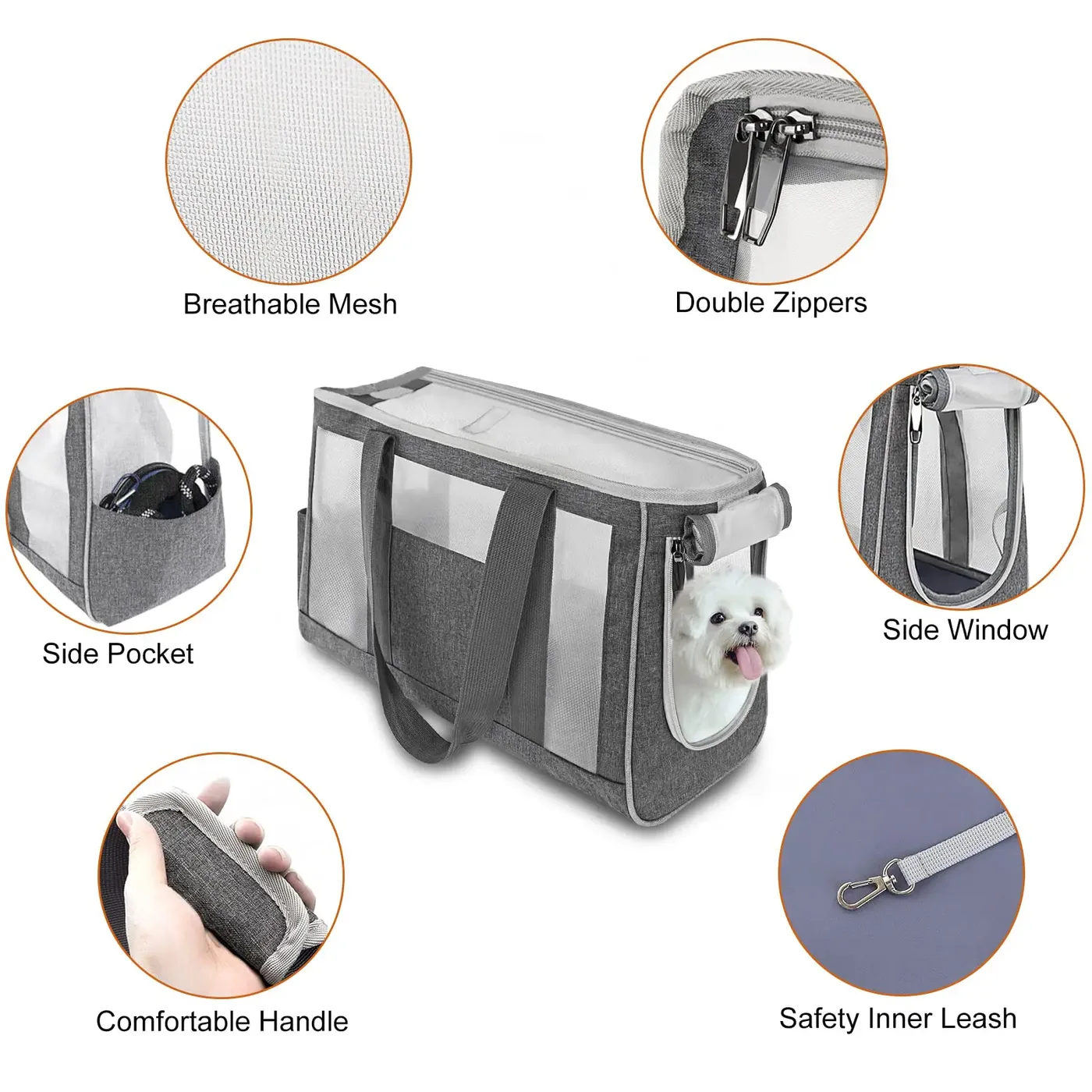
Fleet economics improve when soiled or damaged soft parts can be replaced without discarding the structural shell. Define a service kit containing the floor board, washable pad, divider, status card, and shoulder strap. Each part needs a common code and fit across the relevant production revision. The floor sleeve should retain its board during loading but open fully for inspection. Divider anchors must remain covered when the divider is absent, preventing snag points in single-cat mode.
Branding serves identification, fundraising, and volunteer confidence, yet campaign names may change before the bag wears out. Reserve a 130 x 80 mm loop field on the solid upper side for a removable rescue or sponsor patch. The permanent mark can be a small woven organization label near the asset code. This hierarchy allows event artwork to change while safety instructions and ownership remain stable. Avoid a large embroidered design through a coated lower panel: dense needle penetration may encourage seepage and distort the substrate.
| Module | Target control | Replacement trigger | Fleet benefit |
|---|---|---|---|
| Floor board | 5 mm rounded PP, coded size | Warp or cracked edge | Restores stable support |
| Washable pad | Low-lint face, closed-cell core | Retained odour or delamination | Separates hygiene from shell life |
| Divider | Four-point tension, breathable centre | Torn mesh or weak anchor | Controlled approved pair transport |
| Status card | Water-resistant, two-sided | Unreadable state or asset code | Reduces custody ambiguity |
| Campaign patch | Removable, matte, bounded size | New sponsor or worn artwork | Updates branding without waste |
Photograph each service operation and include a one-page parts diagram with the shipment. Volunteers should be able to identify the correct board orientation and divider attachment without opening a technical manual. Keep spare parts in labelled packs of ten, with the same lot and revision fields used on carriers. Modularity creates value only when parts remain captured in use, interchange reliably, and can be reordered under controlled codes.
Translate fleet reliability into sewing and assembly controls
Repeated loading amplifies small manufacturing variation. Establish critical-to-quality dimensions for base length, door opening, divider anchor spacing, belt-tunnel position, webbing overlap, and zipper-stop clearance. Laser or die-cut reinforcement patches help keep anchor geometry consistent. During sewing, the handle and belt webbing should form a continuous load cradle under the base; inspectors can verify the hidden path at a defined in-process stage before the lining closes it.
Specify bonded polyester thread with size selected through seam trials, and lockstitch density appropriate for the laminate. Too many stitches perforate a coated panel; too few permit seam extension. Retain seam coupons from the pre-production run and test both dry and after disinfectant exposure. At curved doors, control differential feeding so zipper tape does not ripple. Install upper and lower zipper stops, then cycle first-off assemblies while applying outward pressure with an inert form.
Divider anchors require their own operation standard. Reinforcement must extend beyond the visible attachment, and opposing points should align within a tight tolerance so the divider remains vertical. A simple fixture can verify anchor rectangle and belt-tunnel spacing on every cut panel. Asset labels should be printed from controlled data, scanned before packing, and checked for duplicate codes. If serialization is not required, lot plus unit sequence can still support complaint isolation.
Inline inspection should occur at component preparation, shell closing, hardware installation, and final setup. The production team can use first-piece approval at every operator change or material-roll change. Final bags should be erected for appearance inspection rather than judged only while folded. Rescue-fleet consistency depends on controlling hidden load paths and serialized identity before those features disappear inside the finished shell.
Needle control deserves a documented line procedure because a broken fragment inside a dark carrier is unacceptable. Record issued and returned needles, isolate affected work, and use the production base's approved detection and search process before release. The same discipline applies to clipped wire ends, rivet debris, and detached zipper stops. Final interior inspection should use directed light and a gloved hand sweep along bound seams, with special attention to divider anchors and belt-tunnel reinforcement. This check is separate from exterior cosmetic review. A carrier can look uniform in a folded carton while concealing a sharp remnant or missed reinforcement; process gates must therefore protect the inside before packing pressure makes inspection more difficult.
Qualify the fleet with failure-focused tests
Build a design-verification plan from field failure modes. For an 11 kg working load, hold 16.5 kg in the carrier for one hour by the joined handles, then inspect seam opening, webbing migration, hardware, floor shape, and door alignment. Run 1,000 lift-and-set cycles at working load, including periodic one-sided pickup that represents hurried volunteers. The shoulder strap receives 500 alternating-angle cycles and a controlled buckle pull. Acceptance should require continued function, not merely prevention of total separation.
Cycle each zipper route 2,000 times, with at least 500 cycles after cleaning exposure. Test the divider installed and removed 250 times, then apply lateral pressure in each bay. Measure base deflection under centred and offset loads. A loaded tumble sequence inside a padded drum can reveal strap snagging and slider movement during handling, while a 75 cm packaged drop checks whether compression packing damages frames or boards. These methods should be documented with fixtures, loads, speeds, and pass criteria so repeat orders remain comparable.
Run 100 cleaning cycles on three completed bags from separate material rolls. Measure mass change after standardized drying, evaluate odour with a defined panel, inspect printed codes, and flex coated corners. Expose hardware to a 24-hour neutral salt-spray screening only where metal finishes warrant it; the program can reference appropriate methods available through ASTM International rather than inventing a vague “rustproof” claim. Verify label abrasion by repeated dry and wet rubbing until the agreed cycle count.
Final random inspection at AQL 2.5 cannot replace design testing. Use it to sample dimensions, workmanship, assembly, marking, and packaging from completed cartons. Critical defects such as sharp points, open restraint seams, nonlocking exits, or a missing load label require the stricter disposition agreed in the inspection plan. Reliability evidence is credible only when tests target known foster-network failures and preserve repeatable procedures for the next purchase order.
Add a storage-aging check because rescue stock may remain folded between seasonal intake peaks. Condition packed samples for four weeks under an agreed warm, humid environment, then compare opening force, coating feel, frame recovery, mesh creases, and zipper alignment with an unaged control. Follow with a loaded carry cycle rather than accepting appearance alone. If the bag requires manual reforming, document the permitted method and time; if recovery is inconsistent, revise stay material or carton compression. The goal is not to claim a universal shelf life, but to establish that the actual pack density and material set survive the network's realistic reserve-storage interval.
Launch with route pilots and govern repairs
The first pilot should follow actual routes rather than remain in a conference room. Send numbered samples through municipal pickup, clinic intake, two foster vehicles, a multi-hour adoption event, return processing, and storage. Use inert weights for initial handling and only conduct animal trials under the rescue's welfare protocol. Ask each participant to record setup, door access, belt routing, carrying balance, label scanning, cleaning effort, and missing components. A problem that appears at the fifth handoff is more relevant than a cosmetic preference during unpacking.
Turn pilot findings into controlled revisions. If floor boards migrate, modify sleeve retention and repeat loaded tests. If status cards collect moisture, adjust the window drain or move it away from the lower zone. If volunteers route belts through handles despite clear tunnels, change icon position and update training before adding more text. Freeze the bill of materials, artwork, labels, component codes, test report, and packing diagram when the route pilot passes.
Set repair categories before distribution. Field-replaceable pad, board, divider, and strap faults can return to READY after documented replacement and inspection. Open load-bearing seams, damaged belt tunnels, distorted door frames, or exposed sharp components require removal from service and qualified repair or retirement. Do not let a familiar volunteer make an undocumented structural patch. Quarterly stock review should compare units deployed, returned, repaired, missing, and retired by cause.
Reorder forecasts should use available-ready inventory rather than total assets. A fleet may list 500 carriers while only 380 are clean and complete. Combine deployment rate, loss rate, repair yield, and the 35-50 day production schedule to set a trigger. Preserve a signed reference sample and one unopened production unit for comparison. A rescue wholesale program remains dependable when route feedback, repair authority, and replenishment data are managed as deliberately as the original product specification.
Complaint handling should separate product evidence from transport anecdotes. Ask for the asset code, production lot, photographs of the complete carrier and failure area, load band, cleaning history, and point in the route where the issue appeared. Quarantine nearby codes only when the evidence suggests a shared component or operation. The retained reference unit and supplier material records can then support a focused investigation. Publish any resulting inspection change to foster coordinators in plain language, and revise the controlled specification before reorder. This closed loop prevents one unexplained failure from becoming either an ignored pattern or an unnecessary fleet-wide withdrawal.
Why brands source here
- Pet carrier programs run since 2014; founding team in sewn goods since 2004
- SGS-verified production floor of 4,950 m² with 137 workers across 7 lines
- Monthly capacity of 200,000 units, audited to BSCI and ISO 9001
People Also Ask
What makes a cat carrier suitable for a rescue organization?
A rescue carrier needs repeated-cycle construction, captured components, clean-state marking, asset identity, vehicle securement, and inspection rules suited to many volunteer handoffs.
How many reuse cycles should a rescue carrier withstand?
Set cycles from the intended fleet life. One example qualification includes 100 deployments, 1,000 loaded lifts, 2,000 zipper circuits, and 150 cleaning cycles.
How should a rescue clean reusable cat carriers?
Use the organization's approved chemistry, dilution, wet contact time, rinse, and drying process. The bag materials should be validated against those exact steps.
Can rescue carrier branding be replaced?
A removable campaign patch can change while a smaller permanent ownership label and asset code remain fixed, extending usable shell life across sponsorship cycles.
How should a cat carrier attach in a volunteer's car?
Use reinforced, clearly marked belt tunnels connected to the under-base load structure, then verify fit across representative seats without making unsupported crash claims.
What spare parts should a rescue stock?
Common floor boards, washable pads, status cards, approved dividers, and shoulder straps cover frequent nonstructural losses and wear when all parts use controlled codes.
What are critical defects in a rescue carrier?
Sharp interior points, open load-bearing seams, insecure doors, damaged restraint paths, and missing safety labels require quarantine under the agreed defect plan.
Frequently Asked Questions
Can rescue carriers be serialized?
Yes. A recessed printed or woven asset label can carry a unique sequence, and the code can be duplicated inside the floor sleeve to reunite separated parts.
Can one carrier hold two cats?
Only compatible small cats approved by the rescue should share a specifically divided carrier, and their combined mass must remain within the working load. Other cats require separate units.
What happens when a divider is removed?
Its attachment points should be covered or recessed so no hook surface or loose fitting faces the animal. The carrier then operates as the qualified single compartment.
How are missing shoulder straps reduced?
Use a strap that remains attached or stores in a captured exterior pocket. The final check should include every removable component before a unit returns to READY status.
Should foster names be printed on carriers?
No permanent personal data is needed. Use the rescue's controlled status card or digital system, with only the asset identity fixed to the product.
Can the bag stay in a hot car?
No. Ventilation panels do not make an unattended vehicle safe. Permanent instructions should require active climate management and supervision.
Which vehicle position is preferred?
The rescue should define placement in its transport procedure, generally using a stable rear-seat or approved cargo arrangement with the designed restraint path and no blocked ventilation.
Are replacement parts included in MOQ?
The quotation should separate complete carriers and service-part packs. Common boards, pads, dividers, and straps can be ordered with the fleet under agreed quantities.
How often should the carrier be inspected?
Check closures, load seams, floor, restraint loops, and interior condition before every deployment, with a deeper documented inspection at the rescue's chosen return interval.
Can embroidery be used for the main rescue logo?
It can be used on a suitable noncritical panel, but dense stitching through coated lower surfaces should be avoided or tested for distortion and seepage.
What triggers retirement from the fleet?
Retire or quarantine units with open structural seams, damaged restraint paths, distorted exits, irreparable contamination, sharp parts, or identification that cannot be restored.
Are samples tested in volunteers' vehicles?
They should be fitted in representative vehicles during the pilot. Record routing, buckle interference, carrier movement, ventilation clearance, and ease of correct setup.
Talk to QUANZHOU JUNYUAN BAGS about a pet carrier program: MOQ 500 pieces per colourway, samples in 6-10 working days, bulk production in 35-50 days under AQL 2.5 inspection.
Get a free quote Request a sample