Dog Carrier Backpack for Australian Shepherds: Smart Breed
An Australian Shepherd-capable carrier covers a 16-32 kg population over a 520-620 mm back length, in interiors of 380-460 mm wide by 660-760 mm long by 500-580 mm high. The governing specification is closure defeat resistance: a two-action latch that survives a 350 N pull, a 180 N bite and a 60 N lateral paw sweep, plus a shrouded slider and paw-access control over every reachable mechanism.
This page treats intelligence as a load case. An Australian Shepherd does not simply push at a closure the way a scent-driven breed does; it investigates, finds the operating sequence, and repeats it. That behaviour defeats single-action mechanisms reliably, and it defeats a shrouded single-action mechanism eventually, because the animal learns from partial success. The specification that survives it is a two-action closure requiring two different motions in sequence, with every intermediate mechanism shrouded against paw and muzzle access. Structure, sizing and thermal behaviour follow the frame, which at 25-32 kg is near the top of the practical carrier range. Commercial terms follow the standard program: MOQ 500 pieces per colourway, prototypes in 6-10 working days, bulk production 35-50 days after sample approval, final random inspection to AQL 2.5, T/T 30/70 payment and FOB Xiamen loading.
Pet carrier OEM and ODM work on dog carrier backpack platforms splits at the pattern - OEM builds to your drawing, ODM adapts an existing platform and removes the tooling cost.
Body Parameters and the Two-Population Problem
The Australian Shepherd comes in two recognised size populations, and a carrier programme that addresses only one of them loses half the market. The standard population runs 20-32 kg with males at the top of that band; the miniature population runs 9-18 kg. Both share proportion, coat and behaviour, and only the dimensions differ.
Standard measurements run 520-620 mm in back length, 320-400 mm in chest depth, 230-290 mm in chest width, 400-500 mm in neck girth and 460-580 mm in height at the withers. The miniature population scales to roughly 80% of those figures, giving a back length of 420-500 mm and a weight range that overlaps the medium-breed classes.
The engineering answer is a two-step platform on shared tooling, as it is for the designer-cross classes. One shell geometry, one floor tool at the larger step trimmed down for the smaller, one hardware set, and two graded interiors differing in panel length and gusset depth. Because both populations share the same behaviour, the closure specification is identical across both and does not need grading.
| Step | Weight | Back length | Interior W x L x H (mm) | Rated load |
|---|---|---|---|---|
| Standard | 20-32 kg | 520-620 mm | 460 x 760 x 580 | 36 kg |
| Miniature | 9-18 kg | 420-500 mm | 380 x 660 x 500 | 22 kg |
Interior height is the dimension most often mis-set at this breed. Chest depth of 320-400 mm means a lying animal occupies a large vertical envelope, and the height figure of 500-580 mm is derived from chest depth plus shoulder clearance rather than from standing height. A pattern derived from standing height will be 80-120 mm too shallow and the animal will not settle.
Rated load is set at 36 kg for the standard step, which places the class just inside the practical limit for a wearable configuration and makes the wheeled-chassis discussion relevant rather than optional. Two populations, one closure specification and one tooling set: the size grading is cheap and the behaviour grading does not exist.
Manipulation Behaviour and the Defeat Sequence
The breed's working style is the specification driver. An Australian Shepherd is bred to make independent decisions and to solve problems without direction, and that trait transfers directly to a carrier closure. The animal tests a mechanism, observes the result, and modifies its approach — which means a closure that resists the first attempt may not resist the tenth.
The defeat sequence is consistent enough to specify against. The animal begins with a muzzle thrust at the closure line, then a lateral paw sweep along it looking for a purchase, then a bite at any projection, and finally a sustained pull on whatever it has engaged. Each step applies a different load in a different direction, and a closure specified against only one of them fails at the next.
| Step | Action | Measured load | Counter-specification |
|---|---|---|---|
| 1 | Muzzle thrust | 250-350 N sustained | Shrouded closure line, bound seam |
| 2 | Lateral paw sweep | 40-60 N, repeated | No exposed projection, flush shroud |
| 3 | Bite at projection | 120-180 N | No projection above 4 mm |
| 4 | Sustained pull | 250-350 N, 60 s hold | Two-action latch, metal slider |
| 5 | Repeat learning | 200 cycles | Two different motions required |
The learning component is the part with no analogue in a strength specification. A mechanism that resists 350 N on a pull is defeated if the animal can operate it with 40 N applied in the right direction, so the specification has to address operating force and direction as well as holding force. That is the whole argument for a two-action latch: the animal can learn one motion, and a sequence of two different motions — a lift and a slide, or a squeeze and a rotate — is substantially harder to discover by trial.
Cycle count in the test reflects the learning behaviour rather than wear alone. The mechanism is operated 200 times with the defeat sequence applied between every ten operations, and acceptance includes no partial engagement at any point. A latch that can be left half-closed is a latch the animal will eventually open. Specify against the sequence, not against the peak: the load that defeats a closure at this breed is often the smallest one, applied in the right direction.
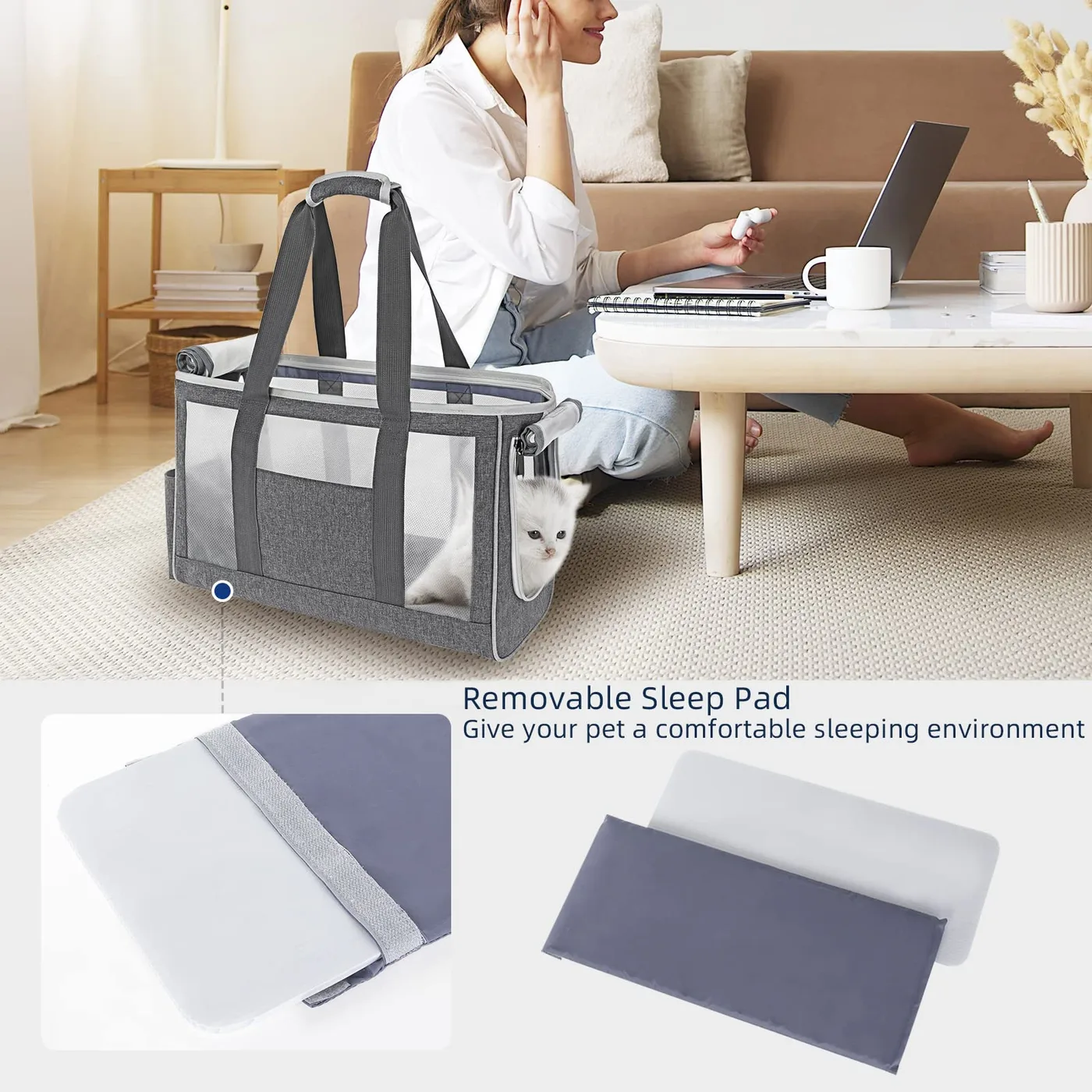
Closure Design: Two-Action Latches and Shrouding
The closure assembly for this class is a latch rather than a zipper as the primary restraint, with the zipper demoted to a secondary role. That is a departure from every other class in the range and it follows directly from the defeat sequence above.
A two-action latch requires two distinct motions in sequence — a squeeze followed by a rotate, or a lift followed by a slide — with each motion in a different axis. The requirement is not that each motion is strong but that they are different, because a repeated identical motion is exactly the pattern the animal learns. A squeeze-and-slide combination is the most robust of the common options, and a lift-and-rotate is the weakest because a dog can produce both with one paw movement.
Shrouding is the second requirement and it applies to the whole closure line rather than to the latch alone. A housing that leaves no projection above 4 mm removes the bite purchase at step three of the sequence; a flush shroud with a radiused entry removes the paw purchase at step two. The shroud has to be stiff enough that it cannot be pried, which means a moulded or extruded housing rather than a fabric flap.
The zipper remains as a closure for the panel but is no longer the restraint. It is a covered coil with a locking metal slider parked inside a closed box, and it is backed by the latch taking the containment load. That arrangement also solves the maintenance problem: if the zipper is contaminated or damaged, containment does not depend on it.
Shroud material is a decision with a real failure mode attached. A moulded housing in PA6 or PP with a wall of 2.0-2.5 mm survives the bite step; an ABS housing of the same wall thickness cracks at the latch aperture under a 180 N bite at low temperature, and a fabric flap offers no resistance at all. The shroud is also the element that takes the wearer's own abuse, so it is specified with an impact test at -10 °C as well as the bite test at ambient.
Engagement indication is a small requirement with a large effect. A latch that gives an audible and tactile click confirms to the owner that it is closed, and a half-engaged latch is the failure the 200-cycle test is designed to find. Where the design allows it, a visual indicator — a coloured band visible only at full engagement — removes the ambiguity entirely for under 0.20 USD.
Access control closes the specification: no reachable adjustment hardware, no exposed webbing tail within 60 mm of the closure, and no interior grab point within 120 mm of the latch. A two-action latch in a stiff shroud with a positive engagement indicator, backed by a demoted zipper, is the closure specification that survives a problem-solving breed.
Structure and Load for a 32 kg Herding Frame
At 25-32 kg the standard step sits at the top of the practical range for a wearable product, and the structure is specified accordingly. The load is both heavy and dynamic — a herding breed shifts and reacts — so the floor, frame and attachment all carry a fatigue requirement on top of a strength one.
Floor specification follows the large-class rule: rib depth rather than board thickness. A moulded tray with ribs of 14-16 mm on a 45-50 mm pitch, or a die-cut laminated board with bonded alloy rails at lower volume, holds deflection under 5 mm at a 700 mm span under 36 kg rated load. A flat board of any reasonable thickness does not meet the target at that span.
The frame is a closed box tied to the floor at four points, as it is for the other high-energy classes, with the emphasis on torsion because a herding breed twists as well as pushes. Twist is held under 1.5 degrees at 50 Nm, joints carry two fasteners with a 25 mm minimum spacing, and thread-locking compound is specified throughout.
Fatigue is the governing case and the cycle count is high: 10,000 cycles at 1.5x rated load at 0.4 Hz, plus a 20,000-cycle scrabble run at 3 Hz against the forward panel and floor corners. The impulse case applies too, at 3-4x static mass with a rise time under 150 milliseconds, because the breed reacts quickly rather than leaning persistently.
Carry configuration is the honest constraint at this class. Thirty-two kilograms of animal plus 4-5 kg of product is beyond most wearers for any distance, so the specification includes a wheeled chassis as standard rather than as an accessory: two wheels of 80-100 mm engaging the floor rails, a telescoping handle tied into the rear uprights, and a 100,000-cycle roll test. Backpack mode remains available for short distances and is not the primary mode.
Attachment testing is run at 5x carried mass in shear and 3x in peel, with frame-to-rail joints tested separately at 4x in torsion. At the standard step the chassis is part of the specification, and a programme that offers the class without it is specifying a product most wearers cannot use.
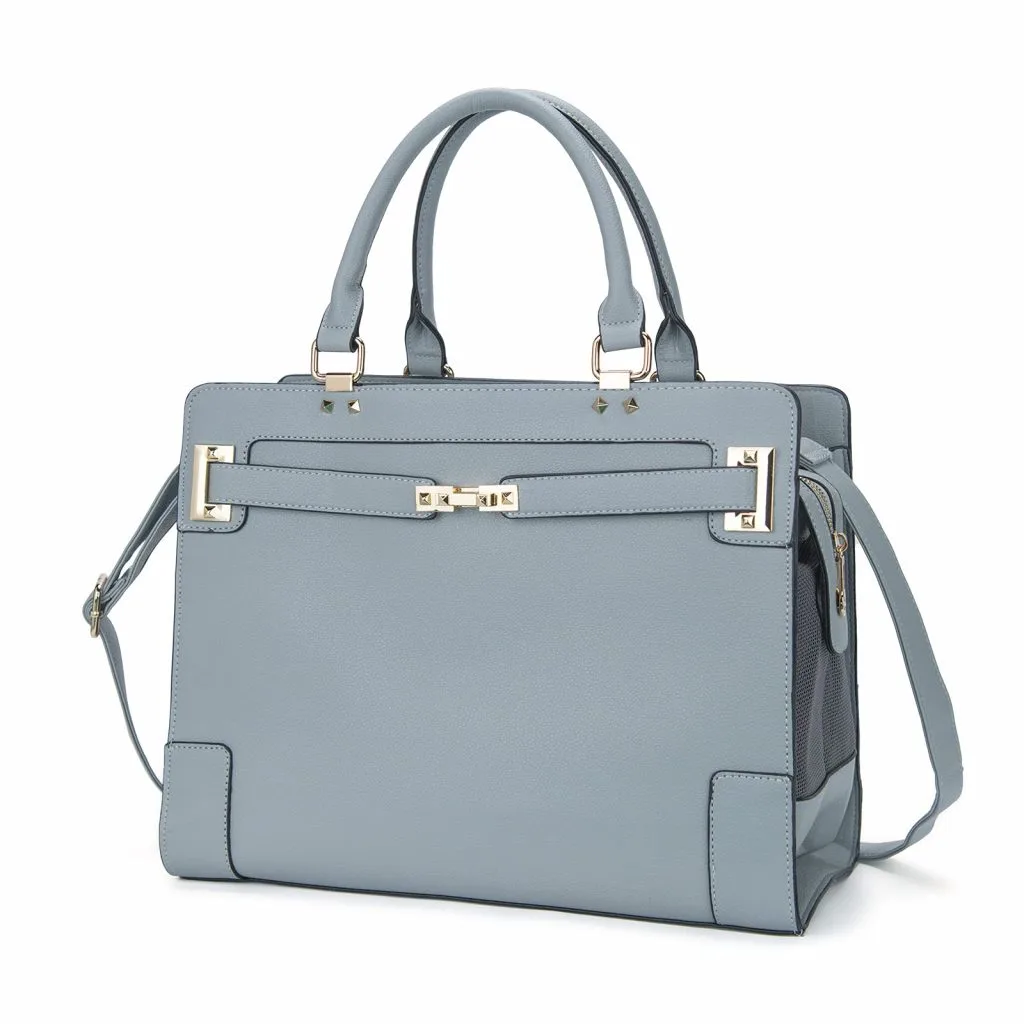
Coat, Shedding and Thermal Management
The Australian Shepherd carries a medium-length double coat with a dense undercoat that sheds seasonally and continuously in between. That produces the same two problems the other coated classes produce — airflow clogging and hair ingress — at a larger scale, because the animal is bigger and the coat volume with it.
Aperture selection follows the coated-breed rule: 4-6 mm monofilament apertures or a perforated panel with 5-6 mm holes, resisting the bridging that reduces a fine mesh to 11-16% effective open area. Open area starts at 30-36% and the acceptance criterion is an effective figure above 22% after a defined fibre-loading cycle.
Thermal load is high because the mass is high: resting output of 90-130 W and arousal output of 160-220 W in a compartment of 150-180 litres. The humidity criterion binds before the temperature criterion, and acceptance is under 66% relative humidity at the head position after 45 minutes alongside a temperature rise under 4 °C above ambient.
Path geometry is the practical answer, as it is at the other large coated classes. Intake split into pairs at 25% and 75% of the length on both side faces, exhaust high at the rear and upper rear corners, areas within 15% of each other. The split matters more at this size because the animal occupies a larger fraction of the floor and blocks a single intake panel completely.
Solar gain at this surface area is 80-140 W for a dark shell, comparable to the animal's own output. A light outer with reflectance above 0.55 is a specification rather than a preference for warm-climate programmes, and a shade flap over the aperture is worth its 0.40-0.90 USD. Welfare framing is commonly cross-checked against guidance from the American Veterinary Medical Association, and air movement rules are published by IATA.
Interior Geometry and Paw-Access Control
Interior layout at this class is governed by what the animal can reach rather than by what it needs. A breed that manipulates mechanisms will reach further and more precisely than a breed that pushes, and the interior has to be laid out so that no mechanism, seam end or grab point is within reach.
The reach envelope is measured rather than assumed. From a standing position inside the compartment, an animal of this class can reach 200-280 mm beyond its nose in a forward direction and 120-180 mm laterally, which means the keep-out zone around any closure is 300 mm in the direction of reach and 200 mm laterally. Every latch, slider, webbing adjuster and seam end has to sit outside that zone or inside a shroud.
Grab points are the second category and are easy to miss. A webbing tail, a loose binding end, a corner of a mat, a zipper pull and a label all present a purchase, and a dog that finds one will use it to work at whatever it is attached to. The specification is that no element inside the compartment presents a projection above 4 mm or a free edge longer than 15 mm.
Interior surfaces are smooth, bound and loop-free, with corners radiused above R30 and no hook-and-loop anywhere within reach. The lining is a hydrophobic 420-600D that releases hair, and the floor mat is clipped rather than loose so it cannot be dragged into the closure zone.
Restraint is specified as it is for the other high-energy classes but with the keep-out rule applied to it as well: an interior tether anchored to the frame with a 400 N minimum break strength, limited travel of 150-200 mm, and its own adjuster placed outside the animal's reach rather than at the collar end. Paw-access control is a layout discipline: a 300 mm keep-out zone around every mechanism, and no interior element presenting a projection above 4 mm.
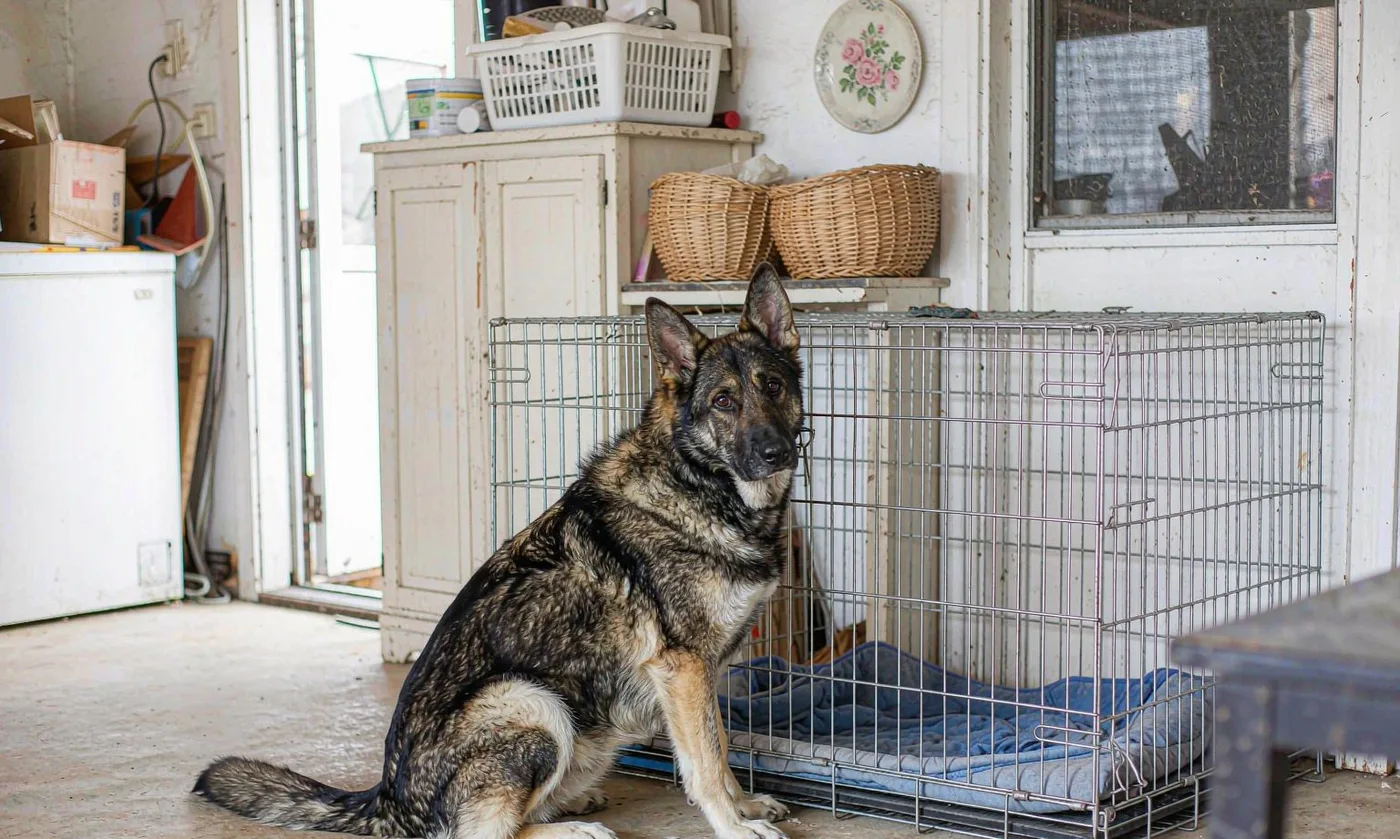
Test Protocol for Australian Shepherd-Class Release
Release testing runs the large-class protocol at the standard step with two behaviour-specific additions: a defeat-sequence test on the closure and a reach-envelope test on the interior. Both are cheap, both are fixture-light, and both are the reason the class exists as a separate specification.
The defeat-sequence test applies the five steps in order — a 350 N muzzle thrust, a 60 N lateral paw sweep repeated 20 times, a 180 N bite on any projection, a 350 N sustained pull for 60 seconds, and a repeat of the whole sequence 20 times with 200 mechanism operations interleaved. Acceptance is no release, no partial engagement at any point and no shroud deformation above 2 mm.
The reach-envelope test is dimensional and uses a gauge rather than an animal. A probe representing the reach envelope is placed at five positions inside the loaded compartment, and any mechanism, seam end or interior element within the keep-out zone must be shrouded or relocated. The test is repeated at first article on every size change.
Structural testing is the large-class set: 36 kg rated load, 144 kg static proof for 60 seconds with deflection under 5 mm, 10,000 cycles at 54 kg at 0.4 Hz, a 20,000-cycle scrabble run at 3 Hz, and attachment at 5x carried mass in shear and 3x in peel with frame-to-rail joints at 4x in torsion. Drop testing runs at 300 mm at four orientations with a 36 kg ballast.
Chassis and thermal testing close the protocol: a 100,000-cycle roll test with a 36 kg ballast and acceptance of no wheel flat-spotting beyond 1 mm and no handle deflection above 10 mm, plus thermal and humidity logging against the 66% and 4 °C criteria. Conditioning and method references follow practice published by ASTM International, and quality system requirements are held to ISO 9001.
Cost, MOQ and Programme Notes
A build at the standard step is a large-class build. The two-action latch with a moulded shroud adds 3.20-6.40 USD, the moulded ribbed tray adds 5.80-6.60 USD, the closed box frame adds 6.00-12.00 USD, the harness set adds 7.50-14.00 USD, the wheeled chassis adds 9.00-18.00 USD, and the fabric and hardware grade-up adds 5.00-9.00 USD. Total unit cost lands at 56-92 USD FOB.
Tooling is significant and the decisions have to be made at quotation. The tray runs 12,000-24,000 USD on a twelve to sixteen week path, the latch shroud 5,000-9,000 USD, and the chassis 8,000-16,000 USD. The shroud is the item programmes try to avoid and should not: a fabric flap in place of a moulded housing fails the bite step of the defeat sequence and costs the same in returns within a season.
MOQ is 500 pieces per colourway, and the two-step platform is what makes that workable. Rather than splitting one colourway across two sizes at 250 each, the better structure for this class is to launch the standard step alone at 500, because the standard population is larger and the miniature step can be added on the same tooling once demand is established.
Positioning deserves a closing note. Defeat resistance is the property buyers care about at this breed and the one almost nobody specifies, which is an opportunity: a programme that publishes the measured defeat sequence — the forces, the directions and the cycle count — is making a claim no competitor can match without doing the work.
Schedule and commercial terms are unchanged: prototypes in 6-10 working days once the latch and floor decisions are frozen, bulk production 35-50 days after approval, final random inspection to AQL 2.5 with defeat-sequence and reach checks added to the defect list, T/T 30/70 and FOB Xiamen. The smart-breed class is the one place in the range where the closure is a designed mechanism rather than a bought component.
Production capability
- SGS-verified production space of 4,950 m², 149 machines, 7 assembly lines
- Pet carrier and pet bag output since 2014 from a 137-person team
- 200,000 units shipped monthly under BSCI and ISO 9001 systems
People Also Ask
What interior size suits an Australian Shepherd?
460 x 760 x 580 mm at the standard step from a 520-620 mm back length, and 380 x 660 x 500 mm at the miniature step from 420-500 mm. Height follows chest depth of 320-400 mm, not standing height.
How do you stop a smart dog opening a carrier?
A two-action latch requiring two different motions in sequence, in a stiff moulded shroud with no projection above 4 mm, plus a positive engagement indicator and the zipper demoted to a secondary role.
What is the defeat sequence in testing?
A 350 N muzzle thrust, a 60 N lateral paw sweep, a 180 N bite, a 350 N sustained pull held 60 seconds, and the whole sequence repeated 20 times with 200 mechanism operations interleaved.
Why is a two-action latch better than a stronger single latch?
The animal learns from partial success and can discover one repeated motion. Two different motions in different axes are far harder to find by trial, and holding force alone does not help if the operating force is 40 N.
How much ventilation does a 30 kg coated dog need?
30-36% nominal open area, specified as 22% effective after a fibre-loading cycle, with intake split at 25% and 75% of the length on both sides and rear exhaust high.
Is a wheeled chassis necessary at this size?
Yes. Thirty-two kilograms of animal plus 4-5 kg of product is beyond most wearers for any distance, so the chassis is standard rather than an accessory and backpack mode is the short-distance mode.
Frequently Asked Questions
What keep-out zone is specified around closures?
300 mm in the direction of reach and 200 mm laterally, from a measured reach of 200-280 mm forward and 120-180 mm lateral from a standing position.
Which latch motions are strongest against manipulation?
A squeeze followed by a slide. Lift-and-rotate is the weakest common option because a dog can produce both with one paw movement.
Why is the zipper demoted rather than removed?
It remains useful for closing the panel but no longer carries containment. If it is contaminated or damaged, containment still holds — and the maintenance problem is solved at the same time.
What engagement indicator is used?
An audible and tactile click at full engagement, plus a coloured band visible only when fully closed for under 0.20 USD. A latch that can be left half-engaged is a latch that will eventually be opened.
What floor specification applies at the standard step?
A moulded tray with ribs of 14-16 mm on a 45-50 mm pitch holding deflection under 5 mm at a 700 mm span under 36 kg, or a die-cut laminated board with bonded alloy rails at lower volume.
What fatigue and impulse counts are used?
10,000 cycles at 1.5x rated load at 0.4 Hz, a 20,000-cycle scrabble run at 3 Hz, and an impulse case at 3-4x static mass with a rise time under 150 milliseconds.
How is the reach-envelope test performed?
A gauge representing the reach envelope is placed at five positions in the loaded compartment, and any mechanism or interior element inside the keep-out zone must be shrouded or relocated. It is repeated at first article on every size change.
What interior elements are prohibited?
Anything presenting a projection above 4 mm or a free edge longer than 15 mm: webbing tails, loose binding ends, mat corners, exposed zipper pulls and labels.
How is the tether specified at this class?
Anchored to the frame with a 400 N minimum break strength and 150-200 mm of travel, with its adjuster placed outside the animal's reach rather than at the collar end.
What thermal acceptance criteria apply?
Under 66% relative humidity at the head position after 45 minutes and a temperature rise under 4 °C above ambient, from a resting output of 90-130 W and an arousal output of 160-220 W.
How much does solar gain add at this surface area?
80-140 W for a dark shell, comparable to the animal's own output. A light outer with reflectance above 0.55 and a shade flap are specified rather than optional for warm-climate programmes.
What does the chassis roll test require?
100,000 cycles with a 36 kg ballast and defined obstacles, acceptance being no wheel flat-spotting beyond 1 mm, no bearing play above 0.5 mm and no handle deflection above 10 mm at full extension.
Should MOQ 500 be split across the two steps?
Usually not. Launch the standard step alone at 500 because the population is larger, then add the miniature step on the same tooling once demand is established.
What is the expected FOB unit cost?
56-92 USD, with the latch and shroud at 3.20-6.40, the tray at 5.80-6.60, the frame at 6.00-12.00, the harness at 7.50-14.00, the chassis at 9.00-18.00 and the fabric and hardware grade-up at 5.00-9.00 USD.
Talk to QUANZHOU JUNYUAN BAGS about a pet carrier program: MOQ 500 pieces per colourway, samples in 6-10 working days, bulk production in 35-50 days under AQL 2.5 inspection.
Get a free quote Request a sample