Pet Carrier Cooling Vest: Heat Protection
A cooling vest is specified by mechanism: evaporative fabric takes up 200-450% of its dry weight and holds the surface 6-14 degrees below ambient for 40-90 minutes, while PCM packs at 150-240 J per gram hold 26-30 degrees for 1.5-4 hours. A radiant barrier cuts surface gain 40-70%.
Heat management in an animal-worn garment is a thermodynamics problem with three distinct solutions, and they are frequently confused with one another in a specification. Evaporative fabric cools by latent heat of vaporisation, PCM packs cool by absorbing heat at a fixed phase-change temperature, and a radiant barrier does not cool at all but reduces the heat arriving in the first place. Each has a different duration, a different recharge requirement and a different failure mode, and each suits a different use case and climate. This page separates them, then treats the engineering that follows: how water uptake and retention are specified and measured, what a thermal test rig actually records and how to read it, how a PCM pack is dimensioned and certified, how coverage ratio and airflow interact, and what the care label and use-limit statements have to say. Commercial terms are standard: MOQ 500 pieces per colourway, prototypes in 6-10 working days, bulk production 35-50 days after sample approval, final random inspection to AQL 2.5, T/T 30/70 and FOB Xiamen.
A pet carrier manufacturer is judged on three numbers in this category - MOQ per colourway, sample turnaround and the AQL level applied at final inspection. Ours are 500 pieces, 6-10 working days and AQL 2.5.
Three Mechanisms: Evaporative, Phase Change and Radiant Barrier
Cooling in an animal garment comes from three physical routes and they are not interchangeable. Picking the wrong one for a climate is the most common specification error in this category, and it produces a product that works in the test room and disappoints outdoors.
Evaporative cooling removes heat through the latent heat of vaporisation of water, at roughly 2,260 joules per gram. A vest holding 150-400 grams of water removes 340-900 kilojoules as that water evaporates, which over a 40-90 minute working period is a cooling rate of 90-250 watts. It is powerful, cheap and self-recharging from a tap.
Phase-change cooling absorbs heat at a fixed temperature as a material melts. A paraffin or salt-hydrate pack at 180-240 joules per gram, holding 90-220 grams of material, absorbs 16-53 kilojoules before it is spent. It is weaker in total, but it holds a defined temperature rather than drifting with ambient, and it works in humid air where evaporation stalls.
A radiant barrier does neither. It reflects solar radiation and reduces the heat load arriving at the animal, cutting surface temperature gain by 40-70% in direct sun. It has no duration limit and no recharge, and it is the only one of the three that helps on a hot dry day with no water available.
| Mechanism | Energy removed | Temperature effect | Duration | Recharge | Works in humidity | Cost index |
|---|---|---|---|---|---|---|
| Evaporative fabric | 340-900 kJ | 6-14 degrees below ambient | 40-90 min | Water, 30-90 s | Poor above 70% RH | 100 |
| PCM pack | 16-53 kJ per set | Holds 26-30 degrees | 1.5-4 h | Freeze or cool water, 2-6 h | Yes | 220-380 |
| Radiant barrier | Reduces load 40-70% | 4-9 degrees lower surface | Unlimited | None | Yes | 130-190 |
| Evaporative plus barrier | Combined | 10-19 degrees below ambient | 50-110 min | Water | Poor above 70% RH | 175-260 |
| PCM plus barrier | Combined | Holds 26-30 degrees | 2-5 h | Freeze | Yes | 300-480 |
Humidity is the deciding variable for the evaporative route and it is the one buyers in hot coastal markets discover too late. Evaporation rate falls roughly in proportion to the vapour pressure deficit, so a vest that delivers 10 degrees of cooling at 30% relative humidity delivers 2-4 degrees at 80%. Above about 70% relative humidity the evaporative mechanism is close to spent and a PCM or barrier product is the correct specification.
Combining mechanisms is legitimate and often right, with one caution. A radiant barrier on the outer face slows evaporation from an inner evaporative layer, because it reduces the energy available to drive it. The combination that works is a barrier outer, an evaporative middle and a wicking liner, tested as an assembly rather than assumed from component data.
The honest statement of performance is a temperature difference under stated conditions plus a duration. Anything else — "keeps your dog cool" without a number and a condition — is not a specification and our production team does not put it on a tech pack. Evaporative for dry heat with water available, PCM for humid heat or controlled temperature, radiant barrier where no water exists; each needs a number and a condition attached.
Evaporative Fabric: Uptake, Retention and Distribution
An evaporative garment is a water reservoir with a controlled release rate, and three numbers define it: how much water it holds, how fast it releases that water, and how evenly it distributes it over the animal.
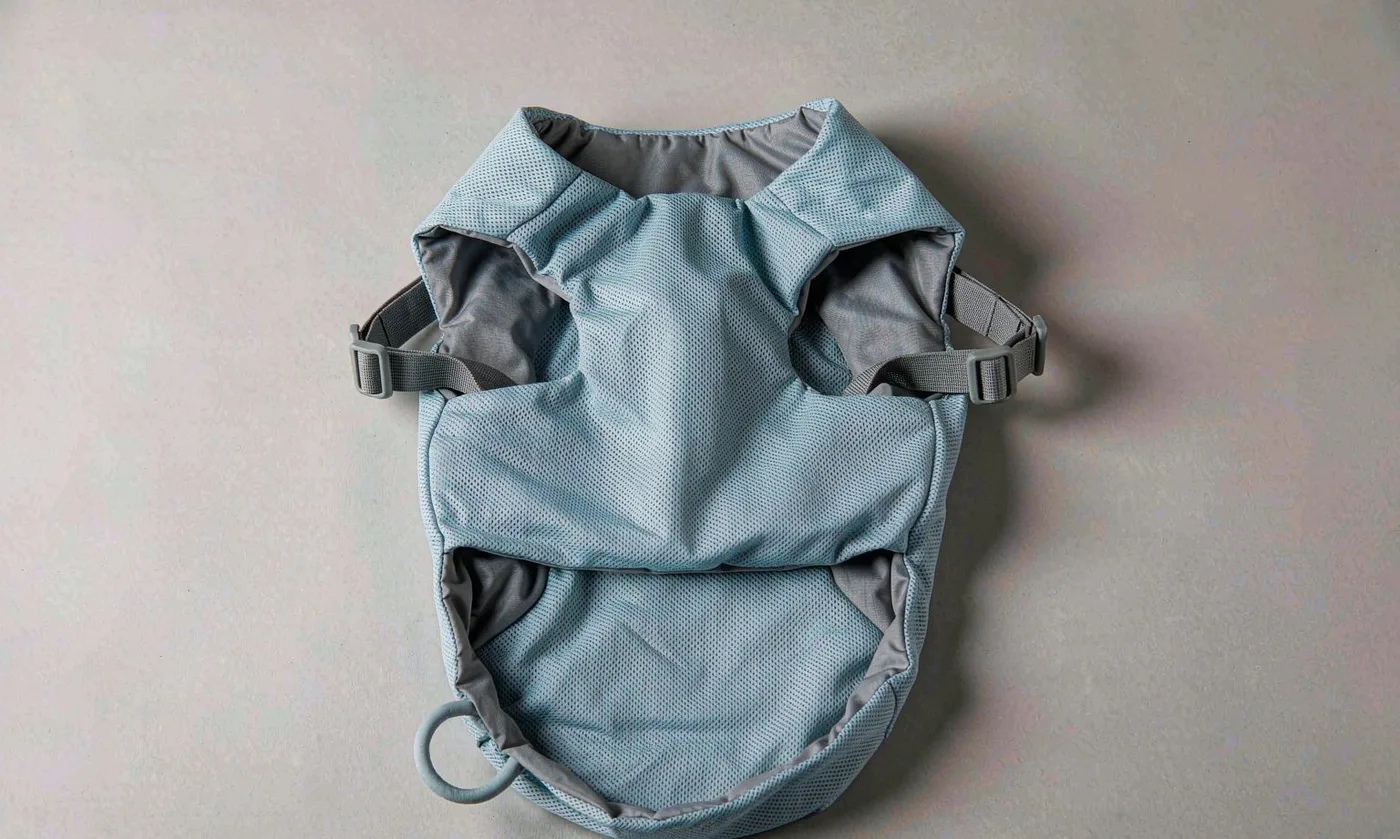
Uptake is the reservoir. A three-layer construction — an outer mesh, an absorbent middle and a wicking liner — takes up 200-450% of its dry weight in water, which on a 180-gram vest is 360-810 grams of water and 810-1,830 kilojoules of latent capacity. A single-layer fabric at 80-150% holds less than half of that and dries in 25-45 minutes.
Retention without dripping is the engineering difficulty. A fabric that holds 400% will also drip, and a vest that soaks a car seat is a returned vest. The control is a middle layer with a capillary structure that binds water against gravity: a nonwoven with a pore size of 20-80 microns holds 300-450% and releases under 2% of its load as free drip over 20 minutes.
| Middle layer | Basis weight (g/m2) | Uptake | Free drip in 20 min | Evaporation rate (g/m2/min) | Dry-out time (min) | Wash cycles |
|---|---|---|---|---|---|---|
| Needle-punch nonwoven, 40 micron | 180-280 | 320-450% | Under 2% | 8-14 | 70-110 | 60-120 |
| Needle-punch nonwoven, 80 micron | 160-240 | 240-340% | Under 1% | 11-18 | 50-80 | 60-120 |
| Cellulose sponge sheet | 220-350 | 400-620% | 3-9% | 6-11 | 90-160 | 20-50 |
| Polymer superabsorbent laminate | 120-200 | 500-900% | Under 1% | 3-7 | 150-260 | 30-80 |
| Knitted spacer, hydrophilic | 240-380 | 200-320% | 1-4% | 14-22 | 35-60 | 80-160 |
| Woven cotton terry | 300-450 | 180-280% | 4-11% | 12-20 | 40-70 | 40-90 |
Superabsorbent polymer deserves a specific caution. It holds enormous quantities of water and does not drip, but it releases that water slowly — 3-7 grams per square metre per minute against 8-18 for a nonwoven — because the water is chemically bound rather than capillary-held. The result is a vest that feels wet and cools weakly, which is the opposite of what the uptake number promises.
Distribution is the third number and it is a pattern decision. Water migrates downward in a worn garment, so an unsegmented panel is saturated at the belly and dry at the shoulder within 15-25 minutes. Quilting the absorbent layer into channels of 60-120 millimetres with a 10-16 spi stitch line limits migration and holds the distribution within 20-30% of even across the panel.
Wicking liner selection determines whether the cooling reaches the animal or evaporates outward. A hydrophobic liner pushes vapour out and away; a hydrophilic liner holds water against the coat and improves contact cooling but slows the cycle. For a short-haired breed the hydrophilic liner is measurably better by 1-3 degrees of surface reduction.
A capillary nonwoven at 300-450% uptake and under 2% free drip, quilted into 60-120 millimetre channels, with a hydrophilic liner for short-coated breeds.
Measuring Cooling: Test Rig, Conditions and Reading the Data
Cooling performance is measurable and the measurement is not expensive, which makes the absence of data in most specifications indefensible. The rig is a heated form, a controlled chamber and a set of surface thermocouples.
The method: a torso form of defined mass is heated to a surface temperature in the range a companion animal maintains, the vest is applied wetted or charged, and the form is placed in a chamber at controlled temperature, humidity and air speed. Surface temperature is logged at four to eight points for 120 minutes and water loss recorded by mass.
Conditions have to be stated or the number is meaningless. A test at 35 degrees and 30% relative humidity produces a result two to four times larger than the same vest at 35 degrees and 75%, and a test with no air movement produces a result 30-50% lower than one at 1.5 metres per second. The standard reporting set is 32 degrees at 40% relative humidity and 0.8 metres per second.
| Build | 32 C, 40% RH | 32 C, 70% RH | 38 C, 30% RH | 38 C, 70% RH | Duration to dry | Water used (g) |
|---|---|---|---|---|---|---|
| Evaporative, 350% uptake | Minus 11 to 14 degrees | Minus 3 to 5 degrees | Minus 12 to 16 degrees | Minus 2 to 4 degrees | 70-110 min | 360-810 |
| Evaporative, 250% uptake | Minus 7 to 10 degrees | Minus 2 to 4 degrees | Minus 8 to 12 degrees | Minus 1 to 3 degrees | 50-80 min | 250-520 |
| PCM, 180 g at 28 degrees | Minus 6 to 9 degrees | Minus 5 to 8 degrees | Minus 8 to 12 degrees | Minus 7 to 10 degrees | 1.5-2.5 h | 0 |
| PCM, 220 g at 26 degrees | Minus 8 to 11 degrees | Minus 7 to 10 degrees | Minus 10 to 14 degrees | Minus 9 to 12 degrees | 2.5-4 h | 0 |
| Radiant barrier only, in sun | Minus 4 to 7 degrees | Minus 4 to 7 degrees | Minus 5 to 9 degrees | Minus 5 to 9 degrees | Unlimited | 0 |
| Evaporative plus barrier | Minus 13 to 17 degrees | Minus 4 to 7 degrees | Minus 14 to 19 degrees | Minus 3 to 6 degrees | 80-120 min | 320-720 |
Reading the table correctly is most of the value. The evaporative rows collapse in the high-humidity columns and the PCM rows do not, which is the whole decision. The barrier row is flat across humidity because it is not an evaporative mechanism, and in shade indoors it delivers close to nothing.
Duration is as important as magnitude and is reported as time until the surface returns to within 2 degrees of an untreated control. A vest dropping 14 degrees for 25 minutes and one dropping 8 degrees for 90 deliver similar total cooling, and the second is more useful in the field.
Test frequency should be modest but real: a full thermal curve per design, per absorbent material lot and per season, and a single-point check at 60 minutes per production lot. One curve costs 180-520 USD and a single-point check 40-110. Thermal and textile test methods of this class are documented by ASTM International, and referencing the method makes the number defensible to a buyer.
Report magnitude, duration and conditions together, at 32 degrees with 40% relative humidity and at 38 degrees with 70%; a number without conditions is not data.
PCM Pack Engineering: Phase Point, Enthalpy and Cycle Life
A phase-change pack is a small thermal battery, and it is specified by four numbers: the temperature at which it changes phase, how much energy it absorbs, how many cycles it survives, and how it is contained and attached.
Phase point is the first decision and it is a comfort decision rather than a physics one. A pack that melts at 20-24 degrees feels cold and can cause local vasoconstriction; one at 32-34 degrees is barely below skin temperature and does little. The working range for an animal-worn garment is 26-30 degrees, with 28 as the common default and 26 for breeds that run hot.
Enthalpy determines duration. Paraffin wax at 180-220 joules per gram and salt hydrates at 150-260 are the two practical families; water itself at 334 joules per gram is the best by far and the reason an ice pack is heavy. A 200 gram pack at 190 joules per gram absorbs 38 kilojoules, which against a 150-250 watt heat load is 2.5-4 minutes of full load or 1.5-4 hours of partial load in a realistic duty cycle.
| Material | Phase point (degrees) | Enthalpy (J/g) | Density (g/cm3) | Cycle life | Supercooling | Cost index | Containment |
|---|---|---|---|---|---|---|---|
| Paraffin, technical grade | 26-30 | 180-220 | 0.76-0.82 | 1,000-4,000 | None | 100 | Welded PE pouch |
| Salt hydrate, inorganic | 26-30 | 150-260 | 1.30-1.60 | 500-2,000 | 2-8 degrees | 80-140 | Welded, needs nucleator |
| Fatty acid blend | 28-34 | 150-200 | 0.84-0.92 | 800-3,000 | None | 130-190 | Welded PE pouch |
| Water or gel pack | 0 | 334 | 1.00 | Long | None | 25-55 | Heavy, too cold |
| Paraffin with graphite | 27-30 | 160-200 | 0.85-0.95 | 1,000-4,000 | None | 180-260 | Faster recharge |
| Microencapsulated PCM coating | 28-32 | 40-90 effective | 0.50-0.80 | 300-1,000 | None | 240-420 | Bound to fabric |
Supercooling is the failure specific to salt hydrates and it is invisible until it happens. A hydrate that melts at 28 degrees may not solidify until 20-22, which means a pack put in a cool box at 24 degrees stays liquid and delivers nothing. A nucleating agent removes most of it, and a solidification check at the stated recharge temperature should be part of the incoming inspection.
Containment is where field failures come from. A pouch welded at a 4-8 millimetre seam with a 90-140 micron polyethylene film survives 500-2,000 freeze-thaw cycles; a thinner film at 60-80 microns punctures in 100-400. A puncture in a paraffin pack is a garment that cannot be cleaned, so the pouch should be specified with a puncture resistance test rather than a thickness number.
Attachment and distribution decide whether the cooling is useful. Two to six packs in pockets of 90-140 by 90-140 millimetres, positioned over the flanks and the dorsal line rather than the belly, put the cooling where the blood flow is closest to the surface. Packs on the belly sit against the ground when the animal lies down and contribute almost nothing.
Paraffin at 28 degrees and 180-220 joules per gram in a 90-140 micron welded pouch, two to six packs on the flanks and dorsal line, with a solidification check at the stated recharge temperature.
Radiant Barrier and Reflective Outer Construction
The outer layer of a cooling garment does more than hold everything together. In direct sun it is the single largest determinant of heat load, and the difference between a well-specified and a poorly-specified outer is larger than the difference between two cooling mechanisms.
Solar irradiance at midday in a temperate summer is 700-1,000 watts per square metre, and a dark textile absorbs 80-95% of it. On a garment of 0.25 square metres that is 140-240 watts of heat arriving at the animal, which is the same order as the cooling the whole vest is trying to deliver. Stopping that load is cheaper than offsetting it.
Colour is the first lever and it is nearly free. A light-coloured outer reflects 45-75% of solar radiation against 5-20% for a dark one, which on the numbers above is a difference of 80-180 watts. It is the most cost-effective single decision in the whole product and it is often given away to a brand colour.
A metallised or aluminised layer is the second lever and it is more effective but more fragile. A deposited aluminium layer of 20-60 nanometres on a polymer film reflects 80-95% of solar infrared, cutting surface temperature gain by 40-70%. It creases, it delaminates after 20-60 wash cycles and it is visible as a metallic finish, which limits where a brand will accept it.
| Outer | Solar reflectance | Surface gain vs black | Wash cycles | Breathability | Adds (USD) | Note |
|---|---|---|---|---|---|---|
| Dark polyester, 600D | 5-12% | Baseline | 150-300 | Good | 0 | Absorbs most load |
| Mid-tone polyester | 25-45% | Minus 20-40% | 150-300 | Good | 0-0.20 | Best value |
| Light or white polyester | 45-75% | Minus 45-70% | 120-260 | Good | 0-0.30 | Shows soil |
| Aluminised film laminate | 80-95% | Minus 60-80% | 20-60 | Poor | 0.85-2.40 | Delaminates |
| Ceramic-loaded coating | 55-80% | Minus 45-70% | 60-150 | Moderate | 0.55-1.60 | Colour-flexible |
| Light ripstop with mesh vent | 45-70% | Minus 40-65% | 120-260 | Excellent | 0.15-0.55 | Best with evaporative |
The interaction with the cooling mechanism is the subtlety. A fully reflective, low-breathability outer traps vapour and kills an evaporative layer beneath it, so the combination that works is a reflective or light outer with deliberate venting: mesh panels of 80-200 square centimetres at the flank, positioned to allow cross-flow but shaded from direct sun.
Ceramic-loaded coatings are the compromise most programmes land on. They reflect 55-80% of solar radiation, accept a brand colour and survive 60-150 wash cycles, against 20-60 for a metallised film. The cost is 0.55-1.60 USD and the performance gap against a light-coloured woven is modest, which is why the honest recommendation is usually a light woven with mesh vents.
Antimicrobial treatment on the outer is worth specifying on this product because it is stored wet. A silver or quaternary ammonium finish at 0.10-0.40 USD suppresses odour and mould for 20-60 washes and is the difference between a garment that is worn again and one that is left in a cupboard.
A light-coloured woven at 45-75% solar reflectance with 80-200 square centimetres of mesh venting, plus an antimicrobial finish, outperforms a sealed metallised laminate on any evaporative build.
Fit, Coverage Ratio and Airflow
A cooling garment only cools what it covers, and it only evaporates where air can move. Coverage and airflow are in tension, and the balance point depends on the mechanism chosen.
Coverage ratio is the fraction of the torso surface the garment contacts. For an evaporative product the useful range is 45-70% of torso area: below 45% the total latent capacity is too small to matter, and above 70% the garment insulates and traps the heat it is trying to remove. For a PCM product the useful range is lower, at 30-55%, because contact area matters less than total enthalpy.
Contact quality is the second half of coverage and it is a fit problem. A panel that stands 4-8 millimetres off the coat evaporates into the gap and cools the air rather than the animal; a panel in contact transfers directly. The specification is a gap of under 3 millimetres at the flank and under 6 at the dorsal line, achieved by an elasticated side panel with 15-30% stretch.
| Build | Coverage ratio | Contact gap (mm) | Vent area (cm2) | Air gap under outer (mm) | Strap adjustment (cm) | Mobility index |
|---|---|---|---|---|---|---|
| Evaporative, hot dry | 55-70% | Under 3 | 80-160 | 3-8 | 8-14 | 75-85 |
| Evaporative, temperate | 45-60% | Under 3 | 120-200 | 4-10 | 8-14 | 80-90 |
| PCM only | 30-50% | Under 5 | 40-90 | 0-4 | 8-14 | 85-94 |
| Radiant barrier | 60-80% | Not critical | 100-220 | 6-14 | 8-14 | 70-82 |
| Combined evaporative and barrier | 55-70% | Under 3 | 100-180 | 5-12 | 8-14 | 78-88 |
Airflow through the assembly is what sustains evaporation, and it comes from two sources: the movement of the animal and deliberate venting. A mesh vent at the flank in the path of the animal's own motion generates an exchange of 20-60 air changes per hour at walking speed, which is enough to sustain an evaporation rate of 8-18 grams per square metre per minute.
Mobility is the constraint that stops coverage going higher. A garment that wraps 80% of the torso restricts the shoulder and the animal will not trot in it, and a garment the animal will not move in generates no airflow and therefore no cooling. The mobility index in the table is a measured shoulder range of motion against an unclothed control, and below 70 the product stops working for a reason that has nothing to do with thermodynamics.
Sizing for this product should be graded on chest girth and back length with the same tolerance discipline as any other garment, at five sizes covering 30-112 centimetres of girth. The additional requirement is that the wetted garment does not sag: a wet evaporative panel gains 300-450% of its dry weight and the strap system has to carry that without the panel dropping more than 15-25 millimetres.
Cover 45-70% of the torso in contact within 3 millimetres, vent 80-200 square centimetres at the flank, and keep the shoulder mobility index above 70 or the garment stops generating airflow.
Care Marking, Use Limits and Documentation
A cooling garment is one of the few accessories where the instruction leaflet is a functional part of the product. Recharge procedure, use limits and care determine both the performance and the safety of what the customer actually experiences, and they should be written at design stage rather than translation stage.
The recharge statement is the most important line. An evaporative vest needs the soak time, the water temperature and the wring-out method stated: a 2-5 minute soak at 15-25 degrees followed by a gentle wring to 60-80% of saturation gives the specified performance, and a customer who wrings it to 20% gets a third of the duration. A PCM garment needs the recharge temperature and time stated, including the warning that a salt-hydrate pack may not solidify above a stated temperature.
Use limits belong on the product and not only in the leaflet. The defensible statements are measured performance under stated conditions, a maximum continuous wear duration, and a statement that the garment is an aid and not a substitute for shade, water and supervision. Our production team writes these as measured statements and refers them to the brand's counsel rather than approving claim language on the manufacturing side.
| Item | Where | Content | Lead time | Cost (USD) | Notes |
|---|---|---|---|---|---|
| Fibre composition | Sewn label | Percentages by mass | 1-3 days | 0.03-0.12 | Required in most markets |
| Care symbols | Sewn label | Wash, dry, no-solvent | 1-3 days | 0.02-0.08 | Must match the finish |
| Recharge procedure | Leaflet plus label | Soak time, temperature, wring | 2-5 days | 0.05-0.22 | Functional, not decorative |
| Performance statement | Pack | Degrees, duration, conditions | 3-8 days | 0.04-0.18 | From the test curve |
| Use limits | Pack plus leaflet | Duration, supervision, shade | 3-8 days | 0.04-0.18 | Reviewed by brand counsel |
| Restricted substance screen | File | REACH or Prop 65 | 8-20 days | 140-540 | Annual or per material |
| Textile declaration | File | OEKO-TEX criteria | 10-25 days | 180-620 | Retailer-driven |
Chemical documentation follows the standard route. Restricted substance screening is documented against the European regime through ECHA, and a California assessment runs against the Proposition 65 list published by OEHHA. Textile components, including the absorbent middle layer and the wicking liner, are declared against OEKO-TEX criteria because retail buyers ask for it by name.
Supervision and heat-illness guidance is a veterinary matter rather than a manufacturing one, and the correct approach is to point the customer at a professional source rather than write advice. Guidance from the American Veterinary Medical Association is the reference our production team uses in the instruction template, cited without reproducing or paraphrasing clinical advice.
Wash durability of the whole assembly is the last item and it is what the care label promises. A finished evaporative garment is tested to 30 wash cycles with uptake and evaporation rate re-measured at the end; acceptance is a loss under 15% of uptake and under 20% of evaporation rate. That test costs 120-340 USD and it is the number that backs a "machine washable" claim.
State the recharge procedure in numbers, print measured performance with conditions, and test the finished assembly to 30 washes before claiming machine washable.
OEM Programme: Sizes, Branding and Season Planning
A cooling garment programme is more seasonal and more size-sensitive than most accessories, and the commercial decisions follow from that. The two numbers that shape the plan are the size curve and the sell-through window.
Size mix for this category is skewed toward the middle and the large end, because the product is bought for active animals. A working curve for a 5,000-unit first order is 8-12% XS, 18-24% S, 26-34% M, 22-28% L and 10-16% XL. A programme that orders evenly across five sizes will be left with small sizes at the end of the season, and small sizes are the hardest to move because they are the most price-sensitive.
Branding routes are the usual set with one addition. A woven label, a heat transfer and an embroidery all work on the outer shell, and a care label is mandatory. The addition is that the recharge instruction can be printed inside a pocket flap or on the liner, where it is read every time the product is used, at a cost of 0.05-0.22 USD.
| Size | Share | Units | Fabric (m2) | Absorbent (kg) | Carton cube (m3) | Unit cost band (USD) |
|---|---|---|---|---|---|---|
| XS | 10% | 500 | 110-160 | 28-46 | 1.6-2.4 | 4.20-7.80 |
| S | 21% | 1,050 | 260-370 | 66-108 | 3.6-5.2 | 4.90-8.90 |
| M | 30% | 1,500 | 430-610 | 110-178 | 5.4-7.8 | 5.60-10.20 |
| L | 25% | 1,250 | 400-570 | 102-166 | 5.0-7.2 | 6.30-11.60 |
| XL | 14% | 700 | 250-360 | 64-104 | 3.2-4.6 | 7.10-13.20 |
| Total | 100% | 5,000 | 1,450-2,070 | 370-602 | 18.8-27.2 | Weighted 5.70-10.40 |
Carton cube is worth planning because this product is bulky relative to its value. A 5,000-unit order occupies 18.8-27.2 cubic metres, which is one 40-foot high-cube container at 60-75% utilisation or two 20-foot containers. Compressing the garments to a fold of 220 by 280 millimetres rather than shipping them flat-packed reduces cube by 18-30%, and at 1,600-4,200 USD per container that is a real line in the landed cost.
The season plan has to run backwards from the sell-through window. A Northern Hemisphere summer season sells from May to August, so bulk production has to complete by late March, which puts sample approval in early January, prototypes in December and artwork lock in November. Working forward from that: confirm artwork and materials by early November and the programme lands on time; confirm in January and it lands as air freight at 2.40-7.00 USD per unit extra.
Programme terms are unchanged: MOQ 500 pieces per colourway, prototypes in 6-10 working days, bulk production 35-50 days after sample approval, final random inspection to AQL 2.5 including uptake, drip and thermal spot checks, T/T 30/70 and FOB Xiamen. Production runs through the SGS-verified production base under ISO 9001 and BSCI coverage, with 4,950 square metres, 137 staff and seven lines behind a monthly output of 200,000 units. Skew the size curve to M and L, compress the pack to cut cube 18-30%, and lock artwork before November for a Northern summer season.
Order and quality terms
- MOQ 500 pieces per colourway; samples in 6-10 working days
- Bulk production 35-50 days after approval; AQL 2.5 inspection standard
- T/T 30/70 terms, FOB Xiamen, full document set per shipment
People Also Ask
How does a pet cooling vest actually work?
By evaporation of stored water. A vest holding 150-400 g removes 340-900 kJ as it dries, giving a cooling rate of 90-250 W and holding the surface 6-14 degrees below ambient for 40-90 minutes.
Do cooling vests work in humid weather?
Evaporative vests largely do not: above 70% relative humidity they deliver 2-4 degrees instead of 11-14. A PCM pack or a radiant barrier is the correct specification in humid heat.
How much water should a cooling vest hold?
200-450% of its dry weight, which on a 180 g vest is 360-810 g of water. Below 200% the capacity is too small; above 450% the garment drips.
What temperature should a PCM pack change phase at?
26-30 degrees, with 28 the common default. Below 24 the pack feels cold and constricts; above 32 it is barely below skin temperature.
How long does a cooling vest last before it dries out?
40-90 minutes for an evaporative build and 1.5-4 hours for PCM, measured as time until the surface returns to within 2 degrees of an untreated control.
What colour should a cooling vest be?
Light. A light outer reflects 45-75% of solar radiation against 5-12% for a dark one, a difference of 80-180 W on a 0.25 square metre garment.
How much of the body should a cooling vest cover?
45-70% of torso area for an evaporative build and 30-55% for PCM. Above 70% the garment insulates and traps the heat it is meant to remove.
Frequently Asked Questions
Why does a superabsorbent polymer underperform its uptake number?
The water is chemically bound rather than capillary-held, so it releases at 3-7 grams per square metre per minute against 8-18 for a nonwoven. The vest feels wet and cools weakly.
Why must an evaporative panel be quilted into channels?
Water migrates downward in a worn garment, leaving the belly saturated and the shoulder dry in 15-25 minutes. Channels of 60-120 mm hold distribution within 20-30% of even.
Should the liner be hydrophobic or hydrophilic?
Hydrophilic for short-coated breeds, by 1-3 degrees of additional surface reduction. A hydrophobic liner pushes vapour outward and away from the animal.
What test conditions make a cooling number meaningful?
Temperature, humidity and air speed, all stated. The standard reporting set is 32 degrees at 40% relative humidity and 0.8 m per second, with 38 degrees at 70% as the humid reference.
What is supercooling in a PCM pack?
A salt hydrate that melts at 28 degrees may not solidify until 20-22, so a pack cooled at 24 stays liquid and delivers nothing. A nucleating agent reduces it and a solidification check catches it.
How thick should a PCM pouch film be?
90-140 microns welded at a 4-8 mm seam, surviving 500-2,000 freeze-thaw cycles. A 60-80 micron film punctures in 100-400 and a punctured paraffin pack cannot be cleaned.
Where should PCM packs be placed?
On the flanks and the dorsal line, in two to six pockets of 90-140 mm. Packs on the belly sit against the ground when the animal lies down and contribute almost nothing.
Why is a metallised laminate often the wrong outer?
It reflects 80-95% of solar infrared but traps vapour and kills an evaporative layer beneath it, and it delaminates after 20-60 washes. A light woven with mesh vents performs better on an evaporative build.
Why does mobility matter to cooling performance?
A garment wrapping 80% of the torso restricts the shoulder, the animal will not trot, and no movement means no airflow. Below a mobility index of 70 evaporation stalls.
What does the wet garment do to the strap system?
It gains 300-450% of dry weight, and the straps must hold the panel without more than 15-25 mm of sag or the contact gap opens and cooling transfers to air instead of the animal.
Why should the recharge procedure be printed inside the garment?
It is read every time the product is used. A customer wringing to 20% of saturation gets a third of the specified duration, and the instruction costs 0.05-0.22 USD.
What backs a machine washable claim on this product?
30 wash cycles on the finished assembly with uptake and evaporation re-measured, accepting under 15% loss of uptake and under 20% of evaporation rate. The test costs 120-340 USD.
How should heat-illness guidance be handled on the pack?
By pointing to a professional source such as the AVMA rather than paraphrasing clinical advice, plus a statement that the garment is an aid and not a substitute for shade, water and supervision.
When must artwork lock for a Northern summer season?
Before November. Bulk completes by late March for a May-to-August sell-through, which puts sample approval in January and prototypes in December. Locking in January means air freight at 2.40-7.00 USD extra per unit.
Talk to QUANZHOU JUNYUAN BAGS about a pet carrier program: MOQ 500 pieces per colourway, samples in 6-10 working days, bulk production in 35-50 days under AQL 2.5 inspection.
Get a free quote Request a sample