Pet Carrier Fence: Portable Barrier
A portable barrier is specified on five numbers: tube outside diameter of 16-25 millimetres, wall thickness of 0.8-1.5 millimetres, mesh aperture of 40-60 millimetres, panel height of 760-1,220 millimetres, and a folded pack thickness of 60-110 millimetres that gives a packed volume of 0.028-0.055 cubic metres per carton.
A portable barrier is a space-frame problem dressed up as a pet product. Everything that matters is decided by three numbers on the tube drawing and one number on the mesh drawing, and every failure reported in the field traces back to one of them: a wall too thin to survive a clamp load, an aperture wide enough to admit a head, a joint that rotates under a push, or a folded pack too thick to hit a freight bracket. This page works through the category in manufacturing order: tube diameter and wall gauge against panel span, mesh aperture against escape geometry, hinge and connector hardware against cycle life, surface treatment against corrosion hours, and fold-flat geometry against packed volume. It then covers the test protocol a barrier has to pass before it is sampled, the carton and pallet arithmetic that decides the landed cost, and the programme economics of panel count against tooling. Commercial terms are standard: MOQ 500 pieces per colourway, prototypes in 6-10 working days, bulk production 35-50 days after sample approval, final random inspection to AQL 2.5, T/T 30/70 and FOB Xiamen.
As a pet carrier manufacturer handling pet carrier accessory programmes, our team quotes MOQ 500 pieces per colourway and returns a sewn sample in 6-10 working days.
Tube Diameter, Wall Gauge and Panel Span
A barrier panel is a rectangular frame with an infill, and the frame carries everything. The two numbers on the tube drawing are the outside diameter and the wall thickness, and they interact with the panel span in a way that is easy to get wrong because the stiffness term is cubic in diameter and linear in wall.
Outside diameters in this category run 16, 19, 22 and 25 millimetres on round steel tube, with 20 by 20 and 25 by 25 millimetres on square. A 16 millimetre tube at 0.8 millimetres wall has a section modulus of roughly 0.20 cubic centimetres; a 25 millimetre tube at 1.2 millimetres has roughly 0.72. The bigger tube is three and a half times stiffer for a 55% increase in frame weight, which is why the diameter is the first decision and the wall is the second.
Wall thickness is set by the forming operation and by the clamp load rather than by stiffness. Below 0.8 millimetres a round tube ovalises at the bend radius and the joint fitment goes loose; above 1.5 millimetres the tube no longer forms cleanly on a standard rotary-draw bender without mandrel work and the cost per bend rises by 40-120%. The working band is 0.8-1.5 millimetres and most production sits at 1.0-1.2.
Span is what loads the tube. A panel 900 millimetres wide with a mid-rail deflects 8-22 millimetres under a 200 newton horizontal push at the top rail when built from 19 millimetre tube at 1.0 millimetres; the same panel in 25 millimetre tube at 1.2 deflects 3-9 millimetres. The acceptance figure used in sampling is 15 millimetres of residual deflection after load removal, because a panel that springs back is a panel the customer accepts on his own inspection.
Mid-rails are the cheap stiffness. Adding a horizontal rail at 45-55% of panel height reduces top-rail deflection by 55-75% for 8-14% additional frame weight, and it is the single best value change available on a panel that fails a push test.
Material is either cold-rolled steel at SPCC or Q195 equivalent, or aluminium at 6063-T5. Steel is 2.4-3.1 times stiffer for the same section and 35-55% cheaper per kilogram, but it is 2.9 times denser and it is the reason a steel barrier needs a real surface treatment rather than a decorative one.
Specify 22-25 millimetres outside diameter at 1.0-1.2 millimetres wall for any panel above 900 millimetres of span, and add a mid-rail before increasing the wall, because the rail buys 55-75% less deflection for 8-14% of the weight.
Mesh Aperture, Wire Gauge and Escape Geometry
The infill is where the product either works or does not. A barrier is bought to contain an animal, and containment is a geometric question about aperture size, wire stiffness and the deformation of the opening under load.
Welded wire mesh in this category runs at 2.0-4.0 millimetres wire diameter with apertures of 40 by 40, 50 by 50, 50 by 100 and 60 by 120 millimetres. The aperture is specified on the short dimension first, because that is what governs whether a head passes. A 60 millimetre short dimension admits the muzzle of a medium breed and the head of a small one; a 40 millimetre short dimension does not.
Wire gauge governs whether the aperture holds its shape. A 2.5 millimetre wire at a 50 millimetre aperture opens to 62-78 millimetres under a 300 newton concentrated push, which means an aperture specified at 50 has to be tested at load rather than measured at rest. A 3.5 millimetre wire at the same aperture opens to 53-61 millimetres, which is the argument for spending on wire rather than on frame.
Weld shear is the acceptance test and it is the one most often omitted. A single weld on a 3.0 millimetre wire is required to hold 900-1,800 newtons in shear, tested on 3-6 welds per production lot. A mesh that looks correct and welds at 400 newtons will open progressively under repeated loading, and the failure appears in the field as a gap that was not in the drawing.
Climb geometry is the second escape mode and it is independent of aperture. A mesh with horizontal wires on the outside face at 50 millimetre vertical spacing is a ladder; the fix is to orient the mesh so the horizontal wires sit on the inside face, or to specify a 50 by 100 aperture with the long dimension horizontal so the vertical spacing is 100 millimetres and there is no purchase for a paw.
Bottom gap is the third and it is the one that fails on site rather than in the factory. A panel placed on an uneven surface leaves a gap of 10-40 millimetres at the base; a 25 millimetre gap is enough for a small breed to work a panel outward over 15-60 minutes of sustained pushing. The engineering answer is a base rail at ground contact with a tolerance of plus 0 minus 3 millimetres across the panel width, or a ground skirt of 150-300 millimetres.
An aperture of 40-50 millimetres on the short dimension, wire at 3.0-3.5 millimetres, welds holding 900-1,800 newtons in shear, and a base rail with no more than a 3 millimetre gap over the panel width, is the combination that actually contains rather than merely encloses.
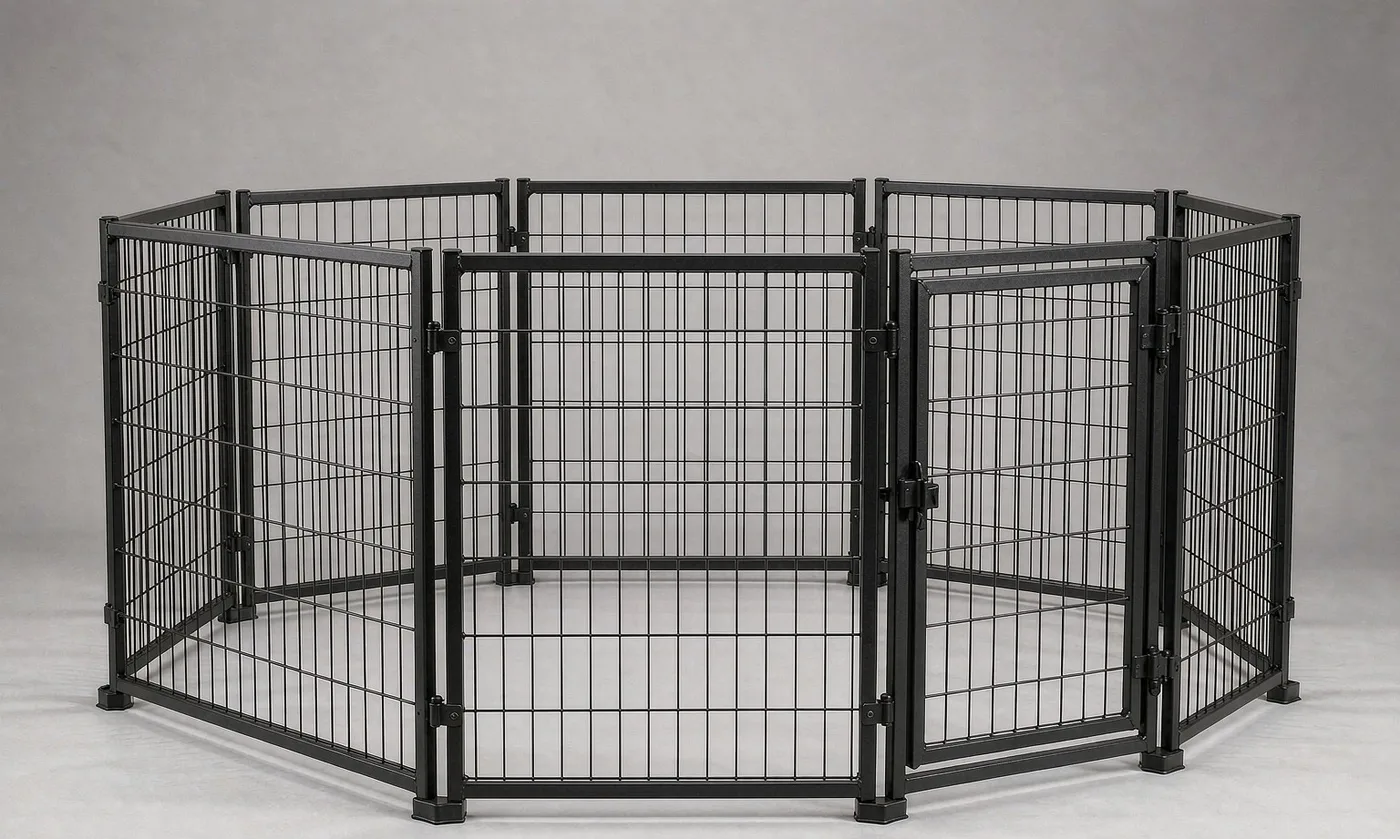
Hinges, Connectors and the Joint Load Path
A multi-panel barrier is only as stiff as its joints, and the joint is the part that accumulates damage over the life of the product. Three joint types are in production: a pinned hinge, a drop-pin hinge and a hook-and-eye connector.
A pinned hinge uses a solid steel pin of 6-10 millimetres diameter through two rolled knuckles, with a washer and a peened or riveted end. It is the stiffest and the most expensive at 0.55-1.90 USD per joint and 20-45 seconds of assembly. Rotation is 180-270 degrees and the joint survives 5,000-15,000 cycles before the knuckle ovalises.
A drop-pin hinge uses a loose pin dropped through aligned knuckles, retained by gravity or by a spring clip. It costs 0.18-0.70 USD and assembles in 5-15 seconds, but the pin is a removable part and it is the most common lost component in the category. Where it is used the pin is tethered with a 40-80 millimetre lanyard and the lanyard is counted in the bill of materials rather than treated as an afterthought.
A hook-and-eye connector is a formed hook engaging an eye, with no pin at all. It costs 0.10-0.45 USD and assembles in 2-6 seconds, and it rotates through 300-360 degrees which is what makes a barrier configurable into an octagon or a rectangle. Its weakness is pull-out: the hook releases at 150-500 newtons depending on the engagement depth of 8-18 millimetres.
Engagement depth is the number to specify on a hook connector. Below 8 millimetres the hook lifts out under an upward pull; at 12-18 millimetres with a closed return it holds 350-900 newtons. The difference between a barrier that holds and one that opens is often 4 millimetres of formed return on a stamped part.
Cycle testing is what qualifies the joint. A hinge is cycled 3,000-10,000 times at 8-20 cycles per minute with a 50 newton side load, then re-measured for knuckle ovalisation of less than 0.5 millimetres and for free rotation without binding. A connector is cycled 1,000-5,000 times and re-tested to pull-out.
Corrosion at the joint is the slow failure. A hinge pin in plain steel seizes in 6-24 months of outdoor exposure; a zinc-plated pin at 5-12 microns lasts 18-60 months. The specification that closes this is a plated pin with a clearance of 0.15-0.40 millimetres on the knuckle bore, and the clearance is what allows the plating to exist without binding the joint.
Specify engagement depth of 12-18 millimetres on a hook connector, a tethered pin on a drop-pin hinge, and a plated pin with 0.15-0.40 millimetres of bore clearance, and the three joint failure modes are addressed at once.
Surface Treatment: Powder Coat, E-Coat and Corrosion Hours
A steel barrier that rusts in one season is a warranty problem and a review problem, and the difference between one season and five is entirely in the pretreatment and the coating specification.
Pretreatment is the step that is skipped when cost is cut. A seven-stage zinc phosphate or a zirconium conversion treatment before coating raises salt spray performance by 2.5-5 times on the same powder. A barrier cleaned but not converted fails at the scribe in 96-240 hours; the same barrier converted passes 500-1,000 hours.
Powder coat is the standard finish at 60-120 microns dry film thickness, applied electrostatically and cured at 180-200 degrees Celsius for 10-20 minutes. Coverage on a mesh is the difficulty: electrostatic application shadows the far side of a wire, and a mesh coated from one side leaves 30-60% of the film thickness on the reverse. The control is a two-pass application with the panel rotated, or a fluidised dip on the mesh before frame welding.
Electrocoat as a primer under a powder topcoat is the premium build at 15-25 microns of e-coat plus 60-90 microns of powder. It costs 0.55-1.80 USD more per panel and it delivers 1,000-2,000 hours of salt spray, which is the specification for a barrier sold as a permanent outdoor product rather than an indoor one.
Edge and weld coverage is where a coating fails first. A weld spatter ball of 0.5-1.5 millimetres breaks the film and becomes a rust nucleus within 200-600 hours; the control is mechanical spatter removal before coating, specified as a process step rather than left to the operator. Cut tube ends are the second site, and a plastic or rubber end cap of 0.03-0.14 USD closes them.
Verification is by neutral salt spray to the ASTM B117 method under a quality system registered to ISO 9001, with the acceptance criterion written as creepage from a scribe rather than as a pass or fail. A barrier at 500 hours with creepage under 2 millimetres is a five-season product; one at 500 hours with 6 millimetres of creepage will show rust at the welds in month 14.
Seven-stage conversion pretreatment, a two-pass powder at 60-120 microns with mechanical spatter removal, and a scribe creepage limit of 2 millimetres at 500 hours, is the finish specification that survives five seasons outdoors.
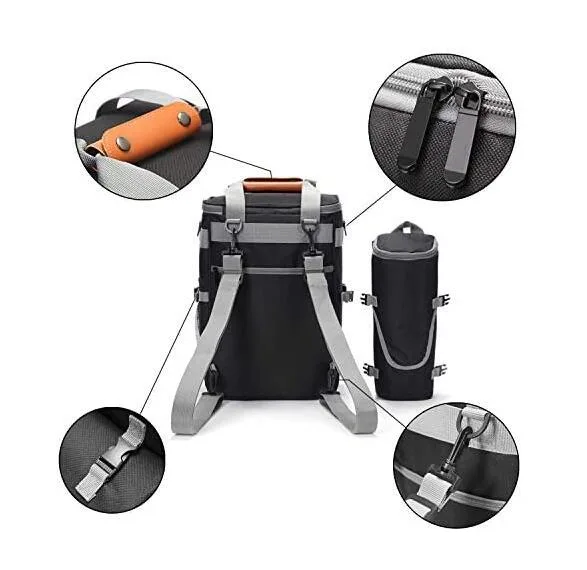
Fold-Flat Geometry and Packed Volume
A barrier is shipped as a flat pack and its freight cost is set by the folded thickness. This is the single most commercially sensitive dimension on the drawing and it is decided by the hinge, not by the panel.
A pinned hinge with knuckles formed outside the tube envelope forces the panels apart by twice the knuckle projection, typically 8-20 millimetres, so an eight-panel barrier folds to 8 times 25 millimetres of tube plus 8 times 14 millimetres of clearance, or 310-430 millimetres. That is too thick.
An offset or Z-hinge puts the knuckle inside the tube envelope and lets panels nest. The same eight-panel barrier folds to 100-180 millimetres, which is a 55-70% reduction in packed volume for a hinge that costs 0.20-0.85 USD more per joint.
A concertina fold, where alternate panels fold in opposite directions, is the other method and it is used on eight-panel and sixteen-panel barriers. It gives a folded thickness of 60-110 millimetres independent of panel count, because the panels stack rather than accumulate, and the folded footprint is the panel width by the panel height.
Panel thickness itself is the floor on the folded pack. A frame at 22 millimetres tube with a 3.0 millimetre mesh welded to one face is 25-28 millimetres thick at the panel, and that is the irreducible minimum for a welded-mesh construction. A mesh inset between two half-frames is thinner in section but doubles the frame weight, and it is not worth it.
Packed volume follows from the fold. A 760 millimetre panel folding concertina to 85 millimetres packs at 760 by 760 by 85 millimetres, or 0.049 cubic metres for a four-panel barrier; the same barrier folded without an offset hinge packs at 0.165 cubic metres. The difference is a factor of 3.4 on the freight bill for the same product.
Nesting is the last lever and it only applies to identical panels. Two panels facing each other nest to 1.4-1.8 times the single panel thickness rather than 2.0 times, because the mesh of one sits in the frame void of the other. It is worth 12-28% of the folded thickness and it requires the mesh to be welded to the same face on every panel.
An offset hinge or a concertina fold takes an eight-panel barrier from 310-430 millimetres of folded thickness to 60-110 millimetres, and that single change cuts the packed volume by 55-70% for 0.20-0.85 USD more per joint.
Carton, Pallet and Container Arithmetic
The landed cost of a barrier is freight-dominated at every panel count above four, and it is calculated from the folded pack rather than from the product.
The retail carton is a brown or printed corrugate at 4-7 kilograms per square metre bursting strength, sized to the folded pack plus 10-25 millimetres of clearance on each dimension. A four-panel barrier at 760 by 760 by 85 millimetres packs in a carton of 790 by 790 by 115 millimetres, or 0.072 cubic metres, at 8-14 kilograms gross.
Master cartons are used where the channel requires them and they hold 2-4 retail cartons. The master is a double-wall at 6-9 kilograms per square metre, and the stacking height on a pallet is 4-6 high, giving a pallet of 1.2 by 1.0 by 1.6-2.0 metres and 450-900 units per pallet depending on panel count.
Container cube is the number on the quotation. A 40-foot high-cube container holds 68 cubic metres usable. A four-panel barrier at 0.072 cubic metres per retail carton gives 940 cartons and 940 units; an eight-panel barrier at 0.118 gives 570 units. The eight-panel product carries 1.6 times the steel and yet it ships at 61% of the unit count per container, which is why the panel count decision is a commercial one and not only a design one.
Weight is the second constraint and it usually binds before volume on steel. A 40-foot high-cube carries 26-28 tonnes of payload. A four-panel steel barrier at 9.5 kilograms packs 940 units at 8.9 tonnes, comfortably inside the limit; a sixteen-panel steel barrier at 31 kilograms reaches the weight limit at 850 units while occupying only 55% of the volume. Steel barriers hit the weight ceiling, aluminium barriers hit the volume ceiling, and the choice between them is made by which ceiling binds first.
Pallet losses are real and are usually omitted from the quotation. Pallet base, top sheet and the void between a 1.2 by 1.0 metre pallet and the container wall consume 8-16% of the container volume. A quotation that divides container volume by carton volume without subtracting that is overstating the load by 500-900 units.
A four-panel barrier ships 940 units per 40-foot high-cube at 8.9 tonnes; a sixteen-panel steel barrier reaches the 26-28 tonne payload limit at 850 units while using only 55% of the volume, and pallet losses take a further 8-16%.

Test Protocol: Push, Climb, Cycle and Tip Stability
A barrier has to be qualified against four exposures, and each has a numeric acceptance criterion that belongs on the drawing rather than in the inspector's judgement.
Horizontal push is the primary test. A load of 200-400 newtons is applied at the top rail at 45-55% of panel height for 60 seconds, and the acceptance criteria are residual deflection under 15 millimetres and no permanent deformation of the mesh. A panel that meets the frame criterion but opens its mesh apertures by more than 25% of the nominal has failed, because the aperture is the containment function.
Impact is the second. A 15-30 kilogram pendulum or a sandbag is swung into the panel centre at 1.0-2.2 joules, and the acceptance is no weld fracture and no joint separation. This is the test that separates a 2.5 millimetre wire from a 3.5 millimetre one, and it is run on six panels from two production lots.
Tip stability is the third and it applies to a freestanding configuration. A barrier set as a rectangle is pushed at the top rail of a corner at 100-200 newtons, and it must resist overturning. Stability is a function of the base footprint: a panel 900 millimetres wide with a foot of 300-450 millimetres resists overturning at 130-260 newtons; the same panel with a foot of 180 millimetres tips at 70-120.
Cycle is the fourth and it covers the fold. A barrier is folded and unfolded 500-2,000 times at 4-10 cycles per minute, then re-tested to push and re-measured for joint clearance. The failure it finds is knuckle ovalisation and pin wear, and the acceptance is under 0.5 millimetres of ovalisation and free rotation.
Salt spray and coating adhesion are run alongside, at 240-1,000 hours and by cross-cut adhesion at 0-1 on a 0-5 scale. Adhesion after 240 hours of humidity exposure is a better predictor of field performance than salt spray alone, because the field failure is a coating that lifts rather than a coating that rusts through.
Sample allocation is 14-26 units per model across the protocol, built from production tooling. Barriers are expensive to sample at 26 units, which is why the push test is often run on a fixture simulating a single panel rather than on a complete barrier, and the fixture result is then confirmed on two complete units.
A protocol of 14-26 units covering a 200-400 newton push with under 15 millimetres of residual deflection, a 1.0-2.2 joule impact, tip resistance at 100-200 newtons and 500-2,000 fold cycles is what qualifies a barrier for production.
Panel Count, Tooling and Programme Economics
Panel count is the central commercial decision in this category because it drives tooling, freight, retail price and the size of the addressable market simultaneously. It is not simply a matter of adding panels.
A four-panel barrier addresses an apartment market and is priced at 28-62 USD retail; a six-panel at 42-88; an eight-panel at 55-120; a sixteen-panel at 95-210. The retail price does not scale linearly with steel content because the perceived value of an enclosure rises faster than its cost, which is why the eight-panel is the volume configuration in most ranges.
Tooling is modest and it is shared across the range. A tube-bending fixture is 800-2,600 USD, a mesh welding fixture is 1,500-5,500, a frame welding jig is 900-3,200, and a hinge forming tool is 2,200-7,500. A complete four-to-eight panel platform is 8,000-22,000 USD and it covers every panel count in the range, because the panels are identical and only the count changes.
This is the key structural advantage of the category: an eight-panel barrier is a four-panel barrier with four more of the same panel. There is no new tooling, no new test, and no new compliance file. The incremental cost is four panels of steel at 6.40-14.80 USD and four hinge sets at 0.72-7.60, against a retail price step of 27-58 USD.
The table below gives the comparative parameters across the four common configurations, built from the same 22 millimetre tube at 1.1 millimetres wall and a 50 by 100 millimetre mesh at 3.2 millimetres wire.
| Configuration | Panels | Enclosed area (m²) | Steel mass (kg) | Folded thickness (mm) | Packed volume (m³) | Units per 40ft HC | FOB cost (USD) | Retail band (USD) |
|---|---|---|---|---|---|---|---|---|
| Compact square | 4 | 0.81 | 7.5-9.5 | 85-110 | 0.072 | 900-980 | 11.80-24.60 | 28-62 |
| Rectangle | 6 | 1.62 | 11.0-14.2 | 90-120 | 0.094 | 680-760 | 16.40-33.90 | 42-88 |
| Octagon | 8 | 2.34 | 14.6-18.9 | 95-130 | 0.118 | 540-610 | 21.20-44.10 | 55-120 |
| Large corral | 12 | 4.86 | 21.9-28.4 | 110-160 | 0.172 | 370-430 | 31.60-66.20 | 78-165 |
| Full yard pen | 16 | 7.29 | 29.2-37.8 | 130-190 | 0.226 | 280-330 | 42.10-88.30 | 95-210 |
| Door panel option | +1 | n/a | +1.6-2.4 | +0-14 | +0.006 | -30 to -60 | +3.20-8.90 | +12-28 |
| Ground skirt option | n/a | n/a | +0.4-1.1 | +0-6 | +0.002 | -10 to -20 | +1.10-3.40 | +6-16 |
The door panel is the highest-margin option in the table and it should be standard rather than optional on any configuration above four panels. It costs 3.20-8.90 USD and carries a 12-28 USD retail step, and it removes the single largest source of negative review in the category, which is a barrier the owner has to climb over.
Extending the range upward is cheaper than extending it downward. Going from four to sixteen panels costs nothing in tooling and 30.30-63.70 USD in steel; developing a second tube diameter to reach a lighter price point costs 8,000-22,000 USD and re-opens the entire test protocol.
One tube diameter, one mesh specification and one hinge family covers a four-to-sixteen panel range with no new tooling; the door panel at 3.20-8.90 USD carrying a 12-28 USD retail step is the highest-margin line in the whole programme.
Why brands source here
- Pet carrier programs run since 2014; founding team in sewn goods since 2004
- SGS-verified production floor of 4,950 m² with 137 workers across 7 lines
- Monthly capacity of 200,000 units, audited to BSCI and ISO 9001
People Also Ask
What tube size should a portable pet barrier use?
22-25 millimetres outside diameter at 1.0-1.2 millimetres wall for any panel above 900 millimetres of span. The 25 millimetre tube is about three and a half times stiffer than a 16 millimetre one for 55% more frame weight.
What mesh aperture prevents escape?
40-50 millimetres on the short dimension with wire at 3.0-3.5 millimetres. A 2.5 millimetre wire at a 50 millimetre aperture opens to 62-78 millimetres under a 300 newton push, so the aperture must be tested at load.
Why does a barrier fold too thick to ship economically?
Because a pinned hinge with knuckles outside the tube envelope forces panels apart by 8-20 millimetres each. An offset or Z-hinge puts the knuckle inside the envelope and cuts folded thickness by 55-70%.
How much does fold geometry change freight cost?
A factor of 3.4 on packed volume. A 760 millimetre four-panel barrier is 0.049 cubic metres folded concertina and 0.165 cubic metres without an offset hinge.
What push load should a barrier withstand?
200-400 newtons at the top rail for 60 seconds, with residual deflection under 15 millimetres and mesh aperture opening no more than 25% of nominal.
Do steel barriers hit the weight or volume limit first?
Weight. A sixteen-panel steel barrier reaches the 26-28 tonne payload limit at 850 units while using only 55% of container volume. Aluminium barriers hit the volume ceiling instead.
How much tooling does a full barrier range need?
8,000-22,000 USD covers four to sixteen panels, because the panels are identical and only the count changes. A second tube diameter costs the same again and reopens every test.
Frequently Asked Questions
Why is wall thickness set by forming rather than stiffness?
Below 0.8 millimetres a round tube ovalises at the bend and the joint fitment goes loose. Above 1.5 millimetres it will not form cleanly on a standard rotary-draw bender without mandrel work, and bend cost rises 40-120%.
How much does a mid-rail help?
A rail at 45-55% of panel height reduces top-rail deflection by 55-75% for 8-14% additional frame weight, making it the best value change on a panel that fails a push test.
What weld shear strength should mesh have?
900-1,800 newtons per weld on a 3.0 millimetre wire, tested on 3-6 welds per production lot. Mesh welding at 400 newtons opens progressively under repeated loading.
How is climb prevented?
Orient the mesh so horizontal wires sit on the inside face, or specify a 50 by 100 millimetre aperture with the long dimension horizontal, giving 100 millimetres of vertical spacing and no purchase for a paw.
Why does a bottom gap matter so much?
A 10-40 millimetre gap on uneven ground is enough for a small breed to work a panel outward over 15-60 minutes. Specify a base rail with a tolerance of plus 0 minus 3 millimetres across the panel width.
What engagement depth does a hook connector need?
12-18 millimetres with a closed return, holding 350-900 newtons. Below 8 millimetres the hook lifts out under an upward pull and releases at 150-500 newtons.
Why tether a drop-pin hinge pin?
It is a removable part and the most commonly lost component in the category. A 40-80 millimetre lanyard costs little and belongs in the bill of materials rather than as an afterthought.
How much does pretreatment change corrosion performance?
2.5-5 times on the same powder. A cleaned but unconverted barrier fails at the scribe in 96-240 hours; the same barrier with a seven-stage conversion passes 500-1,000 hours.
Why is powder coverage poor on mesh?
Electrostatic application shadows the far side of a wire, leaving 30-60% of film thickness on the reverse. The control is a two-pass application with the panel rotated, or a fluidised dip before frame welding.
What is the acceptance criterion for salt spray?
Creepage from a scribe, not a pass or fail verdict. Under 2 millimetres of creepage at 500 hours indicates a five-season product; 6 millimetres means rust at the welds by month 14.
What causes coating failure at welds?
Weld spatter balls of 0.5-1.5 millimetres break the film and become rust nuclei within 200-600 hours. Mechanical spatter removal must be specified as a process step.
How many fold cycles should a joint survive?
500-2,000 on the complete barrier and 3,000-10,000 on the hinge alone, with knuckle ovalisation under 0.5 millimetres and free rotation without binding.
What foot length prevents overturning?
A foot of 300-450 millimetres on a 900 millimetre panel resists 130-260 newtons of corner push. The same panel with a 180 millimetre foot tips at 70-120 newtons.
Should a door panel be standard or optional?
Standard on any configuration above four panels. It costs 3.20-8.90 USD, carries a 12-28 USD retail step, and removes the largest source of negative review in the category.
Talk to QUANZHOU JUNYUAN BAGS about a pet carrier program: MOQ 500 pieces per colourway, samples in 6-10 working days, bulk production in 35-50 days under AQL 2.5 inspection.
Get a free quote Request a sample