Pet Carrier Luggage Tag: Identification
A pet carrier luggage tag needs a 200 N loop break strength, a marking method that survives 500-2,000 hours of UV, and an information panel legible at 300 mm. Silicone or TPU bodies with a laser or sublimated mark and a privacy flip cover are the standard. Confirm 5,000 swing cycles before approval.
A luggage tag is an identification device that has to remain readable after being dragged through an airport, left in the sun and soaked in rain, and it fails in one of three ways: the mark fades, the loop breaks, or the cover stops staying shut. All three are measurable before tooling. This page treats the tag as a printed part with a structural attachment: which substrates hold a mark through 500-2,000 hours of UV exposure, why the attachment loop needs a 200 N rating when the tag itself weighs 15 g, and what legibility actually requires in font size and contrast. It also covers the privacy question, which is a real design decision rather than a marketing word, the marking methods ranked by durability and setup cost, and the production structure for an item that is frequently personalised per order. Commercial terms follow the standard accessory programme: MOQ 500 pieces per colourway, prototypes in 6-10 working days, bulk production 35-50 days after sample approval, final random inspection to AQL 2.5, T/T 30/70 and FOB Xiamen.
Wholesale pet carrier programmes for pet carrier accessory ranges run 35-50 days after sample approval, shipped FOB Xiamen under T/T 30/70 terms.
What the Tag Has to Carry and Keep Readable
The information set on a pet carrier tag is different from a suitcase tag, and it drives the panel layout. A suitcase tag carries a name, an address and a phone number. A pet carrier tag carries the same plus the information a handler needs if the owner is separated from the animal.
The minimum useful set is five fields: the owner's surname, a mobile number with country code, the animal's name, a microchip or identification number, and a note on any medication or handling requirement. On a thermal or handwritten panel, five fields need roughly 55-75 characters, which is a layout constraint rather than a suggestion.
Character height is the legibility specification that follows. A handler reading a tag at arm's length, in poor light, needs a minimum character height of 3.0-4.5 mm for a printed field and 5.0-7.0 mm for the animal's name. Below 2.5 mm the tag stops being an identification device.
| Field | Typical characters | Min character height (mm) | Priority | Handwritten or printed |
|---|---|---|---|---|
| Owner surname | 8-18 | 4.0-5.5 | High | Either |
| Mobile with country code | 11-16 | 4.5-6.0 | Critical | Either |
| Animal name | 3-12 | 5.0-7.0 | High | Either |
| Microchip or ID number | 9-15 | 3.0-4.0 | Medium | Printed |
| Handling or medication note | 12-30 | 3.0-4.0 | Medium | Either |
| Destination or flight | 6-12 | 3.0-4.0 | Low | Either |
Panel area is the arithmetic that follows. Six fields at those character heights, with 3-5 mm of leading, need a writable panel of roughly 78 by 46 mm minimum, which is why the standard tag body is 85-110 mm by 50-65 mm rather than anything smaller.
Contrast is the second legibility requirement and it is often ignored in favour of aesthetics. A dark grey print on a mid-grey silicone body gives a contrast ratio of 1.8-2.6:1 and is not readable in low light. A black print on a light body gives 8-14:1. The specification should state a minimum contrast ratio of 4.5:1.
Redundancy is the point most programmes miss. A single panel on one side means a tag hanging face-down displays nothing. A tag with a writable panel on the reverse, or a printed panel on both faces, costs 0.04-0.12 USD and doubles the chance the information is visible when it is needed.
Five fields at a 4.0-6.0 mm character height need a writable panel of at least 78 by 46 mm, and a minimum contrast ratio of 4.5:1, or the tag stops functioning as identification.
Tag Formats: Flat Card, Fold-Over, Silicone Sleeve and Strap Loop
Four formats cover the market and they differ on how the information is protected, how much the tag costs and how it attaches. The flat card with a window is the classic. The fold-over with a privacy cover is the modern standard. The silicone sleeve wraps a card. The strap loop is the cheapest and the least protective.
The flat card is a rigid or semi-rigid body of 85-110 by 50-65 mm with a clear window over a paper insert. It costs 0.42-1.15 USD, it is easy to personalise because the insert is printed separately, and its weakness is that the window fogs and the insert is lost when the tag is soaked.
The fold-over protects the insert on both faces. Two panels of 55-65 by 85-100 mm fold around a card, with the join at the top, and the information is read by opening the flap or through a window. It costs 0.75-1.85 USD and it is the format that survives a season of travel.
| Format | Body size (mm) | Insert protection | Cost (USD) | Personalisation | Suits |
|---|---|---|---|---|---|
| Flat card with window | 88 x 54 | Front only | 0.42-1.15 | Swap the insert | Volume retail |
| Fold-over with cover | 120 x 60 folded | Both faces | 0.75-1.85 | Swap the insert | Frequent travel |
| Silicone sleeve over card | 95 x 58 | Both faces | 0.68-1.55 | Swap the insert | Premium, quiet |
| Strap loop, printed | 180 x 20 | None | 0.28-0.72 | Printed directly | Promotional |
| Anodised aluminium plate | 85 x 50 | Laser mark only | 0.95-2.40 | Laser per unit | Premium, permanent |
The silicone sleeve is the best balance for a pet product specifically, because it is quiet. A rigid tag on a carrier rattles against the hardware at walking cadence and against a kennel wall in transit; a silicone sleeve does not. That single property is worth more to a customer than any specification on the sheet.
The strap loop is the lowest-cost format and it has one genuine advantage: it cannot be removed and lost, because it is threaded through the handle rather than hung from a loop. Its weakness is that a printed strap abrades at 800-2,400 cycles and the mark goes with it.
Thickness interacts with the format. A flat card under 1.5 mm flexes and cracks its window; over 3.0 mm it is stiff enough to lever against a buckle and break its own loop. The working range for a rigid body is 1.8-2.6 mm, and for a silicone sleeve 1.2-2.0 mm.
A silicone sleeve at 0.68-1.55 USD protects both faces of the insert and is the only format that is silent against carrier hardware, which on a pet product matters more than any printed specification.
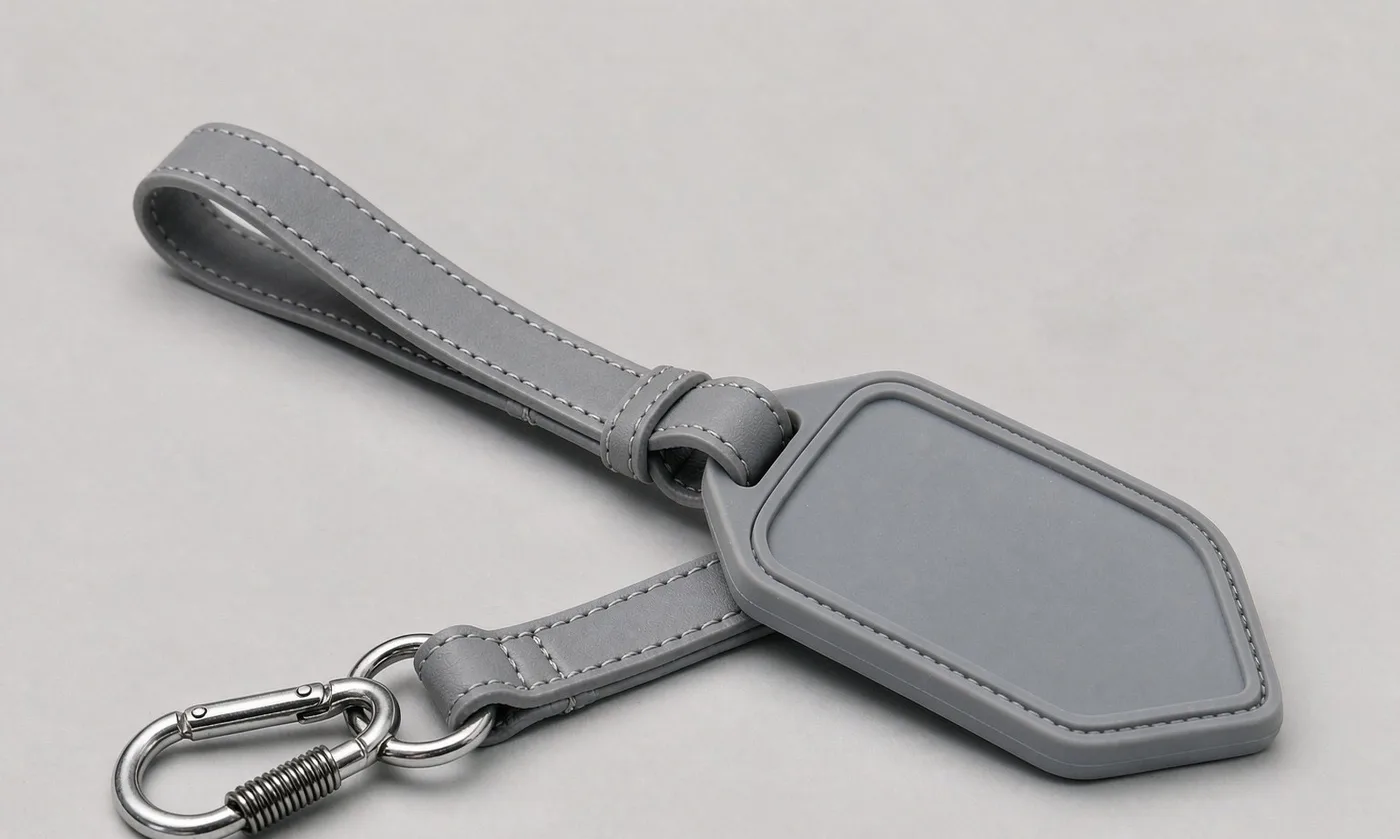
Substrate: Silicone, TPU, PVC, Leather and Anodised Aluminium
Five substrates are in production and the choice is a trade between marking durability, feel, cost and compliance. Silicone and TPU dominate the modern market; PVC is the cheap option with a compliance question; leather is the premium presentation; anodised aluminium is the permanent option.
Silicone takes a moulded or laser mark, is quiet, survives -30 to 200 degrees and does not yellow under UV. Its limitation is that it cannot be sublimated and it takes a screen print poorly unless it is plasma-treated, which adds 0.05-0.12 USD.
TPU takes a sublimation print beautifully, which is the reason it is used where full-colour artwork is required. It survives 500-2,000 hours of UV before measurable fade, against 1,000-4,000 for silicone with a moulded mark, and it abrades faster than silicone at 8,000-18,000 cycles against 15,000-35,000.
| Substrate | UV stability (h) | Abrasion cycles | Marking methods | Temp range | Cost (USD) |
|---|---|---|---|---|---|
| Platinum silicone | 1,000-4,000 | 15,000-35,000 | Moulded, laser | -30 to 200 | 0.55-1.35 |
| TPU | 500-2,000 | 8,000-18,000 | Sublimation, laser | -20 to 90 | 0.48-1.10 |
| PVC, phthalate free | 300-900 | 6,000-14,000 | Screen, pad | 5 to 60 | 0.28-0.68 |
| PU synthetic leather | 600-1,600 | 10,000-24,000 | Deboss, laser, foil | -10 to 70 | 0.75-1.85 |
| Anodised aluminium | 4,000-10,000 | 20,000-50,000 | Laser only | -50 to 150 | 0.95-2.40 |
| Coated card stock | 100-400 | 500-1,500 | Offset, thermal | 0 to 50 | 0.12-0.34 |
PVC carries the compliance question that decides most programmes against it. Where a phthalate plasticiser is present it is restricted under REACH for articles on the EU market, and the restriction list is maintained by ECHA. A phthalate-free PVC is available, costs 15-30% more and still stiffens below 5 degrees.
Anodised aluminium is the permanent answer and the one with the best numbers. A type II anodic layer of 8-15 microns with a laser mark underneath the surface gives 4,000-10,000 UV hours and 20,000-50,000 abrasion cycles. It cannot hold a handwritten insert, which is the trade.
Coated card stock belongs in one place only: as the insert inside a sleeve. On its own it survives 100-400 UV hours and 500-1,500 abrasion cycles, which is a few trips at most, and it fails completely on the first soaking.
Anodised aluminium gives 4,000-10,000 UV hours and a permanent laser mark under the surface; silicone gives 1,000-4,000 hours and is silent. PVC, at 300-900 hours and with a REACH question, is the option to design out.
Marking Methods: Durability Ranked Against Cost
The mark on a tag is the product's entire function, so the marking method is the most important specification on the sheet. Six methods are available and they differ by a factor of ten in durability.
Laser marking into an anodised aluminium body is the most durable, because the mark sits within the anodic layer rather than on it. It survives 20,000-50,000 abrasion cycles and 4,000-10,000 UV hours, costs 0.04-0.12 USD per unit and needs no tooling. Its constraint is single colour and a metallic look.
A moulded or debossed mark into silicone is the second most durable and the only method that can be applied to a silicone body without a surface treatment. The mark is formed in the tool, so it cannot abrade off at all; the tool costs 180-450 USD and the per-unit cost is effectively zero.
| Method | Abrasion cycles | UV hours | Tooling (USD) | Per unit (USD) | Colours |
|---|---|---|---|---|---|
| Laser into anodised aluminium | 20,000-50,000 | 4,000-10,000 | 0 | 0.04-0.12 | 1 |
| Moulded or debossed in silicone | Unlimited | 1,000-4,000 | 180-450 | 0.00-0.04 | 1 |
| Laser on silicone or TPU | 10,000-25,000 | 800-2,400 | 0 | 0.04-0.12 | 1 |
| Sublimation into TPU panel | 8,000-18,000 | 500-2,000 | 0-60 | 0.14-0.38 | Full |
| Screen print, plasma-treated | 3,000-8,000 | 400-1,200 | 60-140 | 0.08-0.22 | 1-4 |
| Pad print, untreated | 800-2,400 | 300-900 | 40-120 | 0.03-0.09 | 1-3 |
| Thermal print on insert | 200-600 | 100-400 | 0 | 0.02-0.06 | 1 |
Personalisation is the commercial variable that usually decides the method. If each tag carries a different name or number, only three methods work: laser, thermal print on an insert, or a swap-out printed insert. Laser gives 0.04-0.12 USD per unit with no setup; a thermal insert is 0.02-0.06 USD but lasts 200-600 cycles.
Sequential numbering is the other personalisation case and it is handled by laser at no additional cost. A programme wanting a unique serial per tag for warranty or recovery purposes gets it free with a laser method and pays 0.05-0.14 USD per unit with any other.
The insert route deserves one caution. A printed paper insert inside a sleeve is only as durable as the sleeve's seal. A sleeve welded or ultrasonically sealed on three sides keeps the insert dry through a soaking; one closed by a friction fit does not, and the insert is lost on the first rain.
Laser marking at 0.04-0.12 USD with no tooling gives 10,000-25,000 abrasion cycles on silicone and 20,000-50,000 on anodised aluminium, and it is the only method that supports per-unit personalisation at no setup cost.
Privacy: Cover Geometry, Window Sizing and Retention
A tag on a pet carrier is displayed in public, which makes the privacy question real rather than decorative. A cover that does not stay shut is worse than no cover, because it gives the owner false confidence that the number is hidden.
Cover geometry is the whole question. A fold-over flap held by a single snap stays shut through 4,000-12,000 open-close cycles before the snap loses retention. A flap held by a hook-and-loop patch stays shut through 3,000-8,000. A slide-in panel with a friction fit stays shut through 1,500-4,000 and is the weakest.
Window sizing is the second half. A window of 45-60 by 25-32 mm shows the animal's name and a partial number, which is the intended balance: enough to identify, not enough to harvest. A full-face window shows everything and defeats the cover entirely.
| Cover type | Cycles staying shut | Opening force (N) | Window shown | Cost (USD) | Verdict |
|---|---|---|---|---|---|
| Fold-over flap with snap | 4,000-12,000 | 2.5-5.5 | 45-60 x 25-32 mm | 0.14-0.34 | Recommended |
| Fold-over flap, hook and loop | 3,000-8,000 | 1.5-4.0 | 45-60 x 25-32 mm | 0.10-0.24 | Acceptable |
| Magnetic flap | 20,000-45,000 | 2.0-4.5 | 45-60 x 25-32 mm | 0.35-0.85 | Premium |
| Slide-in panel, friction | 1,500-4,000 | 1.0-3.0 | Full face | 0.06-0.16 | Avoid |
| Full-face window, no cover | n/a | n/a | Full face | 0.00 | Avoid |
| Rotating dial cover | 8,000-20,000 | 3.0-7.0 | Variable | 0.28-0.68 | Novelty |
A magnetic flap is the premium answer and it has an interesting property: magnets do not wear. A magnetic cover stays shut through 20,000-45,000 cycles because there is no mechanical wear surface, against 4,000-12,000 for a snap. That is the same argument as on a treat pouch, and it is the same 0.35-0.85 USD.
The cover has to be openable by a handler, not just by the owner. A cover that needs two hands and a fingernail will not be opened by someone who finds a carrier, which defeats the purpose. The opening force window of 2.0-5.5 N is the specification that keeps it both private and usable.
Data on the reverse is the final privacy decision. Putting the full contact set on the reverse face and only the animal's name on the front means the cover protects everything that matters and the handler can still identify the animal. That layout costs nothing and it is the correct default.
A fold-over flap at 2.5-5.5 N with a 45-60 by 25-32 mm window and the full contact set on the reverse is private enough to display and openable enough to be useful.
Attachment Loop: Break Strength and Swing Fatigue
The loop is the component that fails on a tag, because a 15-40 g tag swings continuously and the loop is a small section of material carrying the whole thing through a bending cycle. It needs both a static rating and a cycle rating.
The static rating is 200 N applied in line for 60 seconds, with no elongation over 4 mm and no separation at the join. That is far beyond anything a tag sees, and it is not the governing test — it exists to catch a join that was never properly made.
The governing test is swing fatigue: the tag is hung and cycled through a 30-degree arc at 1 Hz to 5,000 cycles, with inspection at 1,000, 2,500 and 5,000. Failure criteria are any visible crack at the loop root, an elongation over 5 mm, or a join separation. This reproduces roughly two years of daily carry.
| Loop | Section (mm) | Break load (N) | Swing cycles | Elongation at 200 N | Cost (USD) |
|---|---|---|---|---|---|
| Moulded silicone strap | 4 x 2 | 120-260 | 3,000-9,000 | 6-14 mm | 0.00-0.06 |
| Webbing loop, bar-tacked | 12 x 1.2 | 320-620 | 8,000-20,000 | 2-5 mm | 0.06-0.16 |
| Webbing plus rivet | 12 x 1.2 | 420-780 | 14,000-32,000 | 1-3 mm | 0.10-0.22 |
| Stainless wire loop | 1.2 dia | 600-1,400 | 25,000-70,000 | Under 1 mm | 0.12-0.32 |
| Stainless cable with crimp | 1.5 dia | 900-2,200 | 40,000-120,000 | Under 1 mm | 0.18-0.44 |
| Ball chain | 2.4 dia | 180-380 | 6,000-16,000 | 2-6 mm | 0.08-0.20 |
A moulded silicone strap integrated into the tag body is the cheapest and the weakest, at 3,000-9,000 cycles. It is adequate for a suitcase that travels twice a year and inadequate for a carrier used daily, which is the distinction worth making in the specification.
A stainless cable with a crimped end is the strongest and the one used where losing the tag is expensive. At 900-2,200 N and 40,000-120,000 cycles it outlasts every other component on the tag, and it costs 0.18-0.44 USD. It is worth specifying on an anodised aluminium tag, where the body will outlast a fabric loop by a factor of ten.
The join is the failure point, not the loop. A bar-tacked webbing loop fails at the stitch line at 8,000-20,000 cycles, and the same loop with a rivet through a backup washer reaches 14,000-32,000. That is the same 0.02-0.05 USD washer argument as on a key clip, and it is worth making again here.
A stainless cable loop at 0.18-0.44 USD gives 900-2,200 N and 40,000-120,000 cycles, which outlasts every other component on the tag and is the correct pairing for an aluminium body.
Durability Testing: Abrasion, UV, Water and Chemicals
A tag is exposed to more environments per unit of cost than anything else on the accessory range: sun, rain, airport cleaning chemicals and constant abrasion against hardware and kennel walls. Four tests cover it and each has a clear acceptance figure.
Abrasion is run on a linear abrader with a specified head and load, to 5,000 cycles, with acceptance being a mark still legible at a 4.5:1 contrast ratio. A silicone body passes 15,000-35,000 cycles; a PVC body passes 6,000-14,000; a printed strap passes 800-2,400.
UV is run to 500 hours in a xenon arc chamber with acceptance being a colour change under Delta E 3.0 and no measurable fading of the mark. Silicone with a moulded mark reaches 1,000-4,000 hours; a sublimated TPU panel reaches 500-2,000; a printed PVC reaches 300-900.
| Test | Condition | Cycles or hours | Acceptance | Sample | Typical result |
|---|---|---|---|---|---|
| Linear abrasion | Specified head, 9 kPa | 5,000 cycles | Mark legible, 4.5:1 | 8 per 500 | 78-100% |
| Xenon arc UV | 500 h, 60 degrees | 500 h | Delta E under 3.0 | 4 per 500 | 82-100% |
| Water immersion | 24 h, 25 degrees | 24 h | Insert intact, legible | 8 per 500 | 66-100% |
| Chemical wipe | 50 wipes, specified agent | 50 | No mark loss | 4 per 500 | 70-100% |
| Thermal cycle | -10 to 50 degrees, 6 cycles | 24 h | No crack, no delam | 4 per 500 | 88-100% |
| Loop swing fatigue | 30 degrees, 1 Hz | 5,000 cycles | No crack or separation | 8 per 500 | 84-100% |
Water immersion is the test that separates sleeve constructions. A friction-fit sleeve loses its insert in the first hour and fails at 66-100% depending on the batch. A sleeve welded on three sides keeps it dry for 24 hours and passes at 100%. That single weld is the difference between a tag that works after rain and one that does not.
Chemical resistance matters more than it appears, because airport and veterinary cleaning agents are aggressive. A specified agent wiped 50 times removes a pad print at 20-40 wipes and has no effect on a laser mark or a moulded mark. That is one more argument for the two durable methods.
Standardised conditioning and abrasion procedures are published by ASTM International, and results are only comparable between suppliers if the head, the load and the conditioning are stated. A result quoted without them is not a result.
A three-sided welded sleeve passes 24-hour immersion at 100% against 66-100% for a friction fit, and a laser or moulded mark survives 50 chemical wipes where a pad print fails at 20-40.
Compliance, Production and Set Bundling
Compliance on a tag is straightforward if the substrate and the marking method are chosen before sampling. Three points are worth stating in the purchase order and none of them is expensive to satisfy.
Restricted substances are the first. The EU regime is maintained by ECHA under REACH and the US consumer product framework by the CPSC. Both require a test on the finished article including the mark, and the substrate most likely to raise a question is a PVC body with a plasticiser.
Certification of the textile components is the second, and it is usually a buyer requirement. OEKO-TEX Standard 100 covers the fabric, thread and print as a system and is documented by OEKO-TEX. A certified webbing loop with an uncertified printed body does not produce a certified article.
| Line | Minimum | Unit cost (USD) | Setup (USD) | Lead time | Notes |
|---|---|---|---|---|---|
| Silicone sleeve, moulded mark | 500 | 0.68-1.55 | 180-450 tool | 35-50 days | Unlimited mark life |
| Silicone sleeve, laser mark | 500 | 0.72-1.67 | 0 | 35-45 days | Per-unit personalisation |
| TPU sleeve, sublimation | 500 | 0.62-1.48 | 0-60 | 35-45 days | Full colour artwork |
| Anodised aluminium, laser | 500 | 1.07-2.52 | 0 | 38-50 days | Permanent mark |
| Three colourways, shared body | 600 total | Plus 6-14% | 60-140 | 35-50 days | 200 per colourway |
| Reorder, existing tool | 300 | Lower than first run | 0 | 35-50 days | Tool retained |
MOQ is 500 pieces per colourway, with the standard mixed rule at 200 per colourway against a 500-piece total where colourways share a body and differ only in pigment or print. Because a moulded mark is tool-dependent and a laser mark is not, programmes that expect to change artwork should choose laser and accept 0.04-0.12 USD per unit rather than a 180-450 USD tool every time.
Personalisation changes the packing line rather than the production line. A per-unit laser mark is applied at pack-out, adding 0.04-0.12 USD and 1-3 days, and it requires a data file from the brand. A sequential serial number is generated in the same operation at no additional cost.
Bundling is the natural commercial home for a tag. A luggage tag, a document holder and a luggage strap make a travel documents kit at a retail index of 2.6-3.4; a tag, a key clip and a small pouch make a daily-carry set at 2.2-3.0. Both share one carton and one insert card with the rest of the range, and neither needs moulding beyond the tag body.
Choose laser over a moulded mark when artwork is expected to change: 0.04-0.12 USD per unit against a 180-450 USD tool each time, plus free sequential numbering.
Why brands source here
- Pet carrier programs run since 2014; founding team in sewn goods since 2004
- SGS-verified production floor of 4,950 m² with 137 workers across 7 lines
- Monthly capacity of 200,000 units, audited to BSCI and ISO 9001
People Also Ask
What information should be on a pet carrier luggage tag?
Five fields: owner surname, mobile number with country code, animal name, microchip or ID number, and any handling or medication note. That needs a writable panel of at least 78 by 46 mm at a 4.0-6.0 mm character height.
Is a silicone or aluminium luggage tag better?
Aluminium on durability, with 4,000-10,000 UV hours and 20,000-50,000 abrasion cycles from a laser mark under the anodic layer. Silicone is quieter, which matters against carrier hardware, and reaches 1,000-4,000 UV hours.
How strong should a luggage tag loop be?
200 N static minimum and 5,000 swing cycles at 30 degrees. A moulded silicone strap gives 3,000-9,000 cycles, a bar-tacked webbing loop 8,000-20,000, and a crimped stainless cable 40,000-120,000 at 0.18-0.44 USD.
Does the printed mark on a luggage tag fade?
It depends on the method. A laser mark into anodised aluminium survives 4,000-10,000 UV hours and a moulded mark in silicone does not abrade at all. A pad print survives 800-2,400 abrasion cycles and 300-900 UV hours.
Should a pet tag have a privacy cover?
Yes, if it stays shut. A fold-over flap with a snap holds 4,000-12,000 cycles and a magnetic flap 20,000-45,000 because magnets have no wear surface. A friction-fit panel holds 1,500-4,000 and gives false confidence.
Can luggage tags be personalised per unit?
Yes, by laser at 0.04-0.12 USD per unit with no setup, applied at pack-out and adding 1-3 days. Sequential serial numbering is generated in the same operation at no additional cost.
Frequently Asked Questions
What is the MOQ for a custom luggage tag?
MOQ 500 pieces per colourway, dropping to 200 per colourway against a 500-piece total where colourways share a body and differ only in pigment or print. Reorders against an existing tool start at 300 pieces.
How long does sampling take?
Samples are produced in 6-10 working days for a laser-marked or sublimated tag. A tag with a moulded or debossed mark needs a tool first, which adds 10-18 days on the first order.
What is the bulk production lead time?
Bulk production runs 35-50 days after sample approval. Per-unit laser personalisation is applied at pack-out and adds 1-3 days to the schedule rather than to production.
Which inspection standard applies?
Final random inspection is to AQL 2.5, with a loop swing check on 8 pieces per 500 units, a legibility and contrast check on 12 pieces, and a water immersion check on 4 pieces per 500.
Can the tag be made in the carrier's own fabric?
Yes, as a fabric-covered body over a rigid insert, which produces a coordinated set. The writable panel and its cover still need a film window, so the fabric version costs 0.10-0.26 USD more than a plain silicone body.
What is the minimum character height for legibility?
4.0-6.0 mm for the printed fields and 5.0-7.0 mm for the animal's name, at a minimum contrast ratio of 4.5:1. Below 2.5 mm the tag stops being a usable identification device.
Is PVC compliant in the EU?
Phthalate-plasticised PVC is restricted under REACH, and the list is maintained by ECHA. A phthalate-free grade is available at 15-30% more, but it still stiffens below 5 degrees, which is why most programmes move to silicone or TPU.
How is the insert protected from water?
By welding the sleeve on three sides rather than relying on a friction fit. A welded sleeve passes 24-hour immersion at 100%; a friction fit loses the insert in the first hour.
Can the tag carry a QR code?
Yes. A laser-marked QR code needs a minimum module size of 0.5-0.8 mm, which means a code area of 12-20 mm square for a scannable result at 200-300 mm. Below that the code will not scan reliably.
What loop options are available?
Moulded silicone strap, bar-tacked webbing, riveted webbing with a backup washer, stainless wire, crimped stainless cable and ball chain. The cable is the strongest at 900-2,200 N and 40,000-120,000 cycles.
Does the tag rattle against the carrier?
A rigid body does and a silicone sleeve does not. On a pet product used daily, that is often the deciding property, and it is the main reason silicone sleeves outsell rigid cards in this category.
How are tags packed?
One polybag per unit, 200-400 per export carton, with the loop folded inside the body to prevent it being crushed in transit. Personalised tags are packed in sequence to match the brand's data file.
What payment and shipping terms apply?
T/T 30/70, FOB Xiamen, with a full document set per shipment. A mould or deboss tool is invoiced 100% in advance, is owned by the brand once paid, and is retained for reorders.
Can replacement loops be ordered?
Yes, at 300 pieces. Because the loop is the wear item at 3,000-9,000 cycles on a silicone strap and every other component lasts longer, ordering 6-10% loop overage with the first run is the cheapest service option.
Talk to QUANZHOU JUNYUAN BAGS about a pet carrier program: MOQ 500 pieces per colourway, samples in 6-10 working days, bulk production in 35-50 days under AQL 2.5 inspection.
Get a free quote Request a sample