Pet Carrier Mesh: Repair and Replacement
Carrier mesh is specified by construction, mass, open area and snag resistance. A warp-knit polyester mesh at 78 g/m² with 46% open area passes 1,800 mm/s of air and holds 22 N against a claw hook. Repair a snag under 8 mm by patching; above 8 mm, replace the panel.
Mesh does two jobs at once and they pull in opposite directions: it has to pass enough air to keep an animal comfortable, and it has to resist a claw, a beak and the sun. This page covers mesh as an engineered textile rather than as a screen: how warp-knit, spacer and coated constructions differ in airflow and in snag behaviour, why open area percentage is a better specification than mesh count, what a claw snag test actually measures and what force a pet-grade mesh should hold, and how ultraviolet exposure and coating hydrolysis age the material in ways that a visual inspection misses. It also covers the repair decision — when a snag is patchable and when the panel has to come out — and the supply side of a replacement panel: construction, binding, fit tolerance, MOQ and inspection. Programme terms: MOQ 500 pieces per colourway, prototypes in 6-10 working days, bulk production 35-50 days after sample approval, final random inspection to AQL 2.5, T/T 30/70 and FOB Xiamen.
Pet carrier OEM and ODM work on pet carrier accessory platforms splits at the pattern - OEM builds to your drawing, ODM adapts an existing platform and removes the tooling cost.
Mesh as a Structural and Environmental Component
Mesh on a pet carrier is not a decorative window. It is the component that sets the internal temperature, the component the animal can physically attack, and in most designs a component that carries load along its perimeter seam. Those three roles are why a mesh specification written as "polyester mesh" is not a specification at all.
The thermal role is the one that gets under-engineered. A carrier in a car on a warm day is a box with an animal producing heat inside it, and the only heat path out is the mesh. Airflow through the panel is a function of open area and of the pressure difference driving the flow — which in a moving vehicle is small, because there is usually no through-draught. That is why ventilation is specified on more than one face: a single mesh panel on the front of a carrier in still air exchanges very little, regardless of how open the mesh is.
The mechanical role is the one that gets over-engineered in the wrong direction. The instinct on hearing that an animal damaged a mesh is to specify a heavier mesh, but a heavier mesh of the same open area passes less air per unit area and often snags worse, because a thicker monofilament presents a bigger edge for a claw to catch. The correct response is usually to change the construction rather than the mass.
The structural role is usually invisible until it fails. On a soft-sided carrier the mesh panel is bonded into the shell, and its perimeter carries the tension that holds the shape. A panel that has lost strength to ultraviolet exposure will not usually tear outright; it will stretch, the carrier will lose its form, and the door will stop sitting flat in its opening. Form loss is the earliest visible symptom of mesh ageing and it is worth training inspection to look for.
Regulatory context reinforces all three: air transport rules published by IATA require ventilation on multiple sides of a live-animal container, and the veterinary guidance on heat and airflow from the American Veterinary Medical Association is what most brands reference when they set their own ventilation figures.
Mesh Constructions: Warp-Knit, Spacer and Coated
Three constructions dominate, and they behave very differently against the two jobs described above.
Warp-knit flat mesh is the default. Polyester yarn is knitted on a warp-knitting machine into an open structure with a defined hole geometry, typically a diamond or a hexagonal repeat. It is light at 60-120 g/m², it is cheap, it sews and binds cleanly, and it can reach a high open area. Its weakness is snag: a claw entering a hole can pull the loop structure apart, and the failure runs. It also has no thickness, so it offers no padding and no stand-off.
Spacer mesh, sometimes called 3D mesh or air mesh, is a double-faced knit with monofilament pile yarns holding two faces apart. It is 3-8 mm thick, weighs 180-320 g/m², and it passes air through its thickness as well as through its faces. That makes it the best construction for a padded panel or a back panel where comfort and airflow both matter, and the worst for a door window, because its thickness makes it hard to bind and because an animal can get a claw into the pile layer.
Coated mesh is a warp-knit or woven base with a PVC or PU coating applied, which stiffens it and closes part of the open area. It is used where dimensional stability matters more than airflow: a base vent, a gusset stiffener, a panel that has to hold a shape. Coated mesh is the most resistant to snag because the coating locks the loop structure, and the least breathable for the same reason.
Monofilament versus multifilament yarn is the decision inside the decision. A multifilament yarn is a bundle of fine filaments: soft, cheap, comfortable, and a claw pulls individual filaments out and the hole grows. A monofilament yarn is a single extrusion: stiffer, slightly more expensive, and a claw tends to slide off it rather than catch. For any panel within reach of an animal, monofilament in at least one direction is the specification that matters.
| Construction | Mass | Open area | Air permeability | Snag hold | Thickness | Typical position |
|---|---|---|---|---|---|---|
| Warp-knit, multifilament | 62 g/m² | 58% | 2,400 mm/s | 9 N | 0.4 mm | Upper vent, low-reach panel |
| Warp-knit, monofilament weft | 78 g/m² | 46% | 1,800 mm/s | 22 N | 0.5 mm | Door window |
| Warp-knit, heavy monofilament | 140 g/m² | 34% | 1,150 mm/s | 38 N | 0.8 mm | Large dog platform door |
| Spacer, 4 mm | 240 g/m² | 52% | 1,600 mm/s | 14 N | 4.0 mm | Back panel, shoulder pad |
| PVC-coated woven | 320 g/m² | 18% | 420 mm/s | 55 N | 0.9 mm | Base vent, gusset stiffener |
The trade is visible in the table: every step up in snag hold costs airflow. The specification is therefore written as a minimum on both — for example, 1,400 mm/s minimum permeability and 20 N minimum snag hold — and the construction is chosen to satisfy both rather than maximising one.
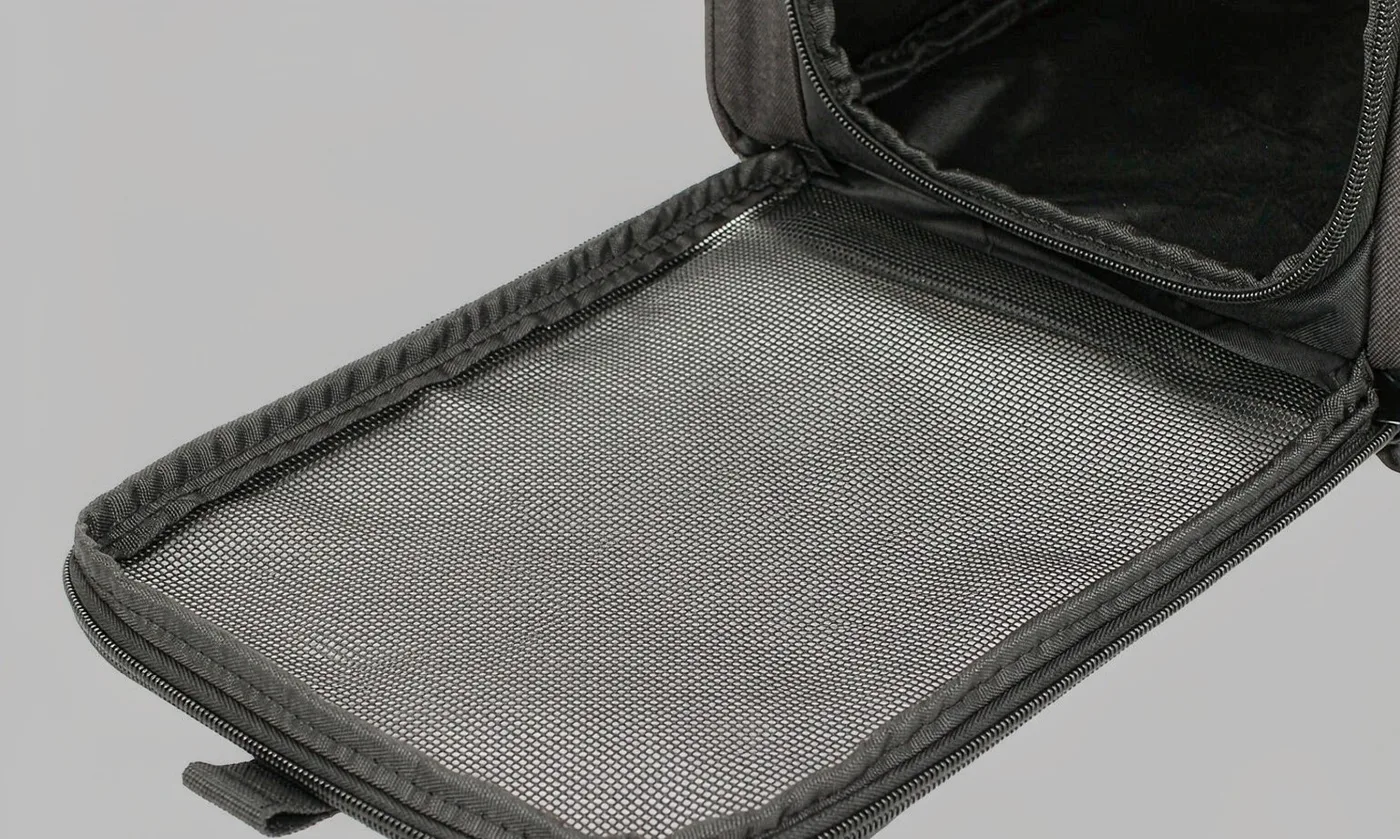
Airflow Mathematics: Open Area, Permeability and Heat
Mesh count — holes per inch — is the number most often quoted and the least useful, because it says nothing about hole size. Open area percentage is the specification that predicts behaviour, and air permeability is the measurement that confirms it.
Open area is the fraction of the panel surface that is hole rather than yarn. It is measured from a calibrated image of the panel rather than calculated from the count, because the yarn thickness varies with construction. For a pet-grade door panel, 40-50% is the working range: below 30% the carrier runs hot, above 60% the structure is too weak to hold in service.
Air permeability is measured by drawing air through the panel at a defined pressure difference and recording the flow, under the textile permeability method published by the ISO standards for textiles. The result is reported in mm/s at a stated pressure, usually 100 Pa, and it is the figure to put on a drawing because it is measurable and comparable, unlike a description.
What the numbers mean in use. Free convection through a vertical panel in still air is weak; the exchange is driven mostly by the animal moving and by any draught in the vehicle. A door panel at 1,800 mm/s and 0.09 m² of area moves a meaningful volume under a modest pressure difference, but two panels on opposite faces move several times that, because they create a path rather than a hole. This is the engineering argument behind multi-face ventilation and it is why a single large panel performs worse than two smaller panels of the same total area.
Heat. The practical consequence of under-ventilating is not discomfort but a temperature rise that becomes dangerous inside 20-30 minutes in a parked vehicle. Programme-level guidance is therefore stated in two figures: a minimum total open area across all panels, typically 0.012 m² for a small carrier and 0.030 m² for a large one, and a requirement that the panels sit on at least two non-adjacent faces so that air can cross the box.
Snag and Claw Resistance: How Mesh Is Tested
Snag resistance is the property that separates a pet-grade mesh from a generic one, and it is tested with a purpose-built method because no general textile method captures it.
The test used is a hook pull-through. A defined steel hook with a 0.8 mm radius tip is engaged into a single hole in the mesh, which is mounted in a 100 mm diameter ring under 2 N of pretension, and the hook is then drawn at 100 mm/min perpendicular to the panel. The recorded figure is the peak force before the structure fails, and the failure is classified as yarn pull-out, loop run, or clean break.
The classification matters more than the force. A clean break at 15 N is a safe failure: the hole is one hole. A loop run at 15 N is not, because the run propagates and a 3 mm snag becomes a 40 mm opening within minutes of the animal working at it. A pet-grade mesh is therefore specified on both axes: a minimum peak force of 20 N and a maximum run length of 10 mm at failure.
Construction response. Three changes raise snag performance. Monofilament yarn in the weft direction raises the peak force by roughly 2.5× over multifilament at the same mass. A heat-set finish stabilises the loop structure and is what converts a run into a clean break. And a smaller hole with a higher yarn count raises both, at the cost of permeability — which is why the specification is written as a pair of minimums.
Abrasion and laundering. Mesh also has to survive washing. A warp-knit mesh is tested by 20 domestic laundering cycles with the peak force re-measured after; a retention of 75% or better is the acceptance figure. Coated mesh does worse here, because the coating cracks at the fold lines, which is another reason coated constructions are kept away from doors.
Field diagnosis follows the same logic. A snag under 8 mm with no run is cosmetic and can be patched. A snag with a run, or any snag above 8 mm, means the panel has to come out, because a patch on a run does not stop it propagating.
Ultraviolet and Chemical Ageing of Mesh
Mesh is the component most exposed to sunlight and the one whose ageing is hardest to see, because a mesh can lose most of its strength while still looking intact.
Ultraviolet. Polyester is more resistant than polyamide but it still degrades, and the mechanism is chain scission at the surface of each yarn. The consequence is that a fine yarn loses strength faster than a coarse one, because its surface-to-volume ratio is higher — which means lightweight meshes, the ones with the best airflow, are also the ones that age fastest. The specification used is 70% strength retention after 300 hours of xenon-arc exposure, measured by retesting peak snag force rather than by a tensile strip, because snag is the property that fails first.
Visible symptoms. Three signs precede failure. Colour shift of more than one shade band on the outward face; a surface that has gone matte and slightly rough, which is the scission layer; and loss of recovery, where a panel pressed with a finger stays dimpled rather than springing back. The last one is the reliable field test and it corresponds to roughly 50% retention, which is past the point where the panel should have been replaced.
Hydrolysis and coating. A PU-coated mesh loses adhesion as the coating hydrolyses in warm, humid storage, and this is a shipping and warehousing failure rather than a use failure — containers held at 40 °C and high humidity for a season do real damage. The symptom is a coating that has gone tacky and then powdery, and it is irreversible.
Chemical exposure. Mesh sees shampoo, cleaning agents and, on the inside of a carrier, urine. Polyester handles all three well; a coated mesh urine-soaked and left will delaminate at the coating interface. Where a carrier is marketed for animals that are not fully house-trained, an uncoated warp-knit with a monofilament weft is the correct specification, and cleanability becomes the argument rather than strength.
Repair: Patch, Rebind or Replace the Panel
The repair decision for mesh follows a size and a mechanism, not a preference, and stating it as a rule avoids the common outcome where a patch is applied to a failure that then propagates behind it.
Patch is correct for a puncture under 8 mm with no run, and for a hole at the panel edge where the binding has lifted but the mesh is sound. A patch is applied from the outside with a matching mesh, set in a compatible adhesive or stitched with a fine zigzag, and it should extend 15 mm beyond the damage in all directions. A correctly applied patch restores most of the local strength and costs a few cents. A patch applied over a run does not stop the run, and this is the single most common field mistake.
Rebind is correct when the mesh is intact but the binding tape that holds it in the frame has failed. Binding failure is a sewing issue — too little tape width, a stitch line too close to the edge, or a binding that was stretched on a curve — and the repair is to unpick the old binding and rebind with a wider tape. Rebinding is also the correct repair when a panel has shrunk slightly and is pulling at its corners, which is a symptom of ultraviolet exposure rather than of mechanical damage.
Replace is correct for any run longer than 10 mm, for any snag above 8 mm, for a panel that has lost recovery, and for any panel where more than three patches would be needed. Replacement is a panel swap: unpick the perimeter, cut a new panel to template, bind it, and sew it in — or, on a platform designed for it, unzip the old panel and zip the new one in, which is why zip-in panel construction is worth specifying at the design stage.
The decision has a warranty dimension. A patched panel that fails later is worse for a brand than a panel replaced at the first request, because the second failure reads as the brand having fixed it badly rather than the product having worn out. Most programmes therefore set the threshold low — patch only under 8 mm — and supply replacement panels freely.
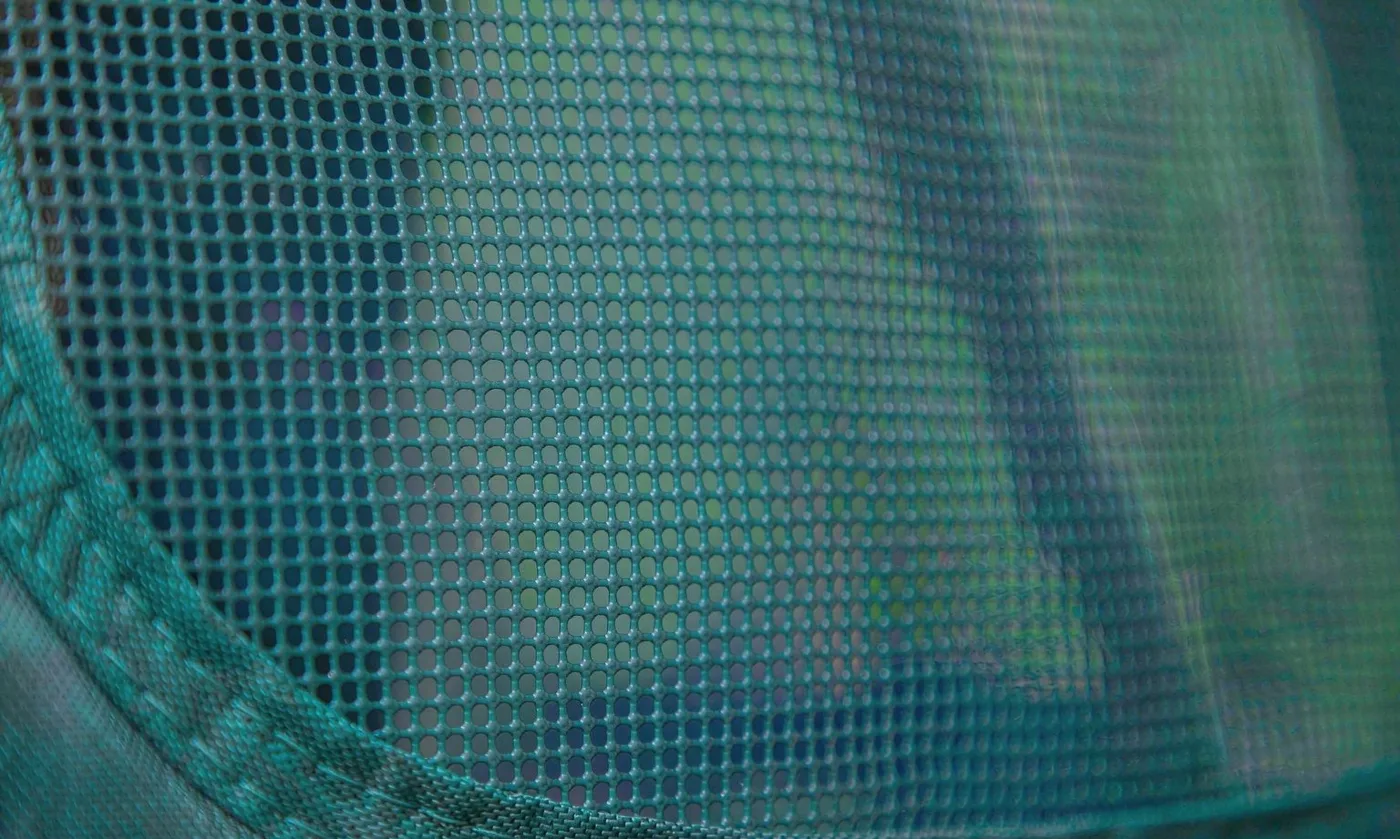
Replacement Panel Construction and Fit
A replacement panel is a cut-and-sewn component with a template, and the template is the deliverable that matters. Everything else about it is standard.
Template. The panel outline is held to ±2 mm against the opening, and the tolerance is asymmetric on purpose: a panel 1 mm small leaves a gap, and a panel 1 mm large bows the perimeter seam. Where the panel is zip-in, the template is taken from the mating chain position rather than from the opening, with the chain centre line marked, because the two are not the same line.
Binding. A 20 mm polyester binding tape, folded and topstitched, is standard; 25 mm on panels that carry perimeter tension. The tape is eased around corners rather than mitred, because a mitre on a mesh panel is a stress concentration and it is where a replacement panel usually fails first. Corners are radiused at 12 mm minimum so the binding has something to turn.
Seam. The panel is set into the shell with a 6 mm seam allowance and a two-pass stitch — one pass attaching the binding, one pass attaching the assembly to the shell. A single pass saves a few cents and is the usual cause of a panel that separates at the perimeter after a season.
Matching. The replacement mesh should be the same construction as the original, not merely the same appearance. Substituting a heavier mesh changes the airflow and the carrier runs hotter; substituting a lighter one reintroduces the failure that caused the request. Where the original construction is no longer available, the substitute must satisfy both minimums — permeability and snag hold — and it should be validated by a physical fit and airflow check rather than approved on paper.
Sourcing Replacement Mesh: MOQ, Colour and Inspection
Replacement panels are ordered as finished components — cut, bound and ready to sew or to zip in — which makes them a sewn goods item rather than a fabric item, and it puts them on the normal accessory economics.
MOQ is 500 pieces per colourway. Because a panel is colour-matched to the shell and is usually offered in the platform black plus one accent, the commitment is met across the two or three sizes in a platform rather than per size. Panels for an older platform revision are the classic case where the 500-piece minimum is hard to justify, and the answer is the same as for other spares: book them into the parent production order while the dyelot and the cutting templates are still live.
Sampling takes 6-10 working days, bulk production 35-50 days after approval. A first article is always fitted to a production shell of the revision it is intended for, and the check is dimensional plus visual: no gap at the perimeter, no bow in the seam, and the panel lying flat with the carrier empty.
Inspection is to AQL 2.5 with mesh-specific definitions: a run in the structure is critical regardless of length, a dimensional deviation beyond 2 mm is critical, a missed binding stitch is major, and a shade deviation within the band is minor. Air permeability is verified on three pieces per lot and snag force on three pieces, with the failure classification recorded — a clean break passes and a run fails even at the same force.
Our production team schedules replacement panel lots into the same window as the parent carrier order so they ship together, inspected to AQL 2.5, on T/T 30/70 and FOB Xiamen terms, from the SGS-verified production base that holds BSCI and ISO 9001 certification.
Production capability
- SGS-verified production space of 4,950 m², 149 machines, 7 assembly lines
- Pet carrier and pet bag output since 2014 from a 137-person team
- 200,000 units shipped monthly under BSCI and ISO 9001 systems
People Also Ask
What mesh is best for a pet carrier?
A warp-knit polyester with monofilament in the weft, at 78-140 g/m² depending on platform size. It gives 34-46% open area, 1,150-1,800 mm/s permeability and 22-38 N of snag hold, which is the balance a door panel needs.
Can a torn carrier mesh be patched?
Yes if the hole is under 8 mm and has not run. A patch extends 15 mm beyond the damage. A patch over a run does not stop it, and a run longer than 10 mm or a snag above 8 mm means replacing the panel.
How much airflow does a carrier need?
Specify a minimum total open area of 0.012 m² for a small carrier and 0.030 m² for a large one, distributed across at least two non-adjacent faces. Two panels that let air cross the box outperform one large panel of the same area.
Why does mesh tear so easily?
Usually because it is multifilament, where a claw pulls individual filaments out and the hole then runs. Monofilament yarn in one direction raises snag hold about 2.5 times at the same mass, and heat-setting converts a run into a clean break.
How long does carrier mesh last in sunlight?
The specification is 70% strength retention after 300 hours of xenon-arc exposure, measured by retesting snag force. The reliable field symptom is loss of recovery: a panel pressed with a finger that stays dimpled is past replacement point.
Is coated mesh better for a carrier?
It resists snag better but passes far less air at 420 mm/s and cracks after repeated laundering. It suits base vents and gusset stiffeners, not door windows, where an uncoated warp-knit performs better.
What is the minimum order for replacement mesh panels?
MOQ 500 pieces per colourway, met across the two or three sizes in a platform. Panels for an older revision are best booked into the parent production order while the dyelot and cutting templates are still live.
Frequently Asked Questions
What does snag force mean?
The peak force recorded when a 0.8 mm radius hook engaged in one hole is drawn through the mesh at 100 mm/min under 2 N pretension. A pet-grade door panel holds 20 N minimum, and the failure must be a clean break rather than a loop run.
How is air permeability measured?
By drawing air through the panel at a defined pressure difference, usually 100 Pa, and recording flow in mm/s under the ISO textile permeability method. It is measurable and comparable, unlike a mesh count.
Should a replacement mesh be heavier than the original?
No. Match the construction. A heavier mesh passes less air and the carrier runs hotter; a lighter one reintroduces the original failure. A substitute must meet both minimums and be validated by a physical fit and airflow check.
How long does sampling take?
6-10 working days. Bulk production is 35-50 days after sample approval, and panels are scheduled into the parent carrier window so they ship together.
What binding tape is used on a mesh panel?
20 mm polyester binding, folded and topstitched, or 25 mm where the panel carries perimeter tension. Corners are radiused at 12 mm minimum and the tape is eased rather than mitred, because a mitre is where a replacement panel fails first.
Why does the binding come away from the panel?
Too little tape width, a stitch line too close to the edge, or tape stretched around a curve. Rebinding with a wider tape is the repair, and it is also the fix when a panel has shrunk and is pulling at its corners.
How much open area should a door panel have?
40-50% is the working range. Below 30% the carrier runs hot; above 60% the structure is too weak to hold in service. Open area is measured from a calibrated image rather than calculated from mesh count.
Does washing damage carrier mesh?
A warp-knit mesh should retain 75% of its snag force after 20 domestic laundering cycles. Coated mesh does worse because the coating cracks at fold lines, which is another reason coated constructions stay off door panels.
Can a zip-in panel be replaced by the customer?
Yes, and that is the argument for specifying zip-in construction at the design stage. A sewn-in panel needs a workshop; a zip-in panel is a swap the end customer can do in under a minute.
What is the fit tolerance on a replacement panel?
Plus or minus 2 mm against the opening, with the tolerance treated as asymmetric because a small panel leaves a gap and a large one bows the seam. On a zip-in panel the template is taken from the mating chain centre line.
How are mesh panel lots inspected?
To AQL 2.5 with mesh-specific definitions: any run in the structure is critical, dimensional deviation beyond 2 mm is critical, a missed binding stitch is major. Permeability and snag force are verified on three pieces per lot.
Why is multi-face ventilation required?
Because a single panel in still air has no path for air to cross the box, so it exchanges very little regardless of how open the mesh is. Air transport rules also require ventilation on multiple sides of a live-animal container.
Talk to QUANZHOU JUNYUAN BAGS about a pet carrier program: MOQ 500 pieces per colourway, samples in 6-10 working days, bulk production in 35-50 days under AQL 2.5 inspection.
Get a free quote Request a sample