Pet Carrier Straps: Replacement Guide
A replacement carrier strap is specified by four numbers: webbing width, thickness, assembly break load and adjuster type. A 25 mm high-tenacity polyester webbing at 1.4 mm reaches 900 N; carriers above 8 kg need 38 mm at 2,100 N. Match width to rated load, not to the look of the strap.
Straps are the most requested replacement item in a carrier programme and the least well specified, because they look simple and are not. This page treats the strap as a load-path assembly and sets out the engineering: how webbing material, weave, width and thickness combine into a break figure, why the assembly almost always fails at the stitch or at the adjuster rather than in the webbing, which adjuster types hold which loads and which ones slip, and what the correct failure order is when a strap is pulled to destruction. It also covers the environmental side — ultraviolet exposure, wet strength loss and abrasion against a metal adjuster — and gives the measurement protocol for specifying a replacement that fits an existing carrier. Commercial terms are the standard programme: MOQ 500 pieces per colourway, prototypes in 6-10 working days, bulk production 35-50 days after sample approval, final random inspection to AQL 2.5, T/T 30/70 and FOB Xiamen.
Private label pet bags and pet carrier accessory lines share one packaging standard here, so a mixed order does not add handling cost or a second carton size.
When a Strap Needs Replacing: Failure Signatures
A strap rarely fails catastrophically. It degrades through recognisable stages, and the stage at which it is caught determines whether the replacement is a strap or a whole carrier.
The earliest signature is adjuster slip: the strap lengthens under load during use and the handler re-tightens it. Slip is a hardware problem, not a webbing problem, and it is caused by a tooth profile that has rounded, by a webbing that is too thin for the adjuster bar, or by a strap that is loaded at an angle the adjuster was never designed for. A strap that slips more than 20 mm in a ten-minute walk is at end of life.
The second signature is edge fraying where the webbing runs through hardware. Fraying confined to the outer 2 mm is cosmetic; fraying that has reached the load-bearing core yarns reduces the effective width and with it the break load. The field test is a visual one — if the woven edge line has disappeared, the strap should be replaced.
The third is stitch distortion. A bar tack that has begun to lift, or a stitch line where the thread has gone slack and the webbing tail has started to rotate inside the box, is a strap that will pull out at a fraction of its rated load. This is the dangerous one because the webbing itself still looks new.
The fourth is UV chalking, visible as a powdery surface and a colour that has gone two shades lighter on the outward face. Chalking means the polymer has begun to degrade and tensile strength is already down, typically 25-40% at the point where it becomes visible.
Handling guidance matters here too: the load a strap has to carry is set by the animal, and the American Veterinary Medical Association publishes the transport and weight-handling guidance that most programmes reference when they set a size band in the first place. A strap rated for an 8 kg class should never be refitted to a 14 kg animal on the grounds that it looks the same.
Webbing Construction: Material, Weave, Width and Thickness
Webbing is a woven narrow fabric, and its mechanical behaviour comes from four variables: the polymer, the weave, the width and the thickness. All four appear on a proper specification and none of them can be inferred from a photograph.
Polymer. High-tenacity polyester is the default for carrier straps. It absorbs under 0.5% water by mass, so a wet strap keeps its strength and its length; it has good ultraviolet resistance relative to polyamide; and it takes a disperse dye well, which matters because strap colour is usually matched to a shell fabric. Polyamide 6 is chosen where abrasion dominates — a strap that cycles through a metal adjuster thousands of times wears less in PA6 — but it absorbs roughly 4% water, which costs 6-9% of its dry break strength when saturated and lengthens it enough to matter on a long strap.
Weave. Plain weave gives the flattest, thinnest webbing and the best hardware feed. A 2/2 twill gives better abrasion resistance and a softer hand at the same width. Herringbone is used mainly for appearance. For a load-bearing strap the weave choice is usually plain or twill, and the deciding factor is whether the strap has to slide through an adjuster under load: twill wears better, plain feeds better.
Width and thickness. These set the break load together. Width is offered at 20, 25, 38 and 50 mm; thickness ranges 1.0-1.8 mm. A thicker webbing of the same width is stronger but feeds worse through hardware and sits harder on the shoulder, so the usual approach is to reach the required load with width first and thickness second.
The test method matters because the figure is meaningless without it. Webbing breaking strength and elongation are measured by the strip method set out in ASTM D6775, and a supplier quoting "900 N" without naming the method is quoting a number that cannot be compared with anything.
| Width | Thickness | Weave | Break load | Elongation at break | Wet strength retention | Typical use |
|---|---|---|---|---|---|---|
| 20 mm | 1.0 mm | Plain | 600 N | 12% | 98% | Chest link, small pet carrier |
| 25 mm | 1.2 mm | Plain | 780 N | 13% | 98% | Cat carrier strap |
| 25 mm | 1.4 mm | Twill | 900 N | 11% | 98% | Standard dog carrier strap |
| 38 mm | 1.5 mm | Twill | 1,900 N | 12% | 97% | Backpack shoulder strap |
| 38 mm | 1.6 mm | Plain | 2,100 N | 10% | 97% | Large dog backpack |
| 50 mm | 1.8 mm | Twill | 2,600 N | 11% | 97% | Waist belt, heavy platform |
Note the elongation column. A strap at 10% elongation at break feels rigid and transmits shock; one at 16% feels springy and lets the carrier swing. Between 10% and 14% is where a carried load stays stable, and it is a specification line worth writing down.
Load Rating: Matching Strap to Carrier Class
The rated load of a strap assembly is not the webbing break load. It is the lowest figure in the chain: webbing, stitch, hardware, and the shell anchorage the strap is sewn to. A strap assembly is rated at whichever of those is weakest, and a competent specification states all four so that the weak link is a deliberate choice rather than an accident.
The design factor used for carrier straps is 5:1 against the working load. A carrier classed at 8 kg imposes a static working load of roughly 78 N, so the strap assembly must break above 390 N; with dynamic effects from walking, a realistic peak is 2.5-3× static, which puts the real requirement near 1,000 N and is why 25 mm webbing with a 900 N figure is paired with a 38 mm assembly on a dynamic platform. The design factor is not padding for its own sake — it is what absorbs a stumble, a stair and an animal that shifts suddenly.
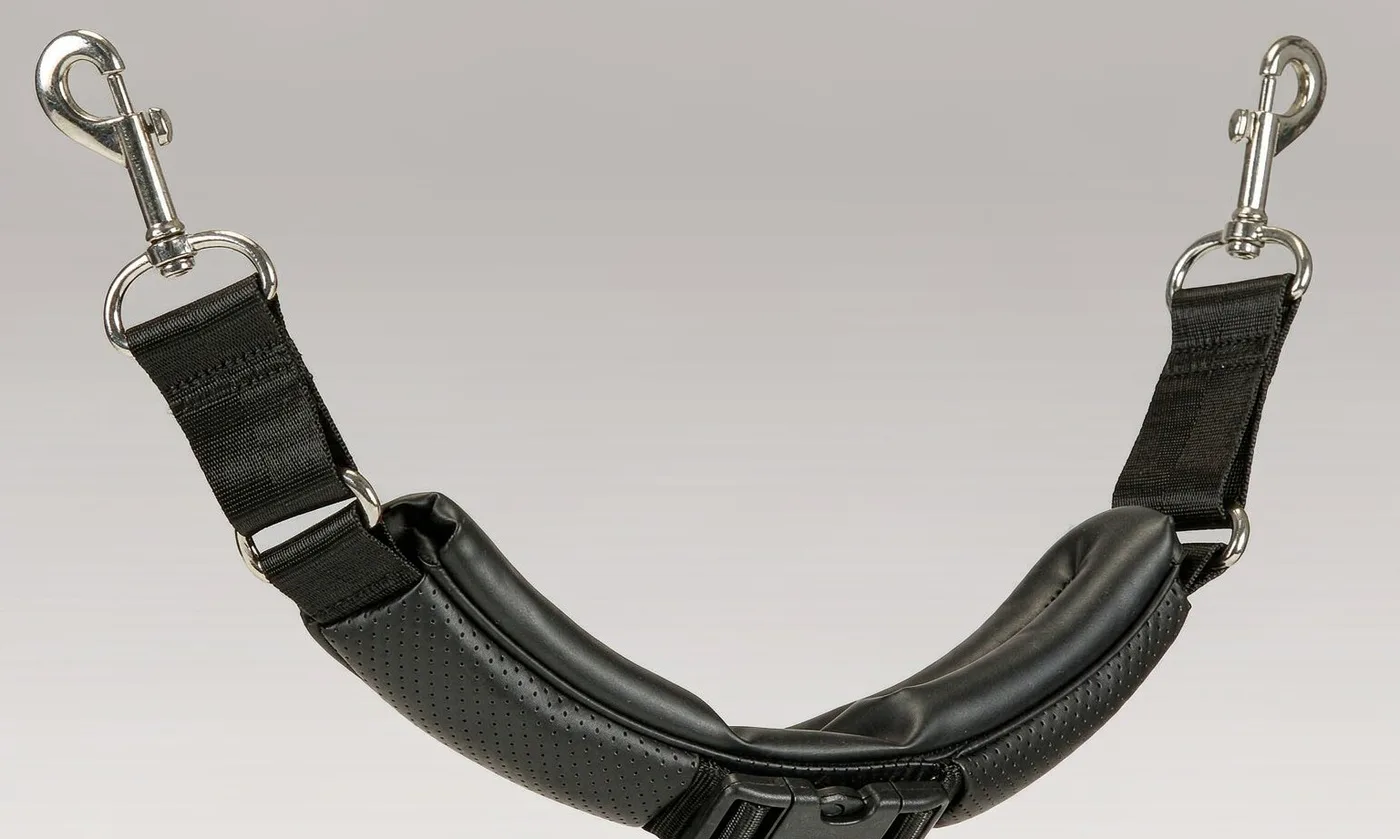
Carrier classes are usefully split by mass. Up to 5 kg, a 20 mm webbing assembly is adequate and is lighter and less bulky. From 5 to 8 kg, 25 mm. From 8 to 15 kg, 38 mm with a padded section, because at that mass the pressure on the handler shoulder becomes the limiting factor rather than the strap strength. Above 15 kg, 50 mm or a yoke arrangement that distributes across both shoulders.
Dynamic loading deserves its own line in the specification. Walking produces a repeated peak of roughly 2.5 to 3 times the static load, and the strap sees that peak a few thousand times per outing. A webbing that is rated by a single static pull therefore tells only half the story: what limits life in the field is the cyclic peak against the design factor, which is why a strap that passes a static test can still pull out after one season.
The shell anchorage is the figure most often overlooked. A 2,100 N webbing sewn to a 420-denier shell panel with a single-pass stitch will tear out of the shell at around 400 N regardless of the webbing. The correct order of failure in a pull test is: shell tears last, webbing breaks first or at worst simultaneously with the stitch. Achieving that means reinforcing the anchorage with a patch of the same denier or heavier, and spreading the load over a wider footprint.
Hardware on the Strap: Adjusters, Keepers and End Fittings
Hardware is where straps actually fail in the field, and it is specified by three things: the bar geometry that grips the webbing, the alloy, and the load path through the part.
Ladderlock (triglide) is the commonest adjuster. It grips by friction and by a tooth bar bearing on the webbing, and its holding force depends on the angle at which the webbing leaves it. In line, a good ladderlock holds 350-500 N before slip; loaded at 30° off axis the same part may hold only 180 N. Straps that run diagonally need a cam buckle instead.
Cam buckle grips with a pivoting toothed cam and holds 600-900 N, but it needs a webbing thickness matched to its cam radius. A 1.0 mm webbing in a cam cut for 1.6 mm will slip progressively and no amount of tightening will fix it. Cam buckles are the right choice for load-bearing adjustment and the wrong choice where the strap must be adjusted one-handed while worn.
Side-release buckle is a connector, not an adjuster. Its rating is the pull-apart figure, typically 250-450 N in acetal at 25 mm. It is the part most often under-specified on a heavy platform, and the standard remedy is to move up a size rather than a material.
Alloy and finish. Acetal (POM) is standard for buckles: dimensionally stable, low friction, good fatigue life, and it does not corrode. Zinc alloy die-cast appears on decorative fittings and is fine where the load is low. Aluminium is used only where a part must be both strong and light. All metal parts are specified nickel-free and checked for 24 hours of neutral salt spray.
Keepers and end fittings. A webbing tail needs a keeper to stop it flapping, and the tail end needs heat-cutting or a folded-and-stitched finish to stop it unravelling. Heat-cut polyester forms a hard bead that is comfortable and will not fray; a cut nylon tail needs a hot knife and a sealant or it will bloom. This is a small detail and it is the difference between a strap that looks finished after a year and one that does not.
Stitch Engineering at the Load Path
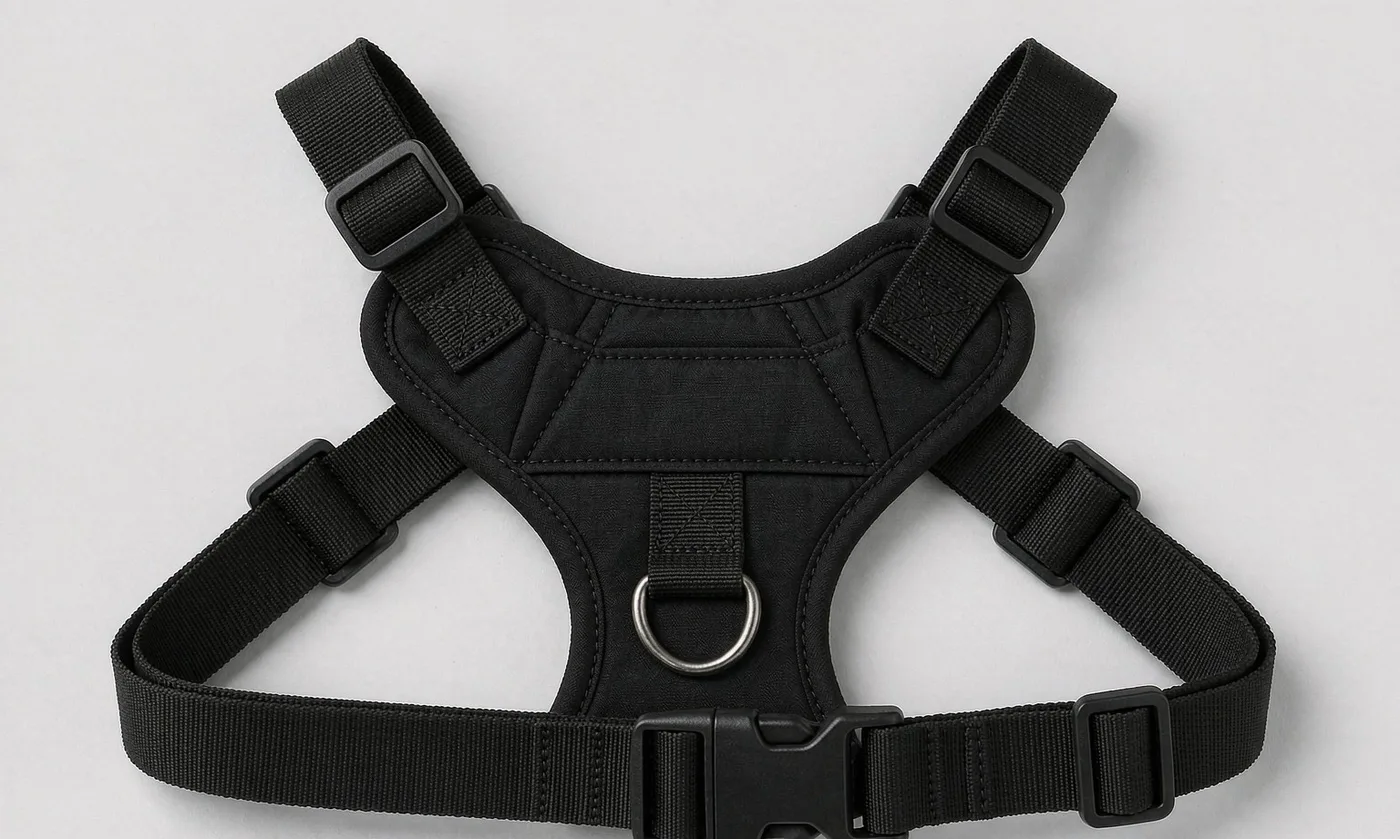
If a strap fails in service, it fails at the stitch far more often than in the webbing. That is not a defect, it is a predictable consequence of how a sewn joint works: the needle punches through the load-bearing yarns, and the thread concentrates the entire load into a line.
Thread. Bonded polyester or bonded nylon at Tex 70 is the standard for a 25 mm strap; Tex 135 for 38 mm and above. Bonding matters because an unbonded thread loses 15-25% of its strength at the needle holes through abrasion during sewing, and it loosens under cyclic load. Polyester thread is preferred on a polyester webbing because the two have matched elongation — a nylon thread on a polyester webbing stretches differently and the stitch line works loose.
Pattern. The box bar tack is the workhorse. A 42-stitch box on a 25 mm webbing, sewn with the webbing tail folded back over the body so the load is carried on two layers, holds past the 900 N break of the webbing itself. A single-pass straight stitch on the same webbing pulls out at roughly 300 N. The difference is not thread strength, it is the number of load paths and the angle at which they cross the webbing.
Stitch density. 7-9 stitches per inch is the range. Below 7 the joint is loose and the webbing can rotate inside the box; above 9 the needle perforations begin to weaken the webbing faster than the added stitches strengthen the joint. On a strap that will be loaded cyclically, the lower end of the range with a bonded thread performs better than the upper end.
Verification. Every strap specification should end with a pull-to-destruction on the finished assembly, recording where it broke. The correct result is webbing failure. Stitch failure below the webbing figure is a specification error, and it is caught in sampling rather than in the field only if the test is run on the assembly rather than on the webbing reel.
Environmental Durability: Ultraviolet, Water and Abrasion
A strap spends its life outdoors, in the sun, occasionally wet, rubbing against hardware. Three degradation mechanisms follow, and they are tested separately because they do not correlate.
Ultraviolet. Polyester is intrinsically better than polyamide here, but neither is immune. Accelerated exposure in a xenon-arc cabinet is the standard method, with the endpoint set at a retained tensile strength rather than at a colour change: the specification used is 80% strength retention after 200 hours of xenon exposure. In service terms that corresponds to roughly two to three years of regular outdoor use in a temperate climate, and about one year in a high-UV market. Chalking on the surface is the visible warning that retention has dropped below roughly 65%.
Water and hydrolysis. Polyester loses little strength when wet but it is not immune to hydrolysis at elevated temperature and humidity, which is a storage and shipping issue more than a use issue — containers that sit at 40 °C and 90% relative humidity for a transit season do measurable damage to webbing and to the coating on it. Polyamide loses 6-9% wet, as noted, and additionally swells, which is why an adjuster set on dry PA6 webbing may slip when the same webbing is wet.
Abrasion. The strap-to-hardware contact is the wear point. Abrasion is measured on a rotary platform abrader with a defined wheel and load, and the endpoint is no exposed core yarn at a stated cycle count: 3,000 cycles for a 25 mm strap is a reasonable specification. A twill weave outlasts a plain weave by roughly 40% at the same construction. Where the strap runs over a metal bar continuously, a webbing with a slightly raised selvedge protects the core yarns and doubles the cycle count.
Colour fastness is a commercial rather than a mechanical property and it is tested separately: rubbing fastness to AATCC 8 with a 4-5 target for a dark strap, and light fastness to AATCC 16 with a 4 minimum. A strap that bleeds onto a light shell fabric is a return even though it is mechanically perfect, and OEKO-TEX certification under OEKO-TEX is the efficient way to cover the chemical side of the same risk.
Specifying a Replacement: The Measurement Protocol
A replacement strap is usually specified from a sample rather than from a drawing, and the measurement protocol decides whether the first article fits. Six measurements are taken, in this order.
Webbing width, measured flat and unmoved, to 0.5 mm. A worn strap measures narrow, so the measurement is taken at a point that has not run through hardware — near the sewn end rather than near the adjuster.
Webbing thickness, with a gauge at 1 kPa, to 0.05 mm. This is the figure that governs hardware compatibility and it is the one most often guessed.
Functional length, from the load point to the load point with the adjuster set mid-travel, not the overall cut length. Overall length is meaningless because the tail length is a finishing choice.
Hardware type and bar diameter, recorded as a dimension rather than as a name, because two parts described as a 25 mm ladderlock can differ by 1.5 mm in bar diameter and behave completely differently.
Stitch pattern, recorded as a photograph with a scale, plus the box dimensions in millimetres.
End fitting, whether the strap terminates in a gate keeper, a sewn loop, a bolt-on plate or a D-ring. This is the item that decides whether a replacement needs tools.
With those six, a replacement can be quoted and sampled without the original drawing. Without them, the sample is a guess, and the usual outcome is a strap that fits the hardware and is 60 mm too short at full extension.
Production, MOQ and Inspection for Replacement Straps
Replacement straps are produced on a dedicated strap line: webbing cut to length on a hot knife, hardware threaded, ends folded and bar-tacked, then packed. It is a short process with a high setup share, which is what drives the economics.
MOQ is 500 pieces per colourway. Because a strap is a single-colour item in most programmes, that commitment is usually met by one colourway across two or three sizes rather than by three separate colourways, and it is worth designing the replacement range that way deliberately — a 25 mm and a 38 mm strap in the same black is one commitment, not two.
Lead times follow the standard programme: prototypes in 6-10 working days, bulk production 35-50 days after sample approval. Where a strap uses a non-standard hardware part, the sampling window usually stretches to the upper end because the hardware has to be sourced before the strap can be assembled.
Inspection is to AQL 2.5 for major defects. The defect definitions for a strap are specific: wrong width or thickness is critical, because it will not fit; a missed bar tack is critical, because it will pull out; a mis-set adjuster is major; a cosmetic thread tail under 5 mm is minor. Dimensional sampling is done on five pieces per lot with a gauge rather than a tape, and pull testing is done on three pieces per lot to destruction with the break location recorded.
Packing is per-pair where the strap is handed, with the handedness marked on the bag — a left and a right shoulder strap in one bag marked "pair" prevents the single commonest pick error. Our production team runs replacement strap lots through the same SGS-verified production base that holds BSCI and ISO 9001 certification, on the same T/T 30/70 and FOB Xiamen terms as the parent carrier order.
Order and quality terms
- MOQ 500 pieces per colourway; samples in 6-10 working days
- Bulk production 35-50 days after approval; AQL 2.5 inspection standard
- T/T 30/70 terms, FOB Xiamen, full document set per shipment
People Also Ask
How strong should a pet carrier strap be?
Rate the assembly at five times the working load. An 8 kg class needs roughly 390 N static and near 1,000 N with walking dynamics, so a 25 mm webbing at 900 N is the minimum and a 38 mm assembly is the correct choice for a dynamic platform.
What width webbing do I need?
20 mm up to 5 kg, 25 mm from 5 to 8 kg, 38 mm from 8 to 15 kg, 50 mm or a yoke above 15 kg. Width is chosen from the rated mass, and thickness is used only to fine-tune because a thicker webbing feeds poorly through hardware.
Why does my strap keep slipping?
Usually an adjuster mismatch rather than worn webbing. A cam buckle cut for 1.6 mm webbing will slip on 1.0 mm webbing no matter how hard it is tightened, and a ladderlock loaded more than 30 degrees off axis loses half its holding force.
Can I replace just the strap and keep the hardware?
Yes, if the hardware is undamaged and the webbing thickness matches. Reusing a ladderlock whose tooth profile has rounded is false economy, because the new strap will slip in it exactly as the old one did.
How long does a polyester webbing strap last outdoors?
The specification used is 80% strength retention after 200 hours of xenon-arc exposure, roughly two to three years of regular outdoor use in a temperate climate and about one year in a high-UV market. Visible chalking means retention is already below about 65%.
What thread should be used on a carrier strap?
Bonded polyester at Tex 70 for 25 mm webbing and Tex 135 for 38 mm and above. Bonding prevents the 15-25% strength loss that unbonded thread suffers at the needle holes, and polyester matches the elongation of a polyester webbing.
Frequently Asked Questions
What is the minimum order for replacement straps?
MOQ 500 pieces per colourway. Specifying a 25 mm and a 38 mm replacement strap in the same black meets the commitment once across both sizes, which is the standard way to open a replacement strap range.
How long does strap sampling take?
6-10 working days for a strap using standard hardware. Where a specific cam buckle or side-release has to be sourced, the window usually runs to the upper end because hardware arrives before assembly can start.
What is the bulk lead time?
35-50 days after sample approval. Padded straps sit at the upper end because the foam and the sleeve add a second process stage after the webbing assembly is complete.
Which is better, polyester or nylon webbing?
Polyester for most carrier straps: it absorbs under 0.5% water, keeps its strength wet and resists UV better. Nylon is chosen only where abrasion dominates, and it costs 6-9% of its dry strength when saturated.
How is webbing strength measured?
By the strip method in ASTM D6775, which reports breaking strength and elongation. A figure quoted without the method named cannot be compared between suppliers, so the method should appear on the specification.
What is the correct failure point in a strap pull test?
The webbing should break, or at worst the webbing and the stitch together. Stitch failure below the webbing figure is a specification error, and shell tear-out means the anchorage needs a reinforcement patch.
How many stitches should a bar tack have?
A 42-stitch box on 25 mm webbing with the tail folded back, which holds past the 900 N webbing break. A single-pass straight stitch on the same webbing pulls out near 300 N.
What stitch density is used?
7-9 stitches per inch. Below 7 the joint is loose and the webbing can rotate in the box; above 9 the needle perforations weaken the webbing faster than the added stitches help.
Do replacement straps need UV testing?
Yes. The endpoint is a strength retention figure rather than a colour change: 80% retention after 200 hours of xenon-arc exposure. Colour change alone does not predict whether the strap is still safe.
How are handed straps packed?
As a marked pair in one bag. Handedness on shoulder straps is the single commonest pick error in a spare parts warehouse, and marking the bag as a pair removes it.
Can a heavier animal use a wider strap on the same carrier?
No, not safely. The strap is only one link; the shell anchorage is usually the limit. A 2,100 N webbing sewn to a light shell panel tears out at about 400 N regardless of the webbing.
What inspection standard applies to strap lots?
AQL 2.5 for major defects, with wrong width or thickness and a missed bar tack classified as critical. Dimensional checks run on five pieces per lot with a gauge, and pull-to-destruction on three pieces with the break location recorded.
Talk to QUANZHOU JUNYUAN BAGS about a pet carrier program: MOQ 500 pieces per colourway, samples in 6-10 working days, bulk production in 35-50 days under AQL 2.5 inspection.
Get a free quote Request a sample