Pet Carrier Towel: Drying After Walks
A drying towel is specified by how fast it takes water off a coat and how long it takes to give that water back: a mass of 300-700 grams per square metre, a loop pile of 2.5-6 millimetres, an absorption of 300-700% of its own dry mass, a wicking time under 10 seconds, and a pile abrasion life of 8,000-25,000 cycles.
A towel is the one product in this range whose performance is entirely measurable and entirely about water, and it is also the one where the two numbers that matter are routinely confused with each other. Capacity is how much a towel holds; rate is how fast it takes it, and a towel that holds a great deal and takes it slowly is useless on a wet coat. This page works through the category in manufacturing order: how loop height and pile density produce absorbency and what they cost in yarn, why capacity and rate are separate specifications with separate tests, how a microfibre split-filament construction compares with a cotton terry on both, and what happens to the pile under abrasion and in laundering. It then covers drying time and the odour question, the ground construction that holds the loops in, the hem that survives a wash, and the programme economics of the size and mass ladder. Commercial terms are standard: MOQ 500 pieces per colourway, prototypes in 6-10 working days, bulk production 35-50 days after sample approval, final random inspection to AQL 2.5, T/T 30/70 and FOB Xiamen.
A pet bag supplier running pet carrier accessory orders at 500 pieces per colourway can consolidate several sizes into one cutting window and hold the dye lot across reorders.
Loop Height, Pile Density and Where Absorbency Comes From
A terry towel absorbs in two places: into the fibre itself and into the capillary spaces between the loops. The second is where most of the capacity sits and it is entirely a construction variable.
Loop height is 2.5-6 millimetres in this product. A short loop at 2.5-3.5 millimetres gives a dense, firm surface that dries fast and holds 250-450% of its mass; a long loop at 4.5-6 millimetres gives a softer, slower surface that holds 450-700% and takes 40-90% longer to dry. The height is set by the terry motion on the loom or on the knitting machine and it is a machine setting rather than a material cost.
Pile density is the second variable and it does cost money. A terry at 1,200-2,000 loops per square decimetre uses 18-32% more pile yarn than one at 700-1,200, and it holds 25-55% more water. Density is where a towel programme chooses its position: a low-density towel is a cheap towel that feels thin when wet.
Pile yarn count is the third. A cotton terry uses a pile yarn of 16-32 English cotton count, or 18-37 tex, and a coarser yarn gives a fuller loop and a slower wicking rate. A 21 count pile wicks in 4-10 seconds; a 32 count wicks in 8-20. The finer yarn is more expensive and it is better on rate, which is the specification for a drying towel rather than a bath towel.
Ground construction holds the loops and it is specified separately. A terry is woven or knitted on a ground of 2-4 times the pile yarn count, at 26-42 ends per centimetre for a woven ground, and the ground is what determines whether a loop pulls out. A ground at 26 ends gives a pull-out force of 4-12 newtons per loop; one at 38-42 gives 9-22.
Twist direction in the pile yarn is the detail that separates a working towel from a decorative one. A low-twist pile at 400-600 turns per metre has more surface area and absorbs faster, at 2-6 seconds of wicking, and it sheds more. A high-twist pile at 750-1,050 wicks at 8-18 seconds and sheds 50-75% less. A drying towel is specified at the low-twist end and the shedding is controlled elsewhere.
Mass is the summary variable that buyers use and it is a poor proxy. Two towels at 500 grams per square metre can differ by 60% in capacity and by a factor of 3 in wicking rate, depending on how the mass is distributed between the ground and the pile. The specification has to name the loop height, the pile density and the ground construction rather than the mass alone.
Absorbency is a construction output of loop height at 2.5-6 millimetres, pile density at 1,200-2,000 loops per square decimetre and a low-twist pile yarn, and it is specified by those three rather than by mass.
Capacity and Rate: Two Numbers, Two Tests
The most common specification failure in this category is stating a capacity figure and believing it describes performance. It does not, and the two numbers behave in opposite directions as a towel is engineered.
Capacity is measured by immersing a conditioned specimen, allowing it to drain for a stated time and weighing it. The result is a percentage of dry mass. A cotton terry at 500 grams per square metre holds 400-600%; a microfibre at 350 holds 300-500% but it holds it in a form that releases more readily; a waffle weave at 300 holds 200-350%.
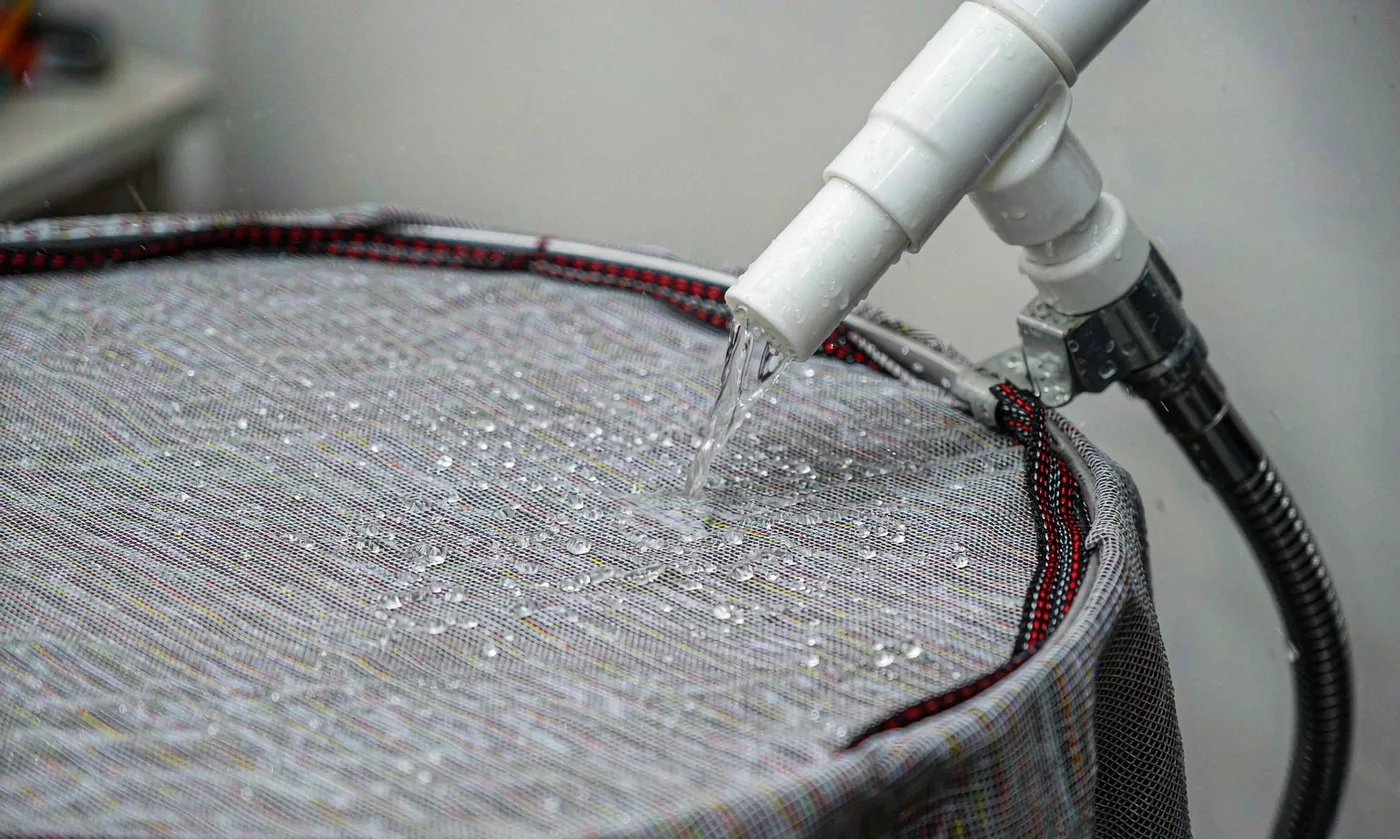
Rate is measured by a wicking test, by a water-absorption time or by a contact-angle measurement, and it is reported in seconds. A towel is useless on a wet coat if the water does not move in the first 3-10 seconds of contact, because the contact is brief and the coat is not saturated.
The two diverge because they depend on different physics. Capacity depends on void volume, which is loop height and pile density. Rate depends on capillary radius and surface energy, which is filament fineness and any finish on the fibre. A towel can be engineered for either and it is rarely excellent at both.
Microfibre is the rate champion. A split polyester-polyamide filament at 0.1-0.3 denier per filament gives a capillary radius an order of magnitude smaller than a cotton fibre at 1.5-2.5 denier, and it wicks in 1-5 seconds against 4-15 for cotton. Its capacity is lower at 300-500% against 400-650% for a heavy cotton terry.
Cotton is the capacity champion and it holds water inside the fibre as well as between the loops, at 8-12% of its own mass in the fibre lumen. That is why cotton feels damp longer and why it takes 2-4 times as long to dry.
The finish on the fibre is the invisible variable that ruins rate. A residual spinning oil or a softener at 0.2-1.5% on weight raises the contact angle and takes a wicking time from 2 seconds to 30-120. A microfibre towel has to be scoured to a residual extractable of under 0.5% before it wicks at all, and that scouring step is the one most often skipped.
Specify capacity as a percentage of dry mass and rate as a wicking time in seconds, and scour a microfibre to a residual extractable under 0.5%, because a finish at 0.2-1.5% takes the wicking time from 2 seconds to 30-120.
Microfibre Versus Cotton Terry on the Numbers That Matter
The two material families are not substitutes and the range decision between them is made on drying time, on laundering life and on price rather than on absorbency alone.
Cotton terry at 400-700 grams per square metre is the traditional construction. It costs 3.20-8.40 USD per kilogram for the yarn, it holds 400-650% of its mass, it wicks in 4-15 seconds, and it survives 100-300 washing cycles before the pile mats. Its weaknesses are drying time at 3-9 hours in still air and weight, at 1.8-4.2 times a microfibre of the same capacity.
Microfibre at 200-500 grams per square metre is a split polyester-polyamide construction, typically 80/20 or 70/30, at 0.1-0.3 denier per filament. It costs 4.60-11.80 USD per kilogram, it holds 300-500%, it wicks in 1-5 seconds, and it survives 200-500 cycles. Its weaknesses are heat sensitivity above 60 degrees, where the filament contracts and the capillary structure collapses, and lint attraction.
Splitting is the manufacturing step that makes microfibre work and it is the one that is easy to get wrong. The bicomponent filament is split by a hydroentanglement or by an alkaline treatment after weaving or knitting, and the target is 80-95% split. A towel at 60% split wicks at 15-40 seconds instead of 1-5, and the difference is invisible on the finished cloth.
Heat sensitivity is the specification that gets microfibre returned. A polyester component softens above 120 degrees and a polyamide component above 180, and a tumble dryer at 70-90 degrees is safe but an iron is not. A microfibre towel dried above 90 degrees loses 20-50% of its wicking rate permanently within 10-30 cycles.
Sand and grit are the field enemy of both. A cotton terry releases grit in the wash; a microfibre holds it in the split capillaries and the grit abrades the filament from inside, reducing the wicking rate by 30-70% over 20-60 cycles. The mitigation is a rinse specification on the care label rather than a material change.
Certification applies to both and it is a textile rather than a performance question. The certificate that closes a dyed and finished textile for the European and most retailer-driven markets is issued under the OEKO-TEX system, and it is held per fabric lot with the dye house and the finishing house named.
Microfibre wicks in 1-5 seconds against 4-15 for cotton and dries in 40-70% less time, but it must be split to 80-95%, scoured to under 0.5% extractables, and kept below 90 degrees in drying or it loses 20-50% of its rate permanently.
Pile Abrasion, Shedding and Loop Pull-Out
The pile is the part of a towel that wears out, and it wears in three distinct ways that need three distinct tests. This is the section that decides whether a towel still works after six months.
Abrasion is the first. A terry or a microfibre surface is abraded on a Martindale head at 9-12 kilopascals and the endpoint is a stated loss of mass or a visual change. A cotton terry at 500 grams per square metre survives 8,000-20,000 cycles before the pile mats visibly; a microfibre at 350 survives 15,000-40,000. The reference procedure for the abrasion endpoint sits within the ASTM textile test system.
Matting is the actual failure and it is not the same as abrasion. A pile that lies down loses 30-65% of its void volume and therefore its capacity, while losing almost no mass. A towel can pass an abrasion test and be functionally dead, which is why the specification includes a capacity measurement after abrasion rather than a mass-loss figure alone.
Shedding is the second mechanism and it is what produces the lint complaint. A low-twist pile at 400-600 turns per metre sheds 1.5-6% of its pile mass in the first five washes; a high-twist pile at 750-1,050 sheds 0.3-1.5%. The test is a wash-and-collect procedure measuring the mass of fibre recovered from the filter, and the acceptance is under 2% per cycle after the third wash.
Loop pull-out is the third and it is the mechanism that ruins a towel on a claw. A loop caught by a claw is pulled, and if it pulls out it leaves a run that unravels across the width. The pull-out force is 4-12 newtons per loop on a ground of 26 ends per centimetre and 9-22 on a ground of 38-42, and the specification is a minimum of 9.
The ground yarn is what sets the pull-out figure and it is the cheapest upgrade available. Moving from a 26-end ground to a 38-end ground costs 6-14% more in ground yarn, which is 1.5-4% of the total fabric cost, and it roughly doubles the pull-out force. No towel programme should be run at the low end.
Snag resistance on a microfibre is a different mechanism because there are no loops. A split filament surface snags by catching a filament bundle rather than a loop, and the resistance is set by the knit density at 24-40 courses per 25 millimetres. A loose microfibre knit at 18-24 courses snags at 1-4 newtons and a tight one at 4-12.
Specify capacity retention after abrasion rather than mass loss alone, shedding under 2% per cycle after the third wash, and a loop pull-out force of at least 9 newtons from a ground of 38-42 ends per centimetre.
Drying Time, Odour Retention and Antimicrobial Finish
A towel that stays damp develops an odour within 12-48 hours, and that odour is the complaint that ends a product's life. It is an engineering problem with three contributing variables.
Drying time is the first and it is the one to specify. A cotton terry at 500 grams per square metre holding 500% of its mass takes 3-9 hours to dry in still air at 20 degrees and 60% relative humidity; a microfibre at 350 holding 400% takes 1-4. The difference is that cotton holds water inside the fibre at 8-12% of its mass and microfibre holds almost none, at 0.4-1%.
Air movement is the second variable and it is a use condition rather than a product property. The same towel dries in 40-70% of the time in a moving-air position against a folded one, which means the care instruction to hang the towel is as much a part of the specification as the fabric.
Odour is a bacterial growth phenomenon and it is measured rather than asserted. A damp towel at 20-30 degrees carries a bacterial count that rises by 2-4 logs in 24-48 hours, and the odour compounds are produced above roughly 10 to the power of 5 colony-forming units per square centimetre. A towel that dries in under 4 hours stays below that threshold; one that takes 9 does not.
An antimicrobial finish is the intervention and it buys a measurable amount. A silver-ion or a quaternary ammonium finish applied at 5-20 grams per litre reduces the bacterial count by 1-3 logs at 24 hours, at 0.14-0.62 USD per unit, and it survives 10-30 washes before it is exhausted. It is a supplement to fast drying, not a substitute for it.
The finish carries a documentation obligation that is often missed. A biocidal claim on a textile is a regulated claim in the European market and a registered one in the United States, and the substance has to be on the approved list for the product type. The article-level registration is administered by the European Chemicals Agency for the biocidal products framework.
Colour choice interacts with odour perception rather than with odour itself. A mid-tone towel shows a damp patch less than a pale one and it is returned less, which is a commercial specification note rather than a technical one but it belongs in the same decision.
A towel that dries in under 4 hours stays below the odour threshold; a cotton terry at 500 grams per square metre takes 3-9 and needs either a move to microfibre or an antimicrobial finish at 0.14-0.62 USD carrying a registered claim.
Ground Construction, Binding and Dimensional Stability
The ground is the structural element of a towel and it is specified in the same way as any woven or knitted base cloth, because it is what holds the pile in and what keeps the towel square.
A woven terry ground is a plain or a twill weave at 26-42 ends per centimetre and 20-34 picks, in a yarn of 2-4 times the pile count. Its tensile strength is 300-700 newtons on a 50 millimetre strip in the warp and 200-500 in the weft, and its tear strength is 12-35 newtons. Tear strength is the figure that predicts whether a caught loop becomes a run.
A knitted terry ground is a single-jersey or a two-bar construction at 24-40 courses per 25 millimetres, and it stretches 15-40% where a woven stretches 2-8%. The stretch is an advantage on a towel that has to wrap around a leg or a body, and it is a disadvantage on dimensional stability, where a knit moves 3-8% against 1-4% for a woven.
Shrinkage on a terry is dominated by the pile rather than by the ground, because the pile relaxes and the loops tighten. A cotton terry dried without tension shrinks 6-14% on the first wash; the same towel dried on a stenter at 130-160 degrees with a controlled overfeed shrinks 2-5%.
Skew is more visible on a towel than on most textiles because the loop rows are a visible stripe. A woven terry has a skew of 1-4 degrees from the weaving and it is corrected on the stenter to under 1.5; above 2.5 degrees the towel does not fold square and the defect shows on a shelf.
Binding and hem follow the blanket specification with one difference: a towel edge is wet for most of its working life and it is the first place to fail. A turned hem at 10-25 millimetres with a polyester thread at Tex 30-50 survives 150-400 cycles; a cotton-wrapped thread fails at 40-150. A binding tape has to be shrinkage-matched to within 1% of the body or the edge puckers after 3-10 washes.
Hanging loop is a small component with a disproportionate claim rate. A loop of 60-120 millimetres in a self-fabric or a webbing at 10-20 millimetres, bar-tacked at 18-28 stitches, is tested to 80-200 newtons of pull. A loop tacked with a plain lockstitch pulls out at 30-90 newtons and it is the single most common defect reported on a drying towel.
A woven ground with a tear strength of 12-35 newtons and a skew corrected to under 1.5 degrees, dried on a stenter at 130-160 degrees to hold shrinkage at 2-5%, with a hanging loop bar-tacked and tested to 80-200 newtons, is the towel construction that lasts.
Laundering Durability and the Care Specification
A towel is washed more often than any other product in the range and the care specification is a design input rather than a label. Three exposures do the damage and each has a numeric limit.
Temperature is the first. Cotton tolerates 60-95 degrees and it is sterilised at the top of that range; a polyester-polyamide microfibre tolerates 40-60 and it loses 20-50% of its wicking rate above 90. Where a product is sold as a towel for an animal, the customer will wash hot, and the material has to be chosen for that rather than the other way round.
Detergent is the second and it is the mechanism behind most gradual performance loss. A cationic softener deposits on the fibre at 0.2-1.5% on weight and it raises the contact angle, taking a wicking time from 2 seconds to 30-120. The care instruction to avoid fabric softener is the single most effective performance instruction on the label and it has to be there.
Bleach is the third. A chlorine bleach at 100-300 parts per million degrades a cotton fibre by 8-25% in tensile strength over 20 cycles and it yellows a polyamide; an oxygen bleach is safe on both at the same concentration. A white towel programme is specified with an oxygen bleach instruction rather than a chlorine one.
Wash testing is the qualification and it is heavier than for a blanket because the endpoint is functional. A towel is washed 10-30 times at the specified temperature and measured for wicking time, for capacity, for dimensional change within plus or minus 5%, and for shedding under 2% per cycle. A towel whose wicking time doubles over 10 cycles has failed regardless of its appearance.
Pilling and matting after laundering are measured on the same specimen. A cotton terry mats to grade 2-3 after 20 cycles and a microfibre to grade 3-4, and the specification is a minimum of grade 3 after 20. Matting is partly a function of drying: a tumble-dried towel mats 40-70% less than a line-dried one.
Labelling closes it. The fibre content has to match a laboratory result on the actual fabric rather than the nominal construction, the care symbols have to match the tested limits rather than the material's theoretical maximum, and any antimicrobial claim has to be supported by a registration rather than by a supplier statement.
A towel is qualified on function after 10-30 washes at the specified temperature, with the wicking time not more than doubling, dimensional change within plus or minus 5%, and shedding under 2% per cycle, and the care label has to prohibit softener.
Size and Mass Ladder, Cost Structure and Economics
A towel range is a size ladder on a fabric platform, and the economics are dominated by yarn because a towel uses more of it per square metre than almost any other textile in the range.
Material is 62-80% of the cost. A cotton terry at 500 grams per square metre costs 1.60-4.20 USD per square metre in fabric; a microfibre at 350 costs 1.61-4.13. A small towel at 400 by 600 millimetres uses 0.24 square metres and a large at 700 by 1,400 uses 0.98, which is 4.1 times the material at 2.6 times the retail price.
Labour is 8-18% and it is nearly constant across the ladder at 1.5-5 minutes, because the hem scales with perimeter and the fold with ply count. As on a blanket, this makes the large sizes the best contribution per minute of sewing time.
Mass is the ladder's second axis and it is where the range is positioned. A towel at 300 grams per square metre is a light travel towel at 3-9 USD retail; at 500 it is the everyday product at 9-24; at 700 it is a heavy drying coat at 16-42. Each step costs 0.40-1.60 USD in yarn and carries a 4-14 USD retail step.
The table below sets out the ladder and the construction options on the parameters that decide the range.
| Option | Mass (gsm) | Area (m²) | Capacity (%) | Wicking (s) | Dry time (h) | Abrasion (cycles) | FOB (USD) | Retail (USD) |
|---|---|---|---|---|---|---|---|---|
| Small, 400 x 600 | 300-500 | 0.24 | 300-600 | 1-15 | 1-7 | 8,000-40,000 | 1.10-3.80 | 3-14 |
| Medium, 600 x 900 | 350-600 | 0.54 | 320-650 | 1-15 | 1-8 | 8,000-40,000 | 2.20-7.40 | 7-26 |
| Large, 700 x 1,400 | 400-700 | 0.98 | 350-700 | 1-15 | 2-9 | 8,000-40,000 | 3.90-13.20 | 14-42 |
| Cotton terry, standard | 400-700 | any | 400-650 | 4-15 | 3-9 | 8,000-20,000 | baseline | baseline |
| Cotton terry, low twist | 450-700 | any | 450-700 | 2-6 | 3-9 | 7,000-16,000 | +0.20-0.90 | +4-12 |
| Microfibre, 80/20 split | 200-500 | any | 300-500 | 1-5 | 1-4 | 15,000-40,000 | +0.40-2.60 | +6-18 |
| Waffle weave, cotton | 300-450 | any | 200-350 | 3-10 | 1-4 | 12,000-28,000 | -0.20 to +0.60 | +0-8 |
| Suede finish, one face | 250-400 | any | 250-450 | 2-8 | 1-3 | 20,000-50,000 | +0.30-1.80 | +5-14 |
| Antimicrobial finish | n/a | any | n/a | n/a | n/a | n/a | +0.14-0.62 | +4-12 |
| Hanging loop, bar-tacked | n/a | any | n/a | n/a | n/a | n/a | +0.08-0.34 | +2-6 |
The microfibre row is the strategic decision in the table. It costs 0.40-2.60 USD more, it carries a 6-18 USD retail step, and it buys a drying time of 1-4 hours against 3-9, which is the difference between a towel that smells and one that does not.
The hanging loop row is the smallest line and the one with the best claim-rate effect. At 0.08-0.34 USD it removes the most commonly reported defect on a drying towel, provided it is bar-tacked to 80-200 newtons rather than lockstitched at 30-90.
Because labour is nearly constant and material scales with area, the large size carries the best contribution per minute of sewing time in the range, at 3.90-13.20 USD FOB for 2-5 minutes against 1.10-3.80 for 1.5-3 minutes on the small.
Microfibre at 0.40-2.60 USD more buys a drying time of 1-4 hours against 3-9 for cotton and carries a 6-18 USD retail step, which is the difference between a towel that develops an odour and one that does not.
Why brands source here
- Pet carrier programs run since 2014; founding team in sewn goods since 2004
- SGS-verified production floor of 4,950 m² with 137 workers across 7 lines
- Monthly capacity of 200,000 units, audited to BSCI and ISO 9001
People Also Ask
What makes a pet towel absorbent?
Void volume between the loops, set by a loop height of 2.5-6 millimetres and a pile density of 1,200-2,000 loops per square decimetre, rather than by the mass of the fabric alone.
What is the difference between capacity and wicking rate?
Capacity is how much water a towel holds as a percentage of dry mass, at 300-700%. Rate is how fast it takes water, at 1-15 seconds, and a slow towel is useless on a wet coat regardless of capacity.
Why does a microfibre towel stop absorbing?
Residual spinning oil or softener at 0.2-1.5% on weight raises the contact angle, or drying above 90 degrees collapses the capillary structure. A towel has to be scoured to under 0.5% extractables.
Does a towel stop absorbing when the pile mats?
Yes. A pile that lies down loses 30-65% of its void volume and therefore its capacity while losing almost no mass, which is why capacity has to be measured after abrasion rather than mass loss alone.
How much should a towel shed?
Under 2% of pile mass per cycle after the third wash. A low-twist pile at 400-600 turns per metre sheds 1.5-6%; a high-twist pile at 750-1,050 sheds 0.3-1.5%.
Why do loops pull out of a towel?
A loose ground. A ground of 26 ends per centimetre gives a pull-out force of 4-12 newtons per loop; one at 38-42 gives 9-22, for 1.5-4% more in total fabric cost.
How long can a towel stay damp before it smells?
Roughly 12-48 hours. Odour compounds appear above about 10 to the power of 5 colony-forming units per square centimetre, which a towel drying in under 4 hours stays below and one taking 9 hours does not.
Frequently Asked Questions
Why is mass a poor specification for a towel?
Two towels at 500 grams per square metre can differ by 60% in capacity and by a factor of 3 in wicking rate, depending on how the mass is split between the ground and the pile.
What loop height suits a drying towel?
2.5-4 millimetres for fast drying at 250-450% capacity, or 4.5-6 millimetres for a softer surface at 450-700% capacity that takes 40-90% longer to dry.
Why does cotton hold water inside the fibre?
Cotton absorbs 8-12% of its own mass into the fibre lumen, which is why it feels damp longer and takes 2-4 times as long to dry as a microfibre holding 0.4-1%.
What split percentage makes microfibre work?
80-95%. A towel at 60% split wicks at 15-40 seconds instead of 1-5, and the difference is invisible on the finished cloth.
Can a microfibre towel be tumble dried?
Yes at 40-60 degrees, but not above 90. Above that the filament contracts and the towel loses 20-50% of its wicking rate permanently within 10-30 cycles.
Why does grit damage microfibre more than cotton?
A split filament surface holds grit in its capillaries and the grit abrades the filament from inside, reducing the wicking rate by 30-70% over 20-60 cycles. Cotton releases grit in the wash.
What does an antimicrobial finish actually achieve?
It reduces the bacterial count by 1-3 logs at 24 hours at 0.14-0.62 USD per unit, surviving 10-30 washes. It supplements fast drying rather than replacing it.
Why is an antimicrobial claim a documentation issue?
A biocidal claim on a textile is regulated in the European market and registered in the United States, and the substance has to be on the approved list for the product type.
How much tear strength does a terry ground need?
12-35 newtons, which is the figure that predicts whether a caught loop becomes a run across the width rather than staying local.
Why is skew more visible on a towel?
Because the loop rows read as a visible stripe. A woven terry has 1-4 degrees of skew from weaving and is corrected to under 1.5; above 2.5 it will not fold square.
What thread survives a wet towel edge?
A polyester thread at Tex 30-50, surviving 150-400 cycles. A cotton-wrapped thread fails at 40-150 and it shrinks, which opens the hem.
Why dosew a hanging loop with a bar-tack?
A bar-tack at 18-28 stitches holds 80-200 newtons; a plain lockstitch pulls out at 30-90, and the hanging loop is the most commonly reported defect on a drying towel.
What wash temperature should the care label state?
40-60 for a microfibre and 60-95 for cotton, with a prohibition on fabric softener, because a cationic softener at 0.2-1.5% takes the wicking time from 2 seconds to 30-120.
Is chlorine bleach safe on a white towel?
At 100-300 parts per million it degrades cotton by 8-25% in tensile strength over 20 cycles and yellows polyamide. An oxygen bleach is safe on both at the same concentration.
Talk to QUANZHOU JUNYUAN BAGS about a pet carrier program: MOQ 500 pieces per colourway, samples in 6-10 working days, bulk production in 35-50 days under AQL 2.5 inspection.
Get a free quote Request a sample