Dog Carrier Backpack Production Lead Time: Timeline
A standard dog carrier backpack program runs 35-50 days from approved sample to ex-factory, on top of 6-10 working days for prototyping and 3-5 days for pre-production sign-off. The critical path is material procurement at 12-18 days, cutting and printing at 4-6 days, sewing and assembly at 9-14 days, then AQL 2.5 inspection and packing at 5-7 days. MOQ is 500 pieces per colourway; each extra 1,000 pieces adds 4-6 days.
Executive Summary
Lead time for a dog carrier backpack is not a single number. It is the sum of five consecutive stages, and the longest stage decides the whole schedule. On a conventional 600D polyester build with a mesh ventilation panel, YKK or SBS zipper set, EPE foam frame and a plastic base board, procurement of fabric, mesh, webbing and hardware occupies 12-18 days because shade matching, coating and plating are all outsourced sub-processes. Sewing itself is only 9-14 days over a 7-line cell layout, so compressing sewing rarely compresses the order.
Commercial terms are fixed across programs: MOQ 500 pieces per colourway, samples in 6-10 working days, bulk production 35-50 days after sample approval, and AQL 2.5 as the final inspection standard. Shipments leave FOB Xiamen under T/T 30/70. Brands that freeze the tech pack, submit Pantone references with the first enquiry and approve the pre-production sample inside 72 hours consistently land at the short end of the 35-day window; those that iterate artwork after cutting starts land at 50 days or beyond.
As a pet carrier manufacturer handling dog carrier backpack programmes, our team quotes MOQ 500 pieces per colourway and returns a sewn sample in 6-10 working days.
Where the 35-50 Day Bulk Window Actually Comes From
The quoted 35-50 day window is a planning band, not a promise of average performance. It is built backward from the ex-factory date using the longest achievable path through five stages, then adjusted for colourway count, print complexity and the seasonal load on the 149-machine equipment pool. Understanding which stage is long tells a buyer which lever is worth pulling.
Procurement is the dominant term. Roll stock for a dog carrier backpack is rarely held in greige form; the 600D or 900D Oxford base fabric has to be dyed to a lab-dip standard, PU or PVC coated, and sometimes calendered for a water-repellent finish. Dyelots run on a mill schedule, and a shade outside the commercial tolerance of Delta E 1.0 against the approved swatch forces a re-dip that costs 5-7 days alone. Hardware is the second sub-critical path: zinc-alloy sliders, D-rings and ladder locks are plated or electrophoresis-finished in a separate plant, and a custom anodised colour adds 6-8 days over a stock finish.
Sewing, by contrast, is short and highly compressible. A carrier of this type consumes roughly 4.5-6.5 minutes of station time across 30-45 operations. Across seven assembly lines that translates into a daily throughput of 1,400-2,200 pieces for an established style, meaning a 3,000-piece order clears the sewing floor in under three working days of pure line time. The 9-14 day figure reflects queueing, thread and needle changeovers, in-line checks and the reality that a line is shared between styles.
The practical conclusion for a sourcing team: the schedule is procured, not sewn. Any decision that touches fabric shade, coating specification, custom hardware finish or printed artwork moves the critical path; decisions about stitch density, binding tape width or internal divider layout do not, because those are absorbed inside the sewing window.
Stage 1 - Sampling and Tech Pack Freeze: 6-10 Working Days
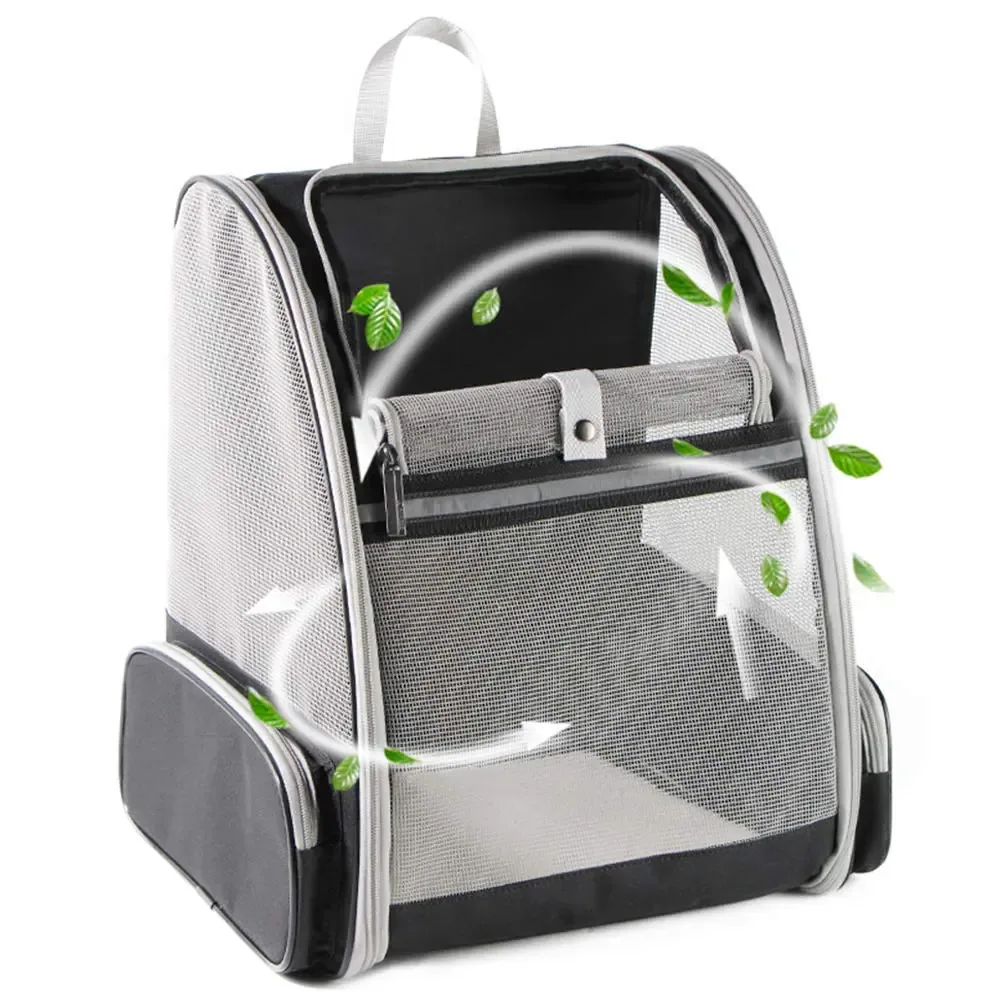
Sampling begins the moment a tech pack is judged complete. A complete pack for a dog carrier backpack contains a dimensioned spec sheet, a bill of materials with denier and grammage for every textile, a hardware list with finish codes, a stitch-and-construction sheet, artwork files in vector form with Pantone callouts, and a packing specification. Packs missing any of those six items generate an average of 2.4 clarification rounds, and each round costs one working day.
Days 1-3 cover pattern making and material pull. The pattern is drafted from the dimensioned spec; if the program is a modification of an existing tool, the base pattern already exists and this step collapses to under a day. Material pull is the variable: stock colours of 600D polyester, 210D lining, polyester mesh and 25 mm polypropylene webbing are on the shelf, but a custom dyed shell or a printed mesh has to be sourced before the first stitch.
Days 4-7 cover construction of the prototype plus internal review. A first prototype is normally sewn on a single-needle lockstitch setup with the same seam construction intended for bulk, because switching from a 1/4-inch single-needle seam to an overlocked or bound seam after approval changes both the costing and the fit of the interior volume. Load-bearing points - shoulder strap attachment, handle roots, base board pocket - are bar-tacked on the sample exactly as they will be in production, so that the prototype is a genuine process sample rather than a visual mock-up.
Days 8-10 cover photography, measurement against the spec, and dispatch. A good sample package ships with a measurement report listing the eight to twelve control dimensions, a photo set under consistent lighting, and a marked-up copy of the tech pack showing any deviation requested by the production team. Approval inside 72 hours of receipt is what keeps the 35-day end of the window reachable.
Stage 2 - Material Procurement and Incoming Inspection: 12-18 Days
Procurement starts only after sample approval, because until a sample is signed the specification is not frozen and any fabric ordered is at risk. This is the single most common misunderstanding in buyer-side planning: the clock for the 35-50 day bulk window starts at approval, not at purchase-order issue.
The long-lead items and their typical durations are listed below. Fabric dyeing is the longest at 10-15 days for a lab-dip-matched shade, and it cannot start until the approved physical swatch is in the mill's hand, because digital colour references are not accepted for shade-critical pet products that retail next to a printed colour card.
| Component | Specification example | Lead time | Notes |
|---|---|---|---|
| Shell fabric | 600D polyester, PU coated, W/R finish | 10-15 days | Lab dip matched to Delta E 1.0 |
| Lining | 210D polyester, plain | 5-8 days | Stock shades often available |
| Ventilation mesh | Polyester warp-knit, 180-220 g/m2 | 7-10 days | Printed mesh adds 5 days |
| Webbing | 25 mm polypropylene, 1.2 mm | 5-7 days | Custom woven jacquard adds 8 days |
| Zipper set | No. 8 coil, reverse tape | 6-9 days | Stock finish faster than anodised |
| Hardware | Zinc-alloy D-ring, ladder lock | 10-14 days | Custom plating colour adds 6-8 days |
| Foam and board | EPE 8 mm, PP hollow board base | 4-6 days | Die-cut to pattern |
| Trim and labels | Woven label, care label, hangtag | 7-12 days | Requires artwork approval |
Incoming inspection runs in parallel with receiving rather than after it. Fabric is checked for grammage against the nominal value with a tolerance of plus or minus 5 percent, coating adhesion by a cross-hatch tape test, and colour under a D65 light box. Hardware is sampled for plating thickness and subjected to a 48-hour neutral salt-spray screen on a batch basis. Zippers are cycle-tested on a 500-cycle pull fixture. Releasing a suspect lot into cutting is the most expensive mistake available in this process, because the defect surfaces only after 9-14 days of labour has been added.
A testing regime of this kind is normally documented against recognised methods published by standards bodies such as ASTM International, and the quality system that governs the inspection records is aligned with ISO 9001. Buyers should ask for the incoming inspection report with the pre-production sample, not after the final audit.
Stage 3 - Cutting, Printing and Panel Preparation: 4-6 Days
Cutting converts roll stock into the panel set that feeds the sewing lines. For a dog carrier backpack the panel count typically runs 22-38 pieces per unit depending on whether the design uses a structured base, an expandable gusset, or a separate laptop sleeve. Panels are nested on a marker with a target material utilisation of 82-88 percent; below 80 percent the costing model breaks and the production team will request a pattern revision.
Two cutting methods are in common use. Die-cutting with a steel rule die is preferred above roughly 1,500 units per colourway because the tooling pays back in reduced cycle time and near-perfect repeatability; below that threshold, a computerised oscillating-knife or single-ply cutter is used and the die cost of 60-180 USD per die is avoided. Steel rule dies themselves take 3-4 days to make, which is why they are ordered at sample approval rather than after procurement.
Printing and branding operations sit inside this stage. Screen printing of a logo onto a mesh panel or a woven label area adds 2-3 days including curing; heat transfer adds 1-2 days; embroidery on a structured panel adds 2-4 days and requires a digitised tape, which is another 2 days if the artwork is issued as a bitmap rather than a vector file. Silicone or rubber patches are the slowest of the common options at 6-9 days because they are moulded off-site.
Panel preparation also includes fusing and pre-assembly. Non-woven interlining is fused to handle and strap areas at 130-150 degrees Celsius with a 10-14 second dwell, and this is done in a batch before the panels are kitted. Kit completeness is checked against a panel count sheet, because a shortage discovered at the sewing line produces a partial build that cannot be finished until the missing component arrives, typically adding 4-6 days to the schedule.
Numbering and bundling are the quiet controls that keep this stage on time. Panels are bundled by size rather than by unit, so that each station receives a continuous run of identical operations and the operator does not re-handle between sizes. Bundles carry a size and shade code that is read at the sewing line before the first unit of a bundle is assembled. This is the last point at which a shade mismatch between shell and lining can be caught cheaply, and catching it here costs an hour rather than a re-inspection.
Stage 4 - Sewing, Welding and Assembly: 9-14 Days
Assembly is where the product becomes three-dimensional. The standard operation breakdown for a mid-size dog carrier backpack runs 30-45 operations across four sub-assemblies: the shell body, the ventilation and entry system, the harness and closure set, and the interior liner with its removable base board.
Stitch specification matters to both cost and durability. Load seams use a lockstitch at 8-10 stitches per inch with a bonded polyester No. 40 or No. 69 thread; decorative topstitching runs at 7-9 stitches per inch for a heavier visual gauge. Every strap root, handle end and D-ring attachment is reinforced with a bar tack of 42-64 stitches, or with a box-and-cross where the geometry allows. Skipping bar tacks is the most common value-engineering request and the most common cause of strap failure in field returns.
Welding appears in two places. High-frequency welding joins PVC or TPU-coated panels where a sewn seam would leak or would require seam sealing, and it is used on wipe-clean base liners. Ultrasonic welding is used for mesh-to-tape joining on lightweight builds, replacing a binding operation and saving roughly 40 seconds of station time per unit. Both processes require parameter sheets recording power, dwell and pressure, and those parameters are part of the process control record.
In-line inspection is built into the line rather than added after it. Operators at the closure station check zipper travel and puller function on every unit. A roving inspector checks seam allowance, stitch count and bar-tack placement at a rate of roughly one unit in twenty. Units failing at station level are repaired within the same operation; units that fail after final assembly are reworked in a dedicated cell and re-enter the final inspection stream, which is why rework rate is a direct driver of the 9-14 day band.
Stage 5 - In-Line QC, AQL 2.5 Final Inspection and Packing: 5-7 Days
Final inspection follows the AQL 2.5 sampling plan for general inspection level II. For a shipment of 3,000 pieces the plan calls for a sample of 125 units with an accept number of 7 and a reject number of 8 for major defects; critical defects are zero-tolerance at any sample size. This is the acceptance standard quoted across programs and it is the reference point in the commercial terms.
Defect classification is agreed before inspection begins, because classification disagreements cause more disputes than defect counts do. Critical defects on a pet carrier include a broken or missing load-bearing bar tack, a zipper that separates under a 200-cycle pull, an exposed sharp edge on hardware, and any non-compliance with the applicable children's product or chemical restriction rules. Major defects include visible shade deviation outside the approved tolerance, seam pucker exceeding 2 mm over a 100 mm run, and print registration off by more than 1.5 mm. Minor defects cover loose thread ends, label skew up to 3 mm, and carton marking inconsistencies.
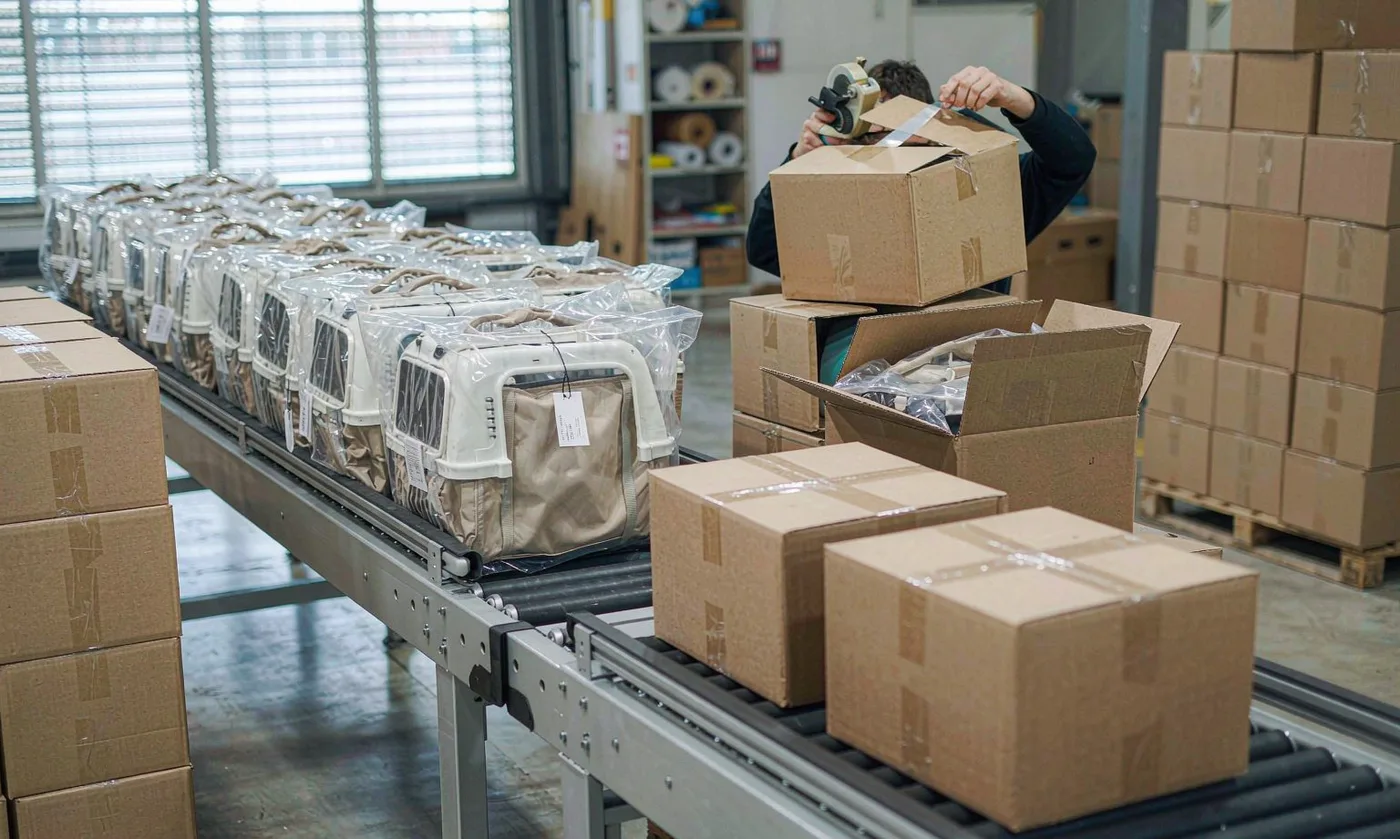
Packing runs concurrently with inspection once the first inspection lot passes. Standard packing is one unit per polybag, 8-12 units per export carton depending on volume, with carton dimensions set to hit a target container utilisation. A 40-foot high-cube container holds roughly 5,000-7,000 folded carriers in master cartons; a design that ships assembled rather than folded drops that to 1,800-2,600 units and changes landed cost per unit materially, which is a costing decision and not a packing detail.
The final 2-3 days cover carton sealing, palletising, container loading and document preparation. The document set - commercial invoice, packing list, certificate of origin, bill of lading instructions and any test report referenced by the buyer - is prepared in this window and is the last item on the critical path before the vessel cut-off.
Capacity Windows: How Volume, Colourways and Season Move the Date
Monthly capacity of 200,000 units across seven lines sounds like ample headroom for any single order, but capacity is allocated by week and the allocation is what determines whether a 35-day or a 50-day window is quoted. Three variables move the allocation.
Volume per colourway is the first. MOQ of 500 pieces per colourway means a 3,000-piece order spread across six colourways consumes six times the changeover burden of a single-colour order of the same total. Each colourway changeover at the cutting stage costs 2-4 hours and at the sewing stage costs half a shift for re-threading and first-piece approval. A six-colourway order therefore carries roughly 2-3 additional days against a single-colour order.
Season is the second. The pet travel category peaks for two shipping windows: January to March for the Northern Hemisphere spring and outdoor season, and August to October for the holiday and winter-travel build. Orders confirmed inside those windows routinely quote at 45-50 days because procurement queues at the mills lengthen by 4-7 days. Orders confirmed in April to June or November to December land at the short end.
Specification novelty is the third. A build that uses stock 600D polyester, black hardware and a screen-printed logo reuses every existing tooling and material channel. A build that specifies a custom-woven jacquard webbing, an anodised hardware finish and a silicone patch adds three parallel sub-processes, each with its own queue, and the schedule takes the maximum of the three rather than the sum. Buyers who need the short window should hold at least two of the three novel elements for a second season.
Allocating a program correctly also means understanding what a line-day is worth. Seven assembly lines at roughly 1,400-2,200 pieces per day for an established style imply a weekly theoretical output in the region of 45,000-55,000 units if all lines ran a single simple style for five days. Real output is lower because lines are shared, because changeovers consume part of a shift, and because new styles run slower than mature ones for their first 2,000 units while operators climb the learning curve. A first production run of a new style should be planned at 60-70 percent of the mature rate, which is one more reason the first order sits at the long end of the band.
Schedule Risk Register and Compression Levers
Compression is possible, but it is bought rather than negotiated, and every lever has a cost attached. The table below sets out the levers available on a standard program, the days each one can remove, and what it costs.
| Lever | Days saved | Cost or condition | Risk |
|---|---|---|---|
| Greige fabric held in advance | 4-7 | Deposit on 3,000 m roll stock | Shade must be repeatable |
| Stock hardware finish instead of custom | 6-8 | Reduced brand differentiation | Low |
| Steel rule dies ordered at PO | 3-4 | Die cost committed before approval | Medium if pattern changes |
| Second shift on assembly | 3-5 | Night shift premium | Low |
| Split shipment, first lot by air | 10-18 | Air freight on 20-30 percent of volume | Freight cost only |
| Simplified packing specification | 1-2 | Plain polybag instead of printed | Low |
| Skip third-party inspection | 1-2 | Internal AQL 2.5 report only | Dispute exposure |
The risk register that should be reviewed at pre-production is short and specific. Fabric shade re-dip is the top risk at 5-7 days. Hardware plating rejection on salt spray is second at 7-10 days because the parts must be re-made rather than repaired. Custom trim artwork delay is third at 5-8 days and is entirely buyer-controlled. Print plate damage mid-run is fourth at 3-4 days. Seasonal mill congestion is fifth and is not controllable by either party, which is why it is priced into the 35-50 day band rather than treated as an exception.
One final planning note concerns the interface between the production schedule and freight. A 35-day production window that ends two days after a vessel cut-off is functionally a 42-day window. Booking freight at the point of sample approval, using the projected rather than actual completion date, removes this interface risk at zero cost and is the highest-return action available to a buyer who is not paying for compression.
Repeat programs behave differently from first programs and deserve separate planning. Once a style has run once, the pattern, the die set, the print plates, the lab dip standard and the trim artwork all exist, and the second order removes the pattern-making, die-making, plate-making and lab-dip loops from the path. A repeat order of the same colourway is realistically a 28-34 day program, and brands that plan their replenishment as a repeat rather than a new development should quote against that shorter band.
Why brands source here
- Pet carrier programs run since 2014; founding team in sewn goods since 2004
- SGS-verified production floor of 4,950 m² with 137 workers across 7 lines
- Monthly capacity of 200,000 units, audited to BSCI and ISO 9001
People Also Ask
What is the average production time for a pet carrier order?
Bulk production averages 35-50 days from approved sample to ex-factory. Add 6-10 working days for sampling and 3-5 days for pre-production approval. Ocean freight is additional and ranges from 18 to 38 days depending on destination.
Why do Chinese suppliers quote a range instead of a fixed date?
Because the two longest stages - fabric dyeing and hardware finishing - run in external plants whose queues vary by season. The quoted band reflects the observed spread of those queues rather than an internal scheduling uncertainty.
How can a brand shorten its first production run?
Choose stock hardware finishes, approve vector artwork with Pantone references before sampling, confirm the packing specification early, and book freight at sample approval against the projected completion date rather than the actual one.
What is the longest single stage in carrier manufacturing?
Material procurement at 12-18 days. Fabric dyeing alone is 10-15 days including lab dip approval, which is longer than cutting, sewing and packing combined for most builds.
Does ordering more units always mean waiting longer?
Not proportionally. Sewing time scales with volume but is the shortest stage; procurement time is largely quantity-independent. A 3,000-piece order is typically only 4-6 days longer than a 500-piece order of the same specification.
What documents are issued at the end of production?
The standard set is commercial invoice, packing list, certificate of origin, bill of lading instructions and any third-party test report referenced in the purchase order. Additional declarations are issued to market-specific requirements on request.
Frequently Asked Questions
Does the 35-50 day bulk window include shipping time?
No. The 35-50 day figure ends at ex-factory, meaning the goods are packed, inspected and available for collection. Ocean transit to a US West Coast port adds 18-25 days, to Northern Europe 28-38 days, and to an East Coast port via Panama 30-40 days. Air freight adds 5-8 days door to door including customs.
When does the production clock actually start?
The clock starts on written approval of the pre-production sample, not on purchase order issue and not on deposit payment. Material procurement cannot be committed before the specification is frozen, because fabric dyed to an unapproved swatch cannot be recovered if the shade is rejected.
How many extra days does each additional colourway add?
Two to three days per colourway beyond the first, driven by cutting changeover and sewing line re-threading rather than by material procurement. Six colourways of 500 pieces each take materially longer than one colourway of 3,000 pieces even though the total volume is identical.
Can a 500-piece first order be produced faster than 35 days?
Rarely. At MOQ 500 the fixed stages dominate: procurement is 12-18 days regardless of quantity, and dies, plates and trim all carry quantity-independent lead times. Volume reduction saves sewing time, which is the shortest stage in the chain.
What is the acceptance number under AQL 2.5 for a 3,000-piece lot?
General inspection level II calls for a sample size of 125 units with 7 major defects accepted and 8 rejected. Critical defects are zero-tolerance at any sample size, and a single critical defect fails the lot regardless of the major defect count.
Why does fabric dyeing take 10-15 days when sewing takes nine?
Dyeing is a batch chemical process queued at an external mill with its own production schedule, and it includes a lab dip approval loop that can require two or three iterations to hit Delta E 1.0. Sewing is an internal, immediately schedulable operation.
Is it possible to hold fabric in advance for repeat orders?
Yes. For programs with a confirmed second season, holding greige or dyed roll stock against a deposit removes 4-7 days from every subsequent order. The condition is that the shade must be repeatable, which requires the original lab dip standard to be retained and physically referenced.
What happens if the final inspection fails?
The lot is reworked in a dedicated cell and resubmitted. Rework and re-inspection typically add 4-7 days, and the cost allocation depends on whether the defects trace to a specification agreed in the tech pack or to a production deviation.
Does a custom zipper puller or branded slider affect the schedule?
Yes, by 6-9 days minimum, and by up to 14 days if the puller is a moulded zinc-alloy part with a custom finish rather than a stock puller with a printed or laser-marked logo.
How does the peak season change the quoted window?
January to March and August to October bookings normally quote at the 45-50 day end because mill and plating queues extend by 4-7 days. April to June and November to December bookings land closer to 35 days.
Are samples and bulk produced on the same equipment?
Samples are sewn on the same machine classes and with the same seam construction intended for bulk, so the prototype is a genuine process sample. Samples are not run on the full seven-line cell layout, because at prototype volume a single-station build is faster and more controlled.
Can two styles share one production window?
Yes, and this is the most efficient use of capacity for brands launching a size range. Two sizes of the same design share the die set, the trim set and most of the procurement channel, so the pair completes in roughly the time of the larger single style plus 3-5 days.
Talk to QUANZHOU JUNYUAN BAGS about a pet carrier program: MOQ 500 pieces per colourway, samples in 6-10 working days, bulk production in 35-50 days under AQL 2.5 inspection.
Get a free quote Request a sample