Cat Carrier Breathable: Mesh Ventilation
A breathable cat carrier needs 150-260 cm² of total mesh open area spread across at least two opposing faces, delivering 40-60 l/min of air exchange in still air and holding interior CO2 below 2,500 ppm and interior temperature within 3 °C of ambient at 25 °C. Mesh should be monofilament polyester at 1.0-1.4 mm aperture, which gives 58-68 % open area and resists claw penetration.
Ventilation is the one performance attribute of a cat carrier that can be calculated rather than judged, and it is the one most often specified with adjectives. Airflow through a carrier is driven by two mechanisms, buoyancy and forced convection, and both depend on geometry: where the openings are, how big they are, and whether they are on opposite faces so that air can actually pass through rather than swirl. Our production team specifies ventilation as a set of four measurable targets: open area, exchange rate, interior CO2 and interior temperature rise, all measured in a chamber with a simulated thermal load rather than estimated from the pattern. The engineering then becomes a trade-off against claw resistance, airline rules and rain protection, each of which pulls the design in a different direction. Commercial terms follow the standard programme: MOQ 500 pieces per colourway, prototypes in 6-10 working days, bulk production 35-50 days after sample approval, final random inspection to AQL 2.5, T/T 30/70 and FOB Xiamen.
Wholesale pet carrier programmes for cat carrier ranges run 35-50 days after sample approval, shipped FOB Xiamen under T/T 30/70 terms.
How Much Air a Cat Actually Needs: The Load Calculation
Ventilation starts from a mass balance rather than from a fabric choice. A cat consumes oxygen, produces carbon dioxide, evaporates water and rejects heat, and each of those four loads has to be carried away by air moving through the carrier. Putting numbers on them is what turns a mesh panel from a design feature into an engineering requirement.
Oxygen consumption for a resting 4-6 kg cat is 0.6-1.0 l per kg per hour, so roughly 3-5 l/h, and carbon dioxide production is close to the same volume at a respiratory quotient near 0.8. That sounds trivially small against a 50-litre carrier, and it is small in terms of oxygen: the limiting gas is CO2, because the acceptable ceiling is much lower relative to ambient. Outdoor air sits near 420 ppm and occupational guidance treats 5,000 ppm as an eight-hour exposure limit; a sensible design target for an enclosed pet space is 2,500 ppm, which is half the occupational limit and well above the level at which a cat shows any measurable response.
Converting that target into an airflow is straightforward. Holding 2,500 ppm against a cat producing 3-5 l/h of CO2 requires a steady exchange of about 33-56 l/min of fresh air, assuming perfect mixing. Real carriers do not mix perfectly, so our production team applies a mixing factor of 1.4 and specifies 45-80 l/min. In a stationary vehicle with no forced convection, achieving that requires roughly 150-260 cm² of open area across opposing faces, because buoyancy-driven exchange through a single 150 cm² opening delivers only 12-22 l/min.
Heat is the second load and the one that dominates in a parked car or a summer journey. A resting cat rejects 12-20 W of sensible heat and up to 8-15 W more by evaporation when panting. Removing 20-35 W from a 50-litre enclosure while holding interior temperature within 3 °C of a 30 °C ambient requires 30-60 l/min of exchange, which is the same order as the CO2 requirement. The two constraints agree, which is convenient: specifying for CO2 also delivers the thermal performance.
| Load | Value for a 4-6 kg cat | Acceptable interior limit | Required exchange |
|---|---|---|---|
| Carbon dioxide | 3-5 l/h production | 2,500 ppm | 33-56 l/min |
| Oxygen | 3-5 l/h consumption | Above 19.5 % | Under 10 l/min |
| Sensible heat | 12-20 W at rest | Within 3 °C of ambient | 25-45 l/min |
| Latent heat, panting | 8-15 W additional | Relative humidity under 70 % | 30-60 l/min |
| Water vapour | 8-20 g/h, up to 50 g/h panting | No condensation on sight lines | 40-70 l/min |
The binding constraint in a still-air test is almost always water vapour rather than CO2, because condensation appears before CO2 reaches its limit, and it appears on the window or the floor where the customer notices it.
Mesh Structures Compared: Monofilament, No-See-Um, Spacer and Hexagonal
Four mesh families are used in cat carriers, and they differ in open area, claw resistance, tear strength and cost. Choosing by appearance alone produces a panel that fails either by tearing or by suffocating the occupant.
Monofilament polyester mesh is the standard. Single extruded filaments of 0.25-0.45 mm diameter are woven or knitted into a grid with an aperture of 1.0-1.4 mm, giving an open area of 58-68 % and an air permeability of 1,800-3,200 mm/s at 100 Pa. It is stiff, it holds its shape in a bound panel, and a cat claw of 0.2-0.4 mm tip radius will not pass through an aperture of 1.0 mm in a taut panel. It costs 1.10-2.20 USD per square metre and it is the default specification for a reason.
No-see-um mesh uses a finer filament of 0.10-0.18 mm at 0.5-0.7 mm aperture, giving an open area of 38-48 % and an air permeability of 900-1,600 mm/s. It keeps out insects and it looks finer and more premium. It reduces airflow by roughly half at equal panel area, it snags far more readily under a claw, and its tear strength is 25-45 N against 60-110 N for the monofilament grade. Where it is specified, the panel area has to be increased by 60-90 % to hold the same exchange rate.
Three-dimensional spacer mesh is a knitted double-face fabric with a 3-8 mm pile of monofilament between two faces, giving 70-85 % air void volume and very high permeability. It is used as a padded back panel on backpack-style carriers and as a floor insert, where its value is that it maintains an air gap under compression: at 5 kPa load a spacer mesh retains 55-70 % of its thickness, where a foam retains 25-40 %. It is not used as a barrier panel because a cat can claw through it easily.
Hexagonal or no-climb mesh is a woven wire or heavy monofilament structure with a 12-20 mm hexagonal aperture, used on rigid-framed carriers and on veterinary holding enclosures. It gives 80-90 % open area and near-zero pressure drop, and it is essentially claw-proof. It is heavy at 180-400 g/m², it looks institutional, and it is used where airflow and containment matter more than retail appearance.
The specification our production team writes for a general-purpose soft carrier is monofilament polyester at 1.2 mm aperture on the two side panels, no-see-um at 0.6 mm on the door panel to keep insects out, and spacer mesh on the shoulder straps and back panel for comfort. Each panel is specified with its own area so the total open area target is met.
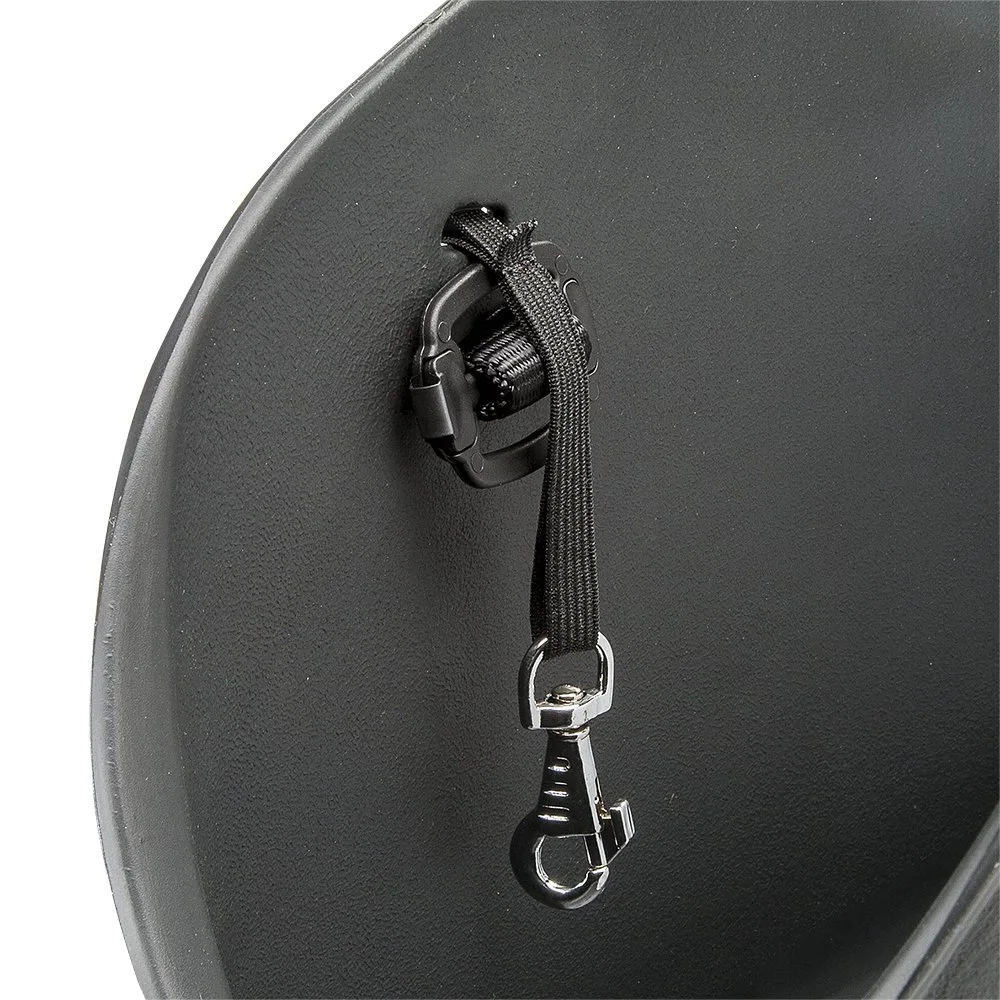
Open Area, Pressure Drop and Panel Placement
Total open area is the number that matters, but it is not the whole story. Airflow through a carrier depends on the pressure difference available to drive it and on the resistance of the path, and both are governed by geometry.
Open area should be calculated from the aperture, not from the panel dimensions. A 300 cm² panel of mesh with a 60 % open fraction delivers 180 cm² of effective opening, and a bound edge, a zip line and a fabric trim each remove a further 8-15 %. The practical method is to specify the finished open area in square centimetres and to verify it by image analysis on a photographed panel rather than by calculating it from the drawing.
Pressure drop through a mesh at the velocities relevant here is small but not negligible. At a face velocity of 0.05-0.20 m/s, which is what buoyancy generates, a monofilament mesh imposes a drop of 1-4 Pa, which is negligible. The dominant resistance is not the mesh but the internal path: a divider panel, a padded floor, or a cat itself occupying 60-75 % of the cross-section. This is why a carrier that measures well empty can still perform badly loaded, and why the test protocol has to include a simulated animal.
Placement determines whether exchange happens at all. Two panels on the same face produce a recirculating flow with an exchange rate 2-3 times lower than two panels on opposite faces at equal area. A high panel and a low panel on the same face produce a stack effect, which is better than two at equal height but still roughly half of the through-flow case. The geometry that works is one panel on the front or door, one on the opposite rear panel, and ideally one on the top, which lets warm, humid air leave at the highest point.
For a carrier used in a moving vehicle, placement interacts with the airflow in the cabin. A carrier placed on a seat with its panels facing the seat back and the door will see almost no exchange, regardless of panel area. This is the reason a ventilation specification should be paired with a placement instruction, and the reason a side-opening design is measurably better than a top-only opening for car use.
Claw, Tear and Burst Resistance: Where Mesh Fails
Mesh is the component a cat attacks first, and the failure modes are specific and testable. A panel that satisfies an airflow target and fails a claw test is a worse product than one that does the reverse, because the consequence of failure is an escaped animal in a moving vehicle.
Claw penetration is a geometry problem. A cat claw tip of 0.2-0.4 mm radius will enter any aperture above about 0.8 mm if the mesh is slack, and once a claw catches a filament the cat pulls, which loads the filament in tension and tears it. Two parameters control this. Aperture below 0.8 mm prevents entry, and panel tension above 15-25 N/m prevents the slack that allows entry in a larger aperture. Our production team specifies mesh bound under tension with a stitch that holds the panel flat against the frame, and we reject panels that can be deflected more than 8 mm by a 10 N point load.
Tear resistance is measured on a tongue or trapezoid tear test, and the numbers separate the mesh grades cleanly. Monofilament polyester at 0.35 mm filament gives 60-110 N; no-see-um at 0.14 mm gives 25-45 N; spacer mesh gives 20-40 N in the face direction. A cat applies 20-80 N in a scratch and 100-250 N in a sustained pull against a caught claw, which means a no-see-um panel of 25-45 N tear strength will fail in a sustained pull and a monofilament panel may hold. Where a fine panel is required for insect protection, the correct construction is a fine inner layer backed by a monofilament structural layer.
Burst strength matters at the seam rather than in the panel. A mesh panel bound into a fabric frame fails at the binding, where the stitch line perforates the mesh and concentrates load. The mitigation is a 20-25 mm binding tape folded over the raw edge, sewn at 8-10 stitches per inch with a ball-point needle, and reinforced with a second row 6 mm inside the first. That construction moves the failure point from the stitch line into the panel, which is where the higher tear strength sits.
Abrasion of mesh against a hard floor or a vehicle seat is the slow failure. Mesh abraded at 5,000 Martindale cycles loses 15-30 % of its tear strength, and a panel positioned on the underside of a carrier abrades faster than any other. The design rule is to keep mesh off the bottom 30 mm of any panel and to place the lowest mesh edge at least 40 mm above the floor line.
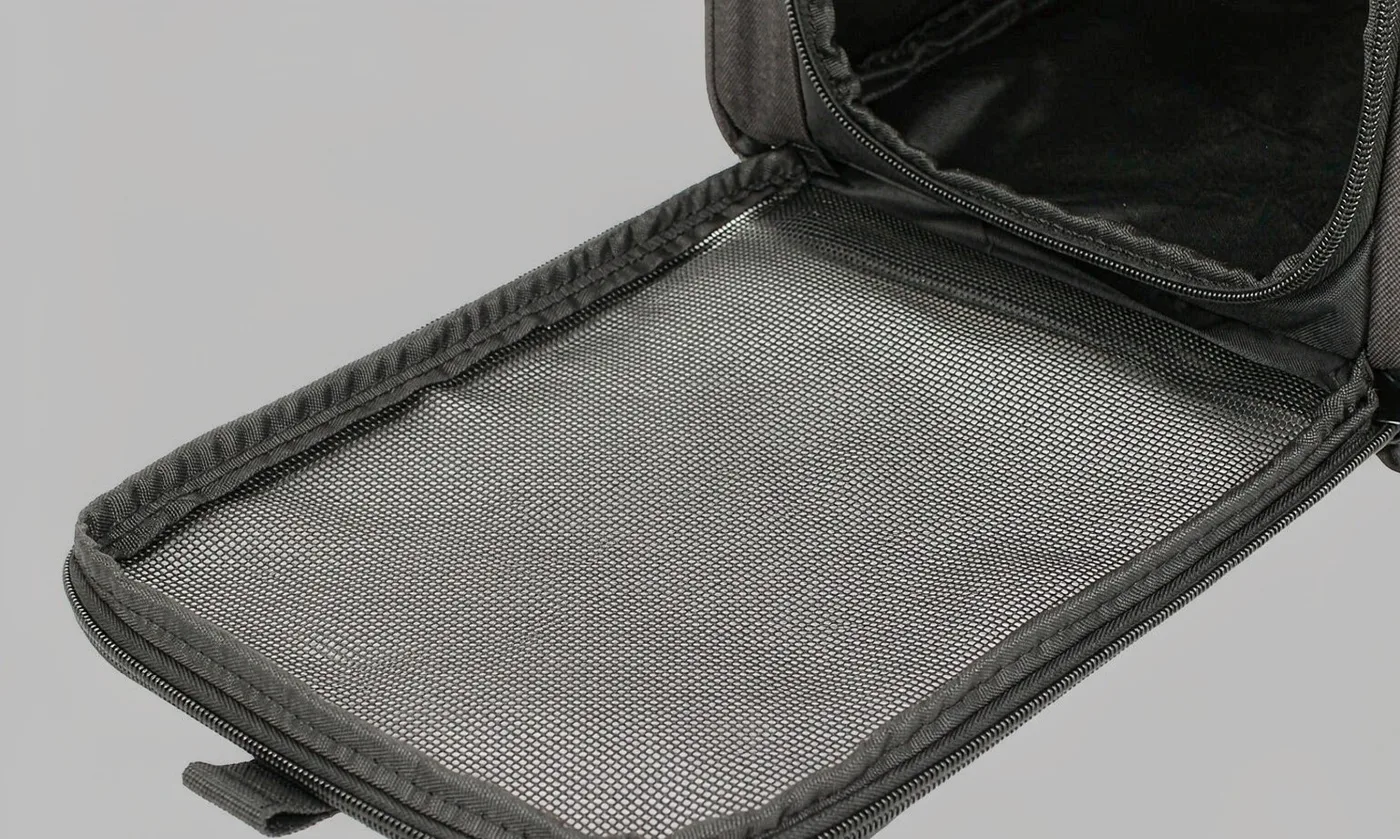
Airflow Testing: Anemometer, Tracer Gas and Thermal Chamber
Three test methods are used to verify ventilation, in ascending order of fidelity and cost. A buyer should know which one a supplier used, because the numbers are not comparable between them.
The anemometer method measures face velocity at the mesh with a vane or hot-wire probe and multiplies by area. It is cheap and fast and it overstates exchange by 2-4×, because it measures local velocity at the opening rather than net exchange through the enclosure, and because it does not account for short-circuiting between adjacent panels. It is useful as a production check and useless as a design tool.
The tracer gas decay method is the correct design measurement. The enclosure is dosed with a tracer gas such as carbon dioxide or sulphur hexafluoride to a known concentration, the source is removed, and the decay curve is logged. The air change rate is derived from the slope, and the result is expressed in air changes per hour or in litres per minute. For a well-ventilated cat carrier in still air, the expected result is 40-90 air changes per hour, which corresponds to 33-75 l/min in a 50-litre enclosure. This method accounts for short-circuiting and for the mixing factor, and it is the one our production team uses for design validation.
The thermal chamber method is the most realistic and the most persuasive to a buyer. A thermal mannequin of 4-6 kg equivalent, held at 38 °C surface temperature and emitting 15-30 W, is placed in the carrier, the carrier is placed in a chamber at 30 °C and 50 % RH with still air, and interior temperature, relative humidity and CO2 are logged for 60-120 minutes. Pass criteria are interior temperature within 3 °C of ambient, relative humidity below 70 %, and CO2 below 2,500 ppm. A carrier that passes this test will not overheat in a parked car for the first 20-30 minutes, and that is the claim worth making.
Testing standards for the underlying fabric properties, including air permeability of textiles, are published by the International Organization for Standardization and searchable at iso.org, which allows the fabric measurement to be specified independently of the assembly test.
Airline and Road Rules: Where Ventilation Meets Regulation
Ventilation is not purely a design choice; it is partly prescribed. Both air transport and, increasingly, road transport rules specify ventilation requirements, and a carrier that satisfies a thermal target may still be rejected at a check-in desk.
For air transport, the governing reference is the IATA Live Animals Regulations, published annually and available at iata.org. It requires ventilation on at least three sides for animals carried in the hold and on the maximum number of sides for those in the cabin, with openings sized so that the animal cannot protrude. For a cabin carrier this effectively means mesh on front, both sides and preferably the top, which is a stronger requirement than the airflow calculation alone and it is the reason a top-only mesh design will not pass airline review.
For road transport, the rules are less prescriptive and are mostly about restraint rather than airflow, but there is a relevant safety dimension. A carrier secured on a seat with mesh facing the seat back will have its ventilation blocked, and in a rear-facing installation on a child seat the same applies. Where a carrier is sold for car use, our production team recommends specifying mesh on all four vertical faces rather than two, which removes the orientation dependency entirely for an added 0.35-0.75 USD.
Sizing deserves a specific note, because it is the criterion a check-in agent can actually enforce. A ventilation opening is disallowed if any part of the animal can protrude through it, and in practice that means an aperture above about 12 mm is rejected for a kitten and above 20 mm for an adult cat in most airline reviews. Monofilament mesh at 1.2 mm aperture therefore passes on sizing with a large margin, while a decorative cut-out panel or a wide bar grille can fail even though it delivers more airflow. Our production team keeps every aperture below 12 mm on any carrier sold as airline-capable and records the dimension on the specification drawing so the value can be quoted to an airline query without a new measurement.
There is also a hygiene dimension. Mesh panels are the surfaces most exposed to saliva, hair and, occasionally, urine spray, and a mesh that cannot be cleaned becomes an odour source. A monofilament mesh can be wiped and, because it is hydrophobic, it dries in 10-20 minutes. A spacer mesh holds water and takes 2-4 hours. For a product used frequently, wipe-clean monofilament is the correct choice even where spacer mesh is more comfortable.
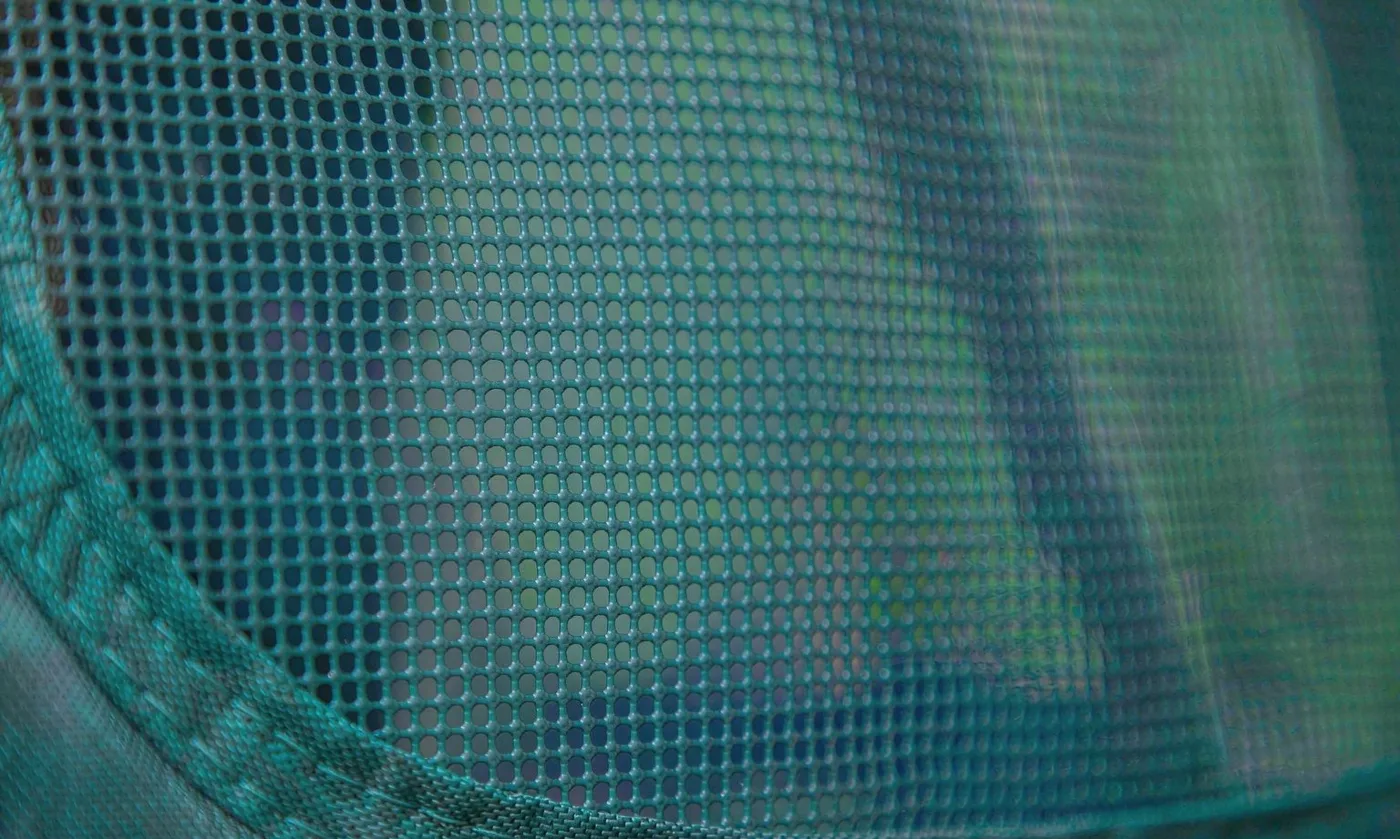
Specification Checklist, Cost and Programme Notes
The ventilation specification that goes into a tech pack is short, and writing it as numbers rather than as a description is what prevents a downgrade during value engineering. Seven items cover it.
First, total finished open area in square centimetres, minimum 150 cm² for a carrier under 45 litres and 220 cm² above it. Second, the number of faces carrying mesh, minimum three and preferably four for a product sold for car or air travel. Third, mesh type and aperture per panel. Fourth, the air change rate measured by tracer gas decay, minimum 40 per hour in still air. Fifth, the thermal chamber pass criteria: within 3 °C of ambient, under 70 % RH, under 2,500 ppm CO2 at 60 minutes. Sixth, the claw test: no penetration at 80 N and no tear propagation. Seventh, panel deflection under a 10 N point load, maximum 8 mm.
Cost is modest. Adding a third and fourth mesh panel to a two-panel design adds 0.45-0.95 USD at 500 pieces, mostly in binding tape and labour rather than in fabric. Upgrading from no-see-um to monofilament on the structural panels adds 0.20-0.45 USD. Reinforcing the binding with a second stitch row adds 0.10-0.20 USD. A complete ventilation validation, including tracer gas decay and a thermal chamber run, costs 350-700 USD at a third-party laboratory and should be run once per platform rather than once per colourway.
Two programme notes matter. Mesh is a stock item in most mills but a custom aperture is not: a non-standard aperture carries a 400-800 kg minimum and 20-30 days, so the first order should use a stock grade. And mesh panels should be cut on a laser or a hot knife rather than with scissors or a cold blade, because an unsealed monofilament edge frays into the binding and produces a visible line of loose filaments within weeks.
The commercial framing for a breathable carrier is measurable and therefore marketable. A product that can state a tested air change rate and a tested temperature rise is making a claim a competitor cannot match with an adjective, and in a category where the customer fear is overheating, that is the claim that closes the sale.
Why Mesh Beats Perforated Panels in a Soft Carrier
Perforated coated fabric looks like an alternative to mesh and it is not. Holes punched in a coated panel give an open area of 8-18 % at best before the panel loses structural integrity, against 58-68 % for a monofilament mesh, and the coating around each hole delaminates under flex. For a soft carrier the mesh panel remains the only way to reach an airflow target without adding weight.
Why brands source here
- Pet carrier programs run since 2014; founding team in sewn goods since 2004
- SGS-verified production floor of 4,950 m² with 137 workers across 7 lines
- Monthly capacity of 200,000 units, audited to BSCI and ISO 9001
People Also Ask
How much mesh ventilation does a cat carrier need?
150-260 cm² of finished open area across at least two opposing faces, delivering 40-60 l/min of exchange in still air. That holds CO2 below 2,500 ppm and interior temperature within 3 °C of ambient at 25 °C.
What mesh aperture is best for a cat carrier?
1.0-1.4 mm monofilament polyester, which gives 58-68 % open area and resists claw penetration because a 0.2-0.4 mm claw tip will not enter a taut 1.0 mm aperture. Fine 0.6 mm mesh halves airflow and tears at 25-45 N.
Do cats tear mesh carrier panels?
They can. A cat applies 20-80 N in a scratch and 100-250 N in a sustained pull against a caught claw, so a fine mesh at 25-45 N tear strength fails. Monofilament at 60-110 N, bound under tension, usually holds.
Does a carrier need mesh on all four sides?
Three is the practical minimum and four removes orientation dependency. In a car, a carrier with mesh facing the seat back has its ventilation blocked, which is why four-sided mesh is worth 0.35-0.75 USD on a car-oriented product.
How is carrier airflow measured?
By tracer gas decay for design, which gives air changes per hour, and by a thermal chamber run with a heated mannequin for validation. An anemometer reading at the mesh overstates exchange by 2-4×.
What air change rate should a cat carrier achieve?
40-90 air changes per hour in still air, which corresponds to 33-75 l/min in a 50-litre enclosure. A single 150 cm² opening delivers only 12-22 l/min because there is no through-path.
Is no-see-um mesh safe for a cat carrier?
It is safe as an inner insect layer but not as a structural panel, because it tears at 25-45 N and reduces airflow by about half. It should be backed by a monofilament layer.
Frequently Asked Questions
What is open area and why is it not the same as panel size?
Open area is the fraction of a panel that is actually aperture. A 300 cm² panel at 60 % open fraction delivers 180 cm², and binding, zip lines and trim remove a further 8-15 %.
Why do two mesh panels on the same side underperform?
Because there is no through-path, so the flow recirculates. Two panels on the same face give an exchange rate 2-3 times lower than two on opposite faces at equal area.
What CO2 level is safe inside a pet carrier?
A design target of 2,500 ppm is sensible, being half the occupational eight-hour limit of 5,000 ppm and well above any level at which a cat shows a measurable response. Ambient outdoor air is near 420 ppm.
How much heat does a cat reject into a carrier?
12-20 W sensible at rest, plus 8-15 W more by evaporation when panting. Removing 20-35 W while staying within 3 °C of a 30 °C ambient needs 30-60 l/min of exchange.
Does IATA require ventilation in a cabin pet carrier?
Yes. The IATA Live Animals Regulations require ventilation on the maximum number of sides for cabin carriage, with openings sized so the animal cannot protrude, which effectively means front, both sides and top.
How should mesh panels be attached?
With a 20-25 mm binding tape folded over the raw edge, sewn at 8-10 stitches per inch with a ball-point needle, plus a second row 6 mm inside. That moves failure from the stitch line into the panel.
Can mesh panels be welded instead of sewn?
Thermoplastic-coated mesh can be high-frequency welded, which removes needle holes and fraying, but the weld narrows the effective open area by 10-18 % and it is used mainly on rigid-framed designs.
How far above the floor should the lowest mesh edge be?
At least 40 mm. Mesh abraded against a floor or seat loses 15-30 % of tear strength at 5,000 Martindale cycles, and the underside of a panel abrades faster than any other surface.
Why does a carrier get condensation on the window?
Because water vapour, not CO2, is usually the binding constraint. A cat evaporates 8-20 g/h, or up to 50 g/h panting, and vapour condenses on the coolest sight line before CO2 reaches its limit.
How much does better ventilation cost?
Adding a third and fourth mesh panel adds 0.45-0.95 USD at 500 pieces, mostly in binding and labour. Upgrading to monofilament adds 0.20-0.45 USD and a second stitch row 0.10-0.20 USD.
What is the MOQ for a custom mesh specification?
500 pieces per colourway for the carrier, but a non-standard mesh aperture carries a 400-800 kg mill minimum and 20-30 days, so the first order should use a stock grade.
Should mesh be cut with a laser or a blade?
A laser or hot knife. An unsealed monofilament edge frays into the binding and produces loose filaments within weeks.
Talk to QUANZHOU JUNYUAN BAGS about a pet carrier program: MOQ 500 pieces per colourway, samples in 6-10 working days, bulk production in 35-50 days under AQL 2.5 inspection.
Get a free quote Request a sample