Cat Carrier Hard Shell: Airline Approved Options
A hard shell cat carrier earns the airline-approved claim at roughly 45 x 30 x 25 cm of external envelope, a 2.2-3.0 mm shell wall that survives a 1.0 m drop at -10 °C, ventilation on at least three faces with 22-28% open area, and a latch validated to 5,000 cycles. Interior volume for the 3.5-7 kg cat class lands at 38-52 litres.
This page sets out how a rigid-shell cat carrier is engineered so that the airline claim survives contact with a real boarding gate — not as a marketing phrase but as a set of measurable shell, hardware and dimensional specifications. The decisions that matter are made at tooling: wall thickness and rib pitch, slot geometry and the open area it costs, latch mechanism and cycle life, and the interface between a moulded shell and the textile parts bonded to it. Each carries a cost and a verification method, and each is quoted with measured values rather than pass/fail so that drift between lots is visible early. Commercial terms follow the standard programme: MOQ 500 pieces per colourway, prototypes delivered in 6-10 working days, bulk production 35-50 days after sample approval, final random inspection to AQL 2.5, T/T 30/70 payment and FOB Xiamen loading.
A pet bag supplier running cat carrier orders at 500 pieces per colourway can consolidate several sizes into one cutting window and hold the dye lot across reorders.
Shell Material Selection: ABS, PP Copolymer and Moulded EVA
Three material families dominate rigid cat carriers, and the choice between them is a stiffness-versus-impact decision made under a weight ceiling. ABS at 2.2-3.0 mm wall is the reference specification: it holds shape, accepts a painted or textured finish, and gives a shell mass of roughly 900-1,300 g for the 40-50 litre class. Its weakness is low-temperature impact, which is exactly the condition a carrier sees in an aircraft hold or a winter loading bay.
PP copolymer answers that weakness. At 2.4-3.2 mm it gives equivalent stiffness at slightly higher mass, holds impact strength down to -20 °C without modification, and costs less per kilogram. The trade is surface quality: PP does not take paint without pre-treatment, and it shows flow lines and sink marks more readily than ABS. Programmes selling on appearance usually pay for ABS plus an impact modifier; programmes selling on durability usually take PP and texture the tool.
Moulded EVA is the third route and behaves differently again. An EVA shell of 4-6 mm is a semi-rigid structure: it absorbs impact better than either thermoplastic, recovers from deformation, and runs 15-25% lighter for the same volume. It does not hold a tight dimensional tolerance, which matters for the under-seat envelope, and it creeps under sustained stack load in a way ABS and PP do not.
| Material | Wall (mm) | Shell mass (g) | Impact at -10 °C | Dimensional stability | Tooling |
|---|---|---|---|---|---|
| ABS | 2.2-3.0 | 900-1,300 | Modifier required | High | 18,000-34,000 USD |
| PP copolymer | 2.4-3.2 | 1,050-1,500 | Inherent | Medium | 18,000-32,000 USD |
| Moulded EVA | 4.0-6.0 | 700-1,000 | Inherent, high | Low | 9,000-18,000 USD |
| ABS + TPE overmould | 2.2 + 1.5 | 1,150-1,600 | High | High | 28,000-48,000 USD |
Selection should be recorded against the failure the programme fears most. A ship-and-stack distribution model punishes creep, which argues against EVA. A drop-and-kick model punishes brittle fracture, which argues against unmodified ABS. There is no best shell material; there is only the material whose failure mode the programme can tolerate.
Moulded Rib Geometry and Load Paths in a Rigid Shell
A flat shell panel of 2.5 mm ABS is not stiff enough to carry a carrier's corner loads, and thickening the wall is the expensive way to fix it. Ribbing is the cheap way: a rib of 10-14 mm depth on a 40-55 mm pitch roughly triples the section modulus of a panel for a mass increase of 8-12%. The design work is in the rib geometry rather than in the decision to rib at all.
Rib thickness is the first constraint. A rib thicker than 60% of the wall it stands on will sink, producing a visible depression on the show surface and a stress concentration at the rib root. The working rule is rib thickness at 0.5-0.6 x wall, rib depth at 3-4 x wall, and a root fillet of 0.25-0.5 x wall. Draft of 0.5-1.0 degrees per side is needed for release, and that draft has to be accounted for when the rib top is used as a bearing surface.
Load paths determine where the ribs go. A carried shell sees load through the handle, through the base when set down, and through the shoulder strap anchors where fitted. Ribs should run continuously between those points rather than radiating from the geometric centre: a radial pattern looks deliberate and does nothing, because the load does not travel to the centre. On a clamshell design, the split line itself is the weak section, and the rib pattern has to continue across it through interlocking features rather than stopping at the flange.
Base ribs carry a different case. The floor of a rigid shell carries the cat's weight distributed over four paws plus the point loads from a cat that jumps or braces, and it is the surface most likely to be dropped onto a corner. A waffle pattern at 40-50 mm pitch in both directions, with a perimeter upstand of 15-25 mm that doubles as liquid containment, is the standard answer. Deflection under a 10 kg distributed load should stay under 2 mm across the floor span.
Corner geometry closes the section. A rigid shell concentrates impact at its corners, and the mitigation is a corner radius of 25-40 mm with local wall thickening rather than a sharp corner with a rib behind it. Ribbing is not decoration: it is the mechanism by which a 2.5 mm shell performs like a 5 mm one at half the mass.
Door, Latch and Hinge Hardware: Cycle and Pull Specifications
The door is where a rigid carrier fails in service, and it fails in a particular way: the latch holds, the hinge does not, and the door comes away from the shell rather than opening. Specification has to treat the latch, the hinge and the shell around them as one assembly, because their failure loads are not independent.
Latch mechanisms fall into three families. A spring-loaded catch in moulded polymer costs 0.40-0.90 USD and is adequate only when the spring is metal and the catch section is above 6 x 8 mm. A rotary barrel latch with a metal cam runs 1.20-2.60 USD and survives cat pawing, which a straight catch does not. A two-point latch driving rods to the top and bottom of the door runs 2.80-5.50 USD and is the specification for any carrier sold on containment claims.
Cycle testing should be run at a realistic number rather than a token one. 5,000 open-close cycles with the door loaded at 2 kg to simulate a cat leaning on it is the working benchmark, with acceptance of no creep in the catch, no cracking at the hinge boss, and latch engagement retained after the cycle set. A second set of samples is run at -10 °C and at 50 °C, because both polymer springs and moulded catches lose force at temperature extremes.
Pull testing separates marketing claims from structural ones. A 400 N pull applied at the latch in the opening direction, and a separate 250 N pull applied at the door edge diagonally, both held 60 seconds, with acceptance of no permanent deformation above 1 mm and no separation of the door from its hinge. Hardware fitted to a moulded boss should additionally be push-tested at 300 N along the fastener axis, since self-tapping screws into a boss are the most common assembly-level failure.
Hinge design is a choice between a moulded living hinge, a metal pin hinge and a sewn textile hinge. Living hinges in PP survive 20,000-50,000 folds and are the cheapest route, but they cannot be used in ABS. A metal pin hinge is stronger and carries 1.10-2.40 USD of hardware, and it requires a metal insert or a through-bolted boss rather than a screw. The door assembly should be validated as a system: a latch that survives 5,000 cycles on a hinge that pulls out at 180 N is not a 5,000-cycle door.
Ventilation Slot Geometry in a Rigid Shell
Cutting ventilation into a rigid shell removes material from the load path, and the temptation is to cut generously and add ribs around the openings. The better approach is to treat open area as a budget: decide the airflow requirement first, then find the slot geometry that delivers it with the least structural loss.
For the cat class, 22-28% open area across the ventilation faces is the working range, higher than a dog carrier of comparable size because cats have a higher surface-area-to-mass ratio and a lower tolerance for stale air. The distribution matters more than the total: airflow needs an intake low on one face and an exhaust high on another, and at least three faces should carry openings so that the carrier passes airline rules and remains breathable if set down against a wall.
Slot geometry beats round holes on two counts. A slot of 6-8 mm width on a 14-18 mm pitch removes less material for the same open area than a hole pattern, and a slot can be oriented along the principal stress direction, which a round hole cannot. Slot ends should be radiused at R1.5 or greater; square slot ends are crack initiators, and in a drop test they are where the shell splits.
Structural compensation is straightforward once the budget is known. A continuous frame rib of 8-12 mm depth around the whole ventilation field restores most of the lost section modulus for 6-10 g of material, and it gives a clean perimeter for a welded or clipped mesh backing. The mesh behind the slots is specified separately: monofilament at 300-400 g/m², bonded rather than sewn to the shell where the shell material permits welding.
Slot width is also a containment specification. A cat can work a paw or a claw into an opening wider than about 10 mm, and openings in the 12-20 mm range invite claw-hooking that can damage both the animal and the shell. Where a higher open area is needed, the answer is more slots at 7-8 mm rather than fewer wide ones. Ventilation in a rigid shell is a structural design exercise with an airflow constraint, not a styling exercise.
Cabin Dimensional Compliance: the Under-Seat Envelope
The airline-approved claim is fundamentally a dimensional claim, and it is the specification most often lost between design and production. Carriers are designed to a nominal size, tooled with shrinkage, assembled with a tolerance stack, and then measured against an airline rule that was written for a different shape. The discipline is to design to the worst case from the start.
The under-seat envelope across major carriers clusters around 45 x 30 x 25 cm external, with meaningful variation: some carriers publish smaller figures for certain aircraft types, and a soft-sided product is usually allowed to compress while a hard shell is not. A rigid shell therefore has to meet the figure outright. The engineering response is to take the tightest published envelope as the design target and treat everything above it as unusable margin.
| Dimension | Common published range | Design target (rigid) | Tolerance allowance |
|---|---|---|---|
| Length | 40-46 cm | 43.0 cm max | +/-1.5 mm tooling |
| Width | 25-33 cm | 27.5 cm max | +/-1.5 mm tooling |
| Height | 20-25 cm | 23.0 cm max | +/-1.0 mm tooling |
| Handle projection | Sometimes counted | Folding, flush | Zero in stowed state |
| Wheel projection | Usually counted | Recessed or none | Zero in stowed state |
Shrinkage is the first trap. PP shrinks 1.0-2.0% and ABS 0.4-0.7%, so a tool cut to 430 mm produces a part between 421 and 428 mm depending on material and process window. That has to be modelled before the tool is cut, not measured afterwards. The second trap is the assembled state: a handle, a latch boss, a feet set or a shoulder strap anchor all add projection that the nominal shell drawing does not show.
Verification is a physical gauge, not a drawing check. A go/no-go frame built to the tightest published envelope, applied to production samples at incoming inspection, catches drift that a dimension report will not. Airline rules change, so the gauge should be reviewed against current published figures at least annually; carriers publish pet-in-cabin rules on their own sites and consolidated guidance is available from IATA and from the US Federal Aviation Administration.
Impact, Stack and Drop Testing for Rigid Shells
Rigid shells fail by brittle fracture, and brittle fracture is temperature- and rate-dependent, so the test protocol has to specify both. A carrier that survives a summer drop test can shatter in a winter one, which is why the conditioning step matters more than the drop height.
The drop matrix is six orientations — base, lid, each side, front and rear — from 1.0 m onto concrete, with the carrier loaded to its rated 10 kg with a distributed mass. Acceptance is no crack longer than 30 mm, no separation at the split line, and door retention throughout. A second set conditioned at -10 °C for four hours is dropped from 0.8 m, and a third set conditioned at 50 °C for four hours from 1.0 m. The cold set is the one that fails.
Stack testing reflects freight rather than use. A cartonised carrier is stacked five to eight high in a container, and the bottom unit carries the load for weeks in humid conditions. The test is a sustained load of 60-100 kg applied through a flat platen to the lid of an assembled carrier for 24 hours at 40 °C, with acceptance of no permanent deflection above 3 mm after a 1-hour recovery and no cracking at the rib roots. Creep is the failure mode here rather than fracture, and EVA shells are the ones that fail it.
Handle and anchor testing closes the structural set. A handle pull at 4x rated load — 400 N for this class — applied vertically for 60 seconds, and a strap anchor pull at 250 N in the wearing direction, with acceptance of no tear-out and no permanent deformation above 2 mm. Where the handle is moulded into the shell, the pull has to be applied through the same geometry a hand uses, because a moulded handle tested at its centre behaves differently from one tested at its ends.
Method references for conditioning and impact testing follow practice published by ASTM International, and plastic and coating components are screened against applicable consumer-safety requirements administered by the US Consumer Product Safety Commission. Every impact report should record the conditioning temperature, because a pass at 23 °C says nothing about a January loading bay.
Shell-to-Soft-Goods Interface: Binding, Gaskets and Rattle Control
A rigid carrier is a composite product: a moulded shell plus textile panels, a floor pad, a handle wrap and usually a welded or clipped mesh backing. Most field complaints on rigid carriers originate at the interface between those materials rather than in either material alone.
Attachment methods rank by durability and cost. Ultrasonic or hot-plate welding works where the textile is a compatible thermoplastic-coated fabric and the shell is PP or ABS with a weld-compatible grade, giving a clean joint at 0.15-0.35 USD per metre with no consumables. Mechanical clipping into a moulded undercut channel costs 0.25-0.55 USD per metre and is serviceable. Adhesive bonding is the weakest route and should be reserved for non-structural trim; it is also the one most likely to fail a chemical screen.
Floor pads and liners introduce the containment requirement. A moulded shell contains liquid at its upstand but not at its textile interface, so the pad should sit inside a welded or sealed tray rather than directly on the shell floor. A removable pad of 300-450 g/m² quilted fabric with a hydrophobic backing and a 15-25 mm upstand lip gives cleanability without compromising the shell. Attachment is hook-and-loop at four points plus a locating pocket at the front, which prevents the pad from migrating under a cat that digs.
Rattle is the defect customers notice first and engineers specify last. A rigid shell amplifies any loose fit: a handle pivot with 0.3 mm of clearance, a pad that is 2 mm undersize, a mesh panel that is not tensioned. The control is dimensional rather than material — pivots at H9/h9 fit, pads cut 1-2 mm oversize on the trim, and mesh panels stretched at assembly to a stated tension. A simple acceptance test is a shake at 2 Hz with 50 mm amplitude for 60 seconds with no audible rattle at 1 m.
Finish and chemical compliance belong on the same checklist. Painted ABS surfaces need an adhesion check by cross-hatch after humidity conditioning, and every coating, adhesive and textile in the assembly is declared against the same restricted-substance screen. A rigid shell amplifies every tolerance error in the soft goods attached to it, so the interface deserves more specification time than either component alone.
Cost, Tooling and Programme Notes
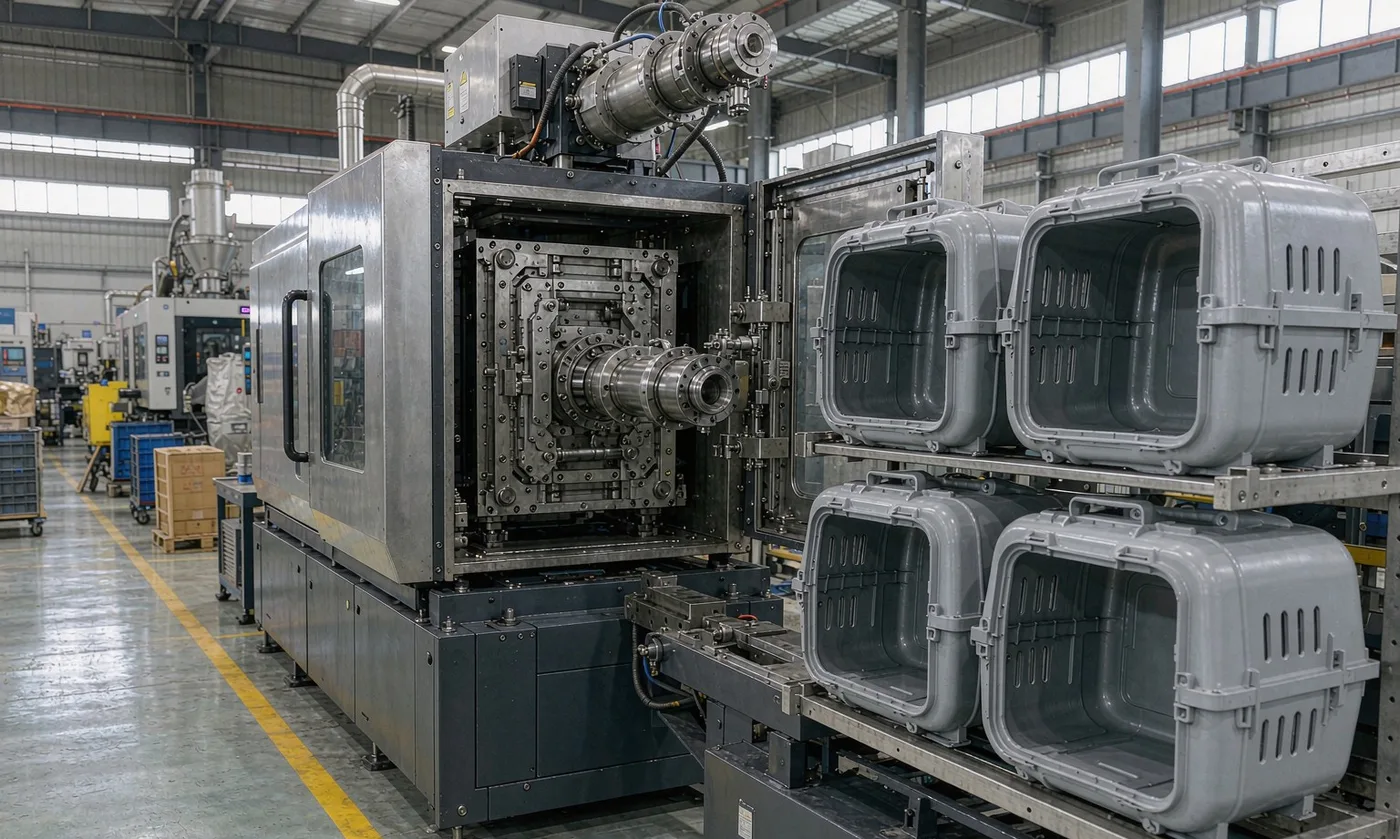
A rigid-shell cat carrier is a tooling-driven programme, and the tooling decision is made before the first sample exists. An injection tool for a clamshell in the 40-50 litre class runs 18,000-34,000 USD for ABS or PP on a ten to fourteen week path; a moulded EVA tool runs 9,000-18,000 USD on six to nine weeks. That path is longer than the sampling cycle, so shell geometry has to be frozen at quotation rather than after the golden sample.
Unit cost breaks down predictably. Shell and door at 4.20-7.80 USD depending on material and mass, hardware at 1.60-5.50 USD depending on latch family, textile interior and pad at 2.40-4.60 USD, mesh and ventilation backing at 0.60-1.40 USD, and assembly and packing at 1.80-3.20 USD. Landed unit cost for a compliant hard-shell cat carrier is therefore 11-23 USD FOB Xiamen, with the spread driven almost entirely by latch choice and shell material.
MOQ is 500 pieces per colourway. At this unit value that is a modest order, and the practical caution is different: rigid shells are bulky, and freight rather than unit cost dominates the landed number. A 45-litre shell ships at roughly 8-12 units per 0.09 m³ carton, so a 500-piece order occupies 40-55 cartons and 4-5 m³. Programmes that plan for nesting or for flat-pack shipping of the textile components recover 15-25% of freight cost.
Production planning follows the standard programme once tooling is complete: prototypes in 6-10 working days from frozen geometry, bulk production 35-50 days after sample approval, with the shell moulding and the textile assembly run in parallel and joined at final assembly. Final random inspection to AQL 2.5 adds the dimensional gauge check, the latch cycle check and a single-set drop check to the standard defect list, because those are the failures that generate returns. Our production team runs these programmes through a SGS-verified production base with ISO 9001 and BSCI coverage, and terms are T/T 30/70 against FOB Xiamen loading. Hard-shell programmes are won or lost at tooling freeze, not at sample approval.
Why brands source here
- Pet carrier programs run since 2014; founding team in sewn goods since 2004
- SGS-verified production floor of 4,950 m² with 137 workers across 7 lines
- Monthly capacity of 200,000 units, audited to BSCI and ISO 9001
People Also Ask
What wall thickness does a hard shell cat carrier need?
2.2-3.0 mm in ABS, 2.4-3.2 mm in PP copolymer, or 4-6 mm in moulded EVA. Below 2.0 mm the shell loses corner impact strength; above 3.2 mm the mass penalty makes the airline weight and handling case worse.
How much ventilation open area is enough for a rigid cat carrier?
22-28% across the ventilation faces, distributed with a low intake and a high exhaust and carried on at least three faces. Slots of 6-8 mm on a 14-18 mm pitch remove less structural material than an equivalent hole pattern.
Why do rigid shells fail drop tests in winter?
Brittle fracture is temperature-dependent. ABS without an impact modifier loses enough toughness at -10 °C that a 0.8 m drop cracks a shell that survives 1.0 m at 23 °C, which is why cold-conditioned sets are mandatory.
What latch specification suits a cat carrier?
A rotary barrel latch with a metal cam at 1.20-2.60 USD for general use, or a two-point rod latch at 2.80-5.50 USD where containment claims are being made. Validate to 5,000 cycles with the door loaded at 2 kg.
How is airline under-seat compliance verified in production?
With a physical go/no-go gauge built to the tightest published envelope, applied at incoming inspection. Drawing checks miss the assembled projection of handles, latch bosses and feet.
Does shrinkage affect the compliance dimension?
Yes. PP shrinks 1.0-2.0% and ABS 0.4-0.7%, so a 430 mm tool dimension produces parts 4-9 mm shorter. The tool has to be cut with shrinkage compensation modelled, not measured after the fact.
What does a hard shell cat carrier cost to produce?
11-23 USD FOB Xiamen, with tooling of 18,000-34,000 USD for ABS or PP injection and 9,000-18,000 USD for moulded EVA. Latch choice and shell material drive most of the spread.
Frequently Asked Questions
Which shell material is best for a hard shell cat carrier?
There is no universal answer. ABS gives the best finish and dimensional control, PP copolymer gives inherent low-temperature impact at lower cost, and moulded EVA gives the best impact absorption and lowest mass but creeps under stack load and holds looser tolerances.
Why should rib thickness be limited to 0.5-0.6 of the wall?
A thicker rib sinks, producing a visible depression on the show surface and a stress concentration at the rib root. The working rule is rib depth at 3-4 x wall with a root fillet of 0.25-0.5 x wall and 0.5-1.0 degrees of draft per side.
How should base ribs be arranged?
A waffle pattern at 40-50 mm pitch in both directions with a perimeter upstand of 15-25 mm that doubles as liquid containment. Deflection under a 10 kg distributed load should stay under 2 mm across the span.
What corner radius is recommended on a rigid shell?
25-40 mm with local wall thickening. Impact concentrates at corners, and the mitigation is geometry plus section rather than a sharp corner with a rib behind it.
Can a living hinge be used in ABS?
No. Living hinges are a PP feature and survive 20,000-50,000 folds there. ABS requires a metal pin hinge with an insert or through-bolted boss, at 1.10-2.40 USD of hardware cost.
What pull loads apply to the door assembly?
400 N at the latch in the opening direction and 250 N diagonally at the door edge, both held 60 seconds, with acceptance of no deformation above 1 mm and no hinge separation.
Why is slot width capped near 10 mm?
A cat can work a paw or a claw into a wider opening, and the 12-20 mm range invites claw-hooking that damages both the animal and the shell. Higher open area should come from more slots, not wider ones.
How is the ventilation field structurally compensated?
A continuous frame rib of 8-12 mm depth around the whole field restores most of the lost section modulus for 6-10 g of material and gives a clean perimeter for a welded or clipped mesh backing.
What are the typical under-seat design targets?
43.0 cm length, 27.5 cm width and 23.0 cm height as maximum external dimensions for a rigid product, since a rigid shell cannot compress to fit the way a soft-sided one can.
How many drop orientations are tested?
Six — base, lid, each side, front and rear — from 1.0 m onto concrete loaded to the rated 10 kg. Acceptance is no crack longer than 30 mm, no split-line separation and full door retention.
What does the stack test simulate?
Five to eight cartons stacked in a container over weeks in humid conditions: 60-100 kg through a flat platen for 24 hours at 40 °C, with permanent deflection under 3 mm after recovery. EVA shells are the usual failure.
Which attachment method is strongest for textile-to-shell joints?
Ultrasonic or hot-plate welding at 0.15-0.35 USD per metre where materials are compatible, then mechanical clipping into a moulded undercut at 0.25-0.55 USD. Adhesive bonding should be reserved for non-structural trim.
How is rattle controlled in a rigid carrier?
Dimensionally: pivots at H9/h9 fit, pads cut 1-2 mm oversize, mesh tensioned at assembly. Acceptance is a 2 Hz, 50 mm amplitude shake for 60 seconds with no audible rattle at 1 m.
How much freight volume does a 500-piece order occupy?
Roughly 40-55 cartons and 4-5 m³ at 8-12 units per 0.09 m³ carton. Nesting or flat-packing the textile components can recover 15-25% of freight cost.
Talk to QUANZHOU JUNYUAN BAGS about a pet carrier program: MOQ 500 pieces per colourway, samples in 6-10 working days, bulk production in 35-50 days under AQL 2.5 inspection.
Get a free quote Request a sample