Cat Carrier Expandable: Extra Space Options
An expandable cat carrier adds usable volume with a gusseted panel of 80-150 mm depth, taking a 40-litre base to 52-62 litres when deployed. The panel must be formed in one piece with its zipper chain, transfer load through a floor extension rather than the zipper, and survive 3,000 open-close cycles with no tape creep.
This page covers the engineering behind an expandable cat carrier: the geometry of the gusset, the way the expansion panel and its zipper are formed as a single component, and the load path that keeps the deployed state structurally honest. Expansion is one of the most frequently specified and most frequently mis-engineered features in the category, because the added volume is easy to draw and the consequence is not: a deployed panel introduces a new escape path, a new flexing seam and a new load on a zipper chain that was never a structural component. Each of those has a measurable control, and each is specified here with values. Commercial terms follow the standard programme: MOQ 500 pieces per colourway, prototypes in 6-10 working days, bulk production 35-50 days after sample approval, final random inspection to AQL 2.5, T/T 30/70 and FOB Xiamen.
Most buyers ask a pet bag supplier the same opening question: can the cat carrier line be reordered in the original colour six months later? The answer depends on dye-lot control, not on goodwill.
Expansion Geometry: Gusset Depth, Fold Line and Deployed Footprint
An expansion panel is a gusset, and the design variables are its depth, the geometry of its fold line and the footprint it creates when deployed. Getting these three right determines whether the feature is useful or merely present, and they interact in ways that are not obvious from a sketch.
Gusset depth sets the added volume. For the cat class a depth of 80-150 mm takes a 40-litre base carrier to 52-62 litres, which is the difference between a carrier that suits a 5 kg cat for an hour and one that suits it for a day. Below 80 mm the added volume is not perceptible to the animal and the feature does not justify its cost; above 150 mm the deployed panel becomes a cantilever that the floor has to support, and the structural cost rises steeply.
The fold line is the detail that determines whether the panel stows cleanly. A gusset that folds on a single straight line bunches at the corners and will not lie flat against the shell when closed; a gusset with a mitred or radiused fold at 30-45 mm from each corner stows flat and opens without fighting the fabric. The fold line should be marked by a pressed crease or a stitch line rather than left to the fabric's memory, because an unmarked fold on a coated fabric migrates and produces a panel that sits proud of the shell.
| Configuration | Gusset depth (mm) | Added volume (L) | Deployed footprint change | Structural demand |
|---|---|---|---|---|
| Single side panel | 80-120 | 6-12 | +80-120 mm one side | Low |
| Rear full-width panel | 100-150 | 12-22 | +100-150 mm at rear | Medium |
| Twin side panels | 80-100 each | 12-18 | +160-200 mm overall | Medium |
| Front bellows with roof | 120-150 | 18-26 | +120-150 mm at front | High |
| Rear panel with floor slide | 120-150 | 16-24 | +120-150 mm, floor extends | High |
Deployed footprint is the specification programmes forget and airlines care about. A carrier that measures 43 cm in its stowed state can measure 55 cm deployed, which is no longer under-seat compliant in most cabins. The label and the instruction sheet must state both figures, and the expansion should be closable from outside so a passenger can return the carrier to its compliant dimension at the gate.
Interior proportion matters as much as total volume. Cats use added depth rather than added length: a panel that extends the floor by 100 mm is more useful to the animal than one that adds 100 mm of headroom, because the cat will lie in the extra depth and will not use extra height. Expansion should add floor area first and volume second.
One-Piece Formed Panels: Integrating the Zipper at Cut and Weld Stage
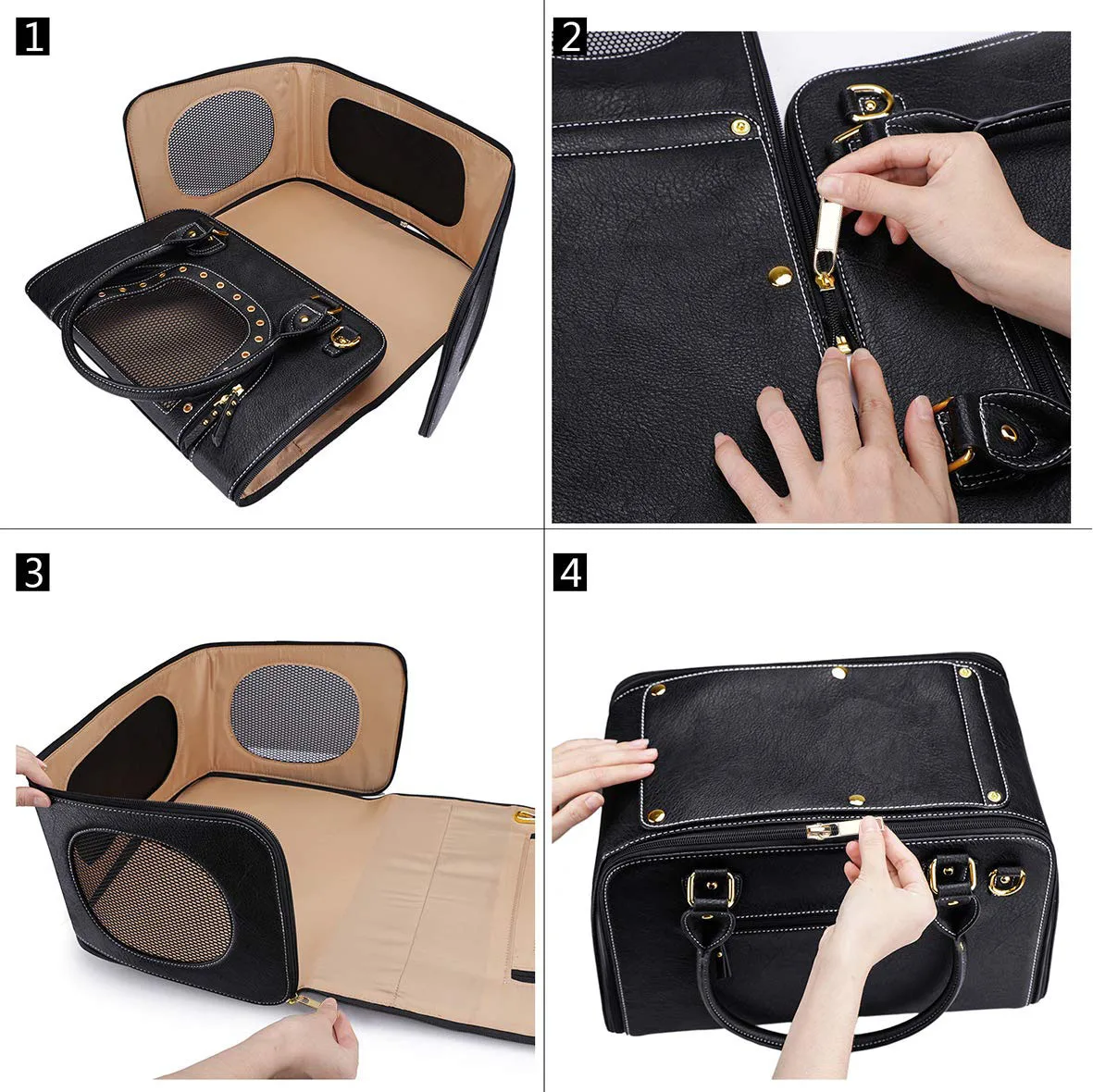
The most reliable expandable constructions are those in which the panel and its zipper are produced as one component rather than assembled from a panel plus a separately sewn zipper. One-piece forming removes the seam that would otherwise sit between the zipper tape and the panel — the seam that, in a deployed panel under load, is the first thing to fail.
Three routes are used in production. High-frequency welding joins a TPU- or PVC-coated panel to a compatible zipper tape in a single operation with a shaped electrode, giving a continuous bond with no stitch holes and a flat profile that stows cleanly. Hot-air or hot-wedge welding works on polyolefin-coated fabrics and gives a wider, slightly stiffer bond. Sewn-and-taped construction is the fallback where coating chemistry rules welding out, using a 10-12 mm seam allowance with a 20 mm waterproof tape applied over the stitch line.
Electrode geometry is the practical constraint on the welded routes. A shaped electrode has to follow the gusset profile including the corner radii, and every change to the gusset geometry means a new electrode at 600-1,800 USD. That cost is why the gusset geometry should be frozen before sampling rather than adjusted through three sample rounds: the electrode, not the sewing, is the expensive part of the iteration.
Corner treatment is where one-piece forming earns its cost. A gusset corner is a three-dimensional junction where two fold lines and the zipper chain meet; sewing it produces a bunched, stiff corner that will not stow, while welding with a formed corner produces a flat junction with no added bulk. A formed corner also removes the claw-catch point that a sewn corner presents, which matters in a panel a cat can reach from inside.
Tolerance control follows from forming rather than fitting. Because the zipper is joined to the panel before assembly, the panel's dimensions are set by the weld fixture and do not depend on operator skill at the sewing stage. Variation in deployed volume between units drops from +/-8% on a sewn assembly to +/-3% on a welded one, which is the difference between a consistent retail product and an inconsistent one. One-piece forming is bought for dimensional consistency and corner geometry; the strength improvement is a bonus.
Zipper Selection for Expansion Panels: Chain, Slider and Tape
The expansion zipper is asked to do something a closure zipper is not: it carries tension in the deployed state, it bends through a corner, and it is operated while the panel is under load. Specifying it like an ordinary pocket zipper is the most common error in expandable designs.
Chain size is set by the tension rather than by the opening length. A #5 coil chain is adequate for a stowed panel carrying no load but is marginal once the panel is deployed and the fabric pulls; a #8 coil or a #5 metal chain is the working specification for panels above 100 mm depth. The chain must also tolerate bending through the corner radii — a metal chain of #8 will not track a 30 mm radius smoothly, which is why large-depth panels usually end up with coil chain despite its lower tensile rating.
| Panel depth | Chain | Tape | Slider | Cycle target |
|---|---|---|---|---|
| Under 80 mm | #5 coil, reverse | 28 mm polyester | Single, auto-lock | 3,000 |
| 80-120 mm | #8 coil, reverse | 32 mm polyester | Single, auto-lock | 3,000 |
| 120-150 mm | #8 coil, reverse | 32 mm, reinforced | Double, opposed | 5,000 |
| Bellows with roof | #8 coil + #5 secondary | 32 mm, reinforced | Double, opposed | 5,000 |
Reverse coil — chain on the inside of the tape, smooth face out — should be specified for any panel a cat can reach. It removes the exposed chain as a claw-catch point and as a chewing target, and it presents a surface that can be wiped. The cost difference over standard coil is 0.08-0.20 USD per carrier.
Slider specification is the part that determines field behaviour. An auto-lock slider with a pull of at least 35 mm length lets the owner operate the panel one-handed while holding the carrier; a double opposed slider arrangement lets the panel be opened from either end, which is what allows partial deployment. Slider pull strength — the force needed to separate the pull from the slider body — should be specified at 80 N minimum, because a pull that comes off in service leaves the panel stuck in whichever state it was in.
Tape compatibility with the welding route has to be confirmed before the chain is ordered. Zipper tapes are finished with their own coatings, and not all of them weld to a given panel coating: a mismatch produces a bond that looks correct and peels at 20-30 N. Specify the zipper as a welded system component, not as a hardware item bought to a size.
Structural Integrity in the Deployed State: Floor and Load Transfer
A deployed panel creates a volume that the floor has to carry and a side wall that has to hold tension. Most expandable carriers handle the first adequately and the second not at all, which is why deployed carriers sag at the panel and why the zipper chain at the panel root is the usual failure.
The floor question is straightforward: the added volume is only usable if the floor extends into it. Two constructions work. A floor slide uses a second board that draws out from under the primary board, giving full support across the deployed footprint at 180-320 g of added mass and 1.40-2.80 USD. A hinged flap uses a board hinged at the panel root that folds down into the deployed space, which is lighter at 90-160 g but leaves a hinge line the cat can feel and, over time, a crease that collects dirt.
Load transfer at the panel root is the harder problem. When the panel is deployed and the cat moves into it, the panel fabric pulls against its attachment to the shell, and that load passes through the zipper chain and its tape bond. The control is a load-spreader: a webbing or reinforced tape of 25 mm width stitched or welded around the full perimeter of the panel root, taking the tension in the webbing rather than in the chain. A spreader of this kind raises the panel root's failure load from 150-250 N to 400-600 N for 0.30-0.70 USD.
Side wall tension determines whether the deployed panel stays square. A fabric panel with no structure will pull into a curve under load, reducing usable volume and pulling the zipper chain out of plane. Two light controls are effective: a perimeter rod of 3-4 mm spring steel in a bound sleeve at the panel's outer edge, adding 60-110 g, or a tensioned corner cord from the panel's outer corners to the shell, adding 15-40 g. The corner cord is the better value and is invisible when stowed.
Base seam loading completes the picture. A deployed panel shifts the centre of mass of the loaded carrier away from the handle axis, so the handle and strap anchors see an eccentric load in the deployed state. The acceptance test should therefore be run deployed as well as stowed, and the anchor specification taken from the worse case. The deployed state is a different structure from the stowed one and needs its own acceptance criteria.
Closure Forces, Mesh Tension and Shape When Deployed
Deployed panels are closed and opened repeatedly, usually by one hand, and the force required is a specification that is almost never written down. It should be: a closure force above roughly 45 N makes the panel awkward to operate while holding a cat, and a force that varies by more than 30% around the travel indicates a geometry problem rather than a hardware one.
Force variation around the travel is diagnostic. A panel that is easy for the first third and stiff for the last two-thirds has a gusset whose fold geometry does not match its deployed shape — the fabric is being stretched rather than unfolded. The fix is almost always to add 10-20 mm of gusset depth at the corners rather than to change the zipper; a stiffer zipper is the wrong answer and makes the problem worse over time.
Mesh tension in the deployed panel is a separate requirement. If the panel carries mesh for ventilation, the mesh is slack when stowed and has to be taut when deployed, and a mesh panel that stays slack will bulge outward and catch on everything. The control is a mesh cut 3-5% undersize against the deployed opening so it is pre-tensioned in the deployed state, together with a bound edge of 18-22 mm that distributes the tension rather than concentrating it at the stitch line.
Shape retention in the deployed state is the acceptance criterion customers actually judge. A deployed panel that stands square reads as added room; one that sags into a curve reads as a defect even though the volume is identical. The measurement is simple: deploy the panel, load the carrier to 10 kg distributed into the extended area, and measure the panel's outer edge height after 60 seconds. Acceptance is a drop of no more than 15 mm from the unloaded deployed height.
Temperature affects all three of these. A coated fabric stiffens at low temperature, raising closure force, and a welded panel bond loses some flexibility too. The closure force measurement should be repeated at 5 °C and at 40 °C, with acceptance of no more than 40% variation from the 23 °C figure. Deployed-state engineering is mostly a geometry problem, and geometry problems are fixed at the gusset rather than at the zipper.
Containment: the Escape Paths an Expansion Panel Creates
An expandable panel adds a zipper, a fold and a flexible wall to a product whose primary job is containment. Every one of those is a potential escape path, and cats are better at finding them than dogs are, because a cat will work a gap with a paw rather than pushing against it with its body.
The zipper is the first path. A cat pressing against a deployed panel puts sustained outward load on the chain, and a coil chain under that load can be opened from the inside by a claw working between the elements. Two controls: a reverse-coil chain so there is no exposed element to hook, and a secondary closure — a hook-and-loop flap of 40-60 mm over the zipper line, or a clip at each end of the travel — so that even a partially opened chain does not create an aperture.
The fold is the second path. A gusset fold that does not sit flat against the shell leaves a triangular gap at each corner when stowed, and a gap of 20-30 mm at the corner is enough for a determined cat to work a paw through. The control is a corner radius at the fold of 30-45 mm combined with a bound corner, and an inspection criterion that the stowed panel shows no gap above 10 mm anywhere along its perimeter.
The flexible wall is the third path and the hardest to control. A deployed fabric panel can be pushed outward from inside, and while it will not open, it can deform enough to let a cat work at the corner cord or the panel root. A panel reinforced with a perimeter rod or corner cords resists this; an unreinforced one does not. Where reinforcement is not acceptable on cost grounds, the answer is to limit the panel depth to 100 mm so the deformation cannot produce a usable gap.
Escape testing should be written as a protocol rather than left to judgement. A loaded panel is subjected to a 100 N outward force applied through a 60 mm pad at the panel centre and at each corner for 60 seconds, with acceptance of no aperture above 15 mm and no chain separation. A second test applies a 40 N claw-hook load at the zipper line. An expandable carrier is a containment product first and a volume product second; the containment acceptance limits come from the deployed state.
Cycle Testing and Acceptance for the Expansion Mechanism
Expansion mechanisms fail by fatigue rather than by overload: the chain, the tape bond and the fold line each degrade with repeated operation, and the failure appears at a cycle count well below the load the component can carry in a single test. Cycle testing is therefore the central acceptance test for an expandable design.
The protocol is 3,000 full deploy-and-stow cycles for panels up to 120 mm and 5,000 for deeper ones, run on a fixture that operates the slider at 200-300 mm/s and applies a 2 kg load to the panel so it is cycled under realistic tension. Acceptance is no chain separation, no tape bond peel beyond 3 mm, no stitch breakage and no increase in closure force above 30% of the initial value.
A soiled cycle set is worth running separately. Cat hair, litter dust and dried moisture accumulate in the chain and raise operating force substantially, and the effect is worse on coil chain than on metal. The protocol adds 500 cycles with 2 g of fine particulate introduced into the chain, with acceptance of no jam and closure force still under 45 N. A design that passes clean and fails soiled will fail in the field, because owners do not clean zipper chains.
Environmental conditioning closes the protocol. One set is conditioned at -10 °C for four hours and cycled 200 times to catch coating stiffening and bond embrittlement; another is conditioned at 50 °C and 85% relative humidity for 48 hours and cycled 200 times to catch hydrolytic softening at the tape bond. Both are cheap tests and both catch defects that a room-temperature cycle set misses.
Method references for conditioning and textile testing follow practice published by ASTM International, and textile and coating components are screened against OEKO-TEX criteria before release. Every cycle report should record closure force at the start, middle and end of the run rather than a pass/fail outcome, since the trend is more informative than the endpoint.
Cost, Tooling and Programme Notes
An expansion panel adds 3.80-8.60 USD to unit cost depending on depth and construction, which is a larger increment than most buyers expect for what looks like a fabric modification. The breakdown: panel fabric and forming at 0.90-2.20 USD, the zipper at 0.80-2.40 USD depending on chain and slider count, the floor slide or flap at 1.40-2.80 USD where fitted, reinforcement and load spreaders at 0.30-0.70 USD, and the added assembly labour at 0.40-0.90 USD — expansion panels are among the slower operations on a carrier line.
Tooling is modest on the sewn route and meaningful on the welded one. A high-frequency welding electrode for a shaped gusset runs 600-1,800 USD with a two to three week path, and it is geometry-specific: any change to the gusset profile or corner radius means a new electrode. Programmes should budget for two electrode iterations, because the first rarely produces an acceptable corner.
Labour is the underestimated line. Stowing and aligning a gusseted panel takes roughly 40-70 seconds more per unit than a plain panel, and on a 500-piece order at MOQ that is 6-10 additional line-hours. It also raises the defect rate: panel misalignment is the most common visual defect in expandable carriers and should be a defined defect class in the AQL 2.5 inspection with a stated tolerance of 3 mm.
Positioning advice closes the section. Expansion is a feature that sells well and is used inconsistently, so the retail presentation has to make the deployed state visible — a photograph of the deployed panel and both dimensional figures on the packaging. Our production team builds expandable programmes through the SGS-verified production base under ISO 9001 and BSCI coverage, with prototypes in 6-10 working days, bulk production 35-50 days after approval, T/T 30/70 and FOB Xiamen. Expansion is worth specifying when the deployed volume is genuinely used; it is not worth specifying as a checklist feature.
Order and quality terms
- MOQ 500 pieces per colourway; samples in 6-10 working days
- Bulk production 35-50 days after approval; AQL 2.5 inspection standard
- T/T 30/70 terms, FOB Xiamen, full document set per shipment
People Also Ask
How much extra space does an expandable cat carrier add?
Typically 12-22 litres, taking a 40-litre base to 52-62 litres with a gusset depth of 80-150 mm. Below 80 mm the added volume is not perceptible to the animal.
Should the expansion panel add floor area or headroom?
Floor area. Cats use added depth rather than added length or height — they will lie in 100 mm of extra floor but will not use 100 mm of extra headroom.
Why is a one-piece formed panel better than a sewn zipper?
It removes the seam between zipper tape and panel, gives a flat corner that stows cleanly, and cuts deployed-volume variation from +/-8% to +/-3%. The weld fixture, not the operator, sets the dimension.
What zipper suits an expansion panel?
#8 reverse coil with a 32 mm tape and an auto-lock slider for depths of 80-150 mm. Reverse coil removes the exposed chain as a claw-catch point and presents a wipeable surface.
How much closure force is acceptable?
Under 45 N, with no more than 30% variation around the travel and no more than 40% variation between 5 °C and 40 °C. Stiffness at the end of travel is a gusset geometry fault, not a zipper fault.
How is the deployed floor supported?
By a sliding second board at 180-320 g and 1.40-2.80 USD, or a hinged flap at 90-160 g. A perimeter load-spreader webbing at the panel root raises its failure load from 150-250 N to 400-600 N.
Can a cat escape through an expansion panel?
Only if the design leaves a path. Controls are reverse-coil chain, a hook-and-loop flap over the zipper line, corner radii of 30-45 mm at the fold, and a 15 mm maximum aperture under a 100 N outward load.
Frequently Asked Questions
What gusset depth is recommended for the cat class?
80-150 mm. Above 150 mm the deployed panel becomes a cantilever the floor has to support and the structural cost rises steeply, and the deployed footprint stops being under-seat compliant.
Why should the fold line be mitred rather than straight?
A straight fold bunches at the corners and will not lie flat against the shell when stowed. A mitred or radiused fold 30-45 mm from each corner stows flat and opens without fighting the fabric.
How should the fold be marked?
With a pressed crease or a stitch line. An unmarked fold on a coated fabric migrates with use and produces a panel that sits proud of the shell.
What does a high-frequency welding electrode cost?
600-1,800 USD with a two to three week path, and it is geometry-specific. Any change to the gusset profile or corner radius requires a new electrode, so budget for two iterations.
Which welding route suits which coating?
High-frequency welding for TPU- or PVC-coated panels, hot-air or hot-wedge for polyolefin coatings, and sewn-and-taped with a 20 mm waterproof tape where coating chemistry rules welding out.
Why is metal chain avoided on deep panels?
A #8 metal chain will not track a 30 mm corner radius smoothly, which is why deep panels usually use coil chain despite its lower tensile rating.
What slider pull strength should be specified?
At least 80 N. A pull that separates from the slider body in service leaves the panel stuck in whichever state it was in, which is a warranty return rather than a minor defect.
Why must zipper tape weld compatibility be confirmed early?
Zipper tapes carry their own finishes and not all weld to a given panel coating. A mismatch produces a bond that looks correct on inspection and peels at 20-30 N.
What are the trade-offs between a floor slide and a hinged flap?
A slide gives full support across the deployed footprint at 180-320 g and 1.40-2.80 USD. A flap is lighter at 90-160 g but leaves a hinge line the cat can feel and a crease that collects dirt over time.
How is the deployed panel kept square?
A tensioned corner cord from the panel's outer corners to the shell at 15-40 g, or a perimeter rod of 3-4 mm spring steel at 60-110 g. The cord is better value and is invisible when stowed.
How should mesh in an expansion panel be cut?
3-5% undersize against the deployed opening so it is pre-tensioned when deployed, with a bound edge of 18-22 mm to distribute tension away from the stitch line.
What is the escape test protocol?
100 N outward through a 60 mm pad at panel centre and each corner for 60 seconds, accepting no aperture above 15 mm and no chain separation, plus a 40 N claw-hook load at the zipper line.
How many deploy cycles are required?
3,000 for panels up to 120 mm and 5,000 for deeper ones, at 200-300 mm/s with a 2 kg panel load, plus 500 soiled cycles with 2 g of fine particulate in the chain.
What does an expansion panel add to unit cost?
3.80-8.60 USD, split across fabric and forming, zipper, floor extension, reinforcement and 40-70 seconds of additional assembly labour per unit.
Talk to QUANZHOU JUNYUAN BAGS about a pet carrier program: MOQ 500 pieces per colourway, samples in 6-10 working days, bulk production in 35-50 days under AQL 2.5 inspection.
Get a free quote Request a sample