Cat Carrier with Food Bowl: Travel Accessories
A travel food bowl for a cat carrier should hold 250-450 ml at a depth of 30-45 mm with a rim radius of 3-5 mm, be moulded from a food-contact material with overall migration under 10 mg/dm², and be retained by an attachment rated to 60 N in any direction. Silicone and polypropylene are the two practical material classes.
A food bowl looks like the simplest accessory in the range and is in fact the one with the most external regulation, because it is the only component that is legally a food-contact article in several markets at once. This page specifies it on three axes: the migration and substance requirements that govern material choice, the geometry that governs whether an animal will actually eat from it, and the attachment and retention requirements that govern whether it survives transport. The geometry section is the one most often skipped, and it is the one that determines whether the accessory is used or carried unused — a deep narrow bowl causes whisker contact and a substantial share of cats will refuse it. The attachment section is the one that generates field complaints, because a bowl stowed loosely inside a compartment becomes a projectile and a contamination source. Commercial terms follow the standard programme: MOQ 500 pieces per colourway, prototypes in 6-10 working days, bulk production 35-50 days after sample approval, final random inspection to AQL 2.5, T/T 30/70 and FOB Xiamen.
A pet carrier manufacturer is judged on three numbers in this category - MOQ per colourway, sample turnaround and the AQL level applied at final inspection. Ours are 500 pieces, 6-10 working days and AQL 2.5.
Food Contact Regulatory Frame and Material Classes
The bowl is regulated as a food-contact article, and the requirements are not optional or market-specific in the way that a fabric claim is. Three frameworks apply across the main export markets, and a material selection that satisfies all three is narrower than most buyers expect.
Overall migration is the first requirement. Both the EU framework regulation and the US food-contact system set an overall migration limit of 10 mg per square decimetre of contact surface, or 60 mg per kilogram of food simulant depending on the jurisdiction's expression. Testing uses food simulants rather than food: distilled water or 10% ethanol for aqueous foods, 3% acetic acid for acidic foods, and a fatty simulant such as isooctane or olive oil for fatty foods, which is the relevant one for wet cat food at 5-12% fat.
Specific migration is the second requirement and it is where material selection narrows. Restricted substances include certain plasticisers, primary aromatic amines from azo colourants, and specific metals; the practical consequence is that plasticised PVC is excluded, recycled content of unknown origin is excluded, and colourants have to be declared rather than chosen from a generic masterbatch.
Substance restrictions under the chemical regimes are the third layer. Restricted substance lists apply to the article as placed on the market, which for a bowl means the moulding, any colourant, any printing ink and any adhesive used to attach a component. The relevant regime for the European market is administered by ECHA, and a US market placing additionally has to be considered against the substance list maintained by OEHHA under Proposition 65.
| Material | Overall migration | Temperature range | Fat resistance | Cost per unit |
|---|---|---|---|---|
| Polypropylene, food grade | Under 10 mg/dm² | -10 to 100 °C | Good | 0.40-1.10 USD |
| Silicone, platinum cured | Under 10 mg/dm² | -40 to 200 °C | Excellent | 0.90-2.60 USD |
| Stainless steel 304 | Non-migrating | Unlimited in range | Excellent | 1.20-3.40 USD |
| TPE, food grade | Under 10 mg/dm² | -20 to 80 °C | Poor with fat | 0.60-1.60 USD |
| Melamine | Under 10 mg/dm² if compliant | -10 to 70 °C | Good | 0.80-2.00 USD |
| Plasticised PVC | Fails | 0 to 50 °C | Poor | Excluded |
Curing chemistry matters for silicone specifically. Platinum-cured silicone has low residual volatile content and passes migration screening with margin; peroxide-cured silicone carries decomposition residues and may require an extended post-cure, which is a process cost rather than a material one.
Declaration and traceability close the item. Each bowl production lot should carry a food-contact declaration referencing the simulants, conditions and result, retained with the production record. Material selection is set by migration testing and substance lists, not by hardness or colour; plasticised PVC and undeclared recycled content are not options.
Bowl Geometry: Volume, Depth, Rim and Whisker Clearance
Geometry determines whether the accessory is used, and the parameter that governs it is whisker clearance. This is the most under-specified dimension in the category and the most common reason a bowl comes back unused.
Whisker fatigue is the mechanism. A cat's vibrissae are highly innervated, and repeated contact with the sides of a bowl during feeding is aversive; a bowl deep enough that the animal's whiskers touch the wall on every bite will be refused by a substantial share of cats. The requirement is an internal diameter of at least 1.5 times the animal's whisker span, which for the adult population is 130-200 mm of whisker span and therefore a bowl diameter of 200-300 mm.
Depth follows from diameter and volume. A 250-450 ml serving in a 220-260 mm diameter bowl is 8-12 mm deep, which is too shallow to contain a dry kibble without spillage; the working compromise is 30-45 mm of depth at a 180-240 mm diameter, which gives 380-450 ml of usable volume while keeping wall contact below the whisker line for most animals.
Rim geometry is the second parameter and it is a cleaning and comfort one. A rim radius of 3-5 mm with no sharp edge is required — a sharp moulded edge both retains residue and contacts the animal's chin. An inward-turned lip of 4-8 mm reduces spillage at the cost of a cleaning trap, and is only worth it for a bowl used in a moving vehicle.
Floor geometry is the third. A flat internal floor of at least 70% of the bowl's plan area lets the animal retrieve the last of the food; a strongly radiused bowl concentrates it and the animal gives up, which reads as the animal not liking the product.
Stability is the fourth and it interacts with the animal's behaviour. A bowl that slides while the animal eats will be abandoned; the requirement is a base with a coefficient of friction of at least 0.40 against the carrier floor and a mass or a fixing sufficient to resist a 5-10 N horizontal push. A silicone bowl achieves this by material; a polypropylene one needs an elastomer ring or a mechanical fixing.
Portion sizing closes the geometry. A single meal for an adult cat is 40-80 g of wet food or 30-60 g of dry, occupying 45-90 ml and 60-140 ml respectively; the 250-450 ml working volume covers a double serving and the displacement of the animal's muzzle. A bowl of 180-240 mm diameter at 30-45 mm depth satisfies whisker clearance and capacity; a deep narrow bowl is refused regardless of its material compliance.
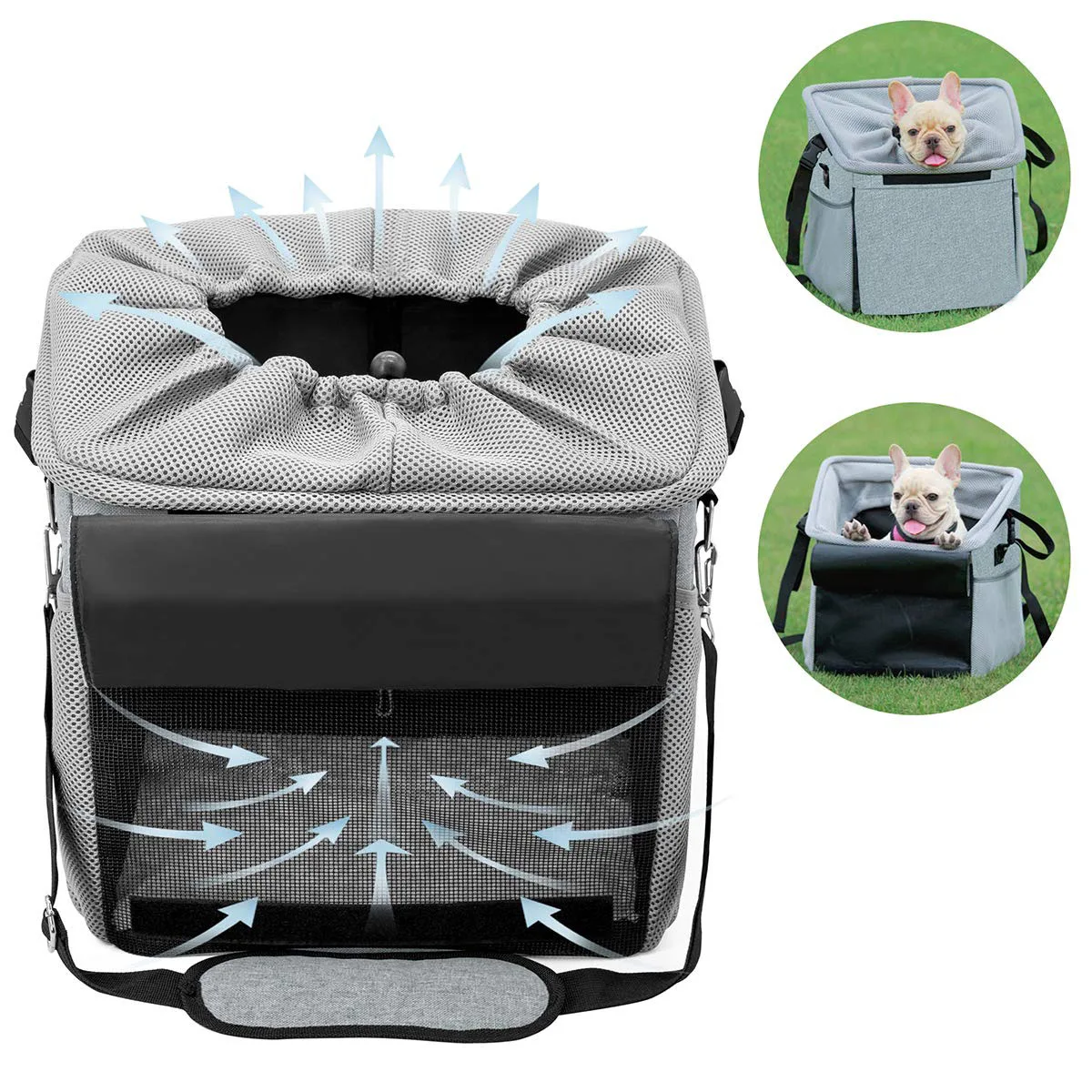
Attachment, Retention and Spill Control in Transit
A bowl that is not retained is worse than no bowl, because a loose rigid object in a compartment with an animal is both a hazard and a contamination source. Three attachment approaches are used and each has a defined load case.
Clip-on attachment to the carrier's interior is the most common. The load case is not the bowl's weight — the bowl is 60-260 g — but the prying load applied by an animal stepping on or against it, which reaches 40-80 N at an unfavourable angle. The specification is a clip rated to 60 N in any direction with a release force of 25-45 N so the user can still remove it for cleaning.
Folding or moulded-in attachment is the second and it removes the release problem entirely by making the bowl part of the shell. It suits a silicone bowl bonded or over-moulded to a fabric panel, it costs 1.80-4.60 USD, and its weakness is the bond line, which has to survive 300 cleaning cycles and a peel load of 40-60 N.
Pocket storage is the third and it is the right answer for transit rather than for feeding: the bowl is stowed in a dedicated external or internal pocket while moving and deployed at rest. The pocket needs a closure rated to 40 N and a drain path, because a wet bowl stowed in a closed pocket is a microbial problem.
Spill control during transit is a separate decision, and the honest answer is that a bowl should travel empty. A bowl with 200 ml of water in it under 0.3 g of lateral acceleration sheds over a 30 mm wall within two seconds; no practical geometry prevents that without a lid, and a lidded bowl is a container rather than a bowl. Where a product must travel with contents, the requirement is a sealed lid with a compression closure at 8-15 N and a leak test of 30 minutes inverted.
Vibration and rattle are the last transit items. A bowl that is retained but has clearance will rattle, which is both a noise and an arousal problem; the specification is a maximum clearance of 1.5 mm at the attachment under a 5 N shake, verified by a fifteen-minute shake test at 5 Hz and 0.3 g with a sound ceiling of 55 dB at 300 mm.
Placement inside the compartment matters for contamination. The bowl should be attachable outside the animal's elimination area and above the floor line, and where the carrier has an integrated litter tray, the bowl must not share a wall with it. Travel empty, retain to 60 N, and keep the clearance under 1.5 mm; the load case is the animal prying at the bowl, not its weight.
Wet Food, Dry Food and Residence Time
Food type changes the material and cleaning requirements more than the geometry, and the variable that matters is residence time — how long food sits in the bowl before it is cleaned.
Wet food is the demanding case. At 75-82% moisture and pH 5.5-6.5 with 5-12% fat, it supports bacterial growth rapidly: at 25 °C a contaminated portion reaches 10^6 colony-forming units per gram within four to eight hours. The requirement is that the bowl be cleaned within two hours of use with wet food, which is an instruction-label item rather than a design one, and that its surface be non-absorbent so residue does not persist between cleanings.
Fat absorption is the specific material risk with wet food. Polypropylene absorbs negligible fat; thermoplastic elastomer absorbs 0.5-3% by mass over repeated exposure and then releases it as rancidity, which is why TPE is listed as poor with fat in the material table despite passing migration screening. Silicone absorbs 1-5% depending on the grade, which is acceptable if the bowl is cleaned promptly and unacceptable if it is not.
Dry food is the milder case chemically and the harder one physically. Kibble at 6-12% moisture and 8-20% fat is abrasive — a bowl used for dry food receives 200-600 abrasive contacts per meal from kibble alone — and it generates dust and fines that work into any seam. Abrasion resistance of the bowl surface should be specified at no visible scratching after 5,000 cycles of a standard abrading head at 9 kPa.
Residence time is the design driver for the cleaning instruction. Under two hours is the target for wet food; under twenty-four hours for dry. Where a product is sold for journeys where cleaning is impractical, the right answer is a disposable liner or a single-use insert rather than a claim that the bowl can be left.
Temperature is the last variable. Food served at 20-40 °C is within the range of every listed material; food heated above 70 °C, which happens when owners warm wet food, exceeds the range of TPE and approaches the limit of polypropylene. Silicone at 200 °C and stainless steel are the safe choices where heating is expected, and the instruction label should say so.
Feeding and welfare guidance for travel is normally cross-checked against published material from the American Veterinary Medical Association, particularly on withholding food before transport. Wet food sets a two-hour cleaning requirement and a fat-absorption limit; silicone or polypropylene for heated food, and never TPE.
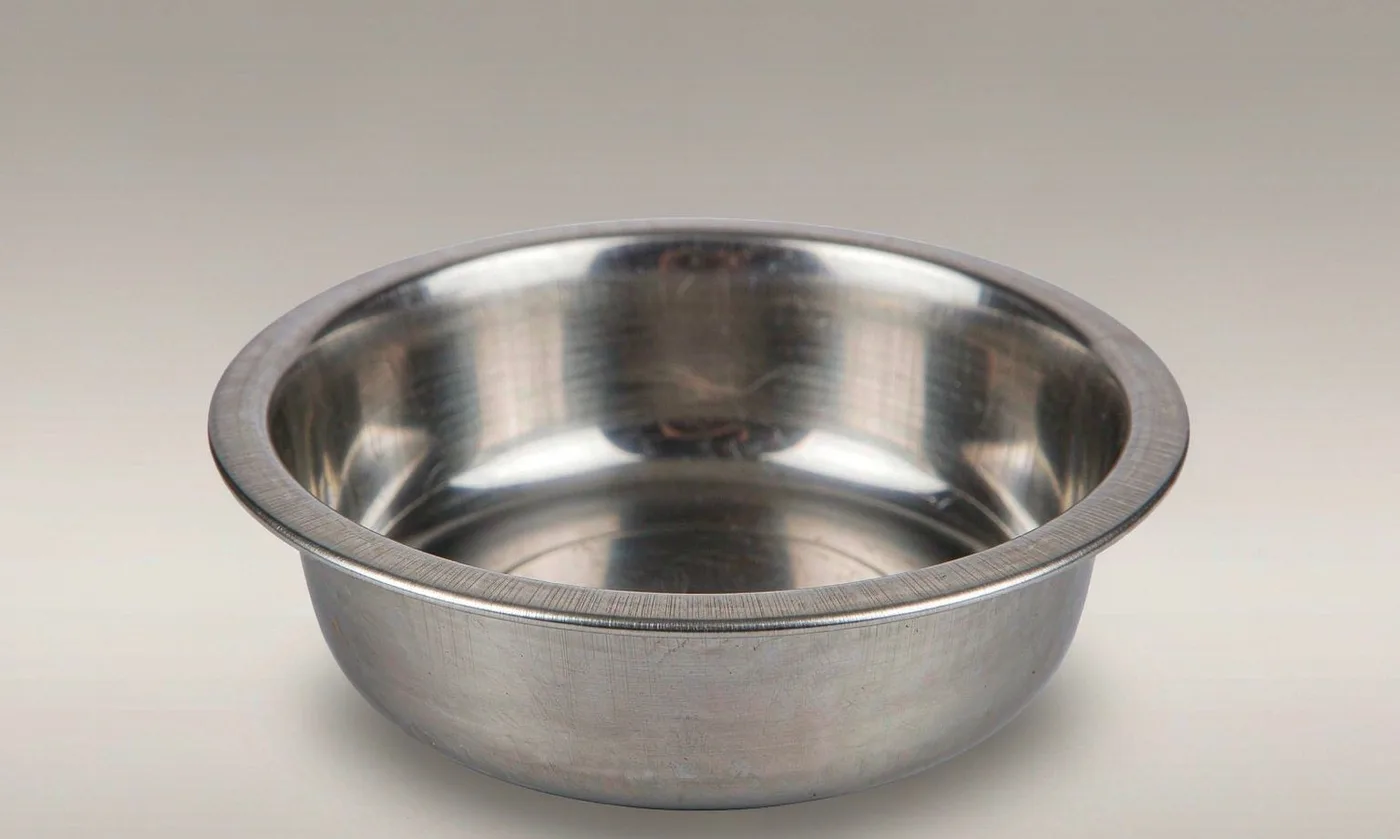
Cleaning, Biofilm and Bacterial Load
A bowl's hygiene performance is governed by surface energy and by geometry rather than by any antimicrobial feature, and the parameter that predicts it is cleanability rather than initial bacterial count.
Biofilm formation is the mechanism. A surface that is not cleaned completely within 24-48 hours develops a bacterial biofilm that resists subsequent rinsing, and once formed it is the source of persistent odour and of the slimy feel that owners report. Biofilm forms faster on a scratched or high-surface-energy surface, which is why abrasion resistance and a low-energy finish matter.
Surface roughness is the measurable predictor. A moulded polypropylene bowl at a roughness average of 0.2-0.8 microns releases residue under a rinse; the same bowl after 2,000 abrasion cycles at 2-5 microns retains it. The specification is a roughness average under 0.8 microns as moulded and under 1.6 microns after the abrasion test.
Geometry is the second predictor and it follows the rim and floor rules already given: no inward-turned lip, no sharp corners at the wall-to-floor junction below 3 mm radius, and no bonded-in components. A bowl with a 4-8 mm inward lip for spill control fails this and should only be used where the spill case is real.
Cleaning method and validation is the third item. The bowl should be dishwasher safe at 60-70 °C or hand-washable at 40-50 °C with detergent at pH 7-11, and the validation is a residue test: a standard soiling challenge, the defined wash, then a protein residue swab with acceptance below a defined threshold by a rapid protein detection method. ATP or protein swabbing gives a number where a visual check gives an opinion.
Antimicrobial additives deserve the same caution here as elsewhere. Silver or triclosan-based additives in a food-contact article are additionally regulated, they do not prevent biofilm on a surface that is not cleaned, and they add 0.20-0.80 USD and a regulatory surface. They are not recommended.
Cycle testing closes the item: 500 wash cycles at 65 °C with detergent, followed by a migration re-test, a roughness measurement and a dimensional check. A bowl that passes initial migration and fails it after 500 washes is a common outcome with lower-grade silicone and is worth finding before tooling. Cleanability is a roughness and geometry specification; an antimicrobial additive does not substitute for a surface that releases residue.
Integration Architectures and What Each Costs
How the bowl is integrated into the carrier determines most of the unit cost and most of the field complaints. Four architectures are in production, and they differ mainly in what happens to the bowl during transit.
The clip-on rigid bowl is the simplest. A moulded polypropylene or stainless bowl on a moulded clip, supplied loose or clipped, at 1.20-3.80 USD. Its weakness is that it is the item most likely to be lost, which is both a customer satisfaction problem and a spare-parts one.
The folding silicone bowl is the most popular at the mid-range. A platinum-cured silicone bowl with a collapsible wall of 1.5-2.5 mm, folded to 20-30 mm when stowed and 40-55 mm when deployed, at 2.20-5.40 USD. It stows flat, it is quiet, and its weakness is the wall's tendency to collapse inward under an animal pushing at the rim, which requires a wall thickness at the upper end of the range or a moulded stiffening ring.
The moulded-in or bonded bowl integrates with the shell and cannot be lost, at 3.60-8.20 USD including the bond or over-mould tooling. Its weakness is the bond line under cleaning cycles, and the fact that the whole carrier has to be cleaned rather than just the bowl.
The pocket-and-liner system separates the vessel from the product: a pocket holding a disposable or washable liner at 1.00-2.60 USD with consumable revenue. It is the right answer where cleaning during a journey is impractical, and it converts the accessory into a repeat purchase.
| Architecture | Unit cost | Loss risk | Cleaning | Best segment |
|---|---|---|---|---|
| Clip-on rigid | 1.20-3.80 USD | High | Dishwasher safe | Everyday travel |
| Folding silicone | 2.20-5.40 USD | Low | Dishwasher safe | Mid-range general |
| Moulded-in or bonded | 3.60-8.20 USD | None | Whole unit | Premium, airline |
| Pocket with liner | 1.00-2.60 USD | Medium | Liner replaced | Multi-day journeys |
| External stow pocket only | 0.60-1.80 USD | Medium | Separate | Accessory kits |
Bundling is worth noting as a commercial point. A bowl sold as part of an accessory kit — bowl, water bottle, pad, ID tag — has a higher attachment rate and a higher perceived value than the same bowl sold as a carrier feature, and it avoids carrying the food-contact compliance burden on the carrier's own bill of materials.
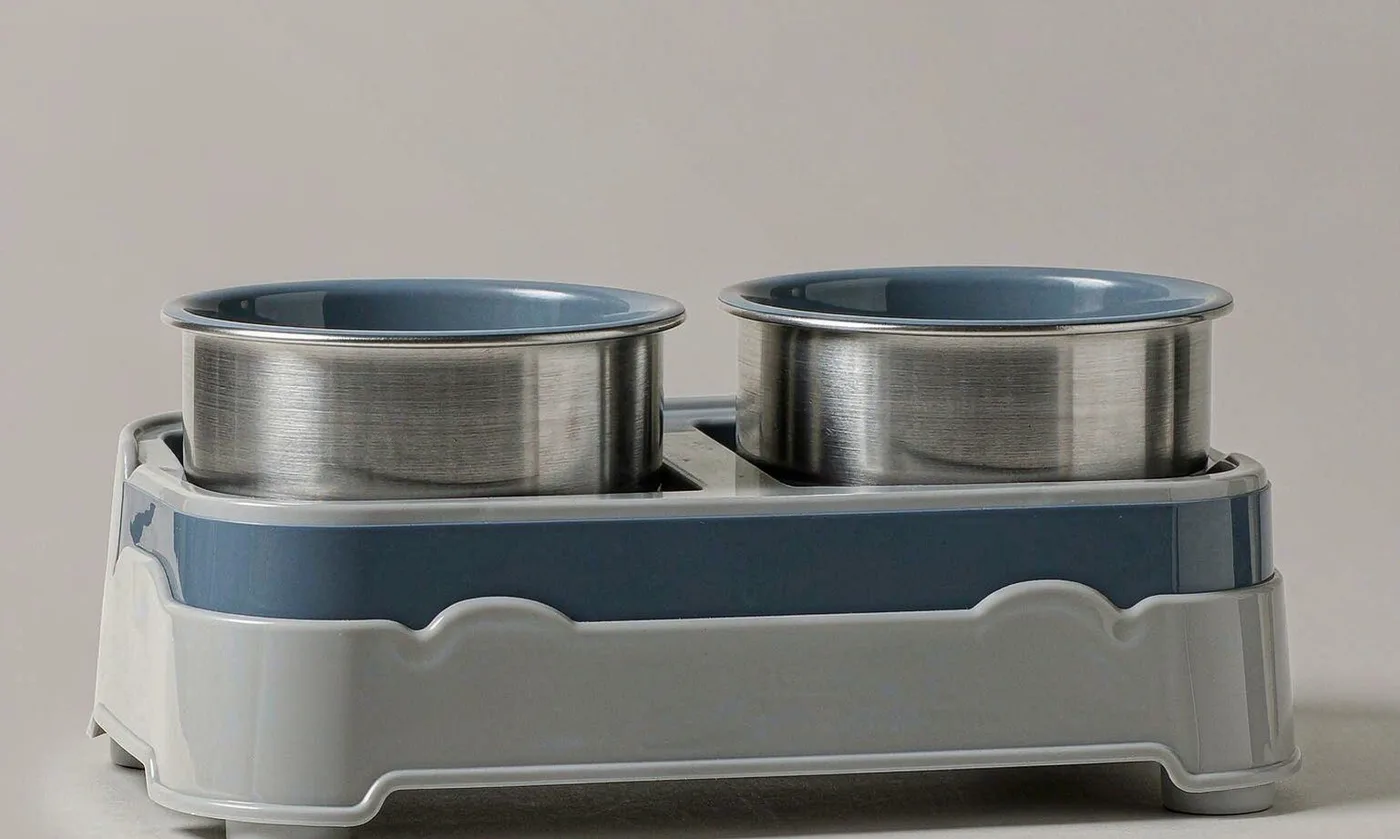
Cost, Tooling, Compliance Documentation and Programme Planning
A compliant bowl programme adds 2.20-8.20 USD per unit and, more significantly, a documentation burden that has to be planned before the first sample rather than after it.
Unit cost breakdown for a folding silicone bowl: the moulding at 0.90-2.60 USD, the stiffening ring or clip at 0.50-1.40 USD, the attachment hardware at 0.40-1.20 USD, and the packaging and instruction leaflet at 0.20-0.60 USD. A polypropylene clip-on bowl is cheaper on the moulding and dearer on the clip.
Tooling is an injection tool for a rigid bowl at 3,500-9,000 USD on six to ten weeks, or a compression or injection tool for silicone at 4,500-11,000 USD on seven to twelve weeks. A two-cavity tool roughly halves the unit cycle cost at a 60-80% tooling premium, which pays back above about 15,000 units.
Compliance documentation is the item that surprises buyers. Each material lot needs a food-contact declaration; the finished bowl needs a migration test report against the relevant simulants; and any colourant, printing ink or adhesive needs its own declaration. Budget 800-2,400 USD for the initial test set and 200-600 USD per additional colourway, since colourants change the migration result.
Market-specific placement matters. A bowl compliant with the EU framework and REACH is not automatically compliant for a California placement, and the Proposition 65 assessment is a separate exercise. Where a product sells into both, the substance declarations should be produced once and assessed against both rather than tested twice.
Colourway strategy follows from the above: because each colourant requires its own migration test, a bowl programme should launch in one or two colours and add colours only where volume justifies the 200-600 USD per colourway. This is the opposite of the usual textile logic, where a colourway costs nothing to add.
Our production team builds accessory programmes through the SGS-verified production base under ISO 9001 and BSCI coverage, with prototypes in 6-10 working days, bulk production 35-50 days after sample approval, final random inspection to AQL 2.5, T/T 30/70 and FOB Xiamen. Budget the migration testing and the per-colourway declarations before the first sample; they are the cost that is easy to forget and impossible to add afterwards.
Order and quality terms
- MOQ 500 pieces per colourway; samples in 6-10 working days
- Bulk production 35-50 days after approval; AQL 2.5 inspection standard
- T/T 30/70 terms, FOB Xiamen, full document set per shipment
People Also Ask
What material should a cat travel bowl be made from?
Food-grade polypropylene or platinum-cured silicone, both with overall migration under 10 mg/dm². Plasticised PVC fails migration and is excluded, and thermoplastic elastomer absorbs fat from wet food.
Why do cats refuse deep narrow travel bowls?
Whisker contact with the bowl wall is aversive. Internal diameter should be at least 1.5 times the whisker span, giving 200-300 mm, with a depth of 30-45 mm.
How much should a cat travel bowl hold?
250-450 ml, covering a double serving of 40-80 g wet or 30-60 g dry plus muzzle displacement, at a 180-240 mm diameter and 30-45 mm depth.
Should a bowl travel with food or water in it?
Empty. Under 0.3 g lateral acceleration a bowl with 200 ml sheds over a 30 mm wall within two seconds; a lidded sealed container is a different product, not a bowl.
How strong does the bowl attachment need to be?
60 N in any direction, because the load is the animal prying at it at 40-80 N rather than the bowl's own 60-260 g. Release force for the user should be 25-45 N.
How soon must a bowl be cleaned after wet food?
Within two hours at 25 °C, where a contaminated portion reaches 10^6 colony-forming units per gram in four to eight hours. Dry food can be left up to twenty-four hours.
What surface roughness keeps a bowl cleanable?
Under 0.8 microns roughness average as moulded and under 1.6 microns after 2,000 abrasion cycles. Above that, residue persists and biofilm forms within 24-48 hours.
Frequently Asked Questions
What is overall migration and what is the limit?
The total mass of substance migrating from the article into a food simulant, limited to 10 mg per square decimetre. Simulants are water or 10% ethanol, 3% acetic acid, and a fatty simulant for wet food at 5-12% fat.
Why is platinum-cured silicone preferred over peroxide-cured?
Platinum-cured material has low residual volatile content and passes migration screening with margin. Peroxide-cured material carries decomposition residues and needs an extended post-cure.
Which substances restrict bowl material selection?
Certain plasticisers, primary aromatic amines from azo colourants and specific metals. That excludes plasticised PVC, recycled content of unknown origin, and undeclared colour masterbatches.
What rim geometry should a bowl have?
A 3-5 mm rim radius with no sharp edge. A sharp moulded edge retains residue and contacts the animal's chin; an inward lip of 4-8 mm reduces spillage but creates a cleaning trap.
How much of the bowl floor should be flat?
At least 70% of the plan area, so the animal can retrieve the last of the food. A strongly radiused bowl concentrates it and the animal gives up.
How is bowl stability on the carrier floor specified?
A coefficient of friction of at least 0.40 and resistance to a 5-10 N horizontal push. Silicone achieves it by material; polypropylene needs an elastomer ring or a mechanical fixing.
What clearance limit applies to a retained bowl?
1.5 mm at the attachment under a 5 N shake, verified by fifteen minutes at 5 Hz and 0.3 g with a sound ceiling of 55 dB at 300 mm.
Why should a bowl not share a wall with an integrated litter tray?
Contamination. The bowl should be attachable above the floor line and outside the animal's elimination area, with no shared wall or air path with the tray.
What abrasion resistance is needed for dry food?
No visible scratching after 5,000 cycles of a standard abrading head at 9 kPa, because kibble delivers 200-600 abrasive contacts per meal and generates fines that work into seams.
How is cleaning validated objectively?
By a protein residue swab after a standard soiling challenge and the defined wash, with acceptance below a defined threshold. A visual check gives an opinion rather than a number.
Are antimicrobial additives recommended for a bowl?
No. They are additionally regulated in a food-contact article, they do not prevent biofilm on a surface that is not cleaned, and they add 0.20-0.80 USD and a regulatory surface.
Why is a migration re-test run after 500 wash cycles?
Because lower-grade silicone commonly passes initial migration and fails it after repeated washing at 65 °C. The re-test is paired with roughness and dimensional checks.
What does a folding silicone bowl cost and what limits it?
2.20-5.40 USD, with a collapsible wall of 1.5-2.5 mm. Its weakness is the wall collapsing inward under an animal pushing at the rim, needing a stiffening ring or a thicker wall.
Why does each bowl colourway need its own migration test?
Colourants change the migration result, so each colour requires its own declaration and test at 200-600 USD. Launch in one or two colours and add colours only where volume justifies it.
Talk to QUANZHOU JUNYUAN BAGS about a pet carrier program: MOQ 500 pieces per colourway, samples in 6-10 working days, bulk production in 35-50 days under AQL 2.5 inspection.
Get a free quote Request a sample