Cat Carrier with Removable Pad: Easy Cleaning
A removable pad for a cat carrier should pair a 25-35 kg/m³ open-cell foam core of 25-40 mm thickness with a fluid-resistant cover that absorbs 300-500 ml without strike-through and dries in under 4 hours at 25 °C and 55 % RH. The attachment must hold peel strength above 6 N/50 mm after 200 open-close cycles, and the whole assembly must survive 50 laundering cycles at 40 °C.
Removability is a manufacturing decision before it is a marketing one: a pad that can be pulled out of a carrier has to be built as a separate article with its own pattern, its own tolerances and its own attachment hardware, and every one of those adds cost. The payoff is real and measurable. A carrier with a fixed liner is set aside for deep cleaning after an accident, while a carrier with a replaceable pad is back in service in the time it takes to swap a part, and the brand sells a second SKU. Our production team specifies pad programmes on four axes: core compression behaviour, cover fluid performance, attachment endurance, and wash life. All four are tested before a sample is released, not after. Commercial terms follow the standard programme: MOQ 500 pieces per colourway, prototypes in 6-10 working days, bulk production 35-50 days after sample approval, final random inspection to AQL 2.5, T/T 30/70 and FOB Xiamen.
A pet bag supplier running cat carrier orders at 500 pieces per colourway can consolidate several sizes into one cutting window and hold the dye lot across reorders.
Pad Construction: Core Density, Thickness and Cover Fabric
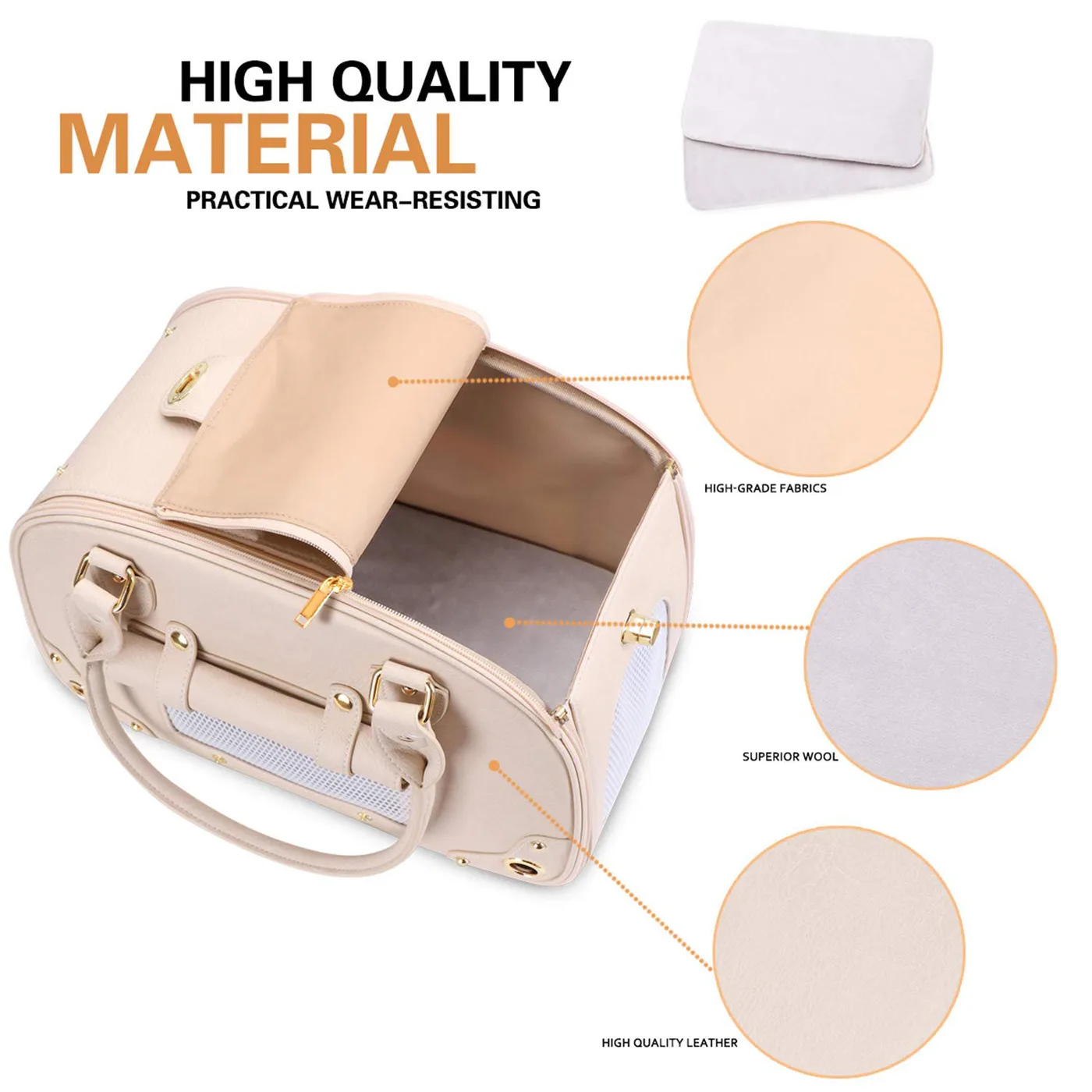
A removable pad is a laminate of three functional layers: a cover fabric that manages fluid, a core that manages load, and a backing that manages friction against the carrier floor. Specifying the pad as a single item with a single weight is the fastest route to a product that either bottoms out under a 5 kg cat or never dries.
The core is normally open-cell polyurethane foam, and the two numbers that matter are density and compression load deflection. Density of 25-35 kg/m³ gives a pad that recovers from compression without feeling like a board; below 22 kg/m³ the pad takes a permanent set within 200-400 hours of static load. Compression load deflection at 40 % compression should land at 2.5-5.0 kPa, which is the range where a 4-6 kg cat is supported without the pad collapsing to the floor.
Thickness interacts with density. A 25 mm core at 30 kg/m³ supports a 4 kg cat adequately and dries quickly after washing; the same foam at 45 mm supports a 7 kg cat but holds 180-260 ml of water after a spin cycle and needs 6-9 hours to dry. Our production team therefore sets thickness by the target cat weight band rather than by a universal number, and the pattern is cut to match the interior within 3-5 mm on all sides so the pad does not ride up the walls.
The cover fabric does the fluid work. A brushed polyester tricot is the softest option and is comfortable, but it absorbs into the cover itself and stains. A 210 D nylon with a PU coating of 15-25 g/m² resists fluid penetration and wipes clean, but is noisy and warm. The common compromise is a two-zone cover: a coated woven perimeter with a soft knit centre panel, which gives comfort where the cat lies and cleanability where fluids pool.
| Parameter | Lightweight pad | Standard pad | Premium pad |
|---|---|---|---|
| Core density | 22-25 kg/m³ | 28-32 kg/m³ | 35-40 kg/m³ |
| Core thickness | 20-25 mm | 30-35 mm | 40-50 mm |
| CLD at 40 % | 1.8-2.6 kPa | 3.0-4.2 kPa | 4.5-6.0 kPa |
| Absorption before strike-through | 180-260 ml | 320-420 ml | 480-620 ml |
| Dry time at 25 °C / 55 % RH | 2.0-3.0 h | 3.5-4.5 h | 6.0-9.0 h |
| Wash cycles to failure | 30-40 | 50-70 | 70-100 |
| Unit cost at 500 pcs | 0.95-1.35 USD | 1.50-2.10 USD | 2.60-3.60 USD |
The table is the selection grid used in quoting; note that dry time, not absorption, is usually the limiting factor for a premium pad at a boarding or veterinary operator, where turnover time is the constraint.
Attachment Systems: Hook-and-Loop, Snap, Zip and Friction Channel
How the pad stays put determines whether the removable feature survives the first month. Four systems are in common use, and each has a distinct failure mode that shows up in field returns rather than in the sample room.
Hook-and-loop is the cheapest and most forgiving of dimensional variation, and its peel and shear behaviour is covered by published test methods from ASTM International, which is what makes the strength figures below comparable between suppliers rather than marketing numbers. A 25 mm wide strip sewn to the pad engages a loop field bonded to the carrier floor. The failure mode is hair and lint packing the hook field, which reduces peel strength progressively: a fresh joint measures 10-14 N/50 mm, and after 200 cycles with cat hair present it falls to 5-8 N/50 mm. Below 6 N/50 mm the pad shifts under a moving cat. Using a mushroom-head hook with a higher filament density slows the loss by roughly 40 %, and it costs 0.04-0.08 USD more per carrier.
Snap fasteners give a positive, tactile location and are immune to hair. A 15 mm ring snap in brass or stainless steel holds 40-70 N in pull-off, which is far above any load a cat applies. The failure mode is the substrate: a snap pulled through a 210 D fabric at 60-80 N tears before it releases, so the snap point needs a 400 D reinforcement patch of at least 25 mm diameter. Snaps also require precise placement, and a 2 mm pattern error produces a visibly skewed pad.
A zip attachment is the premium solution and the only one that fully secures the pad on all four sides. A #5 coil zip with an auto-lock slider costs 0.35-0.65 USD per carrier including seaming, and it is the option to choose when the pad doubles as a mattress for a separate bed product. The failure modes are zipper-chain hair ingress and slider failure, and the mitigation is a covered zip with a garage at the pull end and a chain that has been run through 500 open-close cycles in testing.
A friction channel, where the pad slides into a sleeve formed by a fabric flap on the carrier floor, has no hardware at all and no hardware failure mode. It costs 0.10-0.20 USD to make, it is silent, and it allows the pad to be removed and re-inserted an unlimited number of times. It fails only on tolerance: if the pad is more than 5 mm narrower than the channel it bunches, and if it is more than 2 mm wider it will not insert without effort.
Fluid Management: Absorption, Strike-Through and Containment
A cat bladder holds 15-30 ml per kilogram of body mass, so a 4-6 kg cat releases 60-180 ml in a full void, and a stressed cat on a long journey may void twice. A pad specification built around a 100 ml event will be visibly inadequate on the first real incident, and the resulting review will say the product leaks.
Absorption capacity is measured by placing the pad on an absorbent blotter, dispensing fluid at 20-40 ml/min onto the centre, and recording the volume at which fluid first appears on the underside. Open-cell foam of 30 kg/m³ at 30 mm holds 320-420 ml in its cell structure before strike-through, and the cover fabric contributes nothing unless it is a needle-punched or spacer knit. Adding a 3-5 mm spacer-knit layer between cover and core raises capacity by 90-150 ml and reduces the wet feel against the coat, which is the difference between a pad that works and one that is technically adequate but feels wet.
Containment matters as much as absorption. Fluid that is held in the pad but migrates to the seam and wicks into the carrier floor produces the same failure from the customer point of view. The mitigation is a welded rather than sewn perimeter on the pad cover: a high-frequency weld at 20-30 kHz and 0.4-0.8 s dwell produces a seam with no needle holes, and it survives 50 wash cycles without leaking. A sewn perimeter with a bound seam needs a seam-sealing tape applied at 130-150 °C, which adds 0.12-0.20 USD and a process step that must be controlled.
One chemical detail is worth writing into the specification because it decides which cover finish survives: cat urine is mildly acidic at pH 6.0-6.5 on a normal diet and becomes alkaline at pH 7.0-7.5 where a urinary diet or a stone-forming condition is present, and it concentrates as it dries. A cover finish selected only for acidic resistance will fail against the alkaline end, so our production team tests fluid performance at both pH 6.0 and pH 7.5 rather than at a single neutral point. The difference shows up as a 15-25 % lower strike-through threshold at the alkaline end on acrylic-finished covers and almost no difference on polyurethane-coated ones.
Drying is the operational constraint that most specifications omit. After a 40 °C wash and a 600 rpm spin, a 30 mm foam pad retains 120-200 ml of water and needs 3.5-4.5 hours to dry at 25 °C and 55 % RH with air circulation on both faces. Standing it on edge against a wall roughly doubles that time. A boarding operator with a 4-hour turnaround requirement therefore needs either two pads per carrier or a thinner core, and that is a specification conversation, not a complaint.
Wash Endurance: What 50 Cycles Actually Does
Wash life is the number that separates a pad that is a consumable from a pad that is a durable component. The test is simple to run and rarely run: 50 cycles of a domestic laundering protocol at 40 °C with a standard reference detergent, with measurements at 10, 25 and 50 cycles.
On the cover fabric, the changes are dimensional and visual. A brushed polyester tricot shrinks 2-4 % and shows pilling grade 3 after 25 cycles and grade 2-3 after 50. A coated 210 D nylon shows under 1.5 % shrinkage but the PU coating begins to craze at 30-40 cycles, detectable as a loss of hydrostatic head from 600 mm to under 300 mm. That loss is why a coated cover should not be specified on a pad intended for 50+ washes.
On the core, the change is mechanical. Open-cell PU foam at 30 kg/m³ loses 8-14 % of its compression load deflection after 50 wash cycles, mostly through cell wall fatigue from the mechanical action of the drum. It also hydrolyses slowly: in a humid climate a pad stored damp for 6-12 months develops a crumbly surface and a characteristic sour odour. Specifying a hydrolysis-resistant polyether grade rather than a standard polyester grade adds 0.15-0.25 USD per pad and roughly doubles the storage tolerance.
On the attachment, the change is adhesion loss. Hook-and-loop sewn to the pad loses 20-35 % of peel strength over 50 cycles as the hook filaments deform and the sewing thread abrades. Sonic-welded attachment loses less, 10-18 %, because there is no thread to abrade. Our production team welds hook tape to coated covers and sews it only to knit covers, and we set the acceptance criterion at 6 N/50 mm after 50 cycles rather than as delivered.
The cumulative recommendation is a specification of 40 °C maximum wash temperature, no bleach, low-temperature tumble or spin-only, and a stated service life of 50 cycles. Put that on the care label and the pad will meet it; leave it off and customers will boil-wash a pad in a hygiene panic and then return it.
Hygiene Verification: Bacterial Load and Disinfectant Compatibility
Cleanability claims need evidence, and in this category the evidence is a reduction figure under a defined protocol rather than an assertion that the surface is hygienic. Two measurements are worth specifying: a bacterial transfer or reduction test and a disinfectant compatibility test.
Reduction testing is normally run against Staphylococcus aureus and Escherichia coli on an inoculated carrier, with a recovery count at time zero and after a defined contact time. A smooth coated cover with no antimicrobial finish will show a 1-2 log reduction simply from the wiping action of a wet cloth; adding a silver-ion finish at 0.3-0.8 % on weight of fabric typically brings that to 2-3 log. Any claim above 3 log reduction needs a registration under the applicable biocidal products regulation in Europe or the equivalent in the destination market, which is a regulatory programme rather than a fabric finish.
Disinfectant compatibility is the test that protects the product. Veterinary and boarding operators clean with quaternary ammonium compounds at 200-1,000 ppm, with accelerated hydrogen peroxide, or with sodium hypochlorite at 500-5,000 ppm. Each attacks a different part of the pad: quat solutions leave a residue that degrades hook-and-loop adhesion over 100-200 exposures, peroxide bleaches dyed covers and attacks polyester slowly, and hypochlorite destroys both the foam and any antimicrobial finish within 20-40 exposures at 1,000 ppm.
The specification output is a chemical compatibility table on the product sheet listing which disinfectants the pad tolerates, at what concentration, and for how many exposures. Our production team runs a 50-exposure immersion-and-wipe test on every new cover fabric and issues the table with the sample. Buyers who place this table on their own product page convert it into a genuine differentiator with a veterinary channel, because it answers the question the operator was going to ask anyway.
For general guidance on cleaning and disinfection in animal housing, reference material is available from the American Veterinary Medical Association at avma.org, and we align the test protocol to that guidance rather than inventing one.
Spare Pad Programme: Replacement Economics and Aftermarket
The commercial argument for a removable pad is that it creates a second, higher-margin SKU. That argument only holds if the spare pad is engineered to be sold and shipped on its own, which means it needs its own packaging, its own barcode and its own dimensional tolerance to fit carriers already in the field.
The economics are straightforward. A standard pad costs 1.50-2.10 USD at 500 pieces. Packed individually in a printed polybag with a header card and a barcode, the landed cost rises to 2.10-2.80 USD, and typical retail positioning is 9.90-16.90 USD. That is a 4-6× multiple, which is materially better than the carrier itself and it has no size curve, no returns risk from fit, and no seasonality.
The engineering constraint is dimensional stability across production runs. A pad sold as a spare in year three has to fit a carrier made in year one, which means the pattern cannot drift. Our production team holds pad patterns under revision control with a stated tolerance of ±3 mm on length and width and ±2 mm on thickness, and we cut a physical fit-check sample from every bulk run against a golden-sample carrier shell retained from the original tooling.
Spare pads also change the ordering pattern. Because the pad is a consumable with 50 washes of service life, an operator buying 200 carriers will buy 400-600 pads over three years. The practical recommendation is to quote the carrier with a 1:2 carrier-to-pad ratio in the first shipment and a standing 500-piece pad order thereafter, which lets the pad run on its own production slot without waiting for a carrier order to reach MOQ.
Packaging, Labelling and Documentation for a Two-Part Product
A carrier plus a removable pad is a two-part article in the regulatory sense, and it has to be documented as such. That affects the label, the instruction sheet and the test reports, and getting it wrong creates a customs or marketplace problem rather than a quality one.
Labelling requires fibre composition for both the shell and the pad, because they are separate textile articles. A printed or woven label on the pad stating cover composition, filling material and care symbols is required for the EU market and expected in most others. The pad label is also the natural place for the care protocol, since it is the part that gets washed.
Packaging for a pad-in-carrier shipment needs to prevent the pad from being compressed flat for weeks. A pad packed inside the carrier shell under compression for 8-12 weeks in a container takes a compression set of 10-20 % that is only partly recoverable. The standard pack we specify inserts the pad flat but uncompressed, with a 3-5 mm corrugated insert to hold the carrier shape, one set per polybag, then 10-14 sets per carton at a cube of 0.10-0.13 m³.
Documentation for a pad programme includes a separate technical file for the pad: construction drawing, material declarations for cover, foam and any weld tape, a foam density certificate, a flammability or smoke test report where a retailer requires one, and the chemical test set shared with the carrier. Where the pad is sold as a spare, it also needs its own retail barcode and, for marketplaces, its own product images.
Branding on the pad is cheap and effective. A woven label at 0.06-0.14 USD, a printed care label at 0.02-0.05 USD, and a custom ID tag holder for the carrier exterior at 0.18-0.35 USD together cost under 0.55 USD and convert a generic comfort feature into a branded system that customers associate with the label they bought.
Schedule and Quality Gates: From Drawing to Bulk
The critical path for a pad programme is longer than buyers expect, because the pad has its own pattern and its own material lead times. Working backwards from a required delivery date is the only reliable way to plan it.
Sampling takes 6-10 working days from confirmed specification, which covers pattern cutting, a cover run, foam cutting, assembly and a wash cycle for verification. Where a custom foam density or a custom-dyed cover is required, add 10-18 days for material preparation. A first sample should always be washed once before it is approved, because a pad that looks right on the bench can distort visibly after one cycle.
Bulk production runs 35-50 days after sample approval. The long poles are foam, which is cut to order with a 12-20 day lead time, and any custom trim such as a branded snap or a moulded zipper pull, which needs 18-25 days for tooling plus production. Our production team releases the cutting order only after the foam and trim are physically in the warehouse, because a partial release is the single largest cause of a slipped ship date in this category.
Quality gates are set at three points. Incoming: foam density verified on three samples per batch to ±2 kg/m³ and cover fabric hydrostatic head verified at ≥600 mm. In-process: pad perimeter weld integrity checked by a 30-second air-pressure decay test on 5 % of units, and dimensional check on 10 % against the pattern. Final: AQL 2.5 random inspection covering appearance, dimensions, attachment strength on a 3-piece pull test, and packaging.
The acceptance criteria that catch the most defects in practice are dimensional and attachment-related rather than visual. A pad that is 6 mm short looks acceptable on a table and rattles in the carrier; a hook-and-loop joint at 4 N/50 mm looks perfect and slides the first time a cat turns around. Both are cheap to catch at AQL 2.5 and expensive to catch in a review.
Why brands source here
- Pet carrier programs run since 2014; founding team in sewn goods since 2004
- SGS-verified production floor of 4,950 m² with 137 workers across 7 lines
- Monthly capacity of 200,000 units, audited to BSCI and ISO 9001
People Also Ask
What foam density is right for a cat carrier pad?
28-32 kg/m³ open-cell polyurethane for a standard pad, with compression load deflection at 40 % of 3.0-4.2 kPa. Below 22 kg/m³ the pad takes a permanent set within 200-400 hours of static load under a 4-6 kg cat.
How many times can a removable cat carrier pad be washed?
A properly specified pad survives 50-70 cycles at 40 °C. A coated 210 D cover crazes at 30-40 cycles and loses hydrostatic head from 600 mm to under 300 mm, so knit or welded covers are specified instead for long-life pads.
What is the best way to attach a removable pad?
Hook-and-loop is cheapest and tolerates dimensional variation, holding 10-14 N/50 mm fresh and 5-8 N/50 mm after 200 cycles with hair present. Snaps hold 40-70 N and are immune to hair; a #5 zip secures all four sides for premium builds.
How much fluid should a cat carrier pad absorb?
320-420 ml before strike-through for a 30 mm, 30 kg/m³ core, since a 4-6 kg cat releases 60-180 ml in a full void. Adding a 3-5 mm spacer knit layer raises capacity by 90-150 ml and reduces the wet feel against the coat.
Can a spare pad be sold on its own?
Yes. A standard pad costs 1.50-2.10 USD at 500 pieces, lands at 2.10-2.80 USD with printed polybag and header card, and retails at 9.90-16.90 USD. Pattern tolerance is held at ±3 mm so year-three spares fit year-one carriers.
Does hook-and-loop stop working with cat hair?
Progressively. A fresh joint measures 10-14 N/50 mm and falls to 5-8 N/50 mm after 200 cycles with hair packed into the hook field. A mushroom-head hook with higher filament density slows the loss by about 40 %.
How long does a pad take to dry after washing?
3.5-4.5 hours at 25 °C and 55 % RH with air circulation on both faces, after a 40 °C wash and 600 rpm spin that leaves 120-200 ml retained. Standing on edge against a wall roughly doubles that time.
Frequently Asked Questions
What is the MOQ for a removable pad cat carrier?
MOQ 500 pieces per colourway covers the carrier and pad as a set. Spare pads can be ordered separately at 500 pieces and do not need to wait for a carrier order, because they run on their own production slot.
Should the pad cover be welded or sewn?
Welded for fluid containment. A high-frequency weld at 20-30 kHz and 0.4-0.8 s dwell gives a seam with no needle holes that survives 50 wash cycles; a sewn bound seam needs tape applied at 130-150 °C, adding 0.12-0.20 USD.
Which disinfectants damage a pad cover?
Sodium hypochlorite at 1,000 ppm destroys foam and antimicrobial finish within 20-40 exposures, accelerated hydrogen peroxide bleaches dyed covers, and quaternary ammonium residue degrades hook-and-loop adhesion over 100-200 exposures.
How thick should a pad be for a 6 kg cat?
30-35 mm at 28-32 kg/m³ supports a 6 kg cat without bottoming out and holds 320-420 ml. A 40-50 mm core supports 7 kg but retains 180-260 ml after spinning and needs 6-9 hours to dry.
What tolerance is held on pad dimensions?
±3 mm on length and width and ±2 mm on thickness, under revision control, with a physical fit check cut from every bulk run against a golden-sample carrier shell retained from the original tooling.
Can the pad be used as a standalone bed?
Yes, and that is the argument for a #5 zip attachment and a nicer face fabric. A pad sold as a bed needs its own label, its own barcode and its own flammability documentation in some markets.
How is weld integrity checked in production?
By a 30-second air-pressure decay test on 5 % of units, plus a dimensional check on 10 % against the pattern. These two checks catch more defects than visual inspection and are included in the standard AQL 2.5 plan.
What causes a pad to crumble after a year?
Hydrolysis of polyester-based foam stored damp in a humid climate over 6-12 months. Specifying a hydrolysis-resistant polyether grade adds 0.15-0.25 USD per pad and roughly doubles the storage tolerance.
Is an antimicrobial finish worth specifying?
It moves a wipe-clean reduction from 1-2 log to 2-3 log against standard test organisms. Claims above 3 log reduction require registration under the applicable biocidal products regulation, which is a regulatory programme rather than a fabric finish.
What does the foam lead time add to the schedule?
Foam is cut to order with a 12-20 day lead time and custom trim needs 18-25 days for tooling. The cutting order is released only after foam and trim are physically in the warehouse.
How should pads be packed for sea freight?
Flat but uncompressed inside the shell, with a 3-5 mm corrugated insert holding the carrier shape, one set per polybag and 10-14 sets per carton at 0.10-0.13 m³. Compression for 8-12 weeks causes a 10-20 % compression set.
Can a brand put its own label on the pad?
Yes. A woven label costs 0.06-0.14 USD and a printed care label 0.02-0.05 USD, and the pad label is the correct place for the care protocol because the pad is the part that gets washed.
Talk to QUANZHOU JUNYUAN BAGS about a pet carrier program: MOQ 500 pieces per colourway, samples in 6-10 working days, bulk production in 35-50 days under AQL 2.5 inspection.
Get a free quote Request a sample