Cat Carrier for Vet Trips: Stress-Free Design
A vet-trip cat carrier is specified by access and cleanability rather than by travel comfort: a top aperture of at least 60% of plan area for in-carrier examination, surfaces rated to 500 wipe cycles with a dilute biocide, hardware operating under 45 dB, and a removable floor pad that can be changed between visits.
This page approaches the vet-trip carrier as a piece of clinical equipment that happens to be owned by a consumer. The requirements are different from those of a travel carrier in almost every particular: the journey is short, the animal is already stressed, the carrier is handled by a third party, and it returns home carrying whatever pathogens were in the waiting room. That combination puts access geometry, surface chemistry and acoustic behaviour ahead of weight and ventilation. The sections below cover the clinical workflow and what it demands, aperture geometry, disinfectant compatibility, the stress-load variables that can actually be engineered, quiet hardware, and the clean-down protocol used for clinical release. Commercial terms follow the standard programme: MOQ 500 pieces per colourway, prototypes in 6-10 working days, bulk production 35-50 days after sample approval, final random inspection to AQL 2.5, T/T 30/70 and FOB Xiamen.
Private label pet bags and cat carrier lines share one packaging standard here, so a mixed order does not add handling cost or a second carton size.
What a Consultation Demands of the Carrier
A veterinary consultation is a short, structured sequence in which the carrier is not a container but a restraint device. Understanding the sequence is what turns a general-purpose carrier into one that actually works in a consulting room, and the sequence is remarkably consistent across practices.
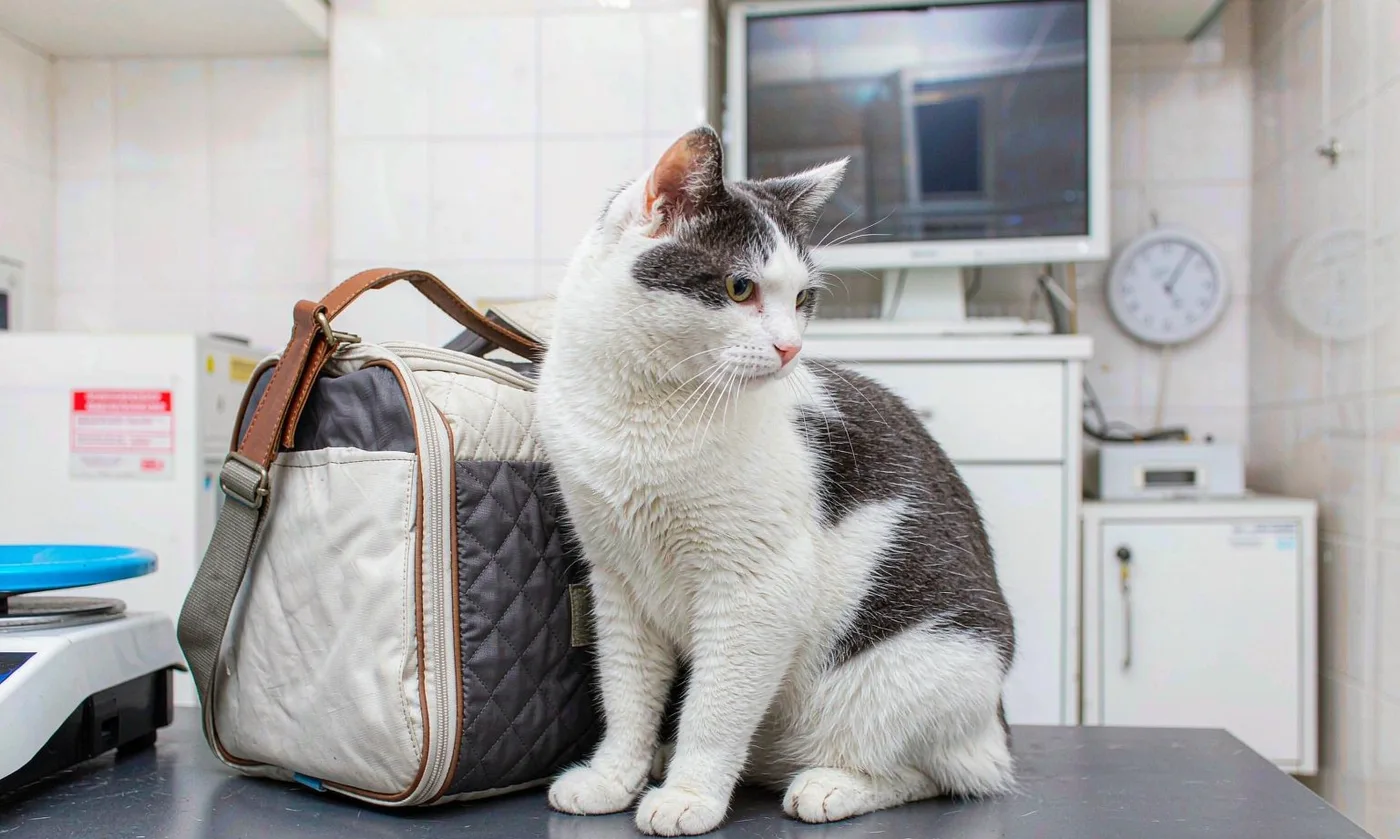
The owner arrives and waits. The carrier sits on a floor or on a chair in a waiting room, often next to other animals, for five to thirty minutes. Then the animal is called, the carrier is placed on an examination table at 800-950 mm height, and the clinician needs to see the animal, assess it, and in many cases examine it without removing it — because removing a frightened cat from a carrier in an unfamiliar room is the single most likely moment for an escape or a scratch injury.
That sequence produces four requirements. The carrier must be stable on a table and on a floor, which argues for a flat base with a non-slip surface and a low centre of mass. It must allow visual assessment without opening, which argues for a large transparent or mesh panel at eye level. It must allow partial examination — a hand, an otoscope, a thermometer — through a controlled aperture. And it must be cleanable between patients, because in a practice setting it is handled by staff who have just handled another animal.
Examination without removal is the requirement that most carriers fail. A carrier with only an end opening forces the clinician to reach in along the animal's axis, which is the direction a cat backs away in, and the result is either a full removal or an aborted examination. A carrier with a top aperture lets the clinician work from above, where the cat has no escape direction and where most examination manoeuvres are easier anyway.
Handling by a third party adds a requirement most consumer products ignore: the carrier must be graspable by someone who does not own it, without asking. Two handles placed symmetrically, or a single handle with a clear grasp zone of at least 110 mm, and no loose straps hanging where they can be caught on a table edge. A clinical carrier is designed for the clinician's hands at least as much as for the owner's.
Dual-Access Openings: Aperture Geometry for In-Carrier Examination
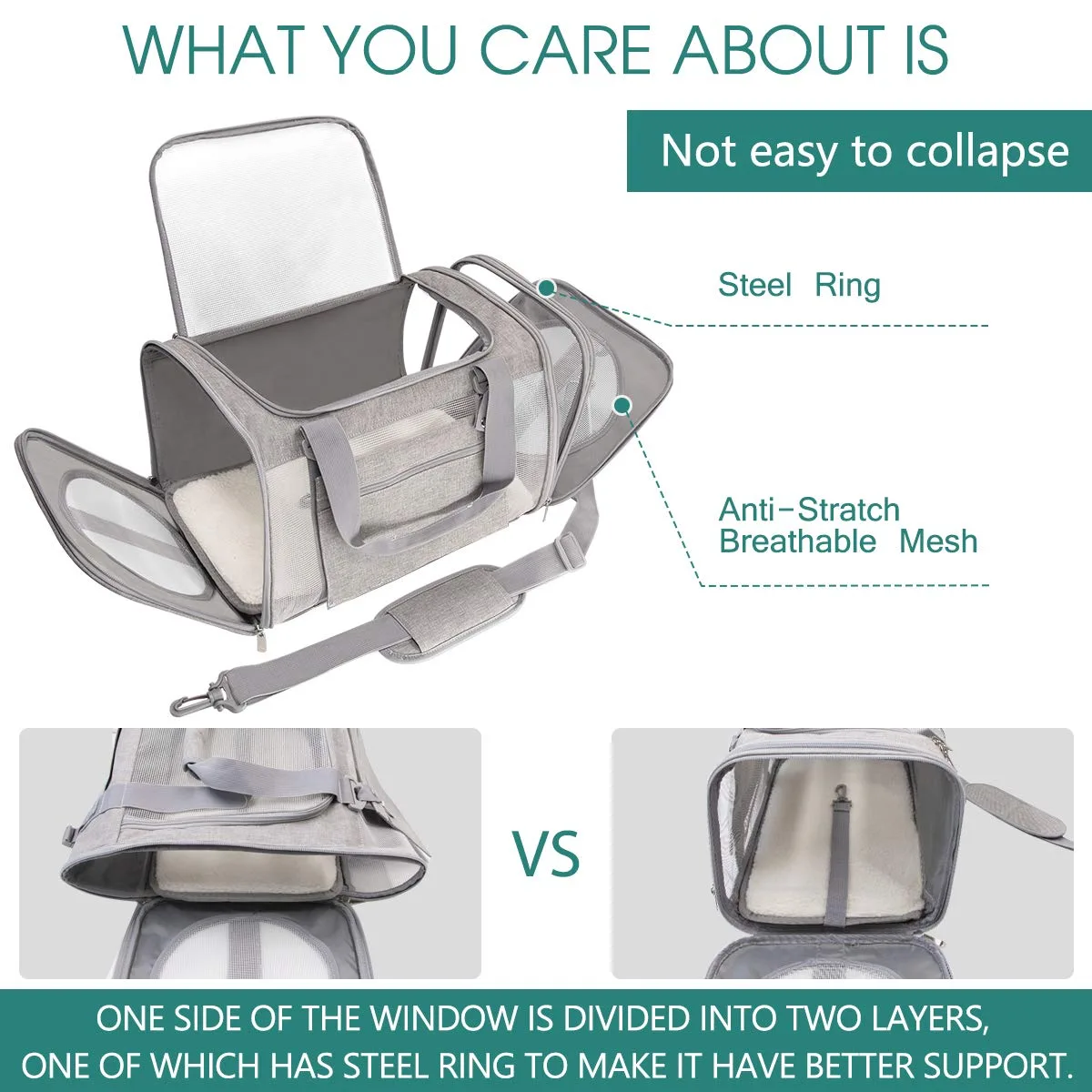
Dual access — a top aperture plus an end or side aperture — is the defining feature of a clinical carrier, and the geometry of each is a separate specification. Getting the top aperture right is worth more than every other comfort feature combined.
Top aperture size is specified against plan area rather than against a linear dimension. For in-carrier examination the opening should expose at least 60% of the interior plan area, and for a 5 kg cat that means an aperture near 300 x 240 mm. Below 45% the clinician cannot work; above 70% the remaining roof structure is too small to keep the carrier rigid, and the top opening becomes the structural weak point.
Aperture shape matters as much as size. A rectangular opening with radiused corners of 25-40 mm is workable and standard; an opening that tapers toward one end directs the clinician's reach and makes a cat in the far corner harder to assess. Where the aperture is a three-sided flap rather than a full removable lid, the hinge should run along the long axis so the flap opens away from the clinician rather than toward them.
Closure of the top aperture in a partial state is the detail that makes the feature useful. A clinician wants the aperture open 100-150 mm — enough to work through, not enough for a cat to leave — and a zipper cannot hold a partial position. The engineering answers are a two-stage zipper with a stop, a hook-and-loop flap that can be secured at any point, or a rigid flap with a prop. The hook-and-loop flap is the cheapest at 0.40-1.00 USD and the quietest, which matters in a stressed-animal context.
The secondary aperture is for loading rather than examination, and it should be at the end rather than the side: an end opening lets a cat be encouraged in along its own axis, whereas a side opening requires the animal to turn inside the carrier. End aperture of 240-300 mm width by 200-260 mm height suits the class.
Reinforcement around the top aperture is the structural consequence. Cutting 60% out of a roof panel removes most of its contribution to the carrier's rigidity, which has to be recovered by a perimeter frame — a bound edge of 25-35 mm carrying a 3-4 mm rod, or a moulded surround on a rigid chassis. Without it, the carrier racks when lifted by one handle. A top aperture is a structural decision before it is an access one.
Infection Control: Wipe-Down Surfaces and Disinfectant Compatibility
A carrier that visits a clinic is a fomite risk, and the surfaces have to survive the disinfectants used against that risk. This is a materials chemistry problem, and it is where vet-trip carriers most often fail — not structurally but gradually, as coatings cloud, stiffen and crack after a few months of wiping.
The disinfectants in question are typically dilute sodium hypochlorite at 500-1,000 ppm, quaternary ammonium compounds at label concentration, accelerated hydrogen peroxide, and alcohol-based wipes at 60-70%. Each attacks coatings differently: hypochlorite oxidises, quaternary ammonium compounds plasticise some polymer coatings, and alcohol extracts plasticisers and leaves coatings brittle.
| Surface | Hypochlorite 1,000 ppm | Quaternary ammonium | Alcohol 70% | Rating |
|---|---|---|---|---|
| PU-coated polyester | Poor, clouds | Fair | Fair | Avoid |
| TPU-coated polyester | Good | Good | Good | Recommended |
| PVC-coated polyester | Good | Poor, plasticises | Fair | Conditional |
| Polyolefin sheet | Excellent | Excellent | Good | Recommended |
| Moulded PP | Excellent | Excellent | Excellent | Recommended |
| Uncoated woven textile | Poor, absorbs | Poor, absorbs | Poor, absorbs | Avoid |
Selection follows the table, and the practical conclusion is that a clinical carrier should use TPU-coated fabrics or polyolefin surfaces throughout the wipe-down zone, with no uncoated textile and no PU coating anywhere the owner or clinician will wipe. That constraint often conflicts with a soft hand or a particular print finish, and the resolution is to use the resistant material on the exterior and upper interior and accept a softer material only on surfaces that are covered by a removable liner.
Seam and stitch detail is the second half of the problem. A wipe removes contamination from a surface but not from a stitch line, and a stitched seam on a clinical surface is a reservoir. The specification is welded or sealed seams in the wipe zone, or where sewing is unavoidable, a seam tape of 18-22 mm applied over the stitch line with the same chemical resistance as the face fabric.
Absorbency is the associated requirement. Any material that takes liquid into its structure cannot be disinfected by wiping, so wadding, open-cell foam and non-woven paddings should be either eliminated from the wipe zone or enclosed behind a sealed, resistant layer.
Cycle life closes the specification: 500 wipe cycles with a diluted biocide under a 500 g load, then a machine wash, with acceptance of no coating cracking, no clouding beyond a stated grey-scale rating, no seam opening and no residual odour after 24 hours. Disinfectant compatibility is the specification that determines whether a clinical carrier looks acceptable after a year or after a month.
Stress Load Reduction: Visual Exposure, Odour and Restraint
Stress in a cat at a clinic is driven by three inputs that are partly design-controllable: visual exposure to unfamiliar animals and movement, odour from the environment and from previous occupants, and the physical sensation of being moved and restrained. Design can address all three, though not equally.
Visual exposure is the most controllable and the one with the largest effect. A cat that can see dogs, other cats and foot traffic in a waiting room is in a sustained stress state before the consultation begins. The engineering answer is a configurable visual barrier: a panel that covers 60-100% of the mesh or window area, deployable from outside, closable in stages, and made of an opaque but breathable material so it does not compromise ventilation.
The barrier has to be breathable or it conflicts with the ventilation requirement, and this is the detail that gets missed. A solid PVC flap over a mesh panel reduces open area to zero. A spacer fabric or a perforated opaque material of 30-45% open area reduces visual exposure effectively while retaining most of the airflow, and a staged closure lets the owner trade the two.
Odour control has two components. Residual odour from the carrier's own history — a previous accident, a disinfectant — is controlled by the cleanability specification covered above, and specifically by the requirement that no absorbent material sits in the airstream. Environmental odour from the clinic is harder; a light activated-carbon layer of 80-150 g/m² in the intake path reduces it measurably, costs 0.40-1.10 USD and has to be replaceable because it saturates in 60-120 hours of use.
Physical sensation is the third input and it is addressed by the floor and the motion. A floor that flexes or slides under the animal raises stress measurably, so the specification is the deflection limit and the traction coefficient covered elsewhere — under 4 mm deflection, friction coefficient above 0.5 — plus a non-slip base so the carrier does not shift on an examination table.
Retention of a familiar scent is a small and cheap design win worth noting: a removable pad that the owner can leave in the cat's bed between visits carries a familiar odour into the clinic and measurably reduces stress. That is an argument for a removable pad on clinical grounds as well as on cleaning ones. Welfare framing for transport and handling is normally cross-checked against guidance published by the American Veterinary Medical Association.
Quiet Hardware: Acoustic Specification for Zippers and Latches
Cats hear transients that humans barely notice, and a consulting room is full of them. Hardware noise from a carrier — a zipper being worked, a latch snapping shut, a plastic buckle clicking — is generated at the exact moment the animal is most alert, and it is one of the few stress inputs that is almost entirely under the designer's control.
The measurement is straightforward: peak sound pressure level at 300 mm from the hardware, operated at normal speed. Unmodified coil zipper operation produces 50-62 dB; a latch closing on a moulded catch produces 62-72 dB with a sharp transient; a polymer buckle engaging produces 55-65 dB. A working acceptance limit for a clinical carrier is 45 dB peak at 300 mm for any hardware operation.
Zipper quieting is achieved three ways. A reverse-coil chain with a fabric pull rather than a metal one removes the element rattle and the metal-on-metal contact, worth 4-8 dB. A zipper garage or a fabric flap over the chain's end stops removes the hard stop contact, worth 3-6 dB. And a slower, longer travel reduces peak level without changing total energy. Together these bring a zipper from 58 dB to 44-48 dB at negligible cost.
Latch quieting needs a different approach because the noise is structural rather than frictional. A moulded catch closing on a moulded strike produces a sharp click whose level depends on the closing velocity and the contact area. The controls are an elastomer bumper of 1.5-3 mm at the strike, worth 6-12 dB, and a mechanism that decelerates over the last 4-6 mm of travel. Where a metal latch is required for strength, a polymer over-mould at the contact face quietens it without reducing its rating.
Buckle and adjuster noise is addressed by material and by fit: acetal-on-acetal with a controlled engagement clearance produces less noise than a loose metal fitting, and a webbing keeper that stops a loose tail from slapping against the shell removes a source that owners report frequently and designers rarely measure.
Verification is a simple protocol: operate each hardware item ten times at normal speed in a quiet room under 35 dB ambient, logging peak level at 300 mm, with acceptance at 45 dB. Hardware noise is the cheapest stress reduction available in a clinical carrier, and the only one that costs nothing to specify.
Handling Weight and the Owner-Carried Clinical Journey
The clinical journey is short in distance and awkward in every other respect: a loaded carrier carried one-handed through a door, set down in a waiting room, lifted onto a table, and held while a clinician works. Weight and handling geometry matter differently here than they do on a long journey.
Total carried mass is the obvious variable and the least interesting. A 5 kg cat in a 1.4 kg carrier is 6.4 kg, and reducing the carrier to 1.1 kg changes the total by 4%, which the owner will not notice on a two-minute carry. What they do notice is where the mass sits relative to the hand and how the carrier behaves when set down and picked up repeatedly.
Centre of mass relative to the handle is the specification that matters. A carrier whose centre of mass sits 30-50 mm below the handle line carries steadily; one whose centre of mass sits below and offset — because the cat has moved to one end — rotates in the hand and feels much heavier than it is. The design response is to keep the interior compact around the animal and to place the handle at the true centre rather than at the geometric centre of the shell.
One-handed carry is the practical requirement and it drives handle geometry. A handle with a grasp zone of 110-140 mm, a section of 22-30 mm, and a padding of 4-8 mm at 50-65 Shore A can be held one-handed for several minutes. Two handles placed at 250-350 mm apart allow a two-handed lift onto an examination table, which is a different and equally common manoeuvre.
Set-down behaviour is the last item. A carrier set down on a waiting-room floor must not rock, tip or slide, which requires a base flat to within 2 mm across its footprint, feet or a base rail with a friction coefficient above 0.4, and a stability angle of at least 20 degrees on the short axis. A carrier that tips when the cat shifts inside is a carrier that will be set down twice and then held for the whole wait.
Accessory handling belongs here too: a shoulder strap that can be deployed for the walk from the car park and stowed so it does not hang into the examination field. Clinical handling is a geometry problem about the centre of mass and the grasp, not a weight-reduction problem.
Clean-Down Protocol for Clinical Release
Clinical release should be gated on a clean-down protocol rather than on a visual inspection, because the failure mode is cumulative chemical degradation rather than an obvious defect. The protocol has four parts and it is cheap to run.
The wipe cycle set is the core: 500 cycles with a diluted quaternary ammonium compound at label concentration, applied with a 500 g loaded pad over a 100 mm stroke, on every surface in the wipe zone. Acceptance is no coating cracking or delamination, no colour change beyond grey-scale 4, and no tackiness or embrittlement assessed by hand. A second set uses hypochlorite at 1,000 ppm and a third uses 70% alcohol, each 200 cycles, because a practice will use more than one agent over a product's life.
The wash cycle follows: a machine wash at 40 °C with a standard detergent, then a dry at 60 °C, repeated ten times, with acceptance of no seam opening, no shrinkage above 2%, and no delamination of any bonded layer. Most clinical carriers are wiped rather than washed, but the wash capability is what allows deep decontamination after a contagious case.
Odour retention is the third part and it is the one owners complain about. After the wipe and wash sets, a sample is inoculated with a synthetic urine solution, cleaned per the instruction, and assessed by a panel of three after 24 hours. Acceptance is no detectable odour at 300 mm. Residual odour is usually a sign of an absorbent layer in the airstream rather than a failure of the face fabric.
Microbial assessment is the fourth part and it is usually run externally. A surface is inoculated with a marker organism, cleaned per protocol, and sampled, with acceptance of a log reduction consistent with the disinfectant's own efficacy — which is the real point: a surface is not disinfectable if its topology protects organisms from the agent. Smooth, sealed, non-absorbent surfaces pass; textured or absorbent ones do not.
Textile and chemical screening closes the set, with all components declared against OEKO-TEX criteria and conditioning and textile test practice following published standards work at ASTM International.
Cost, Tooling and Programme Notes
A clinical build adds 3.20-8.80 USD over a comparable general-purpose carrier. The breakdown: dual-access apertures and their reinforcement at 1.00-2.60 USD, disinfectant-resistant surfaces throughout the wipe zone at 1.00-2.40 USD, the configurable visual barrier at 0.60-1.60 USD, quiet hardware modifications at 0.30-0.90 USD, and the removable pad with a spare at 0.30-1.30 USD.
The disinfectant-resistant surface is the line worth protecting in value engineering. Downgrading a TPU coating to PU saves 0.30-0.70 USD and produces a product that clouds and cracks within a year of clinical wiping, which is a warranty and reputation cost far above the saving. It is the single specification in this category that should be treated as non-negotiable.
Tooling impact is modest. Dual-access on a soft chassis is a pattern and reinforcement change; on a rigid chassis it needs a revised tool at 6,000-16,000 USD if the aperture frame is moulded. The welded-seam requirement adds an electrode at 600-1,800 USD where seams are welded rather than sewn, and that is usually the better route for a clinical product regardless of cost.
Positioning matters because the clinical buyer is not the same as the retail buyer. Practices buy on cleanability and access, not on appearance, and a programme selling into clinics should publish the measurable specifications — wipe cycle rating, aperture dimensions, hardware noise level — rather than generic comfort claims. Packaging should carry the same figures.
Inspection additions for clinical programmes: a coating adhesion check by cross-hatch on one unit per lot, a seam integrity check on the wipe zone, and a hardware noise spot check at 300 mm. Our production team builds clinical programmes through the SGS-verified production base under ISO 9001 and BSCI coverage, with prototypes in 6-10 working days, bulk production 35-50 days after sample approval, final random inspection to AQL 2.5, T/T 30/70 and FOB Xiamen. A clinical carrier is judged by what it survives, not by what it looks like on the shelf.
Order and quality terms
- MOQ 500 pieces per colourway; samples in 6-10 working days
- Bulk production 35-50 days after approval; AQL 2.5 inspection standard
- T/T 30/70 terms, FOB Xiamen, full document set per shipment
People Also Ask
Why does a vet-trip carrier need a top opening?
Because removing a frightened cat from a carrier in an unfamiliar room is the most likely moment for an escape or a scratch. A top aperture lets the clinician work from above, where the cat has no escape direction.
How large should the top aperture be?
At least 60% of the interior plan area, roughly 300 x 240 mm for a 5 kg cat. Below 45% the clinician cannot work; above 70% the remaining roof is too small to keep the carrier rigid.
Which coating survives clinic disinfectants?
TPU-coated polyester or polyolefin sheet. PU coatings cloud under hypochlorite, PVC plasticises under quaternary ammonium compounds, and uncoated textile absorbs and cannot be disinfected by wiping.
How many wipe cycles should a clinical carrier survive?
500 with a diluted quaternary ammonium compound, plus 200 each with hypochlorite at 1,000 ppm and 70% alcohol, accepting no cracking, delamination or colour change beyond grey-scale 4.
How can a carrier reduce a cat's stress at the clinic?
With a breathable visual barrier covering 60-100% of the window area, an activated-carbon intake layer of 80-150 g/m², a floor that does not flex or slide, and quiet hardware under 45 dB at 300 mm.
Why must a visual barrier stay breathable?
A solid flap over a mesh panel reduces open area to zero and compromises ventilation. Use a spacer fabric or perforated opaque material at 30-45% open area so exposure drops without airflow collapsing.
How loud is carrier hardware and what is acceptable?
Unmodified zippers run 50-62 dB and latches 62-72 dB at 300 mm. The acceptance limit for a clinical carrier is 45 dB peak, reached by reverse-coil chain, fabric pulls, zipper garages and elastomer bumpers on strikes.
What handle geometry suits a one-handed clinical carry?
A grasp zone of 110-140 mm, a section of 22-30 mm and padding of 4-8 mm at 50-65 Shore A, with the handle at the true centre of mass rather than the geometric centre of the shell.
Frequently Asked Questions
Why should the secondary aperture be at the end rather than the side?
An end opening lets the cat be encouraged in along its own axis. A side opening requires the animal to turn inside the carrier, which is the manoeuvre cats resist most.
What size end aperture suits the 5 kg class?
240-300 mm wide by 200-260 mm high. The end aperture is for loading rather than examination, so it is sized to the animal's cross-section rather than to the clinician's reach.
How is a partial top opening held open?
A zipper cannot hold a partial position. Use a two-stage zipper with a stop, a hook-and-loop flap securable at any point, or a rigid flap with a prop — the hook-and-loop flap is cheapest and quietest.
Why is the top aperture a structural concern?
Removing 60% of a roof panel removes most of its contribution to rigidity. Perimeter reinforcement of a bound 25-35 mm edge carrying a 3-4 mm rod, or a moulded surround, is required or the carrier racks when lifted by one handle.
Are stitched seams acceptable in the wipe zone?
Not unprotected. A stitch line is a contamination reservoir that wiping cannot clean. Use welded or sealed seams, or a seam tape of 18-22 mm with the same chemical resistance as the face fabric.
Why should wadding and open-cell foam be excluded from the wipe zone?
Any material that takes liquid into its structure cannot be disinfected by wiping. Enclose such materials behind a sealed resistant layer or eliminate them from the zone.
What does the machine-wash part of the protocol require?
Ten cycles at 40 °C with standard detergent and a 60 °C dry, accepting no seam opening, no shrinkage above 2% and no delamination. This is what allows deep decontamination after a contagious case.
How is residual odour assessed?
Inoculate a sample with synthetic urine, clean it per the instruction, and have a panel of three assess it at 300 mm after 24 hours. Residual odour usually indicates an absorbent layer in the airstream.
What does the microbial assessment actually test?
Whether surface topology protects organisms from the disinfectant. A smooth, sealed, non-absorbent surface allows the agent to work; a textured or absorbent one does not.
How effective is an activated-carbon intake layer?
Measurably effective against environmental odour at 80-150 g/m², but it saturates in 60-120 hours of use and must therefore be replaceable to remain useful.
Why is a removable pad specified on clinical grounds?
A pad left in the cat's bed between visits carries a familiar scent into the clinic, which measurably reduces stress, and it can be changed between visits for hygiene.
What are the base stability requirements?
Flat to within 2 mm across the footprint, feet or a base rail with a friction coefficient above 0.4, and a stability angle of at least 20 degrees on the short axis so the carrier does not tip when the cat shifts.
Which cost line should never be value-engineered?
The disinfectant-resistant surface. Downgrading TPU to PU saves 0.30-0.70 USD and produces a product that clouds and cracks within a year of clinical wiping.
What does a clinical build add to unit cost?
3.20-8.80 USD across apertures and reinforcement, resistant surfaces, the visual barrier, quiet hardware and the removable pad with a spare.
Talk to QUANZHOU JUNYUAN BAGS about a pet carrier program: MOQ 500 pieces per colourway, samples in 6-10 working days, bulk production in 35-50 days under AQL 2.5 inspection.
Get a free quote Request a sample