Cat Carrier for Grooming: Easy Access
A grooming-capable cat carrier needs a removable welded liner with a drainage path, a coating rated against shampoo, conditioner and biocide at pH 4-9, an anti-static surface with resistivity under 10^11 ohms, and materials stable at 60 °C for blow-dryer exposure. Access should allow full reach from above and at least one end.
This page treats the grooming carrier as a wet-process product rather than a travel product, because that is what separates a design that works in a salon from one that fails in a month. Grooming introduces four loads that a travel carrier never sees: standing water, continuous hair shedding, surfactant and conditioner chemistry at both ends of the pH range, and sustained warm air from a dryer. Each has a specific material and geometry answer, and the answers interact — a welded liner that resists shampoo is useless if hair cannot be rinsed out of its corners, and an anti-static surface that degrades under conditioner is worse than none. Commercial terms follow the standard programme: MOQ 500 pieces per colourway, prototypes in 6-10 working days, bulk production 35-50 days after sample approval, final random inspection to AQL 2.5, T/T 30/70 and FOB Xiamen.
Custom pet carrier development for cat carrier starts with a tech pack: dimensions, fabric weight, hardware finish and the target test standard.
Grooming Environment Loads: Water, Hair, Heat and Chemicals
A grooming salon is a wet, warm, chemically active environment with a high load of loose hair, and a carrier used in it is exposed to all four simultaneously. Specifying against travel conditions under-designs the product in every respect, so the first step is to write down the loads as numbers.
Water load is the first. A cat moved from a bath to a carrier carries 30-120 ml of surface water, and a carrier used as a holding enclosure during a groom will see standing water in its floor for 20-60 minutes. That is a ponding test rather than a splash test: the floor has to hold 200-400 ml without striking through, and it has to drain or be removable so it can be emptied.
Hair load is the second and the one with no travel equivalent. A grooming session on a short-haired cat sheds 2-8 g of hair and on a long-haired cat 10-30 g, and hair behaves as a fibrous particulate that works into seams, hook-and-loop closures and zipper chains. Every closure and every seam in a grooming carrier has to be specified against hair ingress, or it will stop functioning.
Heat load is the third. A dryer operating at 45-60 °C at 200-400 mm from the carrier surface raises local surface temperatures above what a travel carrier ever sees, and sustained exposure softens some coatings and delaminates some bonds. The specification is continuous exposure at 60 °C for four hours with no coating change, plus a transient of 80 °C for 60 seconds to represent a dryer held too close.
Chemical load is the fourth and the most demanding. Shampoo concentrates are typically pH 6-8 but diluted working solutions and some medicated products run pH 4-10; conditioners carry cationic surfactants and silicones; and the surfaces are then disinfected with a biocide at label concentration. A grooming surface has to tolerate surfactants, silicones, oxidative biocides and a wide pH range, in sequence, repeatedly.
These four loads together rule out most of the material set used in travel carriers. A grooming carrier is a wet-process enclosure; specifying it as a travel carrier with a wipeable lining is the error that produces warranty returns in this segment.
Removable Interior Liner: Attachment, Seams and Drainage
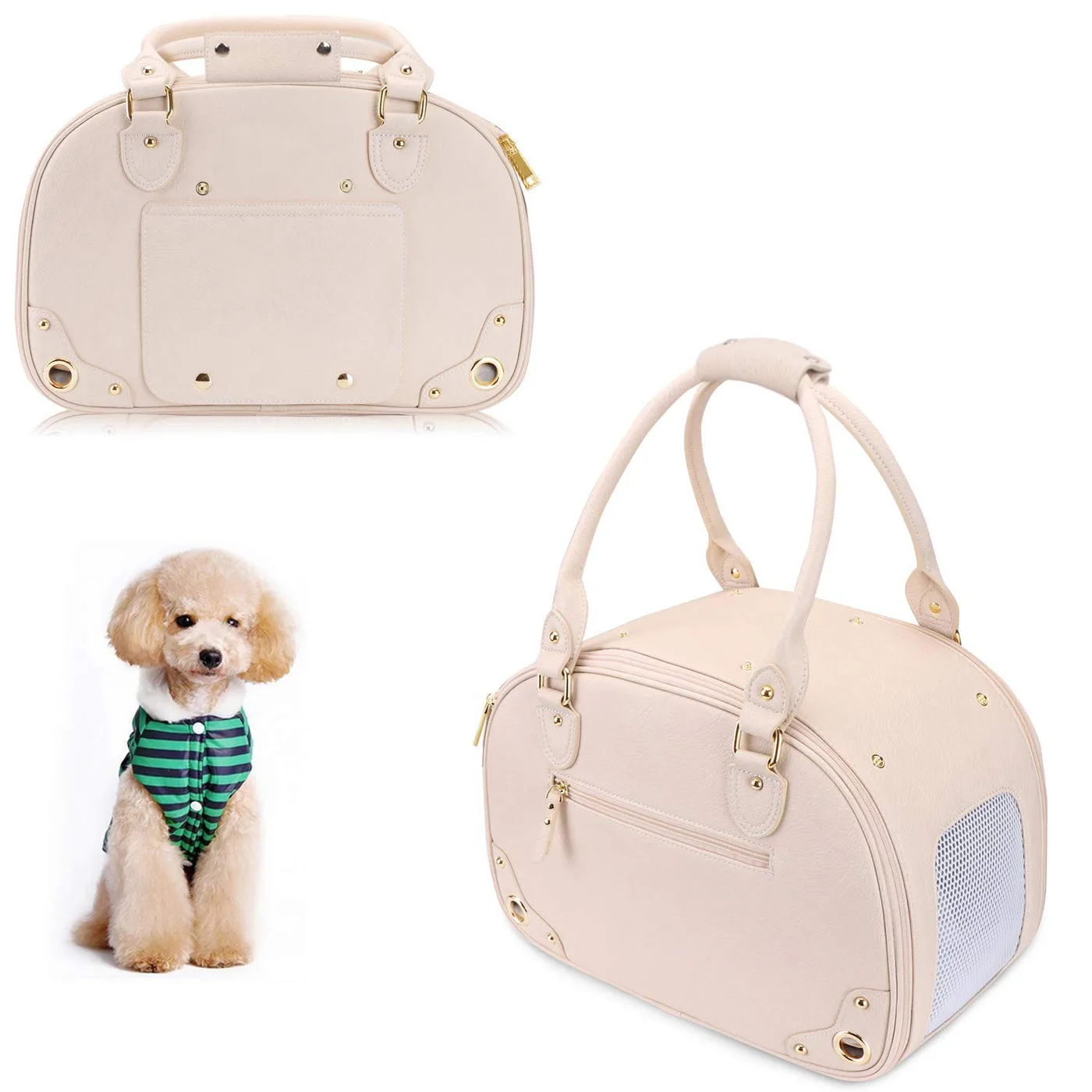
The liner is the component that makes a grooming carrier serviceable, because everything the grooming process deposits — water, hair, shampoo residue — ends up in it. A fixed lining means the whole carrier has to be cleaned after every use; a removable welded liner means the liner is cleaned or replaced and the carrier stays in service.
Construction should be welded rather than sewn. A high-frequency-welded TPU or polyolefin liner with formed corners has no stitch holes, holds water, and can be rinsed out completely; a sewn liner leaks at the stitch line and holds hair at every seam. The cost difference is 0.40-1.20 USD and it is the best-value decision in the product.
Attachment has to survive a cat that digs and a liner that is removed frequently. Hook-and-loop at six to eight points plus a locating pocket at the front is the working specification: it holds the liner in place under load, releases for cleaning, and does not create a hard point inside the compartment. Hook-and-loop in a grooming environment has one specific failure — hair accumulation in the hook tape — which is controlled by specifying a hook tape of 1.5-2.0 mm pile height rather than a fine closure, and by placing the tape where rinsing reaches it.
| Construction | Water hold | Hair release | Removal cycles | Cost (USD) |
|---|---|---|---|---|
| Sewn coated fabric, fixed | Poor | Poor | None | 0.80-1.60 |
| Sewn coated fabric, removable | Fair | Fair | 50-100 | 1.20-2.40 |
| Welded TPU liner, removable | Excellent | Good | 200-400 | 1.80-3.60 |
| Moulded polyolefin tray | Excellent | Excellent | Over 1,000 | 2.60-5.40 |
| Welded liner plus drain | Excellent | Excellent | 200-400 | 2.20-4.20 |
Drainage is the feature that separates a good grooming liner from an adequate one. A welded liner holds water, which is correct for containment, but it also means the liner has to be carried to a sink. A drain — a welded spout of 12-20 mm with a screw or push closure at the lowest corner — lets the liner be emptied in place at 0.40-1.00 USD, and it needs a closure rated to hold 400 ml under a 20 N side load so a cat lying against it does not open it.
Corner geometry determines whether hair can be rinsed out. A formed corner with a radius of 25-40 mm releases hair under a running tap; a square or tight corner traps it and the liner has to be wiped rather than rinsed, which in a salon means it will not be cleaned properly. The same radius argument applies at the liner-to-wall junction.
Capacity closes the specification: a liner that holds 300-500 ml of liquid above its drainage point covers the water load from a wet cat plus a rinse. A removable, welded, radiused liner with a drain is the component that turns a carrier into grooming equipment.
Coating Chemistry Against Shampoo, Conditioner and Biocide
Grooming chemistry is harder on coatings than disinfection chemistry, because it spans a wider pH range and includes solvents and silicones that a biocide does not. The specification has to name the agents and the sequence, not just say chemical resistant.
Surfactants are the first agent and the mildest. Anionic and amphoteric surfactants at working dilution attack coatings primarily by extracting plasticiser over time, which produces stiffening and then cracking at fold lines. TPU and polyolefin coatings resist this well; PVC coatings, which depend on plasticiser for their flexibility, stiffen measurably after 200-400 surfactant exposures.
Cationic conditioners are the second agent and the more aggressive one, because they are designed to deposit on surfaces. Silicone deposition on a coated fabric changes its surface energy, which in turn changes how water and hair behave on it — a surface that was easy to rinse becomes one that holds both. Testing against conditioner cannot be a wipe test; it has to be a deposit-and-rinse cycle test.
| Coating | Surfactant pH 6-8 | Conditioner | Biocide | pH 4 and pH 10 |
|---|---|---|---|---|
| PU, 30 g/m² | Fair, stiffens | Poor | Fair | Poor |
| TPU, 30-40 g/m² | Good | Good | Good | Good |
| PVC | Poor, plasticiser loss | Poor | Fair | Fair |
| Polyolefin | Excellent | Excellent | Excellent | Excellent |
| Silicone finish | Good | Poor, redeposits | Good | Good |
Biocide exposure follows the cleaning cycle and compounds the effect. A surface already carrying silicone deposit is harder to disinfect, because the deposit protects organisms from the agent. The practical consequence is that a grooming surface should be specified at 300-500 cycles of the full sequence — surfactant, conditioner rinse, biocide — rather than against each agent independently.
The test protocol measures three things: visual change by grey scale, stiffness change by a bend-length or handle test, and function change by a rinse test measuring how much hair and water is retained. A coating that looks unchanged but has gained surface energy has failed, which is why the rinse test is included.
Chemical screening closes the item: every coating, adhesive and textile is declared against OEKO-TEX criteria, since a surface in prolonged contact with a wet animal is a higher exposure route than a dry one. Coating selection for grooming is a three-agent sequence test, and a coating that passes each agent separately can still fail them in combination.
Hair Shedding Control and Anti-Static Surface Specification
Hair is the defining contaminant in grooming and the one that determines whether a carrier stays in service or is retired. It is also the reason a grooming carrier needs an electrical specification, because hair behaviour on a surface is dominated by static charge.
A charged surface attracts and holds hair; a dissipative surface releases it. The specification is surface resistivity below 10^11 ohms per square for the interior surfaces, which is achieved either by a conductive yarn grid in the fabric or by a topical anti-static finish. A woven anti-static grid of 20-30 mm pitch is the durable route at 0.30-0.80 USD; a topical finish is cheaper at 0.10-0.30 USD and washes out in 20-50 cycles.
The interaction with conditioner is the complication, and it is the reason this section exists separately from the coating one. Cationic conditioners are anti-static agents — that is their function on hair — so a surface freshly exposed to conditioner is anti-static by contamination. The problem is what happens after: silicone residue builds, the surface becomes tacky, and hair adhesion increases. A conductive grid is unaffected by this; a topical finish is rendered irrelevant by it.
Geometry does the rest of the work. Hair accumulates at corners, at seam lines, at hook-and-loop tape and at the base of any projection. The design rules are: interior corners radiused at 25-40 mm, no exposed seam tape on interior surfaces, hook-and-loop placed on vertical rather than horizontal surfaces so hair falls away, and no interior projections such as pocket flaps or strap tails.
Zipper chains are a specific accumulation point and the reason grooming carriers should specify a covered chain. A fabric flap of 20-30 mm over the chain keeps hair out of the elements and can be rinsed; an exposed chain accumulates hair and eventually jams.
Verification is a rinse test rather than a visual one: the carrier is loaded with 10 g of shed hair distributed across the interior, inverted and rinsed with a standard flow for 60 seconds, and the retained hair is weighed. Acceptance is under 1.5 g retained, which a radiused, welded, dissipative interior achieves and a sewn, square-cornered one does not. Hair control is a geometry and resistivity problem; no coating makes a square corner release hair.
Heat and Blow-Dryer Exposure: Temperature Limits
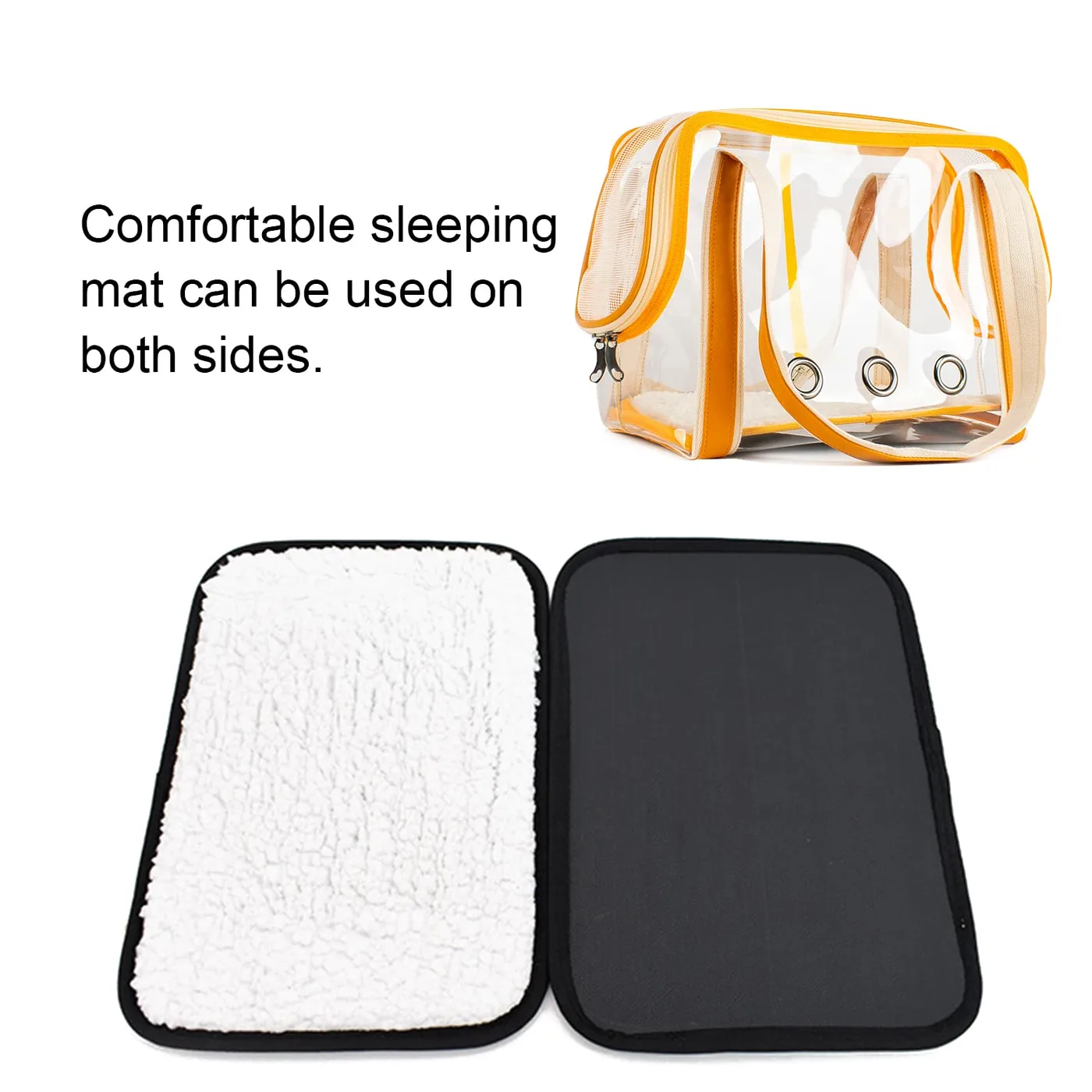
Dryer heat is the load that most often limits material choice in a grooming carrier, and it is the one least likely to be specified. A dryer held 200-400 mm from a surface for several minutes produces local temperatures well above the nominal air temperature, and sustained exposure degrades coatings, adhesives and foam in ways that appear weeks later.
Exposure limits should be stated rather than assumed. The working specification for a grooming carrier is continuous exposure at 60 °C for four hours and a transient of 80 °C for 60 seconds at any single point, with acceptance of no coating softening, no adhesive creep, no foam collapse and no dimensional change above 1%.
Coatings respond first. Thermoplastic polyurethane has a softening range that begins well above 80 °C, so it survives both conditions; PVC coatings begin to soften near 60-70 °C depending on plasticiser content, which is the practical reason PVC is excluded from grooming interiors. Polyolefin coatings survive both comfortably.
Adhesives are the second failure point and the one that surprises designers, because an adhesive that is fine at 40 °C can creep at 60 °C under sustained load. Any bonded layer in a grooming carrier — a laminated foam, a bonded lining, a taped seam — should be specified with a heat-aged lap shear value rather than a room-temperature one, tested at 60 °C under a 20 N load for four hours.
Foam and padding collapse is the third. Low-density open-cell foams used in travel carriers lose thickness under sustained warm, humid conditions; closed-cell EVA at 45-60 kg/m³ holds. Where padding is required in a grooming interior, it should be closed-cell and it should be behind a sealed layer so it cannot absorb water.
Ventilation interacts with the heat requirement in a useful way. A carrier designed to be dried with a dryer needs an airflow path — an intake and an exhaust that allow warm air to pass through rather than pool — which is the same distributed ventilation specification that serves an airline requirement, with the addition that both apertures should be closable so the airflow can be directed. Heat resistance is specified in degrees and hours, and the adhesive is usually the component that sets the limit.
Access Geometry for the Grooming Workflow
Grooming access differs from clinical access in one important respect: the groomer's hands are often wet, sometimes gloved, and always occupied. Closures that require two hands, fine motor control or a dry grip are closures that will not be used, and the result is a carrier worked open and an animal that can leave.
Closure selection follows from that. A hook-and-loop flap can be opened with one wet hand and closed by pressure; a zipper needs two hands and a dry grip; a latch needs fine control but can be operated one-handed. The working specification for grooming is a hook-and-loop primary closure over a zipper secondary, which gives easy operation and positive containment, at a combined 1.00-2.20 USD.
Reach geometry is the second requirement. A groomer needs to reach the whole interior: the full plan area from above, and the ends without contorting the hand. That means a top aperture of at least 65% of plan area and an end aperture that opens the full cross-section rather than a portion of it. An aperture that opens part of the end leaves the far corner unreachable, which is where a wet, unwilling cat will be.
Restraint during grooming is the third and it has a specific requirement that travel carriers do not: a means of holding the animal partially restrained while work is done on one part of it. The answer used in production is an internal restraint panel — a fabric panel with hook-and-loop or clip attachment that can be positioned to limit the animal to part of the interior — rated to 150-250 N and stowable flat when not in use.
Height and working posture matter too. A grooming carrier is worked on a table at 850-950 mm, so the interior floor should sit no more than 180-240 mm below the top aperture edge; a deeper interior forces the groomer to reach down and across, which is both ergonomically poor and more likely to be refused by the animal.
Drainage access closes the geometry: the drain spout should be at a corner that is reachable when the carrier is on a table, not on the underside where it can only be operated by lifting the whole product. Grooming access is a one-handed, wet-grip, full-reach specification, and it rules out most of the closure set used in travel carriers.
Clean-Down Cycle Testing and Service Life
Service life in a grooming carrier is measured in clean-down cycles, and the cycle definition has to include the whole sequence rather than a single wipe. A salon carrier is used several times a day and cleaned between animals, which is 500-1,500 cycles a year — an order of magnitude more than a consumer product sees in its life.
The cycle is defined as: rinse with water at 35-40 °C, apply surfactant at working dilution, rinse, apply conditioner at working dilution, rinse, apply biocide at label concentration, wipe dry. One cycle takes about four minutes by hand and about fifty by machine with a loaded pad. The protocol runs 500 cycles for a consumer-grade claim and 1,500 for a professional-grade one.
Acceptance limits across the run: no coating cracking or delamination, colour change no worse than grey-scale 4, surface resistivity still under 10^11 ohms per square, retained hair under 1.5 g in the rinse test, water hold still above 300 ml, no seam or weld opening, and no closure that has stopped functioning. Inspection at 25%, 50%, 75% and 100% of the run, with measured values rather than pass/fail.
Component-level testing runs alongside: a hook-and-loop cycle test of 1,000 engagements with hair contamination introduced at 200-cycle intervals, a zipper test of 3,000 cycles with the same contamination, and a drain closure test of 500 open-close cycles with a 400 ml hold check after each hundred.
Heat ageing is interleaved rather than run separately, because in service the two occur together: every 100 clean-down cycles, the sample is exposed to 60 °C for four hours. That interleaving catches combined degradation — a coating softened by heat and then abraded by wiping — that separate sequential tests miss.
Conditioning and textile test practice follow published standards work at ASTM International, and handling and welfare guidance for grooming and restraint is commonly cross-checked against material published by the American Veterinary Medical Association. A grooming carrier's service life is a cycle count, and the cycle has to be defined as the full wet sequence rather than as a wipe.
Cost, Tooling and Programme Notes
A grooming-capable build adds 4.60-11.20 USD over a comparable travel carrier. The breakdown: the removable welded liner at 1.80-3.60 USD, the drain and closure at 0.40-1.00 USD, resistant coatings throughout the wet zone at 1.00-2.40 USD, the anti-static grid at 0.30-0.80 USD, the closure and restraint package at 1.00-2.20 USD, and heat-rated adhesives and foams at 0.10-1.20 USD.
Tooling is dominated by the liner. A welded liner needs a high-frequency electrode at 900-2,400 USD on a two to three week path; a moulded tray needs an injection or thermoforming tool at 9,000-22,000 USD on eight to thirteen weeks. For programmes at MOQ 500 per colourway the welded route is almost always correct, and the moulded tray is justified only where the same tray serves several sizes or where the professional-grade cycle target is being claimed.
Segmentation advice matters in this category more than most. A consumer grooming carrier — used after a home bath, cleaned perhaps 50 times a year — is a different product from a salon carrier cleaned 1,500 times a year, and the difference is mostly in the liner and the adhesive specification. Selling one product into both segments means over-building the consumer one or under-building the professional one.
Inspection additions: a weld integrity check on every liner by visual inspection plus a water hold test on one per lot, a drain closure hold test on two per lot, and a surface resistivity spot check on one per lot. Our production team builds grooming programmes through the SGS-verified production base under ISO 9001 and BSCI coverage, with prototypes in 6-10 working days, bulk production 35-50 days after sample approval, final random inspection to AQL 2.5, T/T 30/70 and FOB Xiamen. Grooming capability is bought with the liner, the coating and the closure — and the cycle count is what proves it.
Why brands source here
- Pet carrier programs run since 2014; founding team in sewn goods since 2004
- SGS-verified production floor of 4,950 m² with 137 workers across 7 lines
- Monthly capacity of 200,000 units, audited to BSCI and ISO 9001
People Also Ask
What makes a cat carrier suitable for grooming use?
A removable welded liner with drainage, coatings rated against surfactant, conditioner and biocide, anti-static surfaces under 10^11 ohms per square, and materials stable at 60 °C continuous and 80 °C transient.
Why should the interior liner be welded rather than sewn?
A welded liner has no stitch holes, holds water and rinses clean; a sewn liner leaks at the stitch line and traps hair at every seam. The cost difference is 0.40-1.20 USD.
Which coating resists shampoo and conditioner?
TPU at 30-40 g/m² or a polyolefin coating. PVC loses plasticiser under surfactant exposure and silicone finishes redeposit under conditioner, so both are excluded from grooming interiors.
Why does a grooming carrier need an anti-static specification?
A charged surface holds hair and a dissipative one releases it. Surface resistivity under 10^11 ohms per square, achieved with a conductive yarn grid rather than a topical finish, which washes out in 20-50 cycles.
What temperature must grooming materials tolerate?
60 °C continuous for four hours and 80 °C transient for 60 seconds. Adhesives are usually the limiting component and should be specified with a heat-aged lap shear value.
How much water must the liner hold?
300-500 ml above the drainage point, covering the 30-120 ml carried by a wet cat plus a rinse, with a welded basin rather than a sewn pocket.
What closure works for a groomer with wet hands?
A hook-and-loop primary closure over a zipper secondary, at 1.00-2.20 USD combined. Hook-and-loop opens with one wet hand and closes by pressure; a zipper needs two hands and a dry grip.
How is service life measured for a grooming carrier?
In clean-down cycles: 500 for a consumer-grade claim and 1,500 for professional-grade, each cycle being rinse, surfactant, rinse, conditioner, rinse, biocide and dry.
Frequently Asked Questions
How much hair does a grooming session shed?
2-8 g from a short-haired cat and 10-30 g from a long-haired one. Hair works into seams, hook-and-loop tape and zipper chains, so every closure needs specifying against ingress.
What corner radius releases hair under a rinse?
25-40 mm at formed corners and at the liner-to-wall junction. A tighter corner traps hair and forces wiping instead of rinsing, which in a salon means it will not be cleaned properly.
Why should hook-and-loop sit on vertical surfaces?
So hair falls away from the tape. Combined with a hook tape pile height of 1.5-2.0 mm rather than a fine closure, that keeps the attachment functioning through repeated grooming cycles.
What drain specification is used?
A welded spout of 12-20 mm at the lowest corner with a screw or push closure rated to hold 400 ml under a 20 N side load, positioned so it is reachable when the carrier is on a table.
Why is conditioner harder on coatings than shampoo?
Conditioners are designed to deposit. Silicone deposition changes surface energy so a surface that rinsed clean begins to hold water and hair, which is why testing must be a deposit-and-rinse cycle rather than a wipe test.
Why is biocide efficacy reduced on a grooming surface?
Silicone residue protects organisms from the agent. That is why the surface should be tested at 300-500 cycles of the full sequence rather than against each agent independently.
How is coating failure detected without visible damage?
By a rinse test measuring retained hair and water. A coating can look unchanged while gaining surface energy, which is a functional failure that a grey-scale assessment alone will not catch.
Why is a conductive grid preferred over a topical anti-static finish?
A grid is unaffected by silicone build-up and lasts the life of the product. A topical finish costs less at 0.10-0.30 USD but washes out in 20-50 cycles and is rendered irrelevant by conditioner residue.
Why should zipper chains be covered in a grooming carrier?
An exposed chain accumulates hair and eventually jams. A fabric flap of 20-30 mm over the chain keeps hair out of the elements and can itself be rinsed.
How large should the top aperture be for grooming?
At least 65% of plan area, with an end aperture opening the full cross-section. A partial end aperture leaves the far corner unreachable, which is where a wet, unwilling cat will be.
What is an internal restraint panel?
A fabric panel with hook-and-loop or clip attachment that limits the animal to part of the interior while work is done, rated to 150-250 N and stowable flat when not in use.
How deep can the interior be for table-height work?
The floor should sit no more than 180-240 mm below the top aperture edge when working on a table at 850-950 mm, so the groomer is not reaching down and across.
Why is heat ageing interleaved with clean-down cycles?
Because in service both occur together. Interleaving 60 °C exposure every 100 cycles catches combined degradation — a coating softened by heat and then abraded by wiping — that sequential tests miss.
What tooling does a grooming liner require?
A high-frequency electrode at 900-2,400 USD on two to three weeks for a welded liner, against 9,000-22,000 USD and eight to thirteen weeks for a moulded tray. The welded route suits MOQ 500 per colourway.
Talk to QUANZHOU JUNYUAN BAGS about a pet carrier program: MOQ 500 pieces per colourway, samples in 6-10 working days, bulk production in 35-50 days under AQL 2.5 inspection.
Get a free quote Request a sample