Cat Carrier Pet Influencer: Content Creation
A creator content kit needs 4 units per colourway from one dye lot, colour controlled to Delta-E 2.0 or better under D65, exteriors held at 3-8 gloss units at 60 degrees to kill specular hotspots, and logo placement in the upper third of the camera-facing panel at 45-70 mm cap height. Sampling runs three rounds before the shoot date.
This page treats a pet influencer programme as a manufacturing specification problem, not a marketing one. What a creator needs from a cat carrier supplier is not persuasion but physical repeatability: the unit in the hero frame has to match the unit in the backup box, the fabric must not blow out under 5600 K light, and the logo has to read at the distance a phone camera actually holds. Those are production-line variables — dye lot control, coating gloss, coating thickness, trim geometry, embroidery stitch density — and each one has a measurable target. The commercial frame for a creator-led drop is a small-batch, multi-SKU programme with a hard content date, which changes how sampling, tooling and freight are scheduled. Standard terms apply: MOQ 500 pieces per colourway, prototypes in 6-10 working days, bulk production 35-50 days after sample approval, final random inspection to AQL 2.5, T/T 30/70 and FOB Xiamen. What changes is the revision cadence and the shipping mode, both of which are driven by a shoot date that cannot move.
Any dog carrier factory quoting cat carrier work should be able to show a current BSCI audit and an ISO 9001 certificate before a deposit is released.
What a Content Kit Actually Contains: Unit Counts and Roles
A creator launch consumes more physical units than a retail launch of the same nominal volume, because content production retires, contaminates and modifies product. The working specification is four units per colourway for the first shoot and two units per colourway for every subsequent shoot. A three-colourway influencer drop therefore consumes twelve units before a single customer order is picked.
Each unit has a defined role and a defined inspection level. The hero unit appears in the primary frame and is inspected to zero visible defect on every camera-facing surface, selected from the top of the lot rather than drawn at random. The backup unit is built in the same lot and held sealed, because a hero unit damaged on day two cannot be replaced from a different lot without a colour shift the sensor will resolve.
The flat-lay unit serves overhead stills and is the one most likely to arrive creased, so it ships flat with tissue interleaving at every fold line rather than stuffed into a carton. The fourth unit is the cutaway unit, used for interior frames, cross-section shots and any shot where the product gets modified. Building a dedicated cutaway unit costs one unit of inventory and protects the hero unit.
Lot integrity ties the kit together. All units must come from one production lot and one material dye lot, because a camera sensor resolves a Delta-E of roughly 1.5 to 2.0 between two panels that are nominally the same colour. Splitting a kit across two dye lots is the single most common reason a creator asks why two bags in one frame look different.
| Unit | Role | Inspection level | Shipping form | Replaced after |
|---|---|---|---|---|
| Hero | Primary frame, all camera-facing shots | Zero visible defect, hand selected | Flat-packed, tissue interleaved | Every shoot |
| Backup | Replacement on damage | Same lot as hero | Sealed, unopened | On use |
| Flat-lay | Overhead stills, detail crops | AQL 2.5 or better | Flat, fold-line protection | 3-5 shoots |
| Cutaway | Interior, cross-section, tests | Any | Standard | Single use |
| Retail pack | Unboxing sequence | Full retail specification | In retail carton | Single use |
A fifth unit in full retail packaging is worth specifying whenever an unboxing sequence is planned, because the retail carton is itself a surface on camera and a carton that arrives scuffed is a re-shoot. Cartons for creator shipments should be over-boxed at a 5 mm void, which adds 0.30-0.70 USD and eliminates corner crush in transit.
The content kit is four units per colourway drawn from a single dye lot, and the unit count belongs in the purchase order rather than in an email.
Colour Management: Delta-E Targets Under D65 and 5600 K
Colour is the first specification that separates a creator-ready product from a retail-ready one. A retail buyer accepts a swatch match; a camera does not. The reason is metamerism: a fabric dyed to match a reference under showroom lighting can shift substantially under the 5600 K continuous lights or the mixed LED panels used in a home studio.
The practical target is Delta-E 2.0 or better between the approved reference and the production fabric, measured under D65, plus a secondary check under a 5600 K source with a tolerance of Delta-E 3.0. That second number matters more than the first, because most creator content is shot under daylight-balanced light, not under retail lighting.
Achieving it requires controlling three variables in production. The first is dye lot: each lot is measured and released against the standard, with a lot-to-lot tolerance of Delta-E 1.0 so that two lots shot in the same frame cannot be separated. The second is coating thickness, because a clear topcoat adds optical depth and shifts apparent colour by 0.5-1.5 Delta-E at 20-40 g/m2. The third is the substrate, since the same dye recipe on a 600D and a 900D polyester reads differently.
| Checkpoint | Illuminant | Tolerance | Instrument | Sample size |
|---|---|---|---|---|
| Lab dip approval | D65 | Delta-E 2.0 | Spectrophotometer | 1 per colourway |
| Bulk fabric release | D65 | Delta-E 2.0 | Spectrophotometer | 3 points per roll |
| Lot-to-lot repeat | D65 | Delta-E 1.0 | Spectrophotometer | Every lot |
| Studio check | 5600 K | Delta-E 3.0 | Spectrophotometer | 1 per colourway per lot |
| Panel-to-panel | D65 | Delta-E 1.5 | Spectrophotometer | 5 units per order |
Saturation is a separate decision from accuracy, and it is where creator content diverges most from retail. Saturated mid-tones hold up better under compression and survive the tone mapping a phone applies by default; very dark navy and very light beige both collapse, navy into black and beige into white. For a creator-led colourway the useful range is roughly 40-70% lightness with moderate saturation.
Neutrals deserve a specific warning. Grey fabrics are the hardest to hold, because a grey with even a small colour cast reads as a different colour entirely once a phone applies auto white balance. A neutral grey for camera work should be specified with a chromaticity tolerance of Delta-E 1.0 rather than the standard 2.0.
Every textile and coating is declared against OEKO-TEX criteria as part of the release, since the product is photographed in prolonged contact with an animal. Colour control for camera is two numbers, D65 and 5600 K, and a single illuminant check is not enough.
Surface Finish: Gloss Units, Specular Hotspots and Matte Coatings
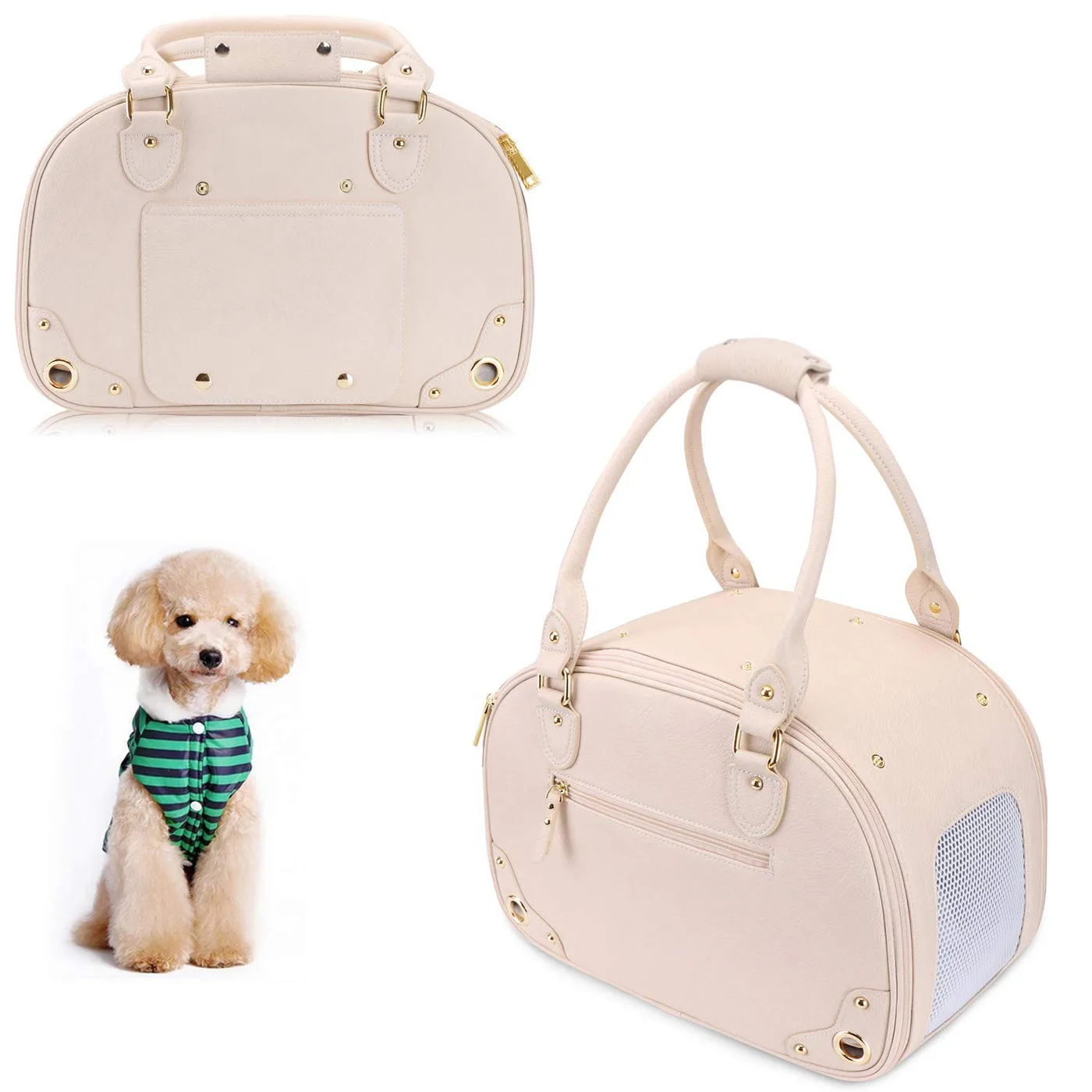
Gloss is the second variable and the one most often missed, because it is invisible on a swatch card and obvious on camera. A coated fabric that reads as matte to the eye can still produce a specular hotspot under a key light, and that hotspot is a blown-out white patch that no grading recovers.
The measurable target is gloss units at 60 degrees. A true matte exterior sits at 3-8 GU; a semi-matte at 10-25 GU; a glossy coated fabric at 40 GU and above. For creator-facing exteriors the specification is 3-8 GU with a maximum of 12 GU at any single measured point, which excludes most PVC-coated and most high-sheen PU finishes.
Finish is achieved in two ways, and they are not equivalent. A matting agent in the topcoat gives a durable finish that survives abrasion and is the preferred route, adding 0.20-0.60 USD per unit. A mechanical emboss that breaks up the surface gives a lower reading when new but polishes up at wear points — handles, corners, the base — within a few weeks, which is exactly where a camera looks.
| Finish | Gloss units | Hotspot risk | Abrasion durability | Added cost (USD) |
|---|---|---|---|---|
| Matte PU, matting agent | 3-8 GU | Very low | Good, 20,000 cycles | 0.20-0.60 |
| Mechanically embossed PU | 6-14 GU new | Low new, high worn | Poor, polishes | 0.10-0.30 |
| Standard PU coating | 18-35 GU | Moderate | Good | Base |
| PVC coating | 40-70 GU | High | Fair | Base minus 0.20 |
| Textured nylon, uncoated | 2-5 GU | Very low | Excellent | 0.30-0.90 |
Hardware is glossier than fabric and is the usual source of a hotspot. A polished metal zipper pull, a nickel-plated D-ring or a glossy plastic buckle will all specular-reflect a key light. The fix is a finish call on every trim item: brushed or anodised metal at 20-40 GU, matte injection-moulded acetal for buckles, and a painted or anodised rather than polished zipper pull. Specifying matte hardware adds 0.15-0.45 USD across a trim set.
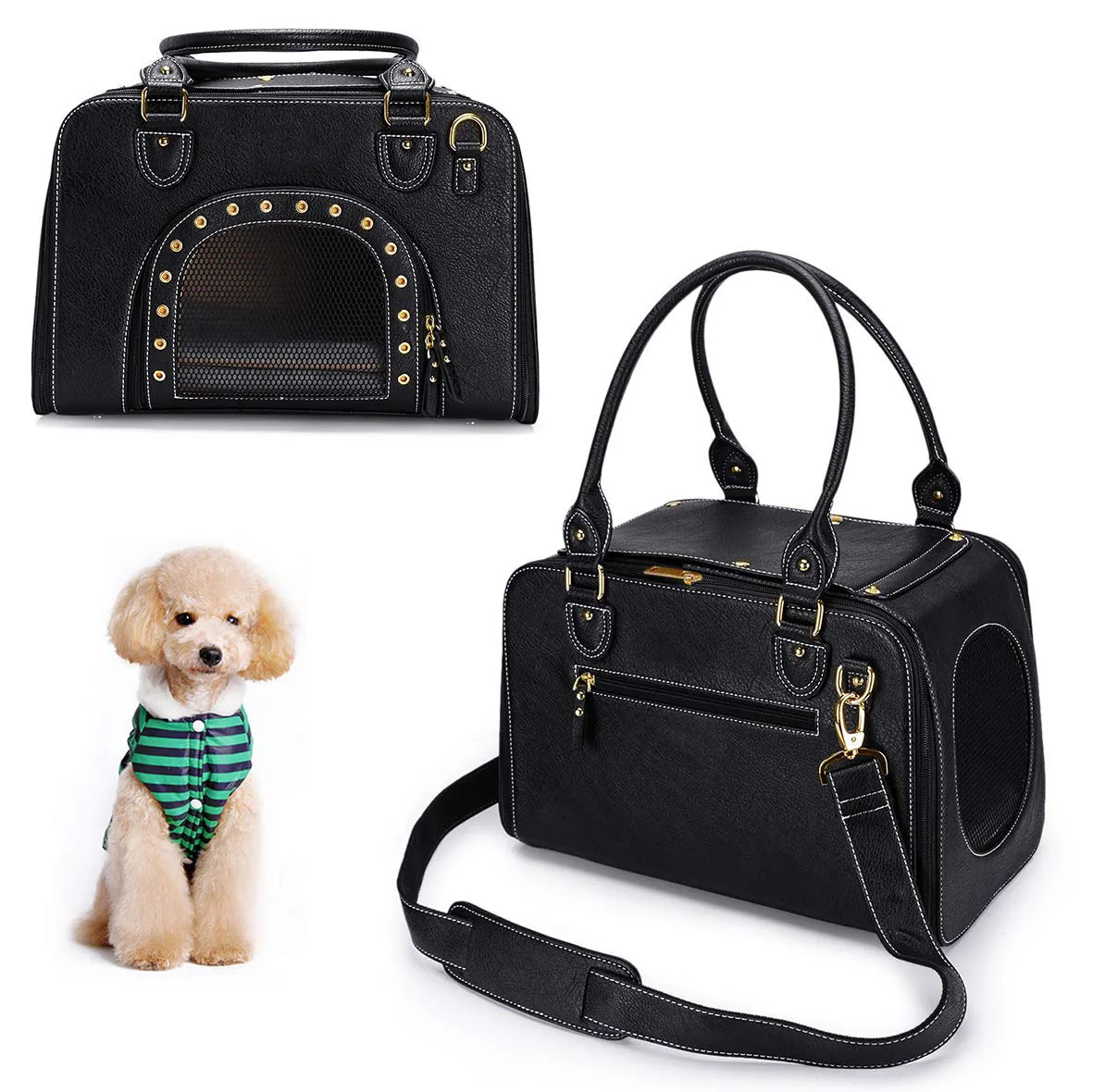
Mesh panels behave differently again and are worth calling out separately. A monofilament mesh reflects as a fine grid of points, which under a hard key light produces a shimmer that reads as noise. A texturised or matte-finish filament reduces it, and a slightly coarser gauge at 1.2-1.8 mm aperture reduces it further without losing ventilation area.
Gloss is a number in gloss units, measured on production fabric rather than judged from a swatch, and hardware needs the same call as the shell.
Logo Placement and Process for Camera: Position, Size and Legibility
Logo placement on a creator-led product is a geometry problem with a camera constraint: the mark has to be legible at the distance a phone actually holds, from the angles a creator actually shoots, without being re-shot. That gives three numbers to specify.
Position comes first. On a carrier carried on the back or shoulder, the camera-facing panel is the front or the outer side, and the logo should sit in the upper third of that panel, centred horizontally within 15 mm. The upper third is chosen because the lower third is usually occluded by a hand, a strap or the animal, and because overhead stills compress the lower part of the frame.
Size is the second number and it follows from resolution. A phone at 1.0-1.5 m resolves roughly 1.5-2.5 mm of detail on a 45-55 cm subject, which sets a minimum cap height of 45 mm for a wordmark and a minimum stroke width of 1.5 mm. Below that the mark turns to mush after compression. Above roughly 90 mm cap height it starts to dominate the frame and creators will shoot around it.
Process is the third decision and it is a cost and durability trade. Embroidery reads best in macro and stills but adds a raised edge that catches light and, on a coated shell, creates a stitch-hole path. A silicone or TPU patch is flat, camera-safe and durable, and is the default recommendation for creator-led SKUs. A woven label is the cheapest and reads acceptably down to about 30 mm cap height.
| Process | Legibility at 45 mm | Macro performance | Wash cycles | Unit cost (USD) | Tooling (USD) |
|---|---|---|---|---|---|
| Embroidery, 3D | Good | Excellent | 50-80 | 0.45-1.20 | 60-140 digitising |
| Silicone or TPU patch | Excellent | Excellent | 80-150 | 0.55-1.40 | 180-450 mould |
| Woven label, sewn | Fair | Good | 40-70 | 0.12-0.35 | 0-60 setup |
| Heat transfer | Fair | Poor | 20-40 | 0.08-0.25 | 40-120 film |
| Laser-etched panel | Excellent | Excellent | Life of product | 0.80-1.80 | 0 programming |
Placement approval should happen on a physical unit rather than on a technical drawing, because a placement that reads correctly on a flat pattern moves once the panel is assembled and loaded. The standard procedure is to place the mark on the prototype, photograph it at 1.0 m and 1.5 m under 5600 K, and approve from the photograph.
Colour choice for the mark interacts with the gloss discussion. A metallic or high-gloss thread in an embroidered logo produces the same hotspot problem as polished hardware, at a much smaller scale but with higher contrast. Matte thread and a matte patch are both safer, and a tonal mark one to two shades off the shell reads better on camera than a high-contrast one.
Logo specification is three numbers — upper third, 45-70 mm cap height, 1.5 mm minimum stroke — plus a process that survives both macro and compression.
Hardware and Trim Visibility: Zippers, Mesh and Moire on Video
Video introduces two failure modes that stills do not: moire on regular structures and audible noise from hardware. Both are production decisions, not post-production problems.
Moire appears when a regular pattern approaches the sensor sampling frequency, and a woven mesh is exactly such a pattern. A mesh with an aperture of 1.0-1.5 mm shot on a phone at typical distances produces visible interference that moves as the camera moves. The mitigation is a non-uniform or texturised weave, or shifting the aperture to 2.0-2.8 mm, which loses the moire without materially reducing open area. If ventilation is being claimed, open area is the number that has to be held, not aperture count: a 2.4 mm aperture at 40% open area is equivalent in airflow to a 1.2 mm aperture at 40%.
Zipper noise is the second issue and it is mechanical. A metal chain against a metal pull produces a rattle in the 2-6 kHz range, which is exactly where a lavalier or phone microphone is most sensitive. A coil zipper with a moulded pull and a fabric garage reduces measured peak noise by 6-12 dB. Specifying a quiet chain costs 0.20-0.55 USD and is worth more than any audio processing a creator will apply.
Handle and strap hardware is the third source. A loose D-ring or an unpadded strap adjuster taps against the shell during movement. The fixes are a bonded or taped trim tail, a silicone sleeve on the adjuster, and eliminating any free-hanging metal on the camera-facing side.
| Component | Problem on video | Specification | Noise or artefact reduction | Added cost (USD) |
|---|---|---|---|---|
| Mesh panel | Moire interference | Aperture 2.0-2.8 mm, 35-45% open area | Interference eliminated | 0.10-0.40 |
| Metal zipper chain | Rattle, 2-6 kHz | Coil chain, moulded pull, fabric garage | 6-12 dB peak | 0.20-0.55 |
| Polished pull | Specular hotspot | Anodised or painted, 20-40 GU | Hotspot removed | 0.05-0.20 |
| Free D-ring | Impact tap | Bonded trim tail or sleeve | Impact eliminated | 0.05-0.15 |
| Loose webbing tail | Movement in frame | Taped and heat-cut, 8-12 mm | Visual noise removed | 0.03-0.10 |
Interior surface finish matters on video for a different reason: the interior is shot through the mesh or through an open aperture, and a shiny interior lining produces a bright, low-contrast frame in which the animal is hard to see. A matte interior at 3-8 GU in a mid-tone, rather than black, gives a workable exposure range against a dark animal.
Video readiness is a mesh aperture, a coil zipper and matte hardware, and all three are cheaper to specify at sampling than to retrofit after a drop.
Small-Batch Multi-SKU Scheduling for Influencer Drops
A creator drop is a small-batch, multi-SKU order with a fixed external date, which is the hardest order type to schedule. The constraint is that a drop wants three to six colourways of one base pattern at low volume each, while a production line wants long runs of one SKU.
The reconciliation is a base-pattern strategy. One shell pattern, one lining, one hardware set, and differentiation carried by colourway, trim colour and logo. That keeps changeovers to a colour and trim swap rather than a full pattern change, which is the difference between a 40-minute changeover and a four-hour one.
MOQ structure follows. Standard MOQ is 500 pieces per colourway. For a drop the practical structure is 500 per colourway with a 1,500-piece programme minimum across three colourways, or a 350-piece colourway at a 12-18% unit cost uplift where the programme total still clears 1,500. Below 300 per colourway the economics break, because fabric minimums, trim minimums and setup are all fixed.
| Units per colourway | Colourways | Programme total | Unit cost index | Changeover count | Lead time impact |
|---|---|---|---|---|---|
| 300 | 5 | 1,500 | 118 | 5 | Plus 4-6 days |
| 500 | 3 | 1,500 | 100 | 3 | Base |
| 500 | 5 | 2,500 | 96 | 5 | Plus 2-3 days |
| 800 | 3 | 2,400 | 92 | 3 | Base |
| 1,200 | 2 | 2,400 | 88 | 2 | Minus 2 days |
| 2,000 | 1 | 2,000 | 84 | 1 | Minus 3-4 days |
Sequencing matters as much as quantity. Colourways should run light to dark, because that avoids a full machine clean between shades and is the single largest saving available across a multi-colour drop, typically 1-3 days of line time. Trim changes run after all colourways of a given trim set are complete.
Capacity planning for a drop should assume the content date is immovable and the sales date is not. That argues for splitting the order: a content batch of 12-30 units shipped early by air, and the balance shipped by sea against the sales date. Our production team schedules drops this way routinely, and the split is specified in the order rather than negotiated after the fact.
The efficient drop is one base pattern, three to five colourways at 500 each, run light to dark, with a content batch air-freighted ahead of the sea shipment.
Sampling Frequency and Revision Cycles Before a Content Shoot
Creator programmes sample more heavily than wholesale programmes, and the reason is that the approval criterion is a photograph rather than a physical inspection. A unit that passes inspection can still fail a shoot, so the sampling loop has to close on images.
The working cadence is three rounds. Round one is a construction and fit sample in a neutral colourway, evaluated for geometry, structure and assembly — 6-10 working days. Round two is a colourway and trim sample in all specified colours, evaluated under studio lighting and photographed at 1.0 m and 1.5 m — 6-10 working days. Round three is a pre-production sample from bulk materials on the bulk line, which is the unit that goes to the creator — 6-10 working days.
Three rounds at 6-10 working days each is 18-30 working days of sampling, plus 3-6 days of courier transit per round. A realistic sampling calendar before a shoot date is therefore six to eight weeks, and that number should be fixed before the shoot date is announced.
| Stage | Duration | Output | Approval criterion | Can be compressed to |
|---|---|---|---|---|
| Round 1, construction sample | 6-10 working days | 1 unit, neutral colour | Geometry, structure, assembly | 5 days |
| Courier to creator | 3-5 days | Physical unit | Handling comment | 2 days express |
| Round 2, colourway set | 6-10 working days | 1 per colourway | Delta-E, gloss, trim match | 6 days |
| Photo approval loop | 2-4 days | Studio images at 5600 K | Legibility, hotspot check | 1 day |
| Round 3, pre-production | 6-10 working days | 2-3 units from bulk line | Identical to bulk | 6 days |
| Content kit assembly | 2-3 days | 4 units per colourway | Lot integrity | 1 day |
| Air freight of content batch | 5-9 days | Delivered kit | On time for shoot | 3 days express |
Compression is possible but it costs. Each round can be shortened by roughly two to three days with dedicated line time, at a 150-400 USD expedite fee per round, and courier can be cut to two days at 3-5 times standard freight cost. The total compressible amount is about 10-14 days, which is worth knowing when a shoot date is already public.
Sample cost is separate from unit cost. A construction sample runs 45-120 USD depending on pattern complexity, a colourway sample 30-70 USD, and a pre-production sample 25-50 USD. Sample charges are credited against the bulk order above 1,500 units and charged in full below that.
Reference practice for conditioning and textile measurement follows published methods at ASTM International, and the quality system under which the programme runs is certified to ISO 9001. Sampling for a creator programme closes on photographs, and the realistic pre-shoot calendar is six to eight weeks.
Freight Decision for Drop Timing: Sea versus Air
A drop has two dates and they rarely align: the content date, when the creator needs the product, and the sales date, when customers can buy it. This is the reason freight for a creator programme is almost always a split rather than a single mode.
The content batch is small and urgent: 12-30 units, needed by a fixed date, with a product value that is trivial next to the cost of missing the date. Air is correct. At 6-9 USD per kg and a typical packed carton of 4 units at 5-7 kg, a 24-unit content kit costs 220-420 USD to fly, against 8-18 USD to ship by sea — and the sea option takes 28-38 days.
The sales batch is large and date-flexible by comparison: 1,500-2,500 units with a landed cost target. Sea is correct. A 20-foot container carries roughly 900-1,400 carton-packed carriers depending on compression and carton size; a 1,500-unit order fills 0.6-1.0 of a container, and the freight cost per unit at less-than-container load rates is 1.10-2.40 USD against 6-9 USD per kg air, which on a 1.3 kg unit is 8-12 USD.
| Mode | Transit | Cost per unit (USD) | Total (USD) | Variance risk | Suits |
|---|---|---|---|---|---|
| Air express, content batch 24 units | 3-5 days | 9-17 | 220-420 | Very low | Content kit |
| Air standard, content batch 24 units | 5-9 days | 6-11 | 150-270 | Low | Content kit |
| Air, full 1,500 units | 5-9 days | 8-12 | 12,000-18,000 | Low | Stockout rescue |
| Sea LCL, 1,500 units | 28-38 days | 1.10-2.40 | 1,650-3,600 | Moderate | Balance order |
| Sea FCL 20 ft, 1,500 units | 26-34 days | 0.75-1.60 | 1,125-2,400 | Moderate | Balance order |
| Sea plus air top-up 300 units | 26-34 plus 6 | 2.20-3.60 blended | 3,300-5,400 | Low | Fast seller |
The decision rule is arithmetical rather than instinctive. Air costs roughly 4-8 times sea per unit. It is justified when the margin lost by arriving late exceeds the freight differential, which on a 1,500-unit drop selling at a 45-60 USD retail price is true for any delay longer than about three weeks.
The second use of air is a top-up after a fast sell-through. A reorder of 300-500 units at MOQ-adjacent volume takes 35-50 days to produce, and sending it by sea adds another 26-34 days, which is 61-84 days from reorder to shelf. Flying the top-up cuts that to 41-59 days, which is the difference between capturing a trend and missing it.
Split the shipment: air for the 12-30 unit content kit on a fixed date, sea for the 1,500-unit balance, and model any air top-up against the margin a three-week delay would cost.
Cost Model: OEM and Private-Label Margins for Creator SKUs
A creator-led SKU has a different cost structure from a wholesale SKU, and the difference is in the fixed costs rather than the variable ones. Understanding where the money goes is what makes a 500-piece colourway viable or not.
The variable cost of a mid-specification soft cat carrier is 12-19 USD FOB Xiamen at 500 pieces per colourway. Of that, shell and lining fabric is 3.20-5.60 USD, hardware and trim 2.40-4.10 USD, foam and structure 1.10-2.30 USD, labour 2.60-4.20 USD, and packaging 0.90-2.10 USD. Creator-specific additions — matte finish, quiet zipper, patch logo, lot-controlled dyeing — add 1.10-2.80 USD in total.
The fixed costs are what dominates at low volume. Tooling for a silicone patch mould is 180-450 USD, a pattern and marker set is 120-320 USD, colourway lab dips are 40-90 USD each, and sampling across three rounds is 300-700 USD. Across 1,500 units those fixed costs are 0.42-1.04 USD per unit; across 500 units they are 1.28-3.12 USD per unit.
| Cost element | 500 units, 1 colourway | 1,500 units, 3 colourways | 2,500 units, 5 colourways |
|---|---|---|---|
| Shell and lining fabric | 5.10 | 4.40 | 3.90 |
| Hardware and trim | 3.90 | 3.20 | 2.80 |
| Foam and structure | 2.10 | 1.70 | 1.40 |
| Labour | 4.00 | 3.30 | 2.90 |
| Packaging | 1.90 | 1.40 | 1.10 |
| Creator-specific additions | 2.60 | 1.90 | 1.40 |
| Amortised tooling and sampling | 3.12 | 1.04 | 0.62 |
| Total FOB per unit | 22.72 | 16.94 | 14.12 |
The model shows why a single colourway at 500 is the weakest configuration in the whole ladder. It carries the highest fabric and labour rate, the highest tooling amortisation, and it gives a creator programme no visual range. Three colourways at 500 each costs 25% less per unit and gives three times the content.
Landed cost adds freight, duty and handling. At 1.20-2.40 USD sea freight per unit, 4-9% duty depending on classification and destination, and 0.40-1.10 USD of handling and inland delivery, a 16.94 USD FOB unit lands at 22.50-27.00 USD. Against a 59-79 USD retail price that supports a workable margin; against a 39 USD price point it does not, which is the point at which a creator programme should move to a simpler specification rather than a cheaper factory.
Payment and inspection complete the model: T/T 30/70, with the balance against a passed final random inspection at AQL 2.5. Our production team runs creator programmes through the SGS-verified production base under ISO 9001 and BSCI coverage, with prototypes in 6-10 working days, bulk production 35-50 days after sample approval and FOB Xiamen. The economics of a creator SKU are decided by tooling amortisation, not by fabric, and three colourways at 500 beats one colourway at 500 on both cost and content.
Why brands source here
- Pet carrier programs run since 2014; founding team in sewn goods since 2004
- SGS-verified production floor of 4,950 m² with 137 workers across 7 lines
- Monthly capacity of 200,000 units, audited to BSCI and ISO 9001
People Also Ask
How many sample units does a pet influencer content kit need?
Four per colourway: a hero unit, a sealed backup from the same lot, a flat-lay unit shipped flat, and a cutaway unit. Add a fifth in full retail packaging when an unboxing sequence is planned.
What colour tolerance should a camera-ready cat carrier hold?
Delta-E 2.0 under D65 against the approved reference, with a second check at Delta-E 3.0 under 5600 K studio light and a lot-to-lot tolerance of Delta-E 1.0.
Why does a matte exterior matter for video content?
A coated fabric can read matte to the eye and still throw a specular hotspot under a key light. Holding 3-8 gloss units at 60 degrees, with a 12 GU maximum at any point, removes it.
How large should a logo be for phone camera legibility?
45-70 mm cap height with a minimum stroke width of 1.5 mm, placed in the upper third of the camera-facing panel. A phone resolves roughly 1.5-2.5 mm of detail at 1.0-1.5 m.
Which logo process works best on camera-facing panels?
A silicone or TPU patch, at 0.55-1.40 USD plus a 180-450 USD mould. It is flat, camera-safe and survives 80-150 wash cycles, unlike a heat transfer at 20-40.
What causes moire on cat carrier mesh in video?
A regular weave near the sensor sampling frequency. Moving the aperture to 2.0-2.8 mm while holding 35-45% open area removes the interference without reducing airflow.
Should a drop ship by air or by sea?
Split it. Air the 12-30 unit content kit at 6-17 USD per unit against a fixed shoot date, and ship the 1,500-unit balance by sea at 0.75-2.40 USD per unit.
Why is one colourway at 500 units the weakest order configuration?
It carries the highest fabric and labour rate plus the highest tooling amortisation, at 3.12 USD per unit. Three colourways at 500 each drops amortisation to 1.04 USD and triples the content range.
Frequently Asked Questions
How long is the sampling calendar before a creator shoot date?
Six to eight weeks. Three rounds of 6-10 working days each, plus 3-5 days courier per round, plus photo approval and kit assembly. Compression of 10-14 days is possible with a 150-400 USD expedite fee per round.
Why should all kit units come from a single dye lot?
A camera sensor resolves about Delta-E 1.5-2.0 between nominally identical panels. Splitting a kit across two lots is the most common cause of two bags in one frame looking different.
What is the minimum cap height for a wordmark on camera?
45 mm, rising to 90 mm as a practical maximum. Below 45 mm the mark degrades after compression; above 90 mm it dominates the frame and creators shoot around it.
How much does matte hardware add to unit cost?
0.15-0.45 USD across a trim set: anodised or painted zipper pulls, matte acetal buckles and brushed metal D-rings at 20-40 gloss units instead of polished finishes.
Why is a coil zipper specified instead of a metal chain?
A metal chain against a metal pull rattles at 2-6 kHz, exactly where phone and lavalier microphones are most sensitive. A coil chain with a moulded pull and fabric garage cuts peak noise by 6-12 dB.
What interior finish works best when shot through mesh?
A matte mid-tone interior at 3-8 gloss units rather than black. A shiny lining produces a bright, low-contrast frame in which a dark animal is hard to expose correctly.
Why should colourways run light to dark on the line?
It avoids a full machine clean between shades, saving 1-3 days of line time across a multi-colour drop. Trim changes run after every colourway in a trim set is complete.
What is the cost of a 350-piece colourway?
A 12-18% unit cost uplift, provided the programme total still clears 1,500 pieces. Below 300 per colourway the economics break, because fabric, trim and setup minimums are fixed costs.
How much does a construction sample cost?
45-120 USD depending on pattern complexity, against 30-70 USD for a colourway sample and 25-50 USD for a pre-production sample. Charges are credited against bulk orders above 1,500 units.
How many units fit in a 20-foot container?
Roughly 900-1,400 carton-packed soft carriers depending on compression and carton size, so a 1,500-unit order fills 0.6-1.0 of a container and is usually shipped as a partial or as LCL.
When is air freight justified for a full bulk order?
When the margin lost by arriving late exceeds the freight differential. Air runs 4-8 times sea per unit, so on a 45-60 USD retail product any delay beyond about three weeks justifies flying.
What does a reorder timeline look like with and without air?
Sea gives 61-84 days from reorder to shelf: 35-50 days production plus 26-34 days transit. Air cuts that to 41-59 days, which is the difference between capturing a trend and missing it.
What is the variable cost range for a mid-specification soft carrier?
12-19 USD FOB Xiamen at 500 per colourway: fabric 3.20-5.60, hardware 2.40-4.10, foam 1.10-2.30, labour 2.60-4.20, packaging 0.90-2.10.
Why is grey the hardest colourway to hold for camera work?
A grey with even a small colour cast reads as an entirely different colour once a phone applies auto white balance, so a neutral grey needs a Delta-E 1.0 tolerance rather than the standard 2.0.
Talk to QUANZHOU JUNYUAN BAGS about a pet carrier program: MOQ 500 pieces per colourway, samples in 6-10 working days, bulk production in 35-50 days under AQL 2.5 inspection.
Get a free quote Request a sample