Dog Carrier Backpack for German Shepherds: Large Breed
A German Shepherd-class carrier is a long-span problem: 22-40 kg carried over a 700-780 mm torso with a high centre of mass. Specify a perimeter frame or 10 mm ribbed tray holding mid-span deflection under 6 mm at a 60 kg proof load, a flat non-contoured floor for hip support, 1680D lower panels, and a load path that transfers into a 50 mm shoulder strap root.
This page addresses the geometry and span problem that separates the German Shepherd class from compact large breeds of similar mass. A 34 kg Shepherd is not a 34 kg Bulldog: the mass sits further from the wearer, over a longer floor span, with a higher centre of gravity and a topline that loads the rear of the compartment differently. The consequences are a deflection limit set by span rather than by weight, a bending moment at the floor-to-wall joint roughly double that of a compact breed, and a carrying geometry that has to be resolved on the wearer side rather than inside the compartment. Commercial terms follow the standard programme: MOQ 500 pieces per colourway, prototypes in 6-10 working days, bulk production 35-50 days after sample approval, final random inspection to AQL 2.5, T/T 30/70 payment and FOB Xiamen loading. Structural data quoted here is produced by our production team across SGS-verified production base partner facilities running seven lines and 149 machines.
Most dog carrier backpack buyers choose between pet carrier OEM and pet carrier ODM on one question: who owns the pattern and the tooling once the programme is approved.
Dimensional Envelope: Long Torso, Sloped Topline and Interior Geometry
German Shepherds run 22-40 kg with working-line males at the upper end, and the dimensional envelope that matters is not the mass but the torso. Body length measured nose to tail base runs 700-780 mm for an adult male, height at the shoulder 600-650 mm, chest girth 75-95 cm, and chest depth 280-330 mm. A carrier built to the compact-breed proportion of roughly 1.4:1 length-to-height will not hold this animal, and a carrier built by simply scaling a small-dog pattern up produces a shell that is long, shallow and structurally weak in bending.
Derived interior dimensions land at 420-480 mm wide, 760-860 mm long and 580-660 mm high. The height figure is driven by the standing shoulder rather than by a lying posture, because a Shepherd will attempt to stand in a compartment that allows it, and a compartment that forces a crouch is refused by the animal. Width is the one dimension that can be held tighter, since the breed is deep-chested rather than broad.
The sloped topline is a genuine engineering input rather than a cosmetic one. The breed's characteristic downhill stance puts a larger share of body mass over the hindquarters, roughly 55-60% against 45-50% in a level-backed breed, and the hindquarters carry the largest muscle mass in the animal. Load distribution inside the compartment is therefore rear-biased, and the rear third of the floor and the rear panel carry proportionally more than a symmetric design assumes.
Centre of mass height is the second geometric consequence. With a 600-650 mm shoulder height, an adult in a standing crouch places its centre of mass 350-420 mm above the floor, which is high relative to the compartment width. Any lateral acceleration — the wearer turning, stepping off a kerb, or a vehicle cornering — produces a moments-induced side load on the upper panels and on the shoulder strap attachment that a low-slung breed never generates.
These two facts set the pattern. The floor is long and rear-biased in load; the upper structure has to resist a side load applied well above the floor; and the shell has to be stiff in bending over a span 30-40% longer than a compact breed of identical mass. The German Shepherd class is specified as a long-span, rear-biased, high-centre-of-mass load case, and every structural number follows from that description rather than from the weight.
Span-Limited Floor Design: Deflection, Rib Layout and Hip Support
Deflection scales with the cube of span for a uniformly loaded beam, which is the whole reason this class is different. Holding the same material and section, moving from a 550 mm span to a 780 mm span increases deflection by a factor of roughly 2.8. A board that holds 5 mm at 550 mm will show 14 mm at 780 mm, and 14 mm is past the point at which a large dog braces and refuses to settle.
The specification for the class is mid-span deflection under 4 mm at working load, taken as 1.5 times the declared 40 kg maximum, so 60 kg, and under 8 mm at the proof load of 120 kg. Both are measured with a dial gauge after a 60-second hold and again after a 60-second recovery, because a board that recovers fully and a board that has taken a permanent set behave very differently over a service life.
Three constructions reach those numbers. A 10 mm polypropylene hollow-board is the cheapest and the heaviest. A moulded polypropylene tray with ribs of 16-20 mm depth on a 50-60 mm pitch reaches the deflection limit at 25-35% less mass and is the specification of choice above roughly 5,000 units a year. A perimeter aluminium or steel tube frame with a thin 4 mm deck reaches it at the lowest mass and the highest cost, and it is the only construction that also solves the bending problem in the shell, discussed in the next section.
Rib orientation matters on a moulded tray. Transverse ribs running across the width resist bending over the long axis, which is the governing case here, and longitudinal ribs do almost nothing for it. A tray designed with longitudinal ribs because they look right on a shorter product will fail the deflection test at this span.
Hip support is a flatness requirement rather than a softness one. The breed has a well-documented predisposition to hip dysplasia, and an animal with uncomfortable hips will not settle on a contoured or sagging surface. The specification is a floor flat within 2 mm across its full area at working load, no contouring, no sculpted bolster inside the support area, and a mat of 8-12 mm closed-cell foam with a compression set under 10% so it does not develop a permanent hollow where the animal habitually lies.
| Construction | Mass (g) | Deflection at 60 kg | Permanent set after proof | Added unit cost (USD) |
|---|---|---|---|---|
| 10 mm PP hollow board | 720-900 | 3-4 mm | Under 0.5 mm | 1.10-1.80 |
| Moulded PP tray, 16-20 mm rib | 520-680 | 3-4 mm | Under 0.4 mm | 2.20-3.60 plus tooling |
| Perimeter tube frame plus deck | 380-520 | 2-3 mm | Under 0.3 mm | 4.60-7.80 |
| 6 mm HDPE sheet (carry-over) | 640-780 | 11-14 mm | 2-4 mm | 0.95-1.50 |
The carry-over row in the table is the trap. A 6 mm sheet is entirely adequate at 550 mm and fails at 780 mm, and because it fails by taking a permanent set rather than by cracking, the defect presents as a floor that slowly sags over weeks of use and is attributed to wear rather than to specification.
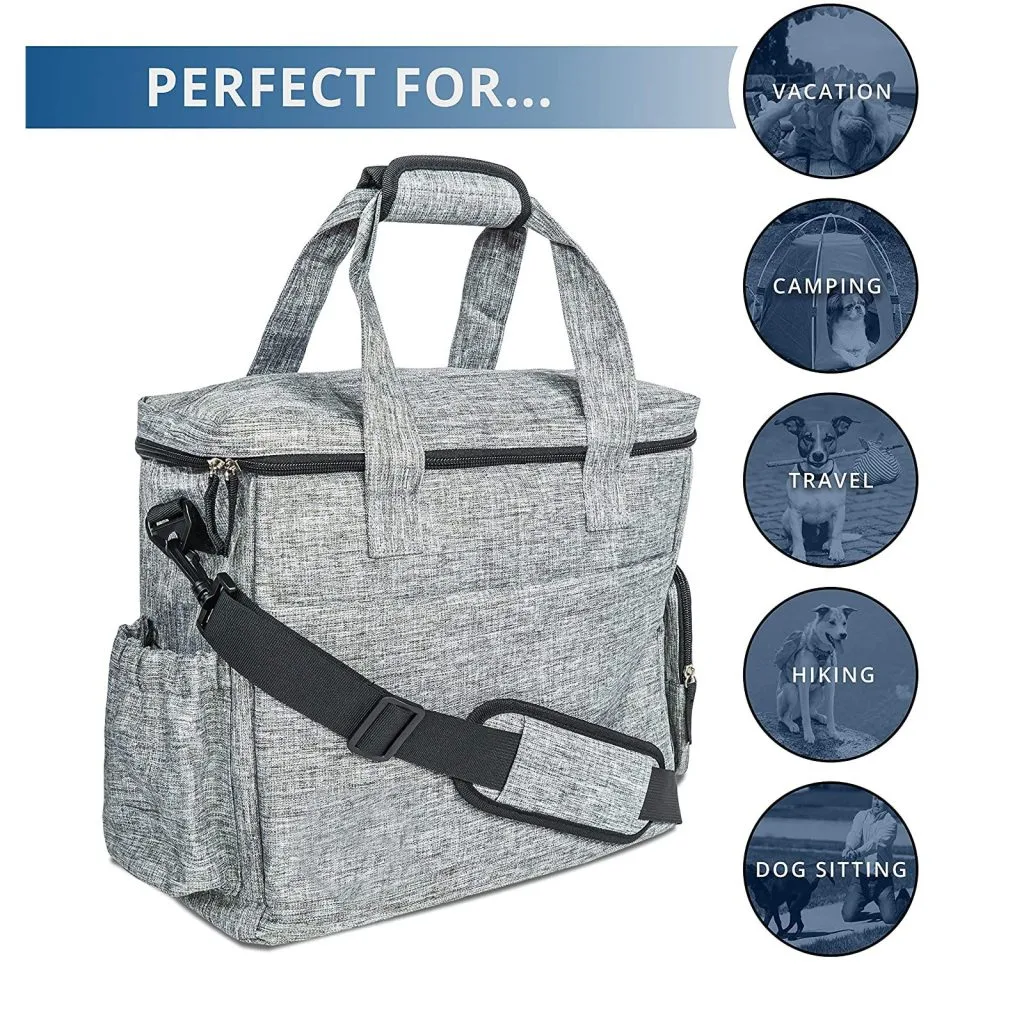
Perimeter Frame and Load Path: From Floor to Shoulder Strap
Once the span exceeds roughly 700 mm, the shell itself becomes the structural problem. A soft shell of coated fabric has essentially no bending stiffness, so at this length the compartment behaves as a beam with no flange: it folds at mid-length under load, and the fold is felt by the animal and by the wearer as the product collapsing around the dog. Adding fabric weight does not fix it. Adding a flange does.
The perimeter frame is that flange. A tube or a pultruded rod of 8-12 mm diameter, or a flat bar of 3 mm by 20 mm, run in a continuous loop around the top edge of the compartment and down the two rear corners, converts the shell into a tensioned membrane over a stiff boundary. Bending stiffness rises by an order of magnitude for a mass addition of 180-320 g, and the fold at mid-length disappears.
Material choice for the frame is a cost and corrosion decision. Aluminium tube is the standard answer at 180-260 g and 3.20-5.40 USD. A fibre-reinforced polymer rod is lighter at 140-200 g but costs 5.80-9.20 USD and is harder to terminate. Steel is avoided entirely because of corrosion at the cut ends and because of the weight penalty at a diameter sufficient to resist buckling.
The load path from the frame to the wearer is the part that fails in practice. A long compartment puts the animal's centre of mass 250-320 mm behind the wearer's back, and that eccentricity produces a continuous moment trying to rotate the pack away from the body. The counters are a load-lifter strap from the top of the frame to the shoulder strap above the collarbone, a sternum strap, and a waist belt that carries 40-60% of the total on any load above 20 kg.
Strap root geometry deserves its own instruction. The shoulder strap attaches to the frame or to a reinforced panel at the top rear corner, not to the shell fabric, and the root is a 50 mm webbing extension bar-tacked over a reinforcement patch of at least 100 mm by 120 mm. A strap root sewn to shell fabric alone is the most common structural warranty claim in the large-breed category.
Clearance is the final geometric constraint at this size. A compartment 860 mm long and 660 mm high will not pass through a standard 800 mm door opening with the wearer turned sideways, and it will not fit under an aircraft seat or in most overhead bins. This is a soft-carrier product for ground transport and veterinary transfer, and the specification should say so rather than implying air-travel compatibility. Buyers working to airline rules should read the live-animal requirements published by IATA before writing a product claim.
Panel Specification for the 22-40 kg Band: Denier, Coating and Abrasion
Panel specification in this class is driven less by claw damage than by abrasion and by the volume of shed coat. German Shepherds carry a dense double coat with a substantial undercoat that sheds continuously, and the shed hair is abrasive, works into zipper coils and hook-and-loop closures, and holds moisture against the lining. Material selection therefore has to account for a duty cycle that includes frequent cleaning as well as mechanical load.
Base fabric is coated 900D polyester at 280-320 g/m² for the upper panels and coated 1680D at 400-480 g/m² for the lower 350 mm of the side walls, the floor-side zone and the rear panel where the animal braces. Tongue tear is specified at a minimum of 100 N for the 900D zones and 180 N for the 1680D zones, tested to the methods published by ASTM International.
Abrasion is the property that actually governs service life here, because a 40 kg animal shifting its weight abrades the floor-side zone continuously rather than in discrete events. Martindale abrasion to the ISO 12947 series is the reference method, with 30,000 cycles to no yarn breakage on the 900D zones and 60,000 on the 1680D zones. Coated fabrics that pass on tear and fail on abrasion almost always fail because the coating is too thin to hold the yarns in place, which is a coating-weight problem rather than a fabric problem.
Coating weight should therefore be specified independently of fabric weight: 35-45 g/m² of dry solids minimum for a PU coating and 45-60 g/m² for TPU, measured on delivered lots rather than taken from a supplier datasheet. Hydrolysis resistance is confirmed by 72 hours at 70 °C and 95% relative humidity followed by a repeat of the abrasion test, and a coating that loses more than 20% of its cycle life in conditioning is rejected.
Colour and cleanability interact. A dark interior shows every shed hair and is the wrong choice for a programme sold on appearance, but a light interior shows soiling and needs a coating with a stain-release finish. The compromise used in most programmes is a mid-tone interior with a soil-release topcoat and a removable, washable mat, and the mat is specified for 50 domestic wash cycles at 40 °C with no dimensional change above 2% and no coating degradation.
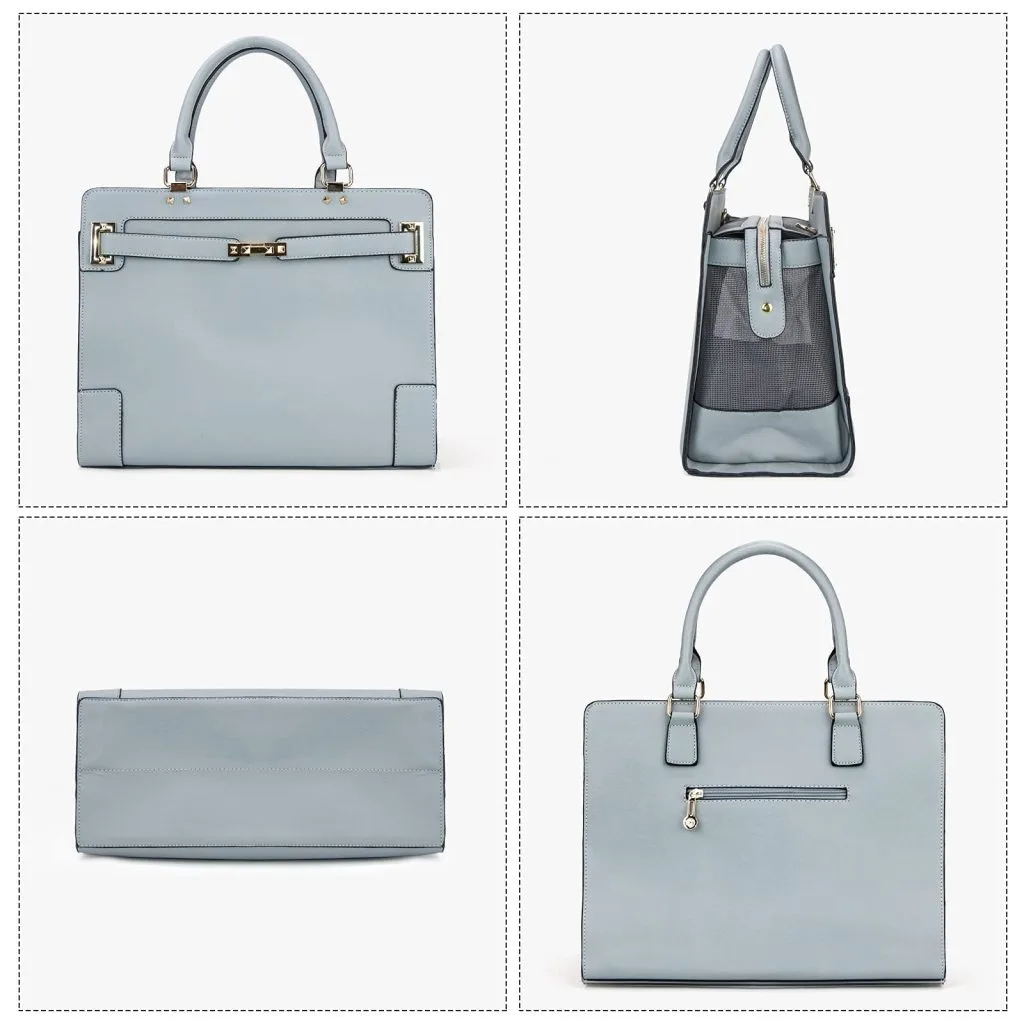
Seam and Attachment Redundancy at High Bending Moments
The bending moment at the floor-to-wall joint is the number that separates this class from the compact breeds. Moment scales with load times distance, and with the rear-biased load distribution placing 55-60% of body mass behind mid-span, the rear floor joint sees roughly 1.8-2.2 times the moment of a symmetric load case at the same total mass. A seam specified by rule of thumb from a smaller product will be under-designed by close to a factor of two at that location.
The joint specification has five elements. A 15 mm minimum seam allowance with the board sleeve captured in the same stitch line. Stitch density of 8-9 per inch in bonded polyester Tex 135. Two parallel rows spaced 4-5 mm apart rather than one. A binding over the raw edge so the seam is never presented to the animal. And a bar-tack of 12 mm minimum at both ends, at each corner and at 150 mm intervals along the rear run, which is the run that carries the highest moment.
Seam efficiency is measured rather than assumed, to the ISO 13935 series for woven fabric seams, with acceptance at 70% for general assembly and 80% for the rear floor joint and all frame attachment points. Results are recorded by seam location, because a global pass figure hides exactly the local weakness that this class produces.
Frame attachment points need separate treatment. Where the perimeter tube terminates or where a strap root lands on the frame, the load is concentrated into a small area and is largely a bearing and pull-out problem rather than a seam problem. The specification is a moulded or stamped termination with a bearing area of at least 400 mm², backed by a reinforcement patch extending 40 mm beyond the stitch line, with the tube captured in a closed channel rather than held by a strap over it.
Creep is the failure mode that static testing misses and that shows up in this class because the loads are sustained. A loaded carrier carried for an hour at a time accumulates creep in the webbing, at the adjuster and in the coated fabric, and the practical control is a proof hold long enough to expose it: 24 hours at the 120 kg proof load with measurements at 1, 4 and 24 hours, and acceptance of no more than 2% total elongation with no recovery loss after unloading.
Ventilation and Thermal Load for a Dense Double Coat
A dense double coat is an insulating layer the animal cannot remove, and it changes the thermal calculation in both directions. It protects against cold, so a winter programme does not need interior insulation. It obstructs heat loss badly in warm conditions, so the upper ambient limit for the class is lower than a short-coated breed of the same mass would suggest, and the ventilation specification has to be set accordingly.
Open area of 26-32% is the working figure for this class, higher than the compact-breed number because the coat blocks convective loss at the skin and because a 40 kg animal produces a great deal of metabolic heat. Intake is placed low on the front and both side faces, exhaust high at the rear and on the upper rear corner, with the exhaust area within 20% of the intake so that neither side throttles the flow.
Airflow direction matters more than area at this size. A long compartment with intake at the front and exhaust at the rear produces a through-flow along the animal's body axis, which is the most effective arrangement for removing heat and for clearing shed hair and dander. Cross-flow arrangements with intake and exhaust on opposite side faces perform measurably worse in a long compartment because a large fraction of the incoming air short-circuits near the intake.
The acceptance test is a temperature rise measurement rather than an open-area calculation: the interior is logged at three positions, front, mid and rear, for one hour in a 26 °C chamber with the animal's mass simulated by a heated block of equivalent thermal output. Acceptance is a rise under 4 °C at mid-compartment and under 6 °C at the rear, where the insulated coat and the rear-biased posture combine to make the worst case.
Hair ingress is a maintenance specification with real warranty consequences. Shed hair packs into zipper coils, hook-and-loop tape and the gap between the mat and the floor, and it accelerates wear in all three. The controls are a zipper garage with a covered coil, hook-and-loop restricted to non-critical closures or eliminated, a mat that lifts out fully for cleaning, and a smooth welded or coated floor with no textile pocket to trap hair.
Veterinary guidance on heat stress and on the practical limits of transporting large dogs is worth citing in the product documentation, and the position statements published by the American Veterinary Medical Association are the reference most buyers recognise when they review a submission.
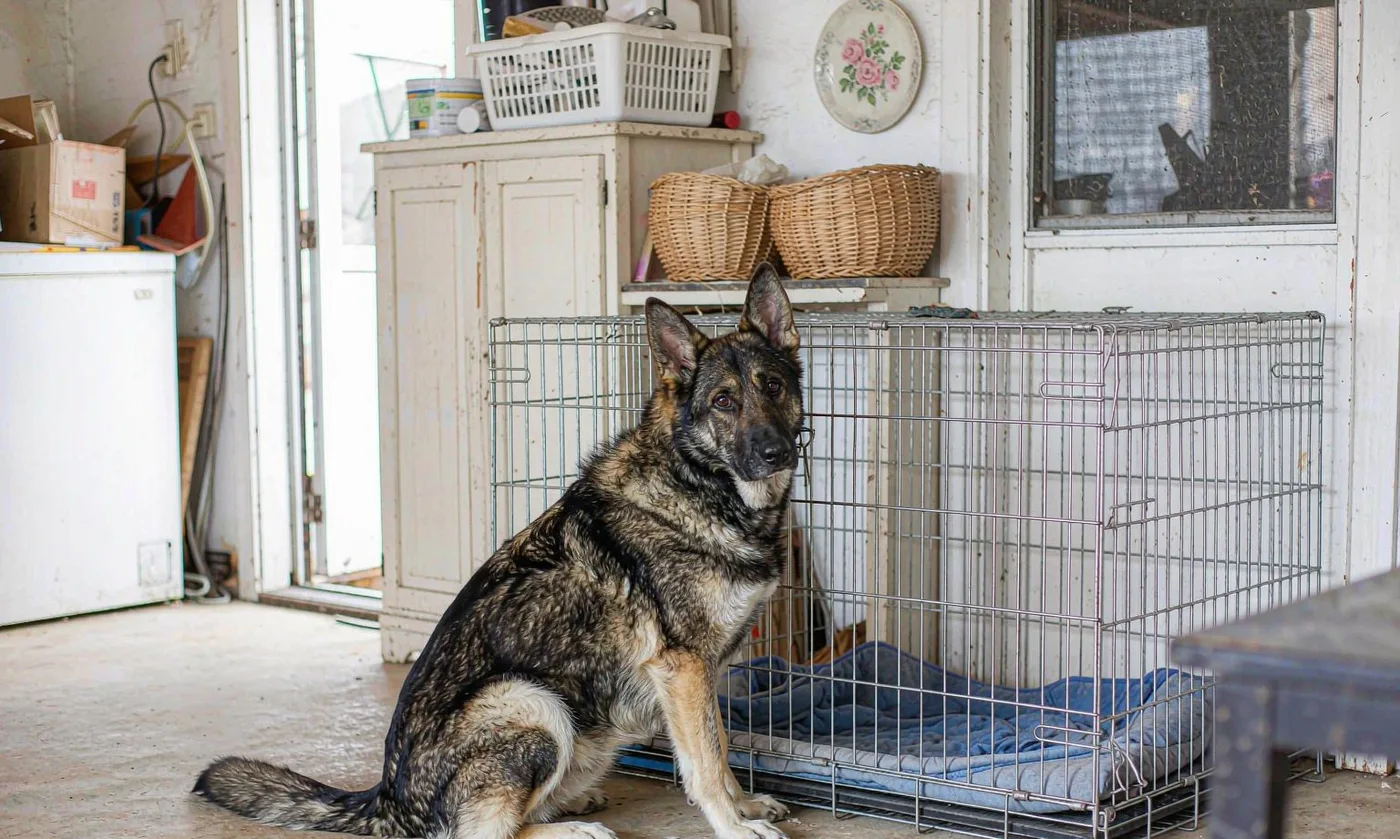
Test Regime: Long-Span Deflection, Creep and Cyclic Protocols
Validation for the class runs as a five-stage sequence applied to first articles, to each colourway change and to one pulled unit per 5,000 in production. It differs from the compact-breed protocol in two places: the deflection measurement is taken at three points along the span rather than at mid-span only, and a creep hold is added, because both are span-dependent failure modes.
Stage one is the long-span deflection test. The unit is loaded to 60 kg working and 120 kg proof with the ballast distributed in the rear-biased ratio of 58:42 front-to-rear, not uniformly, and deflection is logged at quarter, mid and three-quarter span. Acceptance is under 4 mm at working and under 8 mm at proof at every position, with permanent set under 0.5 mm after a 60-second recovery.
Stage two is the 24-hour creep hold described in the seam section, with elongation logged at 1, 4 and 24 hours. Stage three is cyclic: the floor joint is cycled 12,000 times between 30% and 90% of working load, the frame attachment points 8,000 times at 60% of ultimate, and the closure 3,000 cycles under a 250 N spreading load, which is higher than the compact-breed figure because the compartment is longer and a dog can build more momentum in it.
Stage four is conditioning and re-test: 72 hours at 70 °C and 95% relative humidity, 72 hours at minus 20 °C and 120 hours of ultraviolet exposure, followed by a repeat of stage one and a visual and tactile inspection of every coating. Stage five is a drop test from 200 mm at each corner with the rated ballast in place, since a compartment this long is frequently set down unevenly.
| Stage | Load or condition | Measurement | Acceptance |
|---|---|---|---|
| Long-span deflection | 60 kg working, 120 kg proof, 58:42 rear bias | Deflection at quarter, mid, three-quarter span | Under 4 mm / under 8 mm |
| Creep hold | 120 kg, 24 h | Elongation at 1, 4, 24 h | Under 2%, full recovery |
| Floor joint cyclic | 12,000 cycles, 30-90% WLL | Seam opening, board movement | No opening over 6 mm |
| Frame attachment cyclic | 8,000 cycles at 60% ultimate | Bearing deformation, pull-out | No deformation, no pull-out |
| Conditioning | 70 °C/95% RH, -20 °C, UV | Repeat deflection, coating check | Within 10% of baseline |
| Corner drop | 200 mm, four corners, rated ballast | Frame and seam inspection | No crack, no opening |
Retention closes the regime: dated reports with photographs and measured values, one set per colourway and per production run, held for the life of the style plus two years. Where a buyer requires third-party containment evidence, the programme run by the Center for Pet Safety is the standard most United States retailers reference.
Weight, Cost and Freight Parameters for the Long Format
A German Shepherd-class carrier is the point at which product weight becomes a design constraint rather than a side effect. A compliant build with a moulded tray and a perimeter frame weighs 3.4-4.6 kg empty against 1.8-2.6 kg for a compact-breed product, and adding a 40 kg animal puts the wearer at 44 kg before the product's own distribution problems are considered. Every 100 g removed from the structure is worth more here than in any other class.
Unit cost lands at 26-42 USD FOB Xiamen. The floor assembly is 3.20-6.40 USD, the perimeter frame 3.20-7.80 USD, the panel and mesh package 6.20-9.40 USD, the webbing, hardware and harness set 5.40-9.20 USD and labour 6.80-10.40 USD, the last figure reflecting both the size and the number of bar-tacked junctions. Against a compact-breed carrier of the same external volume the premium is 8.40-14.20 USD, and roughly 60% of it is the floor and frame rather than the fabric.
Freight is dominated by cube at this size. Flat-packed, the unit measures about 880 mm by 480 mm by 220 mm, or 0.093 cubic metres, and one unit per carton at 900 by 500 by 250 mm gives 0.113 cubic metres with a gross weight near 5.4 kg. A 40-foot high-cube takes 560-600 cartons, and unlike the compact class it is volume-limited rather than weight-limited, so the moulded tray's mass saving is worth less than its cube neutrality and the frame's packability becomes the deciding factor.
Flat-pack design is therefore a cost lever. A frame that breaks into two lengths and stows alongside the folded shell cuts packed height from 250 mm to roughly 170 mm, which lifts a 40-foot container from 560 to 820-860 cartons and is worth 0.55-0.90 USD per unit on landed freight. The break joint costs 1.20-2.40 USD to engineer and to qualify, and it pays back inside two containers.
Tooling is the last commercial variable. Pattern development for a size this long runs 1,100-1,900 USD, a moulded tray adds 9,000-16,000 USD with ten to fourteen weeks of lead time, and a custom frame extrusion adds 4,000-8,000 USD. Programmes above 5,000 units a year recover the tray; between 2,000 and 5,000 the correct answer is a 10 mm die-cut board with a perimeter frame, which reaches the same deflection limit for less tooling and roughly 1.10-1.80 USD more unit cost.
Production capability
- SGS-verified production space of 4,950 m², 149 machines, 7 assembly lines
- Pet carrier and pet bag output since 2014 from a 137-person team
- 200,000 units shipped monthly under BSCI and ISO 9001 systems
People Also Ask
What interior size suits a German Shepherd carrier?
Around 420-480 mm wide, 760-860 mm long and 580-660 mm high, derived from a 700-780 mm torso and a 600-650 mm shoulder height. The proportions are long and tall rather than long and low.
Why is span more important than weight in this class?
Deflection scales with the cube of span, so moving from 550 mm to 780 mm nearly triples deflection at identical load and material. A board that holds 5 mm at the short span shows 14 mm at the long one.
Is a rigid frame required above 700 mm of compartment length?
Yes in practice. A soft shell has almost no bending stiffness and folds at mid-length, so a perimeter tube or rod of 8-12 mm converts the shell into a tensioned membrane for 180-320 g of added mass.
How is load distributed front to rear?
The sloped topline puts roughly 55-60% of body mass over the hindquarters, so ballast is distributed 58:42 front-to-rear in testing and the rear floor joint is specified above the front one.
What fabric denier suits the 22-40 kg band?
Coated 900D at 280-320 g/m² with tongue tear above 100 N for upper panels, and coated 1680D at 400-480 g/m² with tear above 180 N for the lower 350 mm and the rear brace zone.
How much open area does a double-coated breed need?
26-32%, with through-flow along the body axis from low front intake to high rear exhaust. Acceptance is a temperature rise under 4 °C at mid-compartment in a 26 °C chamber.
Frequently Asked Questions
What deflection limit applies at a 780 mm span?
Under 4 mm at the 60 kg working load and under 8 mm at the 120 kg proof load, measured at quarter, mid and three-quarter span with a dial gauge after a 60-second hold and a 60-second recovery.
Why is the ballast distributed 58:42 rather than evenly?
The breed's sloped topline places 55-60% of mass over the hindquarters. Testing with uniform ballast understates the rear floor joint load by close to a factor of two at that location.
Which floor construction is correct between 2,000 and 5,000 units a year?
A 10 mm die-cut polypropylene hollow-board with a perimeter frame. It reaches the same deflection limit as a moulded tray without 9,000-16,000 USD of tooling, at roughly 1.10-1.80 USD more unit cost.
Why must rib orientation be transverse on a moulded tray?
Transverse ribs resist bending over the long axis, which is the governing case. Longitudinal ribs contribute almost nothing to bending stiffness over a 780 mm span.
What does hip support require?
A floor flat within 2 mm at working load with no contouring, plus a closed-cell foam mat of 8-12 mm with compression set under 10% so it does not form a permanent hollow where the animal lies.
How is the load path completed to the wearer?
A load-lifter strap to the shoulder above the collarbone, a sternum strap and a waist belt carrying 40-60% of total load. The strap root is 50 mm webbing bar-tacked over a 100 by 120 mm reinforcement patch.
Why is creep tested separately from static strength?
Loads are sustained for an hour at a time, and webbing, adjusters and coated fabric all accumulate creep. A 24-hour hold at proof load with readings at 1, 4 and 24 hours exposes what a short static test cannot.
What coating weight is specified?
35-45 g/m² of dry solids for PU and 45-60 g/m² for TPU, measured on delivered lots. Hydrolysis is confirmed by 72 hours at 70 °C and 95% relative humidity with under 20% loss of abrasion cycles.
How is hair ingress controlled?
A zipper garage over the coil, hook-and-loop restricted to non-critical closures, a fully liftable mat and a smooth welded or coated floor with no textile pocket to trap hair.
What is the empty weight of a compliant build?
3.4-4.6 kg with a moulded tray and perimeter frame, against 1.8-2.6 kg for a compact-breed product. At this scale every 100 g removed from the structure has measurable value to the wearer.
What does air freight cost relative to sea?
Volumetric weight bills about 18.8 kg per carton against an actual 5.4 kg, so air is three to four times sea on a per-unit basis and is only justified for the first 300-500 units of a launch.
Why is flat-pack frame design worth the tooling?
A frame that breaks into two lengths cuts packed height from 250 mm to about 170 mm, lifting a 40-foot container from 560 to 820-860 cartons, worth 0.55-0.90 USD per unit on landed freight.
Is this product viable for air travel?
No. A compartment 860 mm long and 660 mm high does not fit under a seat or in an overhead bin, so the class is specified for ground transport and veterinary transfer rather than cabin carriage.
Talk to QUANZHOU JUNYUAN BAGS about a pet carrier program: MOQ 500 pieces per colourway, samples in 6-10 working days, bulk production in 35-50 days under AQL 2.5 inspection.
Get a free quote Request a sampleKeep reading
- Dog Carrier Backpack for Large Dogs: Design Considerations
- Dog Carrier Backpack for Pit Bulls: Robust Design
- Dog Carrier Backpack Bottom: Reinforcement Options
- Dog Carrier Backpack Size: Sizing Chart and Specifications
- Dog Carrier Backpack Straps: Webbing Width and Strength
- Dog Carrier Backpack for Labradoodles: Large Breed