Dog Carrier Backpack for Pit Bulls: Robust Design
A Pit Bull-class carrier is engineered for 16-30 kg of compact muscle carried over a short span, with a dynamic entry load near 1.2 kN. Specify an 8 mm rigid floor rated to a 300 N claw point load, monofilament mesh at 420-480 g/m² with tongue tear above 120 N, 15 mm seam allowances sewn at 8-9 stitches per inch, and webbing and hardware proof-tested to three times the working load.
This page sets out the load cases, material specifications and validation protocol required when a soft carrier is declared for the Pit Bull class rather than for a generic medium dog. The dominant failure modes are not weight-related: they are claw puncture at the floor and lower panels, seam peel where the floor joins the side wall, and zipper burst at the front closure under a lateral push from a dog that does not want to be loaded. Each is addressed with a measurable specification rather than a heavier fabric. Commercial terms follow the standard programme: MOQ 500 pieces per colourway, prototypes in 6-10 working days, bulk production 35-50 days after sample approval, final random inspection to AQL 2.5, T/T 30/70 payment and FOB Xiamen loading. Qualification data referenced here is generated by our production team at SGS-verified production base partner facilities operating to ISO 9001 and BSCI.
Pet carrier OEM builds to your drawing, while pet carrier ODM adapts an existing dog carrier backpack platform and removes the tooling cost. Both start from the same tech pack.
Load Envelope: Mass, Girth and the Dynamic Entry Case
The Pit Bull class covers American Pit Bull Terriers at 14-27 kg, American Staffordshire Terriers at 18-32 kg and Staffordshire Bull Terriers at 13-17 kg, so the declared envelope for a single stock-keeping unit is 16-30 kg with an allowance for individuals outside it. What distinguishes the class is not the mass but its distribution. These dogs carry an unusually high muscle-to-skeleton ratio over a short body, with chest girth of 65-80 cm against a body length of only 60-75 cm measured nose to tail base. The same mass that a lean 30 kg hound spreads over a long span is here concentrated into roughly two thirds of the area, so floor loading per unit area is roughly 1.4-1.6 times that of a same-weight dog with a longer torso.
That concentration drives every downstream decision. Floor deflection limits, board thickness and the seam specification at the floor-to-wall joint are all set by load per unit area rather than by total load, which is why a carrier that performs acceptably with a 30 kg Labrador can fail the same static test with a 25 kg Pit Bull.
Three load cases define the envelope. The static case is body weight at rest, taken as the declared maximum of 30 kg, or roughly 0.29 kN. The rated working load is set at 1.5 times the declared mass to absorb ordinary movement, giving 45 kg. The proof load is three times the declared mass, or 90 kg, and the ultimate design load is 4.5 times, or 135 kg, approximately 1.32 kN.
The third case is the one most often omitted, and it is the one that destroys product: dynamic entry. A dog that jumps or is lifted and dropped into the compartment lands on two feet and generates a transient of three to four times body weight. At the top of the class that is 120 kgf, or roughly 1.2 kN, applied over a claw contact area of a few square centimetres. It arrives at an angle, it arrives repeatedly, and it arrives at the floor-to-wall corner where bending stress in the board and peel stress in the seam are both at their maximum. Any specification that is validated only against the static case will pass in the laboratory and fail in the field within weeks.
Neck and head dimensions matter as a secondary constraint. Neck circumference of 45-55 cm and a broad skull set the minimum opening width, which in practice means a front or top opening of at least 380 mm clear. Head width also sets the reinforcement requirement around the opening, because a dog that pushes its head against a partly closed zipper applies a spreading load directly to the tape.
The engineering conclusion is that the class is defined by load density and by transient events, not by steady weight, and the specification should be written against both. A Pit Bull-class design is validated at 4.5 times declared mass for ultimate strength and separately against a 1.2 kN angled point load at the floor-to-wall corner.
Floor Systems: Board Stiffness, Claw Point Loads and Span Limits
The floor is the first component specified and the one most often under-specified. Under a 30 kg animal carried over a 550 mm span, a board must hold deflection below 6 mm at working load and below 12 mm at proof load, both measured at mid-span with a dial gauge after a 60-second hold. Those limits are not structural; they are comfort and gait limits, because a dog that feels the floor flex will brace, and bracing converts a distributed load into the point loads that damage the structure.
Board selection follows from span and point load, not from weight. An 8 mm polypropylene hollow-board or a 6 mm high-density polyethylene sheet satisfies the deflection limit at this span and, critically, spreads a claw point load over a large enough area that the shell beneath is not stressed. A 4 mm board of the type used in the 10-15 kg class deflects locally under the same claw and transmits the load straight into the base seam, which is the origin of most field failures in this class.
Claw point load is the governing figure. A 30 kg dog that scrambles applies 250-350 N through a single claw with a contact area under 20 mm². The specification is that the board, plus any mat above it, must show no perforation, no permanent indent deeper than 1.5 mm and no delamination after a 300 N load applied through a 6 mm diameter hemispherical indenter for 60 seconds. Boards are tested both bare and with the specified mat, because a soft mat can actually worsen local indentation by allowing the claw to penetrate further before the board takes load.
Where a moulded tray is used instead of a flat board, rib depth of 12-16 mm on a 45-55 mm pitch gives equivalent stiffness at 20-30% lower mass, and the tray upstand of 25-35 mm doubles as liquid containment. Tooling for a tray in this size runs 6,000-11,000 USD with a lead time of eight to twelve weeks, which is only recoverable above roughly 6,000 units; below that, a die-cut board with a welded sleeve is the correct answer and costs 0.55-1.10 USD of added unit cost.
| Construction | Thickness or rib | Deflection at 45 kg | Point load result | Added unit cost (USD) |
|---|---|---|---|---|
| PP hollow board, die-cut | 8 mm | 4-6 mm | Pass at 300 N | 0.55-1.10 |
| HDPE sheet, die-cut | 6 mm | 5-7 mm | Pass at 300 N | 0.85-1.40 |
| Moulded PP tray | 12-16 mm rib | 3-5 mm | Pass at 350 N | 1.20-2.10 plus tooling |
| EVA moulded pad | 10 mm | 7-9 mm | Marginal at 300 N | 0.90-1.60 |
| 4 mm board (small-dog carry-over) | 4 mm | 14-18 mm | Fail at 250 N | 0.30-0.50 |
The board sleeve needs one further instruction: it is captured in the same stitch line as the shell rather than sewn as a separate operation, because a separately sewn sleeve lets the board shift laterally by 5-10 mm under an angled claw load and the shift is enough to roll the seam.
Panel and Mesh Architecture: Tear Resistance Against Claw and Incisor
Pit Bulls damage panels with the forelimb rather than the mouth in most cases, but both modes have to be designed for, and they require different material answers. Claw damage is a tear-and-snag process: the claw catches a yarn, draws it, and the failure then propagates along the weakest path in the weave. Mouth damage is a cutting and crushing process, and it is far more destructive per unit time.
For claw resistance the controlling property is tongue tear strength, measured to methods such as those published by ASTM International, and the practical specification for a reachable panel in this class is a minimum of 120 N in both warp and weft after coating. Uncoated 600D polyester sits at 40-60 N and is not adequate. Coated 900D reaches 70-100 N. A coated 1680D ballistic weave reaches 150-250 N and is the specification used on the lower 300 mm of the side walls where claws actually land.
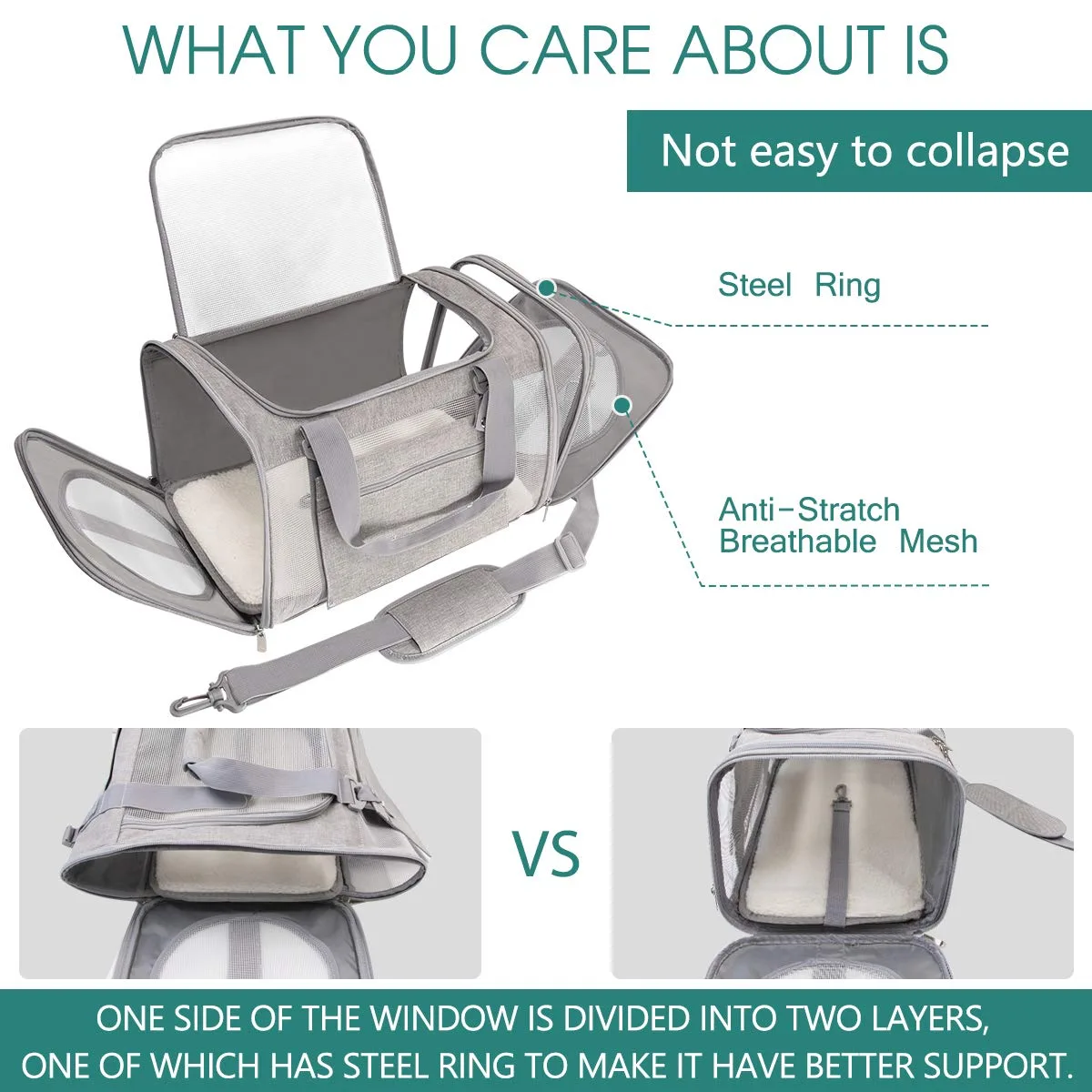
Mesh requires separate treatment because mesh is by construction the weakest panel and by function the most necessary one. Texturised multifilament mesh snags badly: a claw draws a loop, and the loop runs. Monofilament mesh, in which each yarn is a single filament of 0.25-0.40 mm diameter, cannot snag in the same way because there is no loop to draw, and it is the only mesh specification worth using here. Weight should be 420-480 g/m² with an aperture no larger than 3 mm by 4 mm so a claw tip cannot enter.
Aperture geometry interacts with the ventilation requirement. Open area of 22-28% is needed for the class, and a monofilament mesh at 420-480 g/m² with a 3 mm aperture typically delivers 24-30%, so the two requirements are compatible. Where a designer tries to recover open area by enlarging the aperture rather than by enlarging the panel, claw entry follows immediately.
The lower panel strategy is worth stating explicitly. The bottom 250-300 mm of the side and front walls should be solid coated fabric, not mesh, with mesh confined to the upper zone and to the door. This costs open area, which is recovered by a rear exhaust panel placed high and away from the dog. It is a material-cost increase of roughly 0.40-0.80 USD and it removes the most frequently damaged region of the product from the specification entirely.
Colour and coating selection close the panel specification. Pigmented coatings with an ultraviolet stabiliser package are used on exterior faces because a clear coating over a dyed base chalks within a season, and solution-dyed yarn is preferred over piece-dyed yarn where the colourway volume supports the minimum, since it holds tear strength better after coating.
Corner Geometry, Edge Binding and Inline Defect Control
Corner geometry is where a floor assembly fails, and it is a design-stage decision that cannot be recovered later. A square internal corner concentrates bending stress in the board and peel stress in the seam at the same point, and that point is exactly where a scrambling dog puts a claw. Internal corner radii of 30 mm or greater are mandatory in this class, the radius is drawn on the pattern rather than left to the operator, and the floor board is die-cut or routed to the same radius so it does not bridge the corner and force the fabric to take the bend.
Edge treatment is the second half of the same problem. Every edge reachable from inside the compartment is bound with a 20-22 mm tape turned twice, webbing ends are hot-knife sealed before they are bar-tacked, and no raw edge is presented to the animal anywhere in the interior. Panel damage in this class starts at an edge or a corner in the overwhelming majority of field returns, and eliminating reachable edges costs 0.25-0.45 USD while upgrading the fabric across a whole panel costs three to five times that.
Two carry-over constructions are rejected at design review without testing. A fabric hammock floor with no board produces a gait that dogs in this class actively resist and brace against, which converts a distributed load into point loads. Any floor with openings wider than 10 mm concentrates claw load at the opening edge and tears there within a few uses.
Inline control is what keeps the design intent intact through a 500-piece minimum and beyond. Three checks are written into the inspection plan: a bar-tack count against the tech pack at first-piece approval, a seam allowance measurement of 15 mm plus or minus 2 mm at three points per unit, and a corner radius gauge check on the cut board. Missing bar-tacks are the most common defect found at inline inspection in this product family, and they are invisible in a finished-unit visual check unless the count is audited.
Seam Architecture: Peel Risk, Stitch Density and Bar-Tack Redundancy
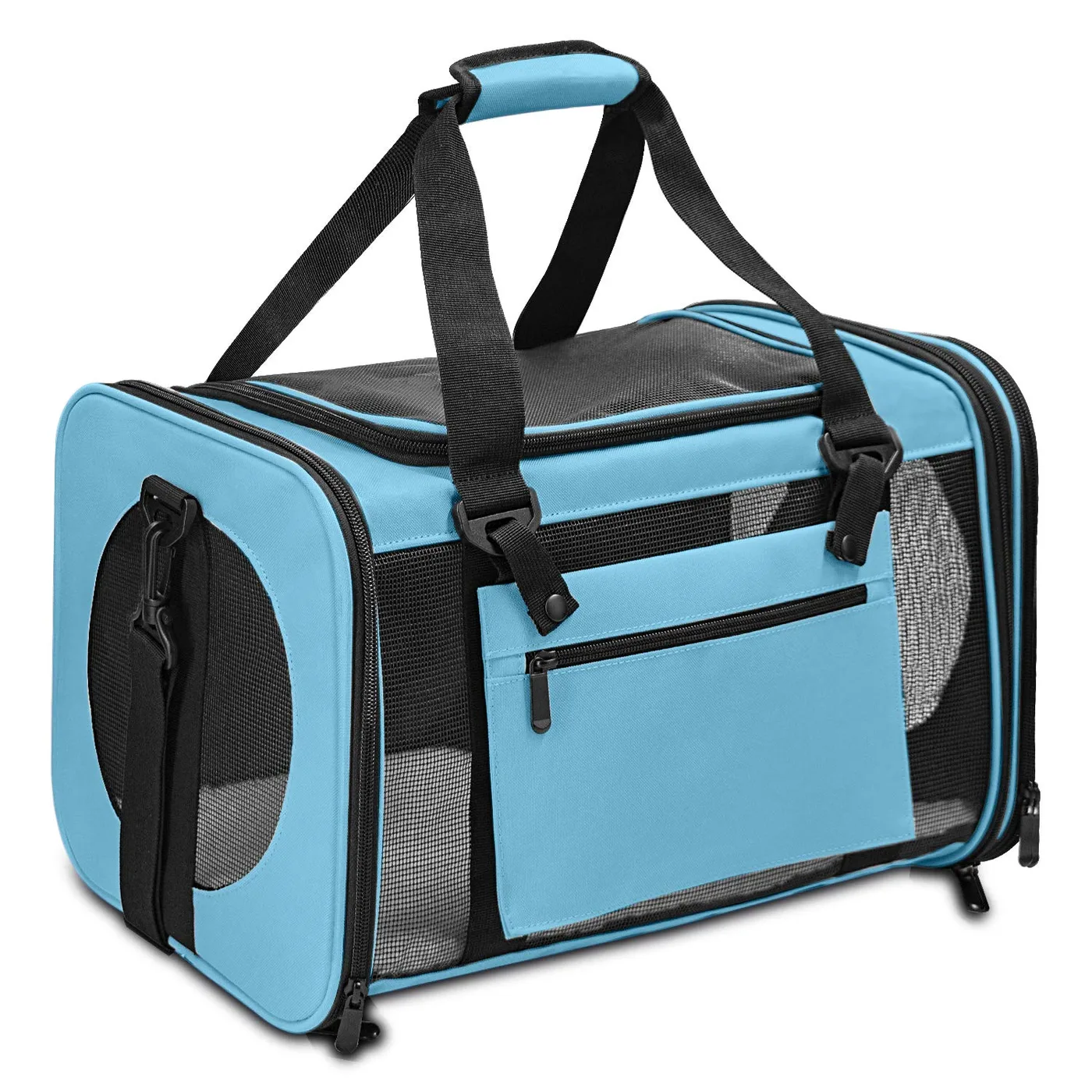
Seam peel is the characteristic failure of the Pit Bull class and the reason a carrier can pass a static load test and still come apart in service. The mechanism is straightforward: the floor carries a concentrated, angled load; that load reaches the floor-to-wall joint as a combination of shear along the stitch line and peel normal to it; and a plain lockstitch seam has almost no resistance to peel because the failure propagates stitch by stitch once the thread is drawn.
The specification that addresses it has four parts. The seam allowance is widened to 15 mm so there is material to distribute peel stress. Stitch density is set at 8-9 stitches per inch, roughly a 3.0-3.2 mm stitch length, because a denser stitch perforates the coated fabric and reduces its tear strength while a looser one allows the plies to separate under peel. Thread is bonded polyester or bonded nylon of Tex 70 to Tex 135 depending on the ply count, with the higher figure on the floor joint. And every termination of every load-bearing seam receives a bar-tack of at least 12 mm width.
Stitch type matters as much as density. A type-401 lockstitch is standard for assembly, but the floor joint and the harness attachment points should use a type-406 coverstitch or a second parallel 401 row spaced 4-5 mm from the first. Two rows do not double seam strength — the second row typically adds 40-60% — but they convert a single-plane peel into a failure that has to propagate through two stitch lines in different planes, which raises the practical peel threshold substantially.
Seam efficiency is the acceptance metric, defined as sewn seam strength divided by the tensile strength of the fabric being joined, measured to the seam-failure methods published by ASTM International and the ISO 13935 series at ISO. The working specification is a minimum of 60% for assembly seams and 75% for the floor joint and all attachment points, with no failure permitted in the stitch line below those values.
Bar-tack placement deserves a drawing rather than a note. Tacks are required at both ends of the floor-to-wall seam, at each internal corner, at every webbing termination, at the base of every handle, and at the four corners of the door opening. A production audit should count tacks against the tech pack at first-piece approval, because a missing bar-tack is the single most common defect found at inline inspection in this product family.
Hot-knife sealing and edge binding interact with the seam specification in one important way: a raw edge inside the compartment is both a fray risk and a chew target. All internal seams in this class should be bound or turned so that no raw edge is presented to the animal, which adds roughly 0.25-0.45 USD of unit cost and removes an entire class of cosmetic and functional complaint.
Webbing, Hardware and Closure: Load Paths and Escape Resistance
The load path in a backpack carrier runs from the floor assembly through the shell into the webbing, and from the webbing into the shoulder straps and the wearer. In the Pit Bull class the path is short and the loads are high, so component ratings are set by the ultimate design load of 135 kg rather than by the static mass of 30 kg, and every element in the chain is specified to at least that figure with a stated safety factor.
Webbing is specified by minimum breaking strength, not by width alone, because a 25 mm webbing can range from 6 kN to 12 kN depending on yarn and weave. High-tenacity polyester flat webbing is the working material: 25 mm at 9-12 kN for adjustment and compression straps, 38 mm at 15-18 kN for the shoulder strap body, and 50 mm at 22-26 kN where the strap meets the load-bearing shell panel. Nylon is avoided on the exterior because it absorbs water, loses strength when wet and creeps under sustained load, all of which matter in a product that carries a 30 kg animal for an hour at a time.
Hardware is rated to the same chain. Zinc alloy is acceptable for non-load-bearing trim; load-bearing buckles, adjusters and D-rings should be cast or stamped steel or a specified engineering polymer with a declared breaking strength, proof-tested to 1.5 times the ultimate design load. A buckle in this class should be proof-tested at 2.0 kN and show no permanent deformation, which is a tighter requirement than most catalogued hardware meets and is the reason hardware selection has to happen before the tech pack is frozen rather than after.
Attachment geometry is as important as component strength. A webbing termination that is sewn flat to a single ply of shell fabric will pull the fabric before it loads the webbing, so every load-bearing termination is backed by a reinforcement patch of 600D or heavier, extending at least 40 mm beyond the stitch line in every direction, and is bar-tacked across its full width rather than sewn with a straight row.
| Element | Specification | Minimum breaking strength | Proof test | Safety factor on WLL |
|---|---|---|---|---|
| Shoulder strap webbing | 38 mm high-tenacity polyester | 15-18 kN | 2.0 kN, 60 s | 11x |
| Load panel webbing | 50 mm high-tenacity polyester | 22-26 kN | 3.0 kN, 60 s | 16x |
| Compression straps | 25 mm polyester | 9-12 kN | 1.2 kN, 60 s | 8x |
| Load buckles and D-rings | Steel or engineering polymer | 4.0 kN | 2.0 kN, 60 s | 3x |
| Interior tether | 20 mm webbing, 300 mm effective | 6-8 kN | 1.5 kN, 60 s | 11x |
| Main closure | Number 10 coil with storm flap | Lateral 900 N | 500 N spread, 60 s | 4x |
The safety factors in the table look generous and are deliberate. They exist because the load path is worn, not static: abrasion at the adjuster, ultraviolet exposure on the exterior and repeated flexing at the strap root all erode breaking strength over the service life, and a component specified at 3x on day one is closer to 2x after eighteen months. Component safety factors above 8x on webbing and above 3x on hardware are what allow a 30 kg-class product to survive its full service life rather than its first month.
Closure Systems and Interior Restraint
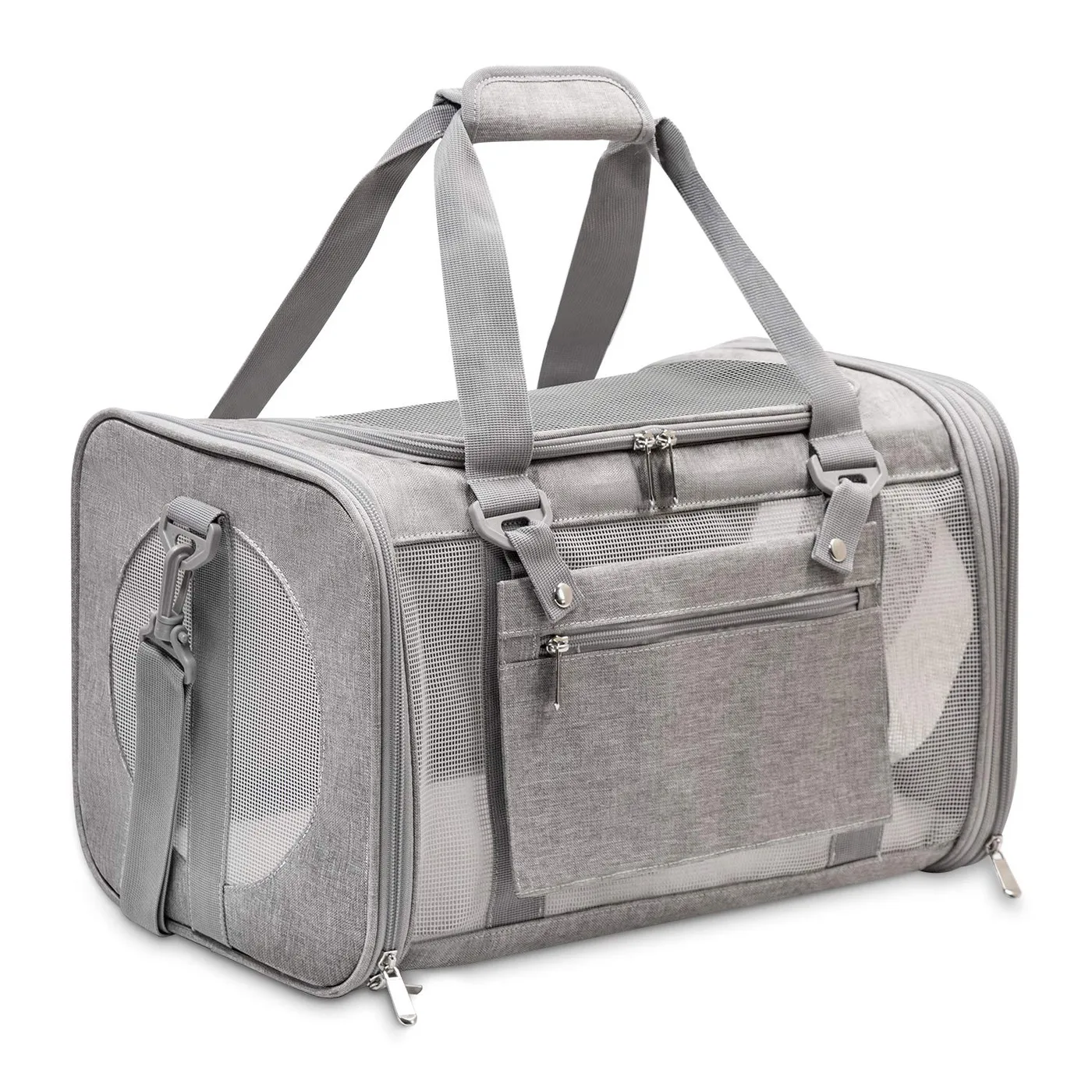
The closure is the highest-risk element in the whole product and the most common escape route reported in the class. A dog that pushes against a partly closed zipper applies a spreading load directly to the tape and the coil, and a coil zipper under a lateral load fails by the slider forcing the two tapes apart rather than by the teeth breaking. The specification therefore addresses the spreading load rather than the tensile one.
Four elements are required. The chain is a number 10 coil or a number 8 metal chain with a declared lateral strength near 900 N. The slider arrangement is a double slider with locking pulls so the closure can be secured at any point and cannot be walked open by movement from inside. A storm flap covers the closure so that an internal push is spread onto fabric and then into the shell rather than onto the teeth. And a secondary snap-hook or strap carries the load if the zipper opens, so that a single-point failure is not an escape.
Interior restraint is non-negotiable and is specified as a component, not as an accessory. A tether with a 300 mm effective length in 20 mm webbing and a clip rated to 1.5 kN keeps the animal from driving its full weight into the closure from inside, which is the load case that produces zipper burst in the first place. The anchor is a separate webbing loop bar-tacked to a reinforced panel, never a clip to a D-ring mounted on the lining, because lining attachment pulls out under exactly this load.
Tether length is a deliberate compromise. At 300 mm the animal can stand, turn and lie down but cannot build momentum against the closure, which is the mechanism that generates the peak load. Longer tethers allow a run-up and measurably increase the peak; shorter ones restrict posture and are resisted by the animal, which produces the same result by a different route.
Escape behaviour is the reason the secondary restraint exists at all. Dogs in this class learn fast: an animal that has opened a zipper once will work at it again, and a closure that relies on a single mechanism will eventually be defeated. Dual-redundant closure is standard practice in the class and is increasingly requested by retailers as a condition of listing.
Validation: Static Proof, Drop and Cyclic Protocols
Validation for this class runs as a sequence, not as a single test, because the failure modes are different and a product can pass one and fail the next. The protocol used by our production team has five stages and is applied to first-article samples, to every colourway change and to one pulled unit per 5,000 in production.
Stage one is static proof. The loaded carrier is suspended by its straps with 90 kg of distributed ballast, three times the declared mass, and held for 24 hours. Acceptance is no seam opening longer than 10 mm, no board crack, no permanent strap elongation above 2%, and no hardware deformation. Units are inspected after the hold and again after a 24-hour recovery period, because some seam damage closes visually once load is removed.
Stage two is the dynamic entry test, which is specific to this class. A 30 kg ballast mass with four attached claw indenters is dropped into the compartment from 150 mm onto the floor-to-wall corner, ten times, with the floor inspected for perforation and the seam for peel after each drop. This is the test that separates a Pit Bull-class specification from a medium-dog one, and it is the single most useful predictor of field performance.
Stage three is cyclic. The closure is opened and closed 3,000 cycles under a 200 N spreading load applied at the slider; the shoulder straps are cycled 5,000 times through a 100 mm adjustment range under 400 N; and the floor joint is cycled 10,000 times at 40-90% of working load on a servo frame. Acceptance is no functional loss and no visible damage beyond defined cosmetic limits.
Stage four is environmental conditioning followed by a repeat of stage one. Conditioning is 72 hours at 70 °C and 95% relative humidity for hydrolytic ageing of coatings, then 72 hours at minus 20 °C for coating and hardware embrittlement, then 120 hours of ultraviolet exposure for exterior webbing. A carrier that passes stage one and fails stage four has a coating chemistry problem, not a structural one, and the fix is a TPU or polyolefin coating rather than a heavier fabric.
Stage five is the claw and mouth fixture test on panels and mesh, using a hardened claw of 1.2 mm tip radius driven at 80 N and an opposed incisor fixture at 1.0-1.5 mm edge radius closing to a 3 mm gap at 60 N, each held for 60 seconds at every reachable location. Results are recorded by panel zone so that design changes can be targeted rather than global.
Documentation closes the protocol. Every stage produces a dated report with photographs, measured values and the sample identification, and the set is retained for the life of the style plus two years. Retailers in the United States increasingly ask for evidence of restraint and containment validation, and the independent programme run by the Center for Pet Safety is the reference point most buyers cite when they review a submission.
Carton Cubing, Freight and Unit Cost for the 30 kg Class
A 16-30 kg carrier is physically large, and at this size the commercial variables shift from fabric cost to freight cost. The finished product measures roughly 620 mm long, 420 mm wide and 460 mm high when packed flat, which is 0.120 cubic metres, and it does not nest usefully because the rigid floor board prevents compression. That single fact drives the export economics more than any material decision in the specification.
Carton cubing is calculated from the flat-packed unit, not from the collapsed shell, because the board sets the packed height. With two units per carton at 640 by 440 by 500 mm the carton is 0.141 cubic metres with a gross weight near 7.5 kg. A 20-foot general-purpose container at 28 cubic metres of usable volume takes roughly 190-198 cartons and hits the weight ceiling long before it fills; a 40-foot high-cube at 68 cubic metres takes 460-480 cartons and is also weight-limited rather than volume-limited. Freight is therefore quoted on weight, and the board specification has a direct freight consequence: moving from an 8 mm hollow board to a moulded tray saves 180-260 g per unit, which is worth 90-130 kg per 40-foot container and does not change the cube.
Air freight is a different calculation and is usually the wrong answer for this class. Volumetric weight at the industry divisor of 6,000 gives 23.5 kg per carton against an actual 7.5 kg, so the shipper pays for roughly three times the real weight. Air only makes sense for the first 300-600 units of a launch when a sea lead time of 30-38 days cannot be absorbed.
Unit cost for a compliant build lands at 19-31 USD FOB Xiamen depending on the floor construction and hardware grade, with the floor assembly at 2.40-4.10 USD, the panel and mesh package at 4.80-7.20 USD, the webbing and hardware set at 3.60-6.40 USD and labour at 4.20-6.80 USD on a 7-line, 149-machine configuration running 200,000 pieces a month. The premium over a generic medium-dog carrier of the same external size is 5.20-9.40 USD, and it is almost entirely structural.
Tooling and development cost should be budgeted separately. New patterns for a size this large run 900-1,600 USD, a moulded floor tray adds 6,000-11,000 USD with eight to twelve weeks of lead time, and a custom hardware item adds 3,000-7,000 USD. Programmes above roughly 6,000 units a year recover the tray tooling; below that the die-cut board with a welded sleeve is the correct engineering and financial answer.
Lead time planning needs one warning. The 35-50 day bulk window assumes the board and hardware are standard items. A custom board extrusion or a custom buckle adds 15-25 days to the critical path and should be ordered at sample approval rather than at purchase-order issue, which is the single most effective schedule risk control available on this product family.
Why brands source here
- Pet carrier programs run since 2014; founding team in sewn goods since 2004
- SGS-verified production floor of 4,950 m² with 137 workers across 7 lines
- Monthly capacity of 200,000 units, audited to BSCI and ISO 9001
People Also Ask
What weight should a Pit Bull carrier be rated for?
Declare 16-30 kg and engineer to a working load of 45 kg, a proof load of 90 kg and an ultimate of 135 kg. The rating is driven by dynamic entry transients of 3-4 times body weight, not by the static mass alone.
Why do Pit Bull carriers fail at the floor seam?
The floor carries a concentrated angled load over a short span, which reaches the floor-to-wall joint as combined shear and peel. Plain lockstitch resists shear well and peel poorly, so the seam unzips stitch by stitch once the thread is drawn.
Is 900D fabric enough for the Pit Bull class?
Coated 900D at 70-100 N tongue tear is adequate for upper panels but marginal at the lower 300 mm of the side walls. Coated 1680D at 150-250 N is the specification used where claws actually land.
How thick should the floor board be?
8 mm polypropylene hollow-board or 6 mm HDPE sheet holds deflection under 6 mm at working load on a 550 mm span and passes a 300 N claw point load. A 4 mm board deflects 14-18 mm and fails at 250 N.
Can mesh be used on a Pit Bull carrier?
Yes, but only monofilament mesh at 420-480 g/m² with an aperture no larger than 3 mm by 4 mm, confined to the upper zone and door. Texturised multifilament mesh snags and the loop runs.
What zipper specification prevents escape?
A number 10 coil or number 8 metal chain with a declared lateral strength near 900 N, a double locking slider, a storm flap that spreads the load onto fabric, and a secondary snap-hook so one failure is not an escape.
Frequently Asked Questions
What interior dimensions suit the Pit Bull class?
Around 400-460 mm wide, 620-720 mm long and 480-560 mm high, derived from a chest girth of 65-80 cm and a body length of 60-75 cm. The proportions are short and wide rather than long and low, which is why a hound-derived shell shape fits badly.
How is the dynamic entry test set up?
A 30 kg ballast with four claw indenters is dropped from 150 mm onto the floor-to-wall corner ten times, with the floor and seam inspected after each drop. It is the best single predictor of field performance for this class.
What stitch density is specified on the floor joint?
8-9 stitches per inch, a 3.0-3.2 mm stitch length, on a 15 mm allowance with Tex 70 to Tex 135 bonded thread. Denser stitching perforates coated fabric and lowers tear strength; looser stitching lets the plies separate under peel.
Why are two stitch rows used at the floor?
The second row adds only 40-60% to seam strength, but it forces a peel failure to propagate through two stitch lines in different planes, which raises the practical peel threshold well beyond the arithmetic gain.
What seam efficiency is required?
A minimum of 60% for general assembly seams and 75% for the floor joint and all attachment points, measured as sewn seam strength divided by the tensile strength of the fabric being joined.
Which webbing widths are used where?
25 mm at 9-12 kN for compression straps, 38 mm at 15-18 kN for the shoulder strap body and 50 mm at 22-26 kN where the strap meets the load-bearing shell panel, all in high-tenacity polyester.
Why is nylon webbing avoided on the exterior?
Nylon absorbs water, loses strength when wet and creeps under sustained load. For a product carrying 30 kg for an hour at a time, polyester holds its rating and its dimensions.
How is hydrolytic ageing checked?
72 hours at 70 °C and 95% relative humidity, then a repeat of the static proof test. A unit that passes before conditioning and fails after has a coating chemistry problem, fixed by switching to TPU or a polyolefin coating.
What does the claw fixture look like?
A hardened claw with a 1.2 mm tip radius driven at 80 N and held 60 seconds at every reachable location. An incisor fixture at 1.0-1.5 mm edge radius closing to a 3 mm gap at 60 N covers the mouth mode.
How many cycles are run on the closure?
3,000 open and close cycles under a 200 N spreading load at the slider, plus 5,000 strap adjustment cycles under 400 N and 10,000 floor joint cycles at 40-90% of working load.
What is the FOB cost range?
19-31 USD FOB Xiamen, with the floor assembly at 2.40-4.10 USD, panels and mesh at 4.80-7.20 USD, webbing and hardware at 3.60-6.40 USD and labour at 4.20-6.80 USD. The premium over a generic medium-dog carrier is 5.20-9.40 USD.
Why is sea freight usually correct for this class?
The rigid floor board prevents nesting, so volumetric weight at a divisor of 6,000 bills 23.5 kg per carton against an actual 7.5 kg. Air is only justified for the first 300-600 units of a launch.
When does floor tooling pay back?
Above roughly 6,000 units a year. A moulded tray adds 6,000-11,000 USD and eight to twelve weeks of lead time but saves 180-260 g per unit, worth 90-130 kg per 40-foot container.
Talk to QUANZHOU JUNYUAN BAGS about a pet carrier program: MOQ 500 pieces per colourway, samples in 6-10 working days, bulk production in 35-50 days under AQL 2.5 inspection.
Get a free quote Request a sampleKeep reading
- Dog Carrier Backpack for Large Dogs: Design Considerations
- Dog Carrier Backpack Bottom: Reinforcement Options
- Dog Carrier Backpack Straps: Webbing Width and Strength
- Dog Carrier Backpack Mesh: Airflow and Durability
- Best Dog Carrier Backpack Materials: A Complete Comparison
- Dog Carrier Backpack for Boxers: Strong Build