Dog Carrier Backpack for Weimaraners: Sleek Design
A Weimaraner carrier is built around scratch resistance and closure endurance rather than raw load. The 25-40 kg class takes a 400-460 mm interior, a 6 mm floor board, a monofilament mesh at 0.50-0.65 mm filament tested to 8,000 claw cycles, a #8 zipper validated to 900 reciprocating cycles, 40-46% open area, and a draining floor tray for webbed feet.
This page treats the sleek athletic gundog as a surface-durability problem. The breed is lighter than a mastiff type but far more destructive per kilogram: it paws at panels, digs at the floor and works a closure repeatedly when separated from its handler. Those behaviours set the acceptance values for mesh filament diameter, coating toughness, zipper cycle count and floor drainage, and none of them scale with body mass. Commercial terms follow the standard program: MOQ 500 pieces per colourway, prototypes in 6-10 working days, bulk production in 35-50 days after sample approval, final random inspection at AQL 2.5, T/T 30/70 payment and FOB Xiamen loading. Abrasion methods are drawn from the standards catalogue of ASTM International, textile compliance is screened to OEKO-TEX criteria, and production is executed by our production team at an SGS-verified production base.
Wholesale pet carrier buyers usually consolidate to fill one container; for dog carrier backpack assortments our production team mixes sizes and colourways inside a single 500-piece minimum.
Weimaraner Load Envelope and the Standing Geometry
The Weimaraner is a medium-large gundog with a long, lean frame. Males run 32-40 kg and females 25-35 kg at working weight, standing 59-70 cm at the withers with a chest depth of 28-34 cm and a body length of 62-74 cm. The animal is longer in the leg and shallower in the chest than a Doberman of the same mass, so the interior geometry is longer and slightly lower.
Derived interior dimensions are 400-460 mm wide, 780-860 mm long and 580-640 mm high. The length figure is the largest in the medium-large set and comes from the standing footprint on long limbs: a Weimaraner does not crouch into a confined space, so the floor must accept the full stride triangle plus 60-80 mm of margin or the animal will brace against the end panel with its hindquarters, which is the origin of most damaged end seams in this class.
Dynamic load is moderate because the mass is moderate. Taking 40 kg plus 2.5 kg of gear at a dynamic factor of 2.2 gives a design load of 0.92 kN, which is comfortably inside the capability of a 6 mm board at this span provided the board is supported at four points. The lateral component is the meaningful one: a lean, agile animal that turns inside the compartment applies 0.35-0.5 times body weight sideways, roughly 0.14-0.20 kN, and it does so repeatedly.
The structural conclusion is that this class does not need a heavier board but does need better board retention. The specification therefore bonds the board to the frame along all four edges with a 20 mm flange and adds two transverse straps under the board, which prevents the board from sliding within its sleeve during repeated turning. That detail costs 0.30-0.60 USD and eliminates the most common structural complaint in the class.
Head and neck geometry add one more constraint. The breed has a long, clean neck and a moderately long muzzle, so the door aperture is positioned with its lower edge at 220-260 mm above the floor rather than at floor level, which keeps the animal's head inside the compartment while giving a handler room to work.
The internal restraint point is also positioned from this geometry. A short webbing tether of 20 mm width with a 900 N rated snap hook is anchored to the rear upper corner of the frame at 450-520 mm above the floor, so a standing animal has enough length to shift position but cannot reach the door. Tether anchorages are load-spread over 60 x 60 mm and tested at 600 N in the direction of the animal's pull.
Claw Abrasion and the Scratch-Damage Test Method
Scratch damage is the defining failure mode for this breed and it is measured with a purpose-built fixture rather than by a standard abrasion method. Martindale and Taber results correlate poorly with claw damage because a claw is a single hard point that ploughs and snags, not a broad abradant that polishes. The fixture used in development is a hardened steel pin of 1.6 mm tip radius mounted on a reciprocating arm, loaded to 60 N, stroke length 80 mm, running at 60 cycles per minute.
Acceptance for mesh panels is 8,000 cycles with no snag that propagates beyond 5 mm and no aperture distortion above 15% of the nominal opening. For coated shell panels the acceptance is 8,000 cycles with no exposure of the base weave; the coating may be scored but must not be removed. Both figures were set from field returns, where damaged panels appeared between 6 and 14 months of regular use.
Mesh selection follows directly from the fixture result. A monofilament at 0.35-0.45 mm filament, which is adequate for a Doberman-class product, snags at roughly 3,500 cycles on this fixture. Moving to 0.50-0.65 mm filament with a 1.2-1.6 mm aperture raises the result above the 8,000-cycle line but reduces permeability from about 1400 to roughly 1000 l/m²/s at 100 Pa, so total panel area is increased by 12-18% to hold the airflow figure.
A useful secondary finding is that filament cross-section matters as much as diameter. A round monofilament deflects under the pin and lets the tip pass; a flat or oval profile presents a broader surface and resists snagging at the same mass, which is why the specification permits an oval profile at 0.45-0.55 mm equivalent thickness as a lighter alternative.
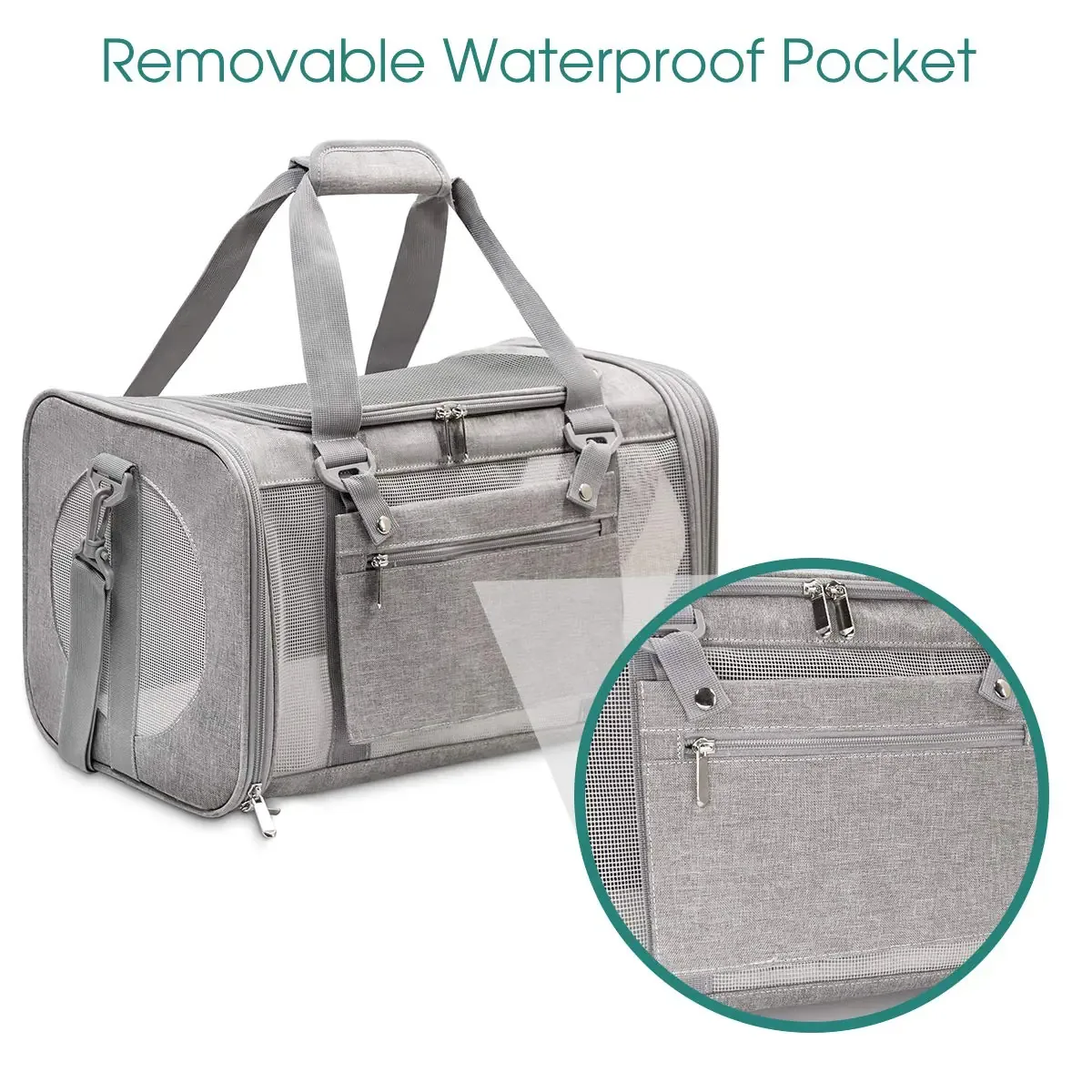
Shell and Coating Selection Against Repeated Contact
Shell specification is set by coating toughness rather than by fabric mass. The base material is 900D polyester at 820-1000 g/m² with a TPU coating at 35-50 g/m² dry solids, chosen because TPU recovers from a score mark where PVC does not. The scratch fixture gives TPU roughly a 40% advantage over PVC of equal coating weight, and the difference widens after thermal ageing.
The lower zone of each side wall, defined as the bottom 320 mm, is upgraded to 1050D at 950-1150 g/m² with a ripstop grid at 10 x 10 mm. The grid is included here for a different reason than in the protective-breed specification: it limits the length of a snag rather than arresting a tear, since a claw catches one yarn and pulls it, and a grid yarn at 10 mm pitch stops the pull within a small area that can be trimmed rather than replacing the panel.
Interior surfaces are smooth by requirement. Any texture that a claw can enter is a snag risk, so the inner face is a calendered TPU film at 0.20-0.28 mm, welded rather than sewn, with welds dressed flush. Stitch is eliminated from every interior face in reach of a standing animal; the only sewn interior seams are on the removable floor mat, which is a consumable item.
Abrasion acceptance is 25,000 Martindale cycles at 12 kPa on the lower zone and 15,000 elsewhere, to ISO 12947-2. Colour fastness to rubbing is grade 4-5 dry and grade 4 wet to ISO 105-X12, because a silver-grey coat against a light grey liner shows any dye transfer immediately, and the grey colourways most often requested for this breed are the ones most prone to visible marking.
Correlating Fixture Results with Field Returns
A test method is only useful if it rank-orders materials the way the field does. The correlation work behind the 8,000-cycle line compared returned panels against their fixture results across four constructions over eighteen months: coating-only 600D, TPU-coated 900D, PVC-coated 900D and the ripstop-grid 1050D. Returns appeared at 6-14 months of regular use on the constructions that scored below roughly 6,500 cycles, and were absent in the two constructions scoring above 8,000. The fixture therefore sets a conservative line rather than a nominal one, and it is re-run whenever a mesh or coating supplier changes, since supplier-to-supplier variation at the same nominal specification was measured at 18-26%.
Closure Cycling for a Separation-Anxiety Escape Profile
The behavioural profile that governs the closure is separation distress. A Weimaraner left in a carrier near but not with its handler will work the closure continuously rather than in short bursts: it noses the welt, paws the slider and pushes at the same point on the door for extended periods. The failure mode is cumulative rather than peak, so the test is a long-duration cycle rather than a high-load hold.
The primary closure is a #8 reverse-coil chain with two sliders, one lockable and one plain, with the chain set behind a continuous 22 mm welt retained by hook-and-loop tape at 20 mm width and a 15 mm bound edge. Welt retention is the weakest point in this arrangement, so the tape is specified at a peel strength above 8 N per 25 mm and a shear above 60 N per 25 mm, and it is tested after 20 laundering cycles rather than new.
Reciprocating acceptance for this class is 900 cycles against the 500 used elsewhere, run at 12 cycles per minute with a 2 kg lateral load and a 25 mm stroke that simulates nosing. Acceptance is no chain separation, no slider deformation, retained cross-wise strength above 85% of the uncycled value, and welt adhesion still above 6 N per 25 mm at the end of the sequence. The welt figure is the one that usually fails first and it is the reason the bound edge is specified.
A secondary restraint is fitted as a 20 mm webbing strap with a two-action side-release buckle over the door centre, anchored to the frame rather than the shell. It is rated at 3 kN, which is well above any load the animal can generate, and it exists to hold the door closed if the primary chain is displaced. The buckle requires 45-80 N on each side, which is outside the range a paw can deliver consistently.
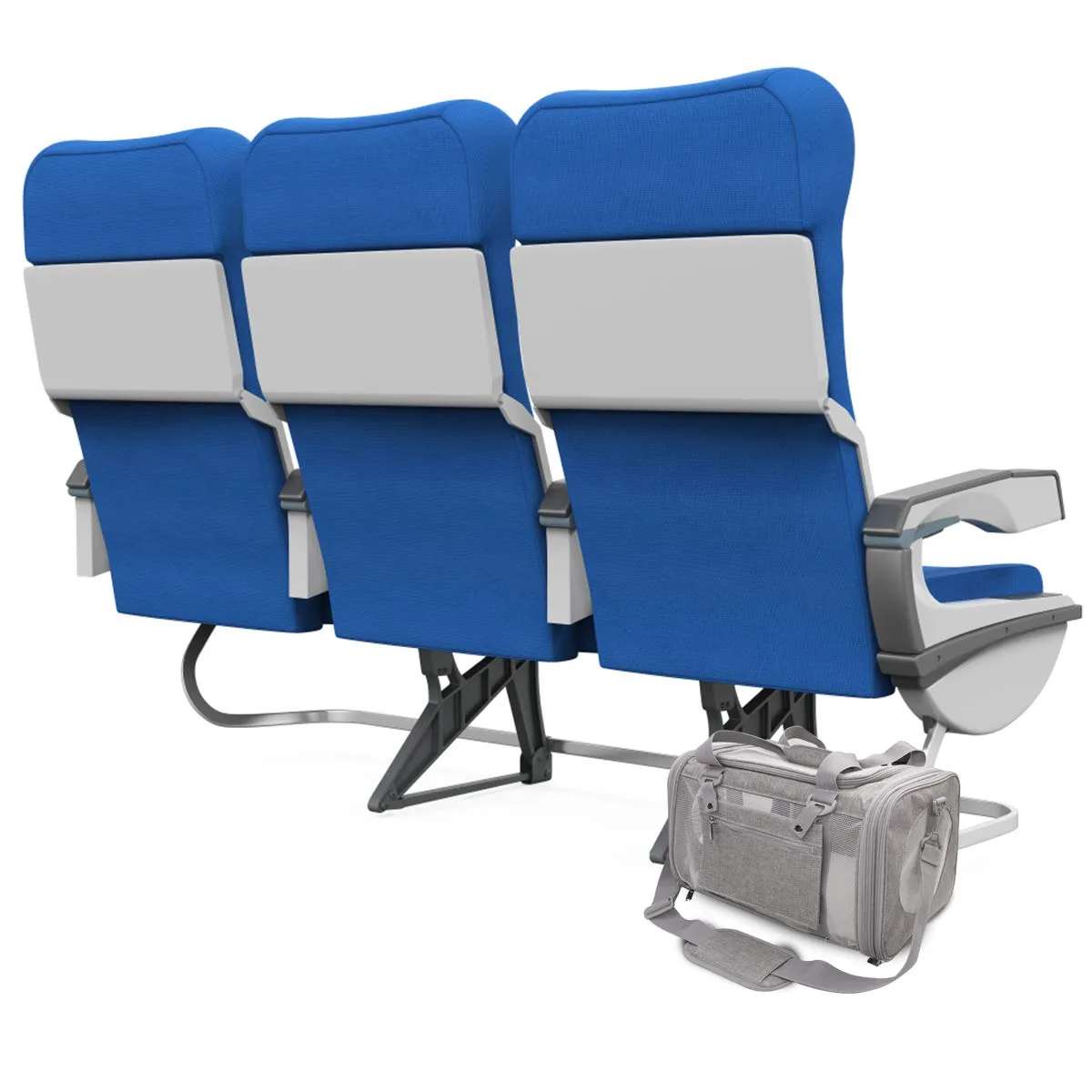
Floor, Drainage and the Webbed-Foot Moisture Case
The Weimaraner has webbed toes and is a retrieving breed, which means it enters the carrier wet far more often than most large dogs. Standing water inside a sealed floor degrades the board bond, raises humidity to saturation and macerates the footpads, so drainage is a specification item rather than a convenience feature.
The floor is a two-part system. The structural element is a 6 mm laminated board, 2 mm EVA over 3 mm PP honeycomb and a 1 mm skin, with a deflection limit of 3.5 mm under the 0.92 kN design load. Over it sits a removable moulded tray of 1.0-1.5 mm EVA with 2.5 mm transverse channels at 12 mm pitch leading to two 10 mm drain ports at the rear corners, sealed with a one-way duckbill membrane that passes water outward but resists backflow.
Tray capacity is specified for the realistic case rather than the extreme: it holds 120-200 ml in the channels before reaching the drain level, which is the volume carried in by a wet animal rather than the volume of a full soaking. Above that the water reaches the drain and exits. The membrane is replaceable and is a spare-part SKU, which matters because a blocked drain is the failure mode that turns a drainage feature into a leak.
The standing surface is a moulded EVA mat at 4-5 mm with a coefficient of friction above 0.6 dry and above 0.5 wet. Wet friction is the harder figure and is achieved with a fine cross-hatch of 1.0 mm depth rather than with ribs, because ribs align with the direction of a webbed foot and lose grip. Mat retention is by four 20 mm hook-and-loop tabs so it can be removed for cleaning without tools.
| Parameter | Sleek gundog (Weimaraner) | Athletic build (Doberman) | Heavy companion (35 kg) |
|---|---|---|---|
| Design mass and load | 42.5 kg, 0.92 kN | 47.5 kg, 1.07 kN | 38 kg, 0.76 kN |
| Interior W x L x H | 400-460 x 780-860 x 580-640 mm | 400-450 x 720-800 x 620-680 mm | 430-480 x 680-760 x 540-600 mm |
| Floor board | 6 mm plus drain tray | 6-7 mm with mid-span rib | 6-7 mm |
| Scratch fixture | 8,000 cycles at 60 N | not required | not required |
| Mesh filament | 0.50-0.65 mm | 0.35-0.45 mm | 0.40-0.55 mm |
| Zipper cycles | 900 at 2 kg lateral | 500 at 1.5 kg | 500 at 2 kg |
| Welt adhesion after cycling | above 6 N per 25 mm | not specified | not specified |
| Mesh open area | 40-46% | 38-44% | 34-38% |
| Wet floor friction | above 0.5 | above 0.45 | above 0.45 |
| BOM cost FOB | 22-38 USD | 21-36 USD | 19-31 USD |
Thermal Position and Airflow for a Sleek Single Coat
A Weimaraner has a short, smooth single coat of 6-12 mm with no undercoat and a low subcutaneous fat fraction. The animal is comfortable in cool air and overheats quickly in still, warm air, so the thermal design removes heat aggressively and offers no fixed insulation at all.
Open area is the highest in the large-dog set at 40-46%, distributed across the door and both side panels with a high-level exhaust at the rear. Permeability of the finished panel is above 950 l/m²/s at 100 Pa, and the total effective aperture area for the class is 0.055-0.070 square metres. With a 40 W internal heat source, chamber testing recorded a steady-state interior rise of 1.8-2.6 C at 24 C ambient and 3.4-4.6 C at 32 C, both inside the acceptance band.
The roof carries a reflective metallised film of 12 microns on its inner face and a light-coloured outer face on all colourways except black, where a near-infrared reflective pigment is used instead. The reason for the restriction on black is measurement: a black outer face reached 63 C surface temperature under 900 W/m² irradiance, which is above the 48 C contact limit applied to the interior and uncomfortably close to it even through the liner.
An optional cool-weather liner is offered as a separate SKU of 80-120 g/m² covering the roof and the two rear panels only, leaving the intake area clear. Restricting the liner to those three faces is deliberate: a full liner reduces open area effectiveness by 30-40% and undoes the airflow calculation, whereas a partial liner retains most of the animal's radiant loss at rest while leaving the stack path open.
Handler-side thermal management is part of the same calculation. A carried unit puts the animal's heat load against the handler's back, so the rear panel of the carrier uses a 3D spacer mesh of 4-6 mm thickness at 320-420 g/m² as a standoff, creating a 15-25 mm air gap between the carrier and the handler. Measured at the contact face, this reduces transferred temperature by 3-5 C against a flat panel and costs 1.10-2.00 USD. The same spacer is used on the shoulder straps, where it also improves load distribution.
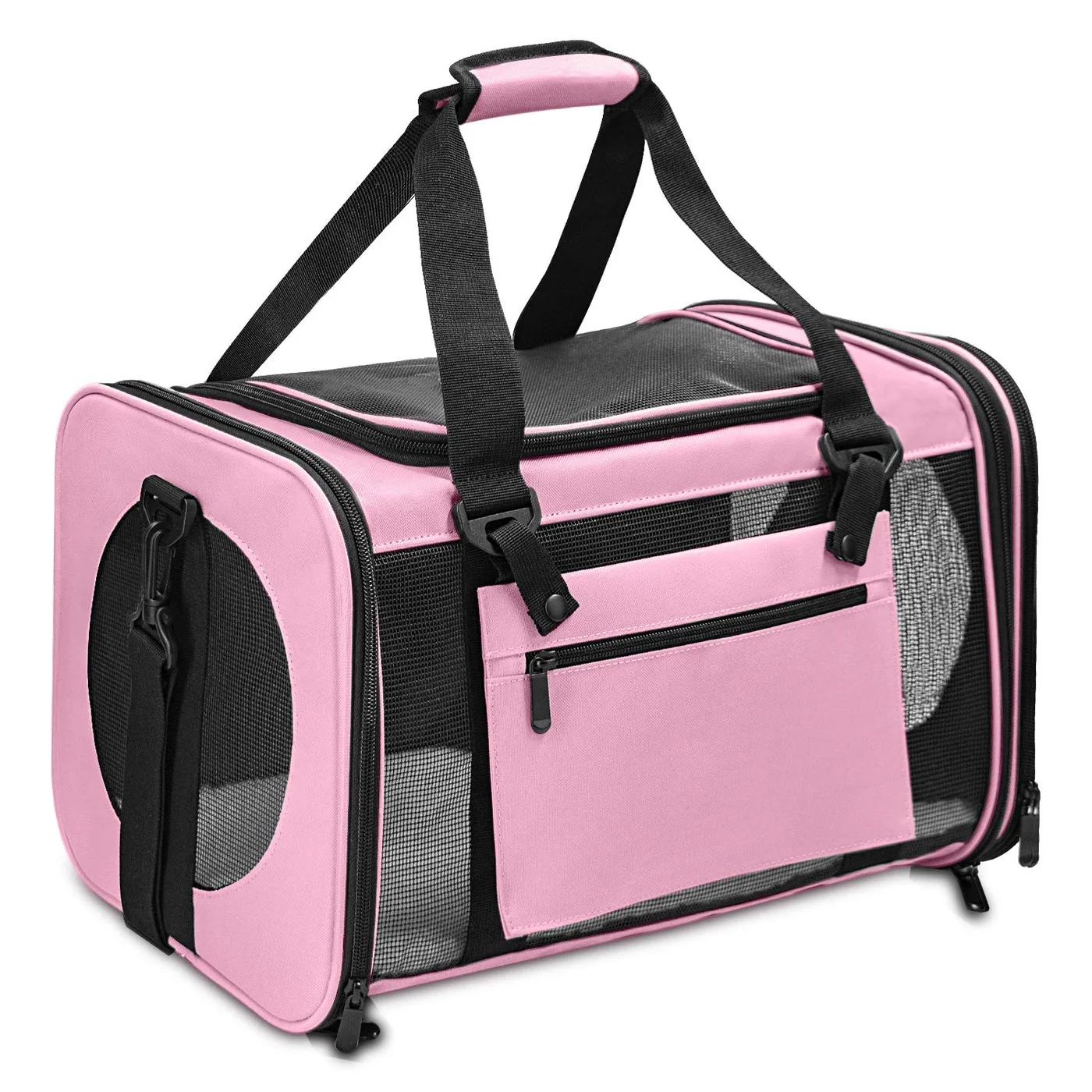
Verification Protocol: Seam Slippage, Zipper Reciprocation, Static Load and Drop
The test matrix for this class substitutes the scratch fixture for part of the abrasion work and raises the zipper cycle count, while the structural tests run at the moderate loads implied by the 0.92 kN design figure. Sampling is three units per size per colourway from the first lot and one unit per 4,000 pieces thereafter.
Seam slippage is measured to ISO 13936-2, with acceptance under 6 mm opening at 130 N on shell seams and under 4 mm at 150 N on the board-retaining seams. Because the board is bonded to the frame rather than floated, the bond is additionally peel-tested at 35 N per 25 mm after 500 lateral load cycles at 0.18 kN, which is the check that the retention detail actually holds.
Zipper reciprocation follows the ASTM method at 900 cycles for the main opening and 300 for the access port, at 12 cycles per minute with a 2 kg lateral load and a 25 mm nosing stroke. Acceptance is no chain separation, retained cross-wise strength above 85% of the uncycled value, slider operation within 12-25 N, and welt adhesion above 6 N per 25 mm measured after the sequence.
Static load is a 24-hour proof at 1.5 times design mass, 64 kg, hung by the suspension with the frame free, accepting permanent deflection under 5 mm, no seam opening above 2 mm, no board movement above 1 mm and full zipper function. A lateral variant applies 0.18 kN at mid-panel height for the same duration with an acceptance of under 6 mm displacement.
Drop testing is a six-face sequence from 380 mm onto concrete with a 42 kg water ballast in an ISTA-style protocol. Acceptance is no rupture in a load-bearing seam, no frame fracture, no buckle release, no drain port detachment and full zipper function. Drain ports are separately pressure-tested at 20 kPa with no leak at the seal, and the duckbill membrane is cycled 500 times in both directions.
Cost Bands, Tooling and Production Scheduling
Unit cost lands at 22-38 USD FOB Xiamen. Shell and cutting account for 8-13 USD, frame and board 6-10 USD, hardware 5-9 USD, the drainage and mat package 3-6 USD, and closing labour 4-7 USD. The scratch-resistant package, meaning the heavier filament mesh, the ripstop grid on the lower zone and the TPU coating at the upper end of its range, adds 2.60-4.40 USD over a general medium-large unit and is the single largest differentiator.
Tooling is low and no moulded parts are required. Profiling dies run 1,100-2,400 USD per size, sewing and welding jigs 900-1,700 USD, and print set-up 300-700 USD per colourway, so a three-size program is tooled under 11,500 USD. The drain port is a standard bought-in component with a die-cut aperture, which keeps it out of the tooling budget entirely.
Cutting efficiency is strong at 85-90% because the panels are narrow and long, and the long side panels nest well against each other. The largest size exceeds 1,400 mm in marker length on the side panel, so a 2,000 mm cutting table is specified for that size; the two smaller sizes run on a standard 1,500 mm table.
Timing follows the standard cycle. Prototypes are delivered in 6-10 working days from confirmed specification, covering patterning, first-cut samples and a fit check. Bulk production runs 35-50 days after sample approval, with fabric lead time as the variable; a custom-colour 900D with TPU coating at 35-50 g/m² adds 12-18 days against stock colours. Final random inspection is to AQL 2.5 under general inspection level II, and payment is T/T 30/70 with FOB Xiamen loading. Monthly capacity across the network is 200,000 pieces, and this class uses roughly 5-7% of a line per 10,000 units.
Production capability
- SGS-verified production space of 4,950 m², 149 machines, 7 assembly lines
- Pet carrier and pet bag output since 2014 from a 137-person team
- 200,000 units shipped monthly under BSCI and ISO 9001 systems
People Also Ask
Why is scratch testing used instead of standard abrasion testing?
A claw is a single hard point that ploughs and snags, not a broad abradant that polishes, so Martindale and Taber results correlate poorly with claw damage. The fixture uses a 1.6 mm steel tip at 60 N, 80 mm stroke and 60 cycles per minute.
What mesh filament survives 8,000 claw cycles?
A monofilament of 0.50-0.65 mm at 1.2-1.6 mm aperture. A 0.35-0.45 mm filament, adequate for a Doberman-class product, snags at roughly 3,500 cycles. An oval profile at 0.45-0.55 mm equivalent is accepted as a lighter alternative.
How is the zipper tested for a dog that works the closure repeatedly?
900 reciprocating cycles at 12 cycles per minute with a 2 kg lateral load and a 25 mm nosing stroke that simulates pawing and nosing, against 500 cycles for other large-dog classes.
Why does the carrier need a draining floor?
The breed has webbed toes and is a retrieving dog, so it enters wet. Standing water degrades the board bond, saturates the interior and macerates footpads. Channels hold 120-200 ml before reaching two 10 mm drain ports with one-way membranes.
How much open area does a sleek-coated breed need?
40-46%, the highest figure in the large-dog set, with a high-level rear exhaust producing a stack effect. Chamber testing recorded a steady-state rise of 1.8-2.6 C at 24 C and 3.4-4.6 C at 32 C.
Why is black restricted on the outer face?
A black outer face reached 63 C surface temperature under 900 W/m² irradiance, well above the 48 C interior contact limit. A light face or a near-infrared reflective pigment is specified instead.
What does the scratch-resistant package add to cost?
2.60-4.40 USD over a general medium-large unit, covering the heavier filament mesh, the 10 x 10 mm ripstop grid on the lower 320 mm, and TPU coating at the top of its weight range.
Frequently Asked Questions
What interior dimensions are derived for a 40 kg Weimaraner?
400-460 mm wide, 780-860 mm long and 580-640 mm high. Length is the largest figure in the medium-large set because the animal does not crouch into a confined space and needs the full stride triangle plus 60-80 mm, or it braces against the end panel.
Why is the board bonded to the frame rather than floated?
A lean, agile animal turns inside the compartment repeatedly, generating 0.14-0.20 kN of lateral load that slides a floated board within its sleeve. A 20 mm bond flange plus two transverse straps under the board removes that failure for 0.30-0.60 USD.
Where is the door aperture positioned?
Its lower edge sits 220-260 mm above the floor, which suits a long neck and moderately long muzzle: the animal's head stays inside the compartment while a handler still has room to work.
What is the acceptance for mesh on the scratch fixture?
8,000 cycles with no snag propagating beyond 5 mm and no aperture distortion above 15% of the nominal opening. Coated shell panels must show no exposure of the base weave at the same cycle count.
Why is a ripstop grid used on the lower zone?
To limit snag length rather than to arrest a tear. A claw catches one yarn and pulls it; a grid yarn at 10 mm pitch stops the pull within a small area that can be trimmed, rather than requiring panel replacement.
How is welt retention verified?
Hook-and-loop tape is specified above 8 N per 25 mm peel and 60 N per 25 mm shear when new, and must still exceed 6 N per 25 mm after the 900-cycle zipper sequence. The welt also carries a 15 mm bound edge, which is what preserves the figure.
What is the drain tray made of and how is it built?
A removable moulded EVA tray of 1.0-1.5 mm with 2.5 mm transverse channels at 12 mm pitch leading to two rear-corner ports. The duckbill membrane is a replaceable spare-part SKU, because a blocked drain converts the feature into a leak.
Why is the floor mat cross-hatched rather than ribbed?
Ribs align with the direction of a webbed foot and lose grip when wet. A 1.0 mm cross-hatch holds a coefficient of friction above 0.5 wet, against the 0.45 figure accepted elsewhere.
Is any insulation fitted as standard?
No. The optional cool-weather liner of 80-120 g/m² covers only the roof and two rear panels, leaving the intake clear, because a full liner reduces open area effectiveness by 30-40% and undoes the airflow calculation.
What is the static proof load for this class?
64 kg, being 1.5 times the 42.5 kg design mass, hung for 24 hours with the frame free. Acceptance is permanent deflection under 5 mm, no seam opening above 2 mm, no board movement above 1 mm and full zipper function.
How are the drain ports tested?
Pressure-tested at 20 kPa with no leak at the seal, and the membrane is cycled 500 times in both directions. Drop testing additionally requires no drain port detachment across the six-face sequence.
What abrasion figure applies to the shell?
25,000 Martindale cycles at 12 kPa on the lower 320 mm and 15,000 elsewhere to ISO 12947-2. Rubbing fastness is grade 4-5 dry and grade 4 wet, because grey colourways show dye transfer immediately.
Which cutting table is needed for the largest size?
A 2,000 mm table, because the side panel marker exceeds 1,400 mm on that size. The two smaller sizes run on a standard 1,500 mm table at 85-90% nesting efficiency.
Can the scratch package be added to an existing pattern?
Partly. The mesh and coating changes are a material swap, but raising open area by 12-18% to offset the permeability loss of a heavier filament requires a panel resize, which means a new marker and a new sample cycle.
Talk to QUANZHOU JUNYUAN BAGS about a pet carrier program: MOQ 500 pieces per colourway, samples in 6-10 working days, bulk production in 35-50 days under AQL 2.5 inspection.
Get a free quote Request a sample