Dog Carrier Backpack for Yorkies: Teacup Breed
A Yorkie carrier is specified at the bottom of the dog mass range with a declared floor rather than a marketing label: the class runs 1.5-3.2 kg, requiring a stated minimum of 1.2 kg, 20-30 mm of impact padding at 25-35 kg/m³, continuous insulation for a single coat with no undercoat, a harness-only restraint and snag-free interior surfaces for a silky coat.
This page sets out the engineering behind a carrier for the lightest dog class the range covers. Three decisions dominate and each is a departure from the generic small-dog pattern. The breed carries hair rather than an undercoat, so it has almost no natural insulation and the thermal problem runs in one direction only, toward cold. The skeleton is fine enough that impact and twisting loads, not static loads, set the structural specification. And the mass label used in the retail channel has no standard definition, so the product has to declare a measured floor rather than inherit a marketing term. Alongside those, tracheal collapse sets an absolute restraint rule and a silky, floor-length coat sets an interior surface specification. Commercial terms follow the standard program: MOQ 500 pieces per colourway, prototypes in 6-10 working days, bulk production 35-50 days after sample approval, final random inspection to AQL 2.5, T/T 30/70 payment and FOB Xiamen loading.
Choose a pet bag supplier that keeps the dog carrier backpack pattern card on file for at least twelve months, so a repeat order matches the approved sample instead of drifting.
Mass Class and the Teacup Definition Problem
Yorkshire Terrier dimensions sit at the bottom of the dog range. The standard adult mass is 1.5-3.2 kg, height at the withers 180-230 mm, body length 250-350 mm and chest girth 280-380 mm. That is comparable to a Chihuahua and lighter than a Pomeranian, and on a weight chart it produces a compartment of 8-16 litres.
The complication is the retail term. Teacup is a marketing description rather than a recognised class, it has no published definition, and in practice it is applied to animals from roughly 1.2 kg downward, produced by selecting the smallest individuals in a line. The engineering problem with the term is that it implies a lower bound that no standard supports, and a product labelled for it will be used with animals lighter than any figure in the specification.
The engineering response is to declare a measured floor rather than to inherit the term. The specification states a minimum supported mass of 1.2 kg and a maximum rated mass of 4 kg, the label carries both figures, and the compartment is validated at both ends. That converts an undefined marketing claim into a measurable product statement, and it is the defensible position if the product is ever questioned.
Grading follows from the same logic. Below roughly 1.5 kg the differences that matter are not in mass but in proportion: a 1.2 kg animal is not a scaled 3 kg animal, it has a relatively larger head, a relatively shorter body and a higher surface-to-mass ratio. One grade covers the population adequately at 240-300 mm internal width, 340-440 mm internal length and 240-300 mm internal height, with the fit adjusted by a removable liner rather than by a second pattern.
The commercial note is worth stating plainly because it affects how the product is sold. A teacup claim on the packaging is a claim about the dog, not about the carrier, and it is not a claim a carrier manufacturer can substantiate. The defensible claim is the measured mass range the product supports, and that is what the tech pack and the label should carry.
| Parameter | Standard adult | Declared product limits | Specification consequence |
|---|---|---|---|
| Body mass | 1.5-3.2 kg | 1.2 kg floor, 4 kg rating | Validated at both ends |
| Height at withers | 180-230 mm | 240 mm interior | Head clearance over the topknot |
| Body length | 250-350 mm | 340-440 mm interior | Extended rest posture |
| Chest girth | 280-380 mm | 300 mm minimum aperture | Measured over the coat |
| Protocol load | 4x rating | 16 kg plus product | Stiffness governs, not strength |
| Impact padding | Not previously specified | 20-30 mm at 25-35 kg/m³ | Fine skeleton, fracture risk |
| Insulation | Not previously specified | 6-10 mm, continuous | Hair coat, no undercoat |
Declaring the floor is the one decision that has to be made before tooling, because it sets the validation points on every fit and thermal test. Specify a measured floor and a measured ceiling; do not build to a marketing adjective.
Single-Coat Thermal Behaviour: A One-Directional Problem
The breed carries hair rather than fur: a long, silky, single-layer coat with no insulating undercoat. That single fact makes the thermal specification simpler and more severe than for any other breed in the range, because the animal arrives with none of the insulation a double-coated breed brings and the product has to supply all of it.
The consequence is that the thermal problem runs in one direction. A Pomeranian or a Shih Tzu is at risk from heat because its undercoat retains more than it can shed; this breed is at risk from cold because it has almost nothing to retain heat with, and the upper limit is comparatively relaxed. The specification follows that asymmetry: continuous insulation on all faces, a closable ventilation section, and no built-in cooling requirement.
Insulation of 6-10 mm closed-cell on the floor, walls and roof is the specification, holding a 15-20 °C differential for an hour in a chamber test at 5 °C. That matches the Chihuahua figure and is the thickest insulation in the dog range, applied to a compartment one third of the size. The floor is insulated here, unlike the heat-sensitive breeds, because conductive loss into a cold floor is the dominant path for an animal with no undercoat.
Ventilation is specified with the same asymmetry in mind: 18-24% open area with a closable section of at least half the total. In cold conditions the closable section is shut and the compartment relies on the residual area; in warm conditions it is open and the same product performs like an uninsulated one. A single fixed aperture cannot do both and a closable one costs 0.30-0.80 USD.
The upper limit still exists and it belongs on the label. Insulated products are used in heated vehicles and in summer, and an animal with no undercoat in an insulated compartment in sun is at real risk. The stated maximum ambient for continuous occupancy is 26 °C with the ventilation fully open, and the documentation should say so. Thermal methods follow conditioning practice published by ASTM International, and welfare framing is cross-checked against guidance from the American Veterinary Medical Association.
Fragility: Skeletal Load Limits and Impact Protection
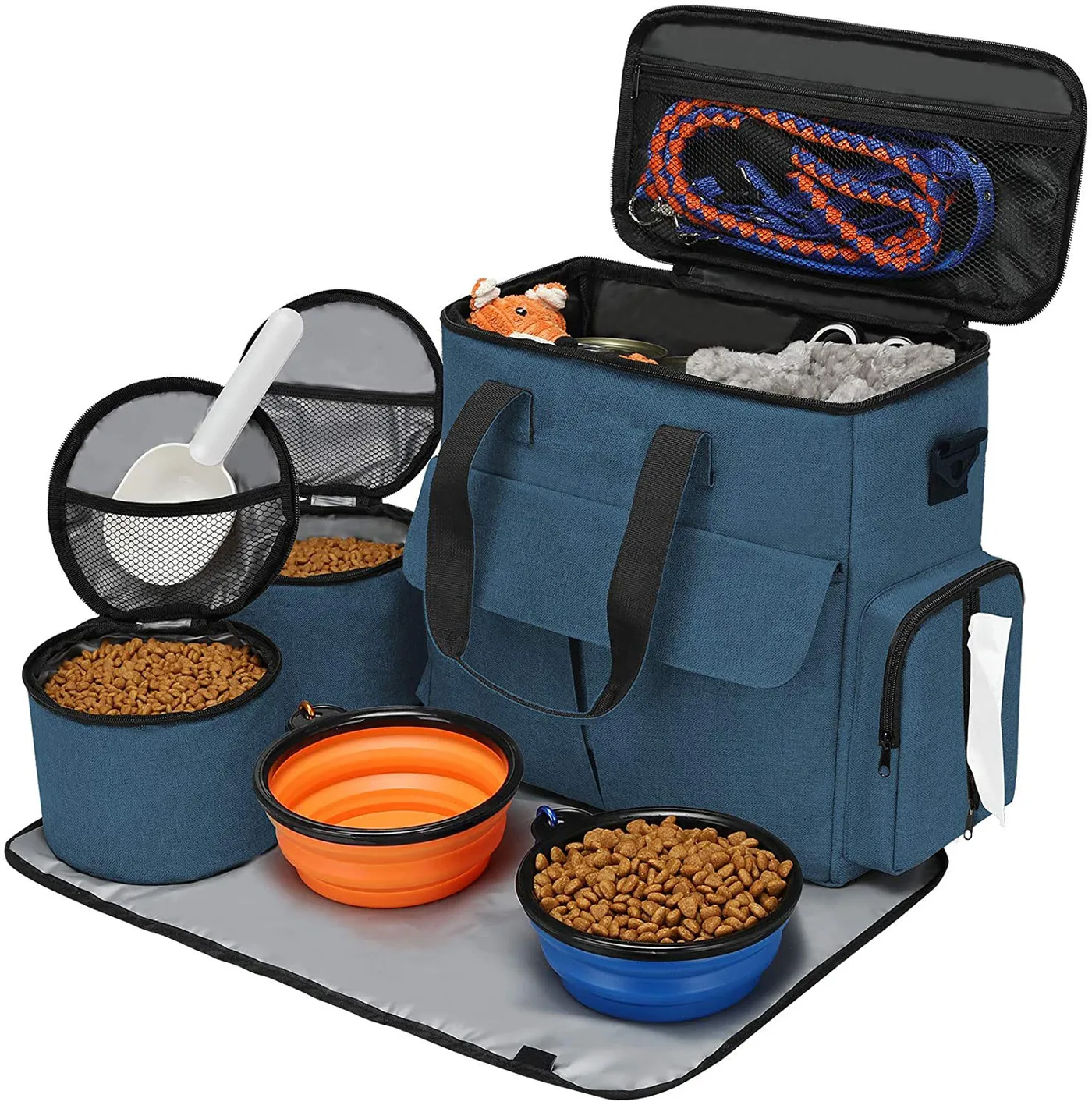
At 1.5-3 kg the skeleton is fine enough that static load is irrelevant and impact is everything. The breed is over-represented for patellar luxation, for Legg-Calve-Perthes disease of the femoral head, and for long-bone fracture from falls that a larger dog would walk away from. A carrier for this class is an impact-protection product, and that is a category of specification most pet products do not carry at all.
Padding thickness and density are the primary control and they work together rather than independently. The specification is 20-30 mm of padding at 25-35 kg/m³ indentation load deflection on all six faces, which yields under a 5 J impact rather than rebounding and which does not bottom out. A thinner layer at a higher density rebounds and transmits; a thicker layer at a lower density bottoms out and transmits; the combination is what works.
Coverage is the second control and it is where cost is usually saved. Padding on the floor and the back panel is standard; padding on the roof, the two end faces and the door is not, and a fall or a knock loads whichever face happens to be downward. The specification is continuous coverage with no unpadded face, including the entry panel, which is the least often padded and the most often struck.
Twisting and point loads are the third control. A fine skeleton tolerates a distributed load well and a concentrated one badly, so every interior surface is flat or softly radiused with no ridge, no raised seam and no hard edge above 2 mm, and the floor is flat with deflection under 2 mm at a 4 kg test load. A contoured floor that holds the hind limbs at a fixed angle is specifically prohibited because of the patellar and femoral considerations.
Impact validation closes the section: a 5 J impactor with a 40 mm hemispherical head dropped from 150 mm onto each of the six faces, accepting no contact with the inner surface and a peak transmitted force under 200 N. The test is repeated at -10 °C, because foam stiffens when cold and the cold case is exactly the one this product is built for.
Airway: Tracheal Collapse and the Harness-Only Rule at Minimum Scale
Tracheal collapse is strongly over-represented in the breed and the restraint rule that follows is absolute. The internal restraint is a chest-loading harness attached to a roof-centreline anchor rated at 120 N, with no neck-adjacent loop, no elastic aperture that can close on the neck, and an explicit label statement prohibiting collar restraint.
At this scale the anchor geometry is the part that needs attention, because a full-size harness fitting is heavy and bulky relative to the product and a scaled-down one is easily mistaken for a collar attachment. The specification is a webbing loop of 10-12 mm with a moulded D-ring, anchored through a reinforcement patch of 200-300 g/m², positioned on the roof centreline at 40-50% of interior length, and recessed so that no element protrudes more than 5 mm into the compartment.
Airway posture follows the rule applied across the small and brachycephalic breeds: the neck extended in line with the spine, 40-80 mm of clearance above the crown measured over the topknot rather than over the skull, and no forward obstruction within 120 mm of the muzzle. At 240-300 mm of internal height that is achievable, and it is the reason the height figure is not reduced further despite the small animal.
Air quality in a compartment of 8-16 litres is a real consideration even though the thermal case pushes toward closing the aperture. Carbon dioxide and humidity rise quickly in a small volume around a small animal, so the closable ventilation section is specified with a positive stop that leaves a residual open area of at least 8% even in the fully closed position. A closable aperture that seals completely is a hazard on this product and the stop is the control.
Irritant control completes the section. The interior lining is low-VOC with water-based adhesive throughout and a 72-hour cure before the shell closes, plus a headspace screen on the finished product. Textile components are screened against OEKO-TEX criteria, and small-part controls for the US market are cross-checked against the regime administered by the Consumer Product Safety Commission.
Silky Coat Interface: Snag, Tangle and Closure Ingress
The breed's coat is long, fine and silky, closer in behaviour to human hair than to fur. It tangles rather than mats, it slips through most surfaces rather than being held by them, and it is long enough to reach the floor on an ungroomed animal. Each of those properties has a different engineering consequence from the double-coated breeds already covered in this range.
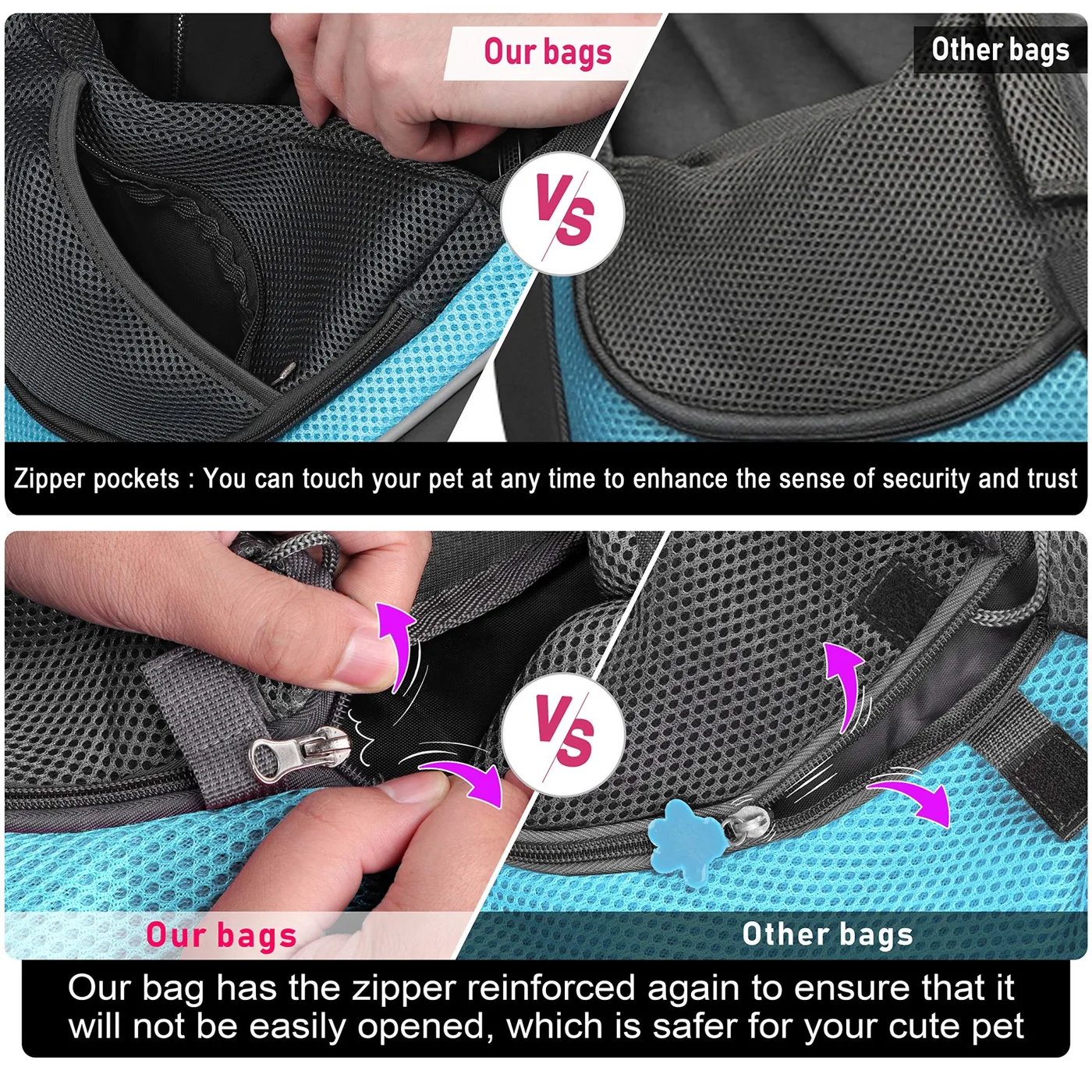
Tangling is the first. A fine silky coat tangles against any surface with a raised fibre, and a tangle tightens with the animal's movement until it pulls at the skin. The specification is a closed, smooth interior surface with no loop pile, no brushed or raised face, no open knit and no free binding edge above 2 mm, with every interior seam bound or welded rather than overlocked. A closed-face coated woven of 240-340 g/m² is the working choice.
Hook-and-loop is prohibited within the animal's reach for the same reason it is across the coated breeds: it grips individual hairs and pulls them at the follicle. The prohibition covers mat retention, pocket closure and liner attachment alike, with a zipper and covered garage, a welded pocket or a press-stud as the alternatives. A domed press stud with a 1.5 mm edge radius is acceptable; a sharp rolled edge is not.
Closure ingress is the third issue and long silky hair is the worst case in the range for it, because a single hair is long enough to wrap the slider mechanism rather than simply pack the coil. The specification is a reverse-coil zipper with a brush-finished slider and a close-fitting covered garage, placed on a vertical face where the design allows, with the slider channel flushable rather than bound. Maintenance validation is the same as across the coated breeds: 200 closure cycles after a standardised shedding exposure with a pulling-force increase under 20%.
Floor contact is the last item. Hair reaching the floor drags and collects debris, and a textile mat holds it. The specification is a closed-cell mat of 3-5 mm with a smooth face that releases hair when shaken, captive rather than loose, removable for cleaning, and with a coefficient of friction above 0.55 because a silky coat slides on a smooth surface more readily than a coarse one does.
Floor, Volume and the Smallest Compartment in the Range
The compartment is the smallest the range produces for a dog, and it is governed by the same stiffness argument that governs the Pomeranian product, with a shorter span and therefore a smaller problem. Interior dimensions of 240-300 mm wide, 340-440 mm long and 240-300 mm high give 8-16 litres, which is comparable to the bird and rabbit products rather than to the small-dog group.
Floor deflection under 2 mm at a 4 kg test load is the specification, measured at mid-span over 340-440 mm. That requires a board of 2.5-4.0 mm or a moulded tray with ribs of 8-12 mm depth, with continuous perimeter support rather than corner support. The board also carries the insulation layer, so the combined section is specified rather than the board alone, and the insulation is stated as thickness under a 2 kPa load rather than as nominal thickness.
Volume interacts with the thermal requirement in a way that helps: a small compartment heated by a small animal reaches equilibrium quickly, and the insulation figure of 6-10 mm delivers a larger differential here than the same thickness would in a 45 litre compartment. The thermal test therefore passes comfortably and the risk is the opposite one, overheating, which the closable ventilation addresses.
Fit is specified with a wider tolerance than the snug-fit rule elsewhere in the range, for two reasons. A silky coat slips rather than compresses, so a snug compartment does not produce the same restraint a snug compartment produces for a coarse-coated animal; and the animal is light enough that sliding is a smaller dynamic problem. The working clearance is 20-50 mm at the shoulder, with a shallow perimeter upstand of 8-12 mm to keep the animal centred.
Weight is the last consideration and it is favourable. At 700-1,100 g the finished product is the lightest in the dog range, which matters because the carried mass is the animal plus the product and a 1.5 kg animal in a 1 kg carrier is a 67% overhead. Keeping the product under 1 kg is a design target rather than a consequence, and it is the reason the shell is specified at 240-340 g/m² rather than heavier.
Hardware, Trim and Small-Part Controls
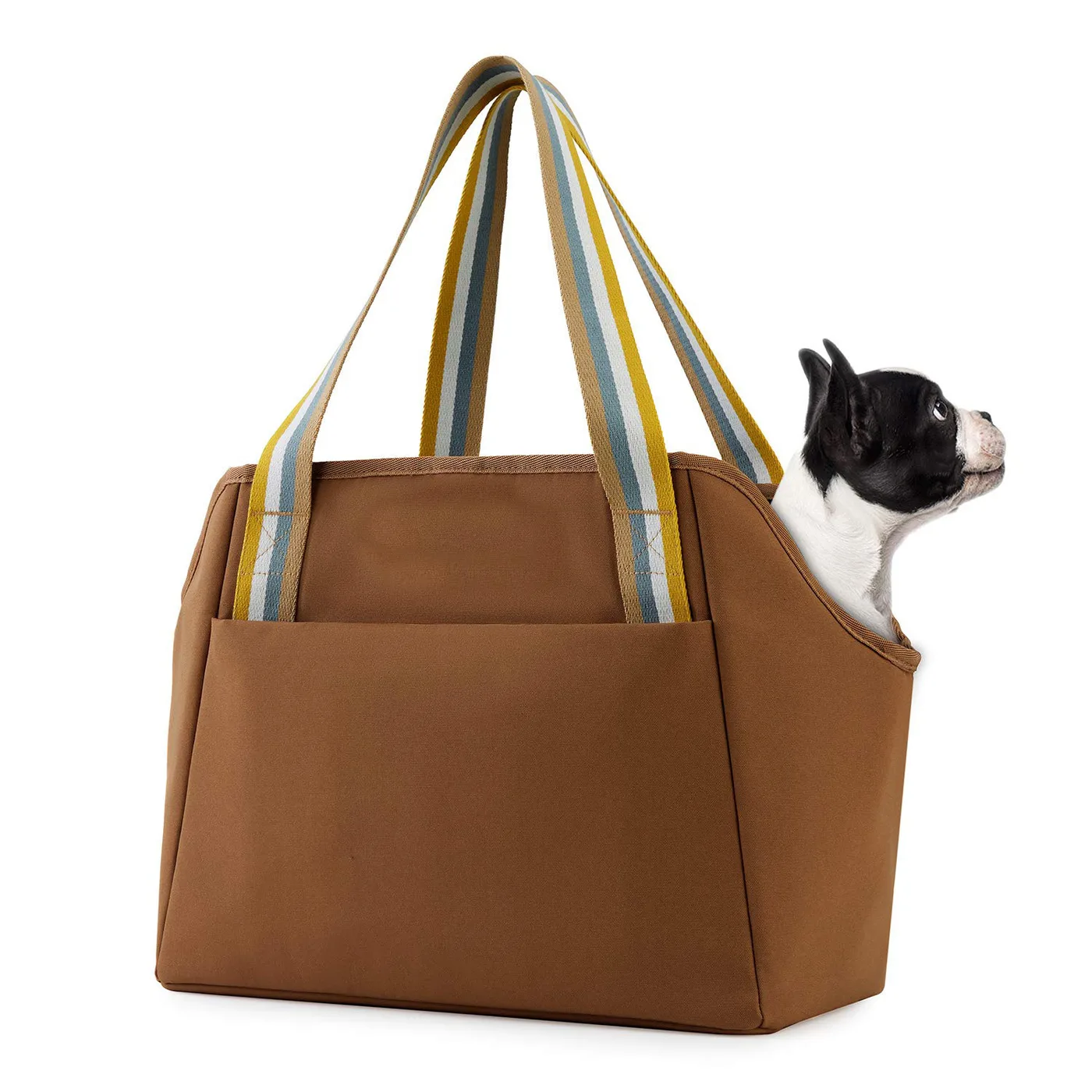
Hardware on this product is governed by small-part rules rather than by load rules. The protocol load is 16 kg, which any #3 zipper and any 12 mm webbing satisfies with a wide margin, so the binding constraints are the 31.7 mm small-parts gauge, the pull test on trim and the size of the fittings relative to the product.
The gauge is the first constraint and it is easy to fail accidentally. A decorative pull, a branded zipper pull, a moulded end-cap or a rivet that is proportionate on a mid-size product can fall inside the gauge on this one, because the gauge is absolute and does not scale with the product. Every detachable or protruding element is screened against it and pull-tested at 50 N, and any element that fails is either enlarged or eliminated.
Webbing and attachment are the second. A 12-15 mm webbing is ample in tensile terms and is correct on the product for weight reasons, but it concentrates load into a narrow panel area, so every attachment carries a reinforcement patch of 200-300 g/m² and a bar-tack of at least 12 mm. The harness itself is 20-25 mm for wearer comfort rather than for strength, with a 40-55 kg/m³ foam core.
Interior fasteners and trim follow the impact-protection rule as well as the small-part rule. Every fastener inside the compartment is recessed under a welded washer or a cover, no interior element protrudes more than 5 mm, and no element within 120 mm of the head position protrudes more than 2 mm. At this scale a protruding rivet is both an eye hazard and a hard point in a padded envelope.
Finish and chemistry close the section: a declared powder coat or stainless throughout, no brass or zinc die-cast, screened for heavy metals, with water-based adhesive and a 72-hour cure before closure. The hardware is small enough that plating thickness varies more in relative terms than on a larger fitting, and the heavy-metal screen is run per colourway rather than once.
Test Protocol, Cost and Programme Notes
Release testing for the class adds four checks to the standard dog protocol: a six-face impact test, a thermal retention test at both ends of the declared range, a snag and tangle survey, and a residual-aperture check. The structural protocol runs at 4x the 4 kg rating, so 16 kg plus product mass, and it is almost never the limiting test.
The impact test is the distinctive one: a 5 J impactor with a 40 mm hemispherical head dropped from 150 mm onto each of the six faces, accepting no contact with the inner surface and a peak transmitted force under 200 N, repeated at -10 °C. Thermal retention is measured in a chamber at 5 °C over 60 minutes, accepting a maintained differential of at least 15 °C, and repeated with the ventilation fully open at 30 °C accepting a rise of no more than 4 °C.
The snag and tangle survey is a documented review confirming no hook-and-loop, no loop pile, no brushed face, no open knit and no free binding edge above 2 mm anywhere in the interior. The residual-aperture check verifies that the closable ventilation section leaves at least 8% open area in the fully closed position, which is the control that prevents a sealed compartment.
Cost is driven by insulation and padding rather than by structure. The 6-10 mm continuous insulation runs 1.20-2.60 USD, the six-face padding package 1.40-3.20 USD, the stiffened floor and insulation section 0.90-2.00 USD, the closable ventilation build 0.30-0.80 USD, and the coated interior and closure package 0.70-1.60 USD. Total increment over a generic small-dog carrier is 4.50-10.20 USD, landing the unit at 12-22 USD FOB for the smallest product in the range.
Programme notes close the page. MOQ is 500 pieces per colourway, prototypes run 6-10 working days and bulk production 35-50 days after approval, with final random inspection to AQL 2.5 and the impact, thermal and residual-aperture checks written into the defect list at critical severity. The declared mass floor of 1.2 kg and ceiling of 4 kg belong on the label, because they are the only substantiable form of the retail claim. Occupant-restraint framing is cross-checked against published work from the Center for Pet Safety. The smallest product in the range carries the thickest insulation and the most complete padding, because at 1.5 kg nothing else is load-bearing.
Production capability
- SGS-verified production space of 4,950 m², 149 machines, 7 assembly lines
- Pet carrier and pet bag output since 2014 from a 137-person team
- 200,000 units shipped monthly under BSCI and ISO 9001 systems
People Also Ask
What mass range should a Yorkie carrier declare?
A floor of 1.2 kg and a rating of 4 kg, both on the label and both validated. Teacup is a marketing description with no standard definition, so the defensible claim is the measured mass range the product supports.
Why does a Yorkie need more insulation than a larger dog?
The breed carries hair rather than an undercoat, so it has almost no natural insulation and the product must supply all of it. The specification is 6-10 mm closed-cell on all faces, including the floor, holding a 15-20 °C differential.
How much padding does a teacup-breed carrier need?
20-30 mm at 25-35 kg/m³ on all six faces including the entry panel, which yields under a 5 J impact without bottoming out. A thinner high-density layer rebounds and transmits; a thicker low-density one bottoms out.
Can a collar be used to restrain a Yorkie in a carrier?
No. Tracheal collapse is strongly over-represented in the breed. The restraint is a chest-loading harness on a roof-centreline anchor rated at 120 N, with a 10-12 mm webbing loop and moulded D-ring recessed to protrude under 5 mm.
How much ventilation does a Yorkie carrier need?
18-24% open area with a closable section of at least half the total, and a positive stop leaving at least 8% open in the fully closed position. A closable aperture that seals completely is a hazard on this product.
Why is hook-and-loop prohibited inside?
Fine silky hair is gripped at the follicle and pulled as the animal moves. The prohibition covers mat retention, pocket closure and liner attachment, with a zipper and garage, a welded pocket or a domed press-stud as alternatives.
Why is long silky hair the worst case for zipper ingress?
A single hair is long enough to wrap the slider mechanism rather than simply pack the coil. The specification is a reverse-coil zipper with a brush-finished slider, a close-fitting garage and a flushable channel on a vertical face.
Frequently Asked Questions
What interior dimensions suit the class?
240-300 mm wide, 340-440 mm long and 240-300 mm high, giving 8-16 litres — comparable to the bird and rabbit products rather than to the small-dog group. Fit is adjusted by a removable liner rather than by a second pattern.
Why is a single grade adequate below 1.5 kg?
The differences below that mass are in proportion rather than in size: a relatively larger head, a shorter body and a higher surface-to-mass ratio. A removable liner handles the fit range more cheaply than a second pattern.
Why is the floor insulated here but not for a Pomeranian?
An animal with no undercoat loses most of its heat by conduction into a cold floor, so the floor is the insulated surface. For a double-coated breed the floor is deliberately conductive because heat retention is not the problem.
What is the upper temperature limit?
26 °C ambient for continuous occupancy with the ventilation fully open. An insulated compartment in sun or in a heated vehicle is a real risk even for a cold-sensitive breed, and the limit belongs on the label.
Why is the impact test run at -10 °C?
Foam stiffens in cold conditions, and the cold case is exactly the one the thick insulation is provided for. Padding that yields at ambient can transmit effectively rigidly at -10 °C.
Why is a contoured floor prohibited?
The breed is over-represented for patellar luxation and for Legg-Calve-Perthes disease, and a contoured floor holds the hind limbs at a fixed angle. The floor is flat with deflection under 2 mm at a 4 kg test load.
How is the harness anchor specified at this scale?
A 10-12 mm webbing loop with a moulded D-ring through a 200-300 g/m² reinforcement patch, on the roof centreline at 40-50% of interior length, recessed to protrude under 5 mm so it is not mistaken for a collar point.
Why is crown clearance measured over the topknot?
The coat is frequently tied and stands well above the skull, and head contact is what the 40-80 mm clearance exists to prevent. Measuring to the skull produces a compartment the animal's head touches.
What interior surface suits a silky coat?
A closed-face coated woven of 240-340 g/m² with no loop pile, no brushed or raised face, no open knit and no overlocked seam. Silky hair tangles against raised fibre and the tangle tightens as the animal moves.
Why is the small-parts gauge the binding constraint?
The gauge is absolute and does not scale with the product, so a pull, end-cap or rivet proportionate on a mid-size product can fall inside it here. Every protruding element is screened and pull-tested at 50 N.
What is the thermal retention acceptance figure?
A maintained differential of at least 15 °C after 60 minutes at 5 °C, and a rise of no more than 4 °C when repeated at 30 °C with the ventilation fully open.
How is the board and insulation section specified together?
The board carries the insulation layer, so the combined section is specified rather than the board alone, and insulation is stated as thickness under a 2 kPa load rather than nominal thickness.
What does a Yorkie build cost?
12-22 USD FOB, an increment of 4.50-10.20 USD: insulation 1.20-2.60 USD, six-face padding 1.40-3.20 USD, floor section 0.90-2.00 USD, closable ventilation 0.30-0.80 USD, interior and closure 0.70-1.60 USD.
Why is the finished weight target under 1 kg?
A 1.5 kg animal in a 1 kg carrier is a 67% overhead on carried mass. The target is achieved with a 240-340 g/m² shell and 12-15 mm webbing on load paths, with the 20-25 mm harness sized for wearer comfort rather than strength.
Talk to QUANZHOU JUNYUAN BAGS about a pet carrier program: MOQ 500 pieces per colourway, samples in 6-10 working days, bulk production in 35-50 days under AQL 2.5 inspection.
Get a free quote Request a sampleKeep reading
- Dog Carrier Backpack for Chihuahuas: Breed-Specific
- Dog Carrier Backpack for Pomeranians: Tiny Dog
- Dog Carrier Backpack for Shih Tzus: Small Breed
- Dog Carrier Backpack for Puppies: Safety Features
- Dog Carrier Backpack Padding: Foam Density Guide
- Dog Carrier Backpack Size Guide: Sizing Chart and Specifications