Pet Carrier Booties: Paw Protection
A pet bootie is specified by five numbers: outsole hardness of 55-70 Shore A, DIN abrasion under 200 cubic millimetres, wet coefficient of friction above 0.5, sole bond peel strength above 40 N per 25 mm, and paw retention of 25-60 N in pull-off. Insole temperature must stay under 45 degrees on a 60 degree surface.
Booties are the hardest product in the accessory range to make well, because they have to hold on to a shape that moves, flexes and sweats, while protecting it from surfaces, chemicals and temperature. Every one of those requirements conflicts with another: grip needs a soft compound and wear needs a hard one, waterproofing needs a closed upper and comfort needs an open one, and retention needs a tight cuff and circulation needs a loose one. This page sets out how those conflicts are resolved numerically: paw geometry and grading, outsole compound selection by measured hardness and abrasion, tread design for wet slip resistance, upper construction for breathability and debris exclusion, and retention measured as a pull-off force rather than judged. It also covers thermal protection, bonding and seam integrity, and the test protocol behind each figure. Commercial terms are standard: MOQ 500 pieces per colourway, prototypes in 6-10 working days, bulk production 35-50 days after sample approval, final random inspection to AQL 2.5.
A dog carrier manufacturer is expected to hold the pet carrier accessory pattern card for at least twelve months, so a reorder matches the approved sample rather than drifting.
Paw Geometry: Grading by Width, Shape and Splay
A paw is not a foot. It has no arch, it splays under load, its width changes by 8-16% between a standing and a loaded position, and the front and rear paws on the same animal differ in shape. A bootie graded on a single dimension will fit some of those conditions and not others.
Two dimensions are needed: paw width across the pads at the widest point, and paw length from the nails to the back of the pad. Width is the governing one, because a bootie that is too narrow cannot be put on and one that is too wide rotates. Length sets the sole length and it is the secondary check.
Splay is the dimension that is usually omitted and it is the one that causes rotation. A bootie sized to the standing paw is tight when the paw splays under load, and the animal's response is to shake it off. The specification therefore grades on loaded width, which is standing width measured under a load of 0.5 times body weight divided among four paws.
| Block | Standing width | Loaded width | Paw length | Sole length | Cuff circumference | Animal mass |
|---|---|---|---|---|---|---|
| XXS | 22-28 mm | 25-32 mm | 32-40 mm | 38-46 mm | 90-110 mm | Under 3 kg |
| XS | 28-35 mm | 32-40 mm | 40-50 mm | 46-56 mm | 110-135 mm | 3-6 kg |
| S | 35-44 mm | 40-50 mm | 50-62 mm | 56-68 mm | 135-165 mm | 6-12 kg |
| M | 44-55 mm | 50-63 mm | 62-78 mm | 68-84 mm | 165-200 mm | 12-22 kg |
| L | 55-68 mm | 63-78 mm | 78-96 mm | 84-102 mm | 200-240 mm | 22-35 kg |
| XL | 68-84 mm | 78-96 mm | 96-118 mm | 102-124 mm | 240-285 mm | 35-55 kg |
Cuff circumference is the dimension that governs retention and it is graded separately from the sole, because the leg circumference above the paw does not scale with the paw. A bootie with a cuff sized from the sole will be too tight on a heavily feathered breed and too loose on a smooth-coated one, so the cuff is specified against leg circumference measured 20 mm above the paw.
Front and rear paws differ and the pattern has to acknowledge it. A rear paw is typically 4-9% narrower and 6-12% longer than the front on the same animal, and a single pattern sold for all four paws fits the fronts well and the rears loosely. Where a programme offers a front and a rear pattern, the rear is narrowed by 5% and lengthened by 8%.
Dewclaw clearance is a small detail that causes a disproportionate number of complaints. A bootie whose cuff sits at the dewclaw rubs it; one that sits below it does not. The cuff height is specified to clear the dewclaw by 8-15 mm on breeds that have one, and a low-cuff variant is offered for breeds that do not.
Grade on loaded paw width rather than standing width, size the cuff against leg circumference 20 mm above the paw, and set cuff height to clear the dewclaw by 8-15 mm.
Outsole Compounds: Hardness, Abrasion and the Grip Trade
The outsole compound is the single most consequential choice on the product, and it is a compromise between two properties that move in opposite directions. A soft compound grips well and wears quickly; a hard one lasts and slips. Both are measurable and the specification states both.
Hardness is measured on the Shore A scale and the working range for a pet bootie is 55-70. Below 50 the sole wears through in weeks and picks up grit; above 75 it is rigid, uncomfortable on a paw that flexes, and it loses grip on a wet surface rapidly. The volume choice sits at 60-65.
Abrasion is measured on a DIN rig as volume loss in cubic millimetres over a fixed path on a specified abrasive, and acceptance is 200 cubic millimetres or less. That figure corresponds to a sole that survives 150-400 kilometres of walking on an abrasive urban surface, which is the service life a customer expects.
| Compound | Shore A | DIN abrasion | Wet coefficient of friction | Dry coefficient of friction | Low-temperature flexibility | Cost index | Verdict |
|---|---|---|---|---|---|---|---|
| Natural rubber | 58-66 | 110-170 mm³ | 0.62-0.78 | 0.82-0.96 | Good to -20 C | 112 | Preferred, grip |
| TPR, general | 60-70 | 150-230 mm³ | 0.44-0.58 | 0.66-0.82 | Fair to -10 C | 100 | Standard |
| TPR, soft grade | 50-58 | 220-320 mm³ | 0.58-0.74 | 0.78-0.92 | Good to -25 C | 106 | Grip, short life |
| TPE, injection | 62-72 | 130-200 mm³ | 0.42-0.56 | 0.62-0.78 | Fair to -5 C | 94 | Economy |
| Nitrile rubber | 65-75 | 90-150 mm³ | 0.52-0.66 | 0.72-0.86 | Poor below 0 C | 138 | Chemical resistance |
| Silicone, moulded | 45-55 | 260-380 mm³ | 0.66-0.82 | 0.88-1.02 | Excellent to -40 C | 164 | Specialist, wears fast |
The grip trade is visible in the table. A soft TPR at 50-58 Shore A reaches a wet coefficient of 0.58-0.74 and wears at 220-320 cubic millimetres, which fails the abrasion acceptance. A general TPR at 60-70 wears at 150-230 and grips at 0.44-0.58, which passes abrasion and is marginal on grip. The resolution is tread design, which is the next section.
Low-temperature flexibility matters in northern markets and it is the reason TPE is restricted. A compound that stiffens below freezing stops conforming to the surface, and grip falls sharply — a TPE sole at minus 5 degrees loses 25-40% of its wet coefficient against its room-temperature figure.
Chemical resistance is the specialist requirement. A bootie used on treated roads, on de-iced pavements or in a veterinary setting meets salt, de-icer and disinfectant, and a nitrile compound resists all three at the cost of poor low-temperature behaviour. It is offered as a variant rather than as the standard.
Compound consistency is verified per lot rather than per order. Hardness is measured on five moulded test plaques per lot with acceptance at plus or minus 3 Shore A from the specification, because a compound that drifts 6 points changes both grip and wear noticeably.
Specify 55-70 Shore A with DIN abrasion under 200 mm³, verify hardness at plus or minus 3 points per lot, and treat nitrile and silicone as specialist variants.
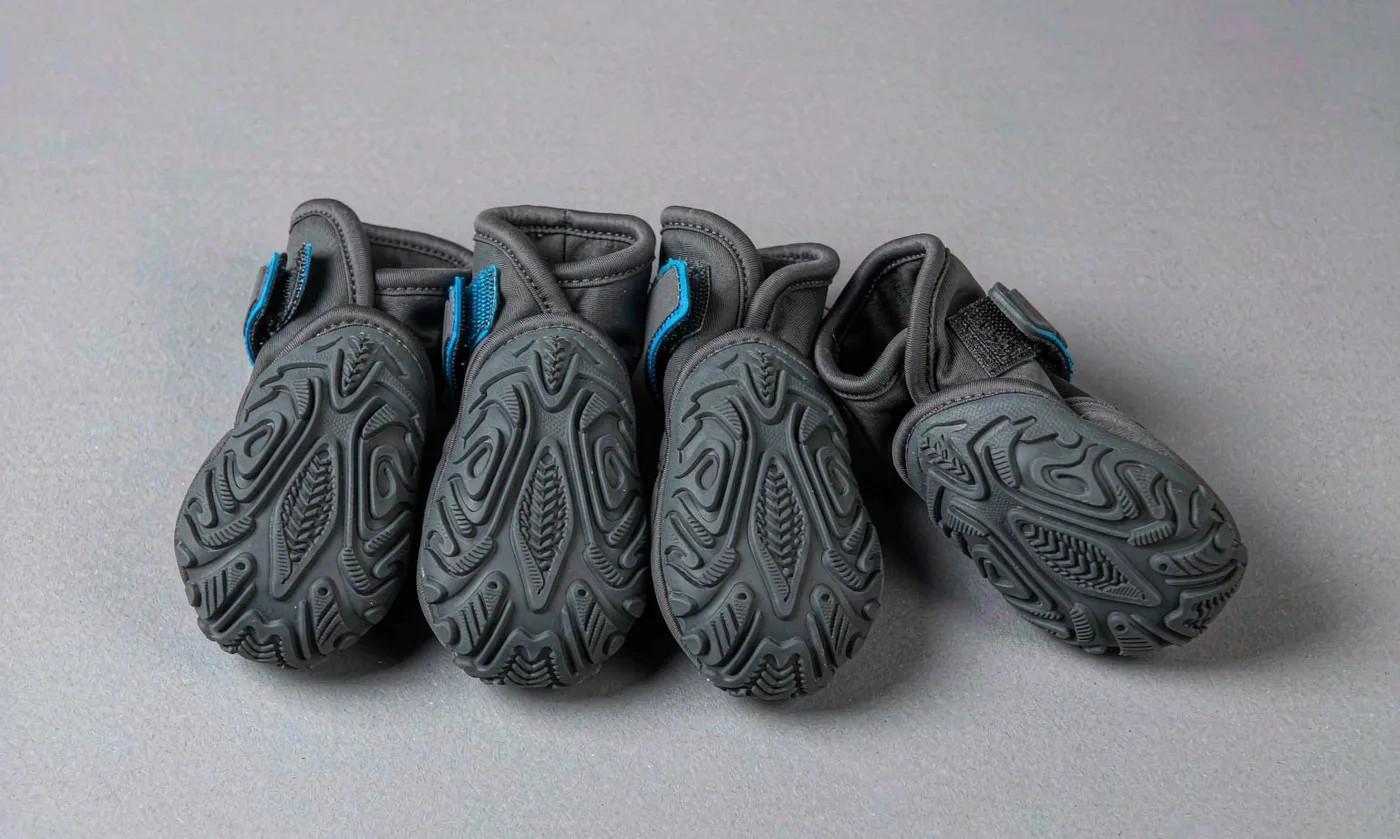
Tread Pattern and Slip Resistance on Wet Surfaces
Tread is what lets a bootie meet the grip requirement without sacrificing wear. Its job is not to add friction chemically but to manage the interface: to break through a water film, to give the compound edges to bite on, and to clear debris that would otherwise sit between sole and ground.
Water film management is the dominant mechanism on a wet smooth surface. A smooth sole at any hardness hydroplanes at walking speed and its coefficient collapses to 0.10-0.20. A tread with channels that give the water somewhere to go recovers most of the dry figure, and the difference is far larger than any compound change.
Pattern depth and channel width are the two design variables. Depth of 1.5-3.0 mm is enough to clear a film and shallow enough that the lugs do not fold under load; below 1.0 mm the channels close and above 4.0 mm the lugs squirm. Channel width of 2.0-4.0 mm at a spacing of 6-12 mm gives a contact area of 55-75%, which is where the wet coefficient peaks.
| Pattern | Depth | Contact area | Wet coefficient | Dry coefficient | Debris shedding | Wear life | Verdict |
|---|---|---|---|---|---|---|---|
| Smooth, no tread | 0 mm | 100% | 0.10-0.20 | 0.70-0.86 | Poor | 100% | Fails wet |
| Fine cross-hatch | 1.0-1.5 mm | 72-84% | 0.42-0.56 | 0.68-0.82 | Fair | 92% | Acceptable |
| Lug, medium | 2.0-3.0 mm | 58-72% | 0.56-0.70 | 0.74-0.88 | Good | 84% | Preferred |
| Lug, aggressive | 3.0-4.5 mm | 42-58% | 0.62-0.78 | 0.80-0.94 | Excellent | 68% | Trail use |
| Siping, fine cuts | 1.5-2.5 mm plus sipes | 64-76% | 0.60-0.74 | 0.72-0.86 | Fair | 80% | Preferred, wet urban |
| Dimpled | 1.0-2.0 mm | 76-86% | 0.36-0.48 | 0.66-0.80 | Poor | 96% | Fails wet |
Siping is the technique worth explaining because it does something the moulded pattern cannot. A sipe is a thin cut of 0.4-1.0 mm in the face of a lug, and it opens under load to give an extra edge and to wick water. Adding sipes to a medium lug raises the wet coefficient by 0.04-0.08 without changing the contact area or the wear life materially.
Measurement is on a slip resistance tester against a specified surface with a water film, at a controlled normal force and sliding speed, and the acceptance on this product is 0.50 wet and 0.65 dry. Those figures are measured at 20 degrees and again at 5 degrees, because a compound behaves differently cold.
Debris shedding is the property that decides tread choice for trail use. A fine cross-hatch packs with mud after 200-400 metres and then behaves like a smooth sole; an aggressive lug sheds it. Where a programme is sold for trail use, the aggressive lug is specified despite its 68% wear life, because a packed tread is worse than a worn one.
Specify a medium lug at 2.0-3.0 mm depth with siping, accept 0.50 wet and 0.65 dry measured at 20 and 5 degrees, and use an aggressive lug for trail programmes.
Upper Construction: Breathability, Water and Debris
The upper has to do three things at once: let moisture out, keep water and grit from coming in, and flex with a paw that bends on every step. Those requirements are partly contradictory and the resolution is usually a layered construction rather than a single material.
Breathability is the one that is most often sacrificed. A paw has sweat glands, and a bootie with a closed upper produces a damp interior within 20-40 minutes, which macerates the skin and causes the rubbing that makes an animal reject booties entirely. Vapour transfer of 400-900 grams per square metre per 24 hours is the working range.
Water exclusion is achieved either by a membrane or by a coated fabric. A membrane at 10-25 microns gives vapour transfer of 600-1,200 with a water entry pressure of 8-20 kPa, at 1.20-2.80 USD per pair. A coated fabric gives 200-500 with an entry pressure of 12-30 kPa, at 0.40-0.90 USD, and it is the reason a cheap waterproof bootie is a damp one.
| Construction | Vapour transfer | Water entry pressure | Abrasion cycles | Flex cycles | Cost (USD/pair) | Suits |
|---|---|---|---|---|---|---|
| Air mesh, single layer | 900-1,400 g/m²/24h | 0 kPa | 12,000-20,000 | Above 60,000 | 0.30-0.62 | Dry conditions |
| Mesh plus coated panel | 400-700 g/m²/24h | 10-18 kPa | 18,000-28,000 | 40,000-60,000 | 0.58-1.14 | General, wet grass |
| Membrane laminate | 600-1,200 g/m²/24h | 8-20 kPa | 22,000-34,000 | Above 60,000 | 1.20-2.80 | Wet, all-day |
| Neoprene 2-3 mm | 120-280 g/m²/24h | 20-40 kPa | 14,000-22,000 | 30,000-50,000 | 0.86-1.72 | Water, cold, short wear |
| Coated nylon, sealed seams | 200-500 g/m²/24h | 12-30 kPa | 26,000-40,000 | 45,000-70,000 | 0.40-0.90 | Economy waterproof |
| Leather, treated | 300-600 g/m²/24h | 6-14 kPa | 30,000-50,000 | Above 80,000 | 1.60-3.40 | Premium, working |
Flex is the test that predicts field life and it is the one most often skipped. A bootie flexes at the paw with every step, and a coated fabric that survives abrasion can fail flex by cracking at the flex point. The test cycles a bootie on a flexing last through 40,000-80,000 cycles at 0.5 Hz, and acceptance is no cracking and no delamination at 40,000.
Debris exclusion is a design detail rather than a material property. Grit enters at the cuff and at the toe, so the cuff is specified with an internal gaiter of 20-35 mm and the toe with a rand that rises 6-12 mm above the sole line. Both are cheap and both are the difference between a bootie that is worn and one that is removed after ten minutes.
Seam sealing is required on any waterproof construction and it is a process with a real failure rate. A seam tape applied at 120-160 degrees with a 12-20 mm width gives a seal that survives 20-40 washes; one applied cold or narrow fails in five. Sealed seams are tested by a water entry test on three pairs per 500 rather than by visual inspection.
Require vapour transfer of 400-900 g/m²/24h, water entry pressure of 8-20 kPa, and 40,000 flex cycles with no cracking, with sealed seams water-tested at three pairs per 500.
Retention: Cuff Elastic, Strap and Pull-Off Force
Retention is the reason most booties are returned. A bootie that comes off in the first hundred metres is worse than no bootie, because it is lost and the walk is interrupted. Retention is measured as a pull-off force, and it has a band rather than a target: too high and it restricts circulation, too low and it comes off.
The lower bound is set by the forces of walking. A paw swinging through a stride and contacting the ground generates a withdrawal force of 12-30 N on a medium animal, and a bootie has to exceed that with margin. The upper bound is set by circulation: a cuff pressing at more than 2.5 N/cm² restricts venous return over a long wear period and causes swelling.
The working band is therefore 25-60 N in pull-off depending on block, measured by drawing the bootie off a paw-form last at 100 mm per minute along the leg axis. Below 25 N it comes off; above 60 N the cuff pressure that produces it is unacceptable.
| Mechanism | Extension at cuff | Cuff pressure | Pull-off | Circumference range | Cost (USD/pair) | Verdict |
|---|---|---|---|---|---|---|
| Elastic cuff only | 30-55% | 1.2-2.0 N/cm² | 14-28 N | 10-20 mm | 0.14-0.30 | Fails retention |
| Elastic cuff, high modulus | 22-38% | 1.6-2.6 N/cm² | 24-44 N | 10-18 mm | 0.18-0.38 | Acceptable |
| Cuff plus adjustable strap | 18-30% | 1.4-2.2 N/cm² | 32-60 N | 18-32 mm | 0.34-0.70 | Preferred |
| Cuff plus strap plus gaiter | 18-30% | 1.4-2.2 N/cm² | 36-66 N | 18-32 mm | 0.48-0.96 | Preferred, debris |
| Full leg sleeve | 20-34% | 0.9-1.6 N/cm² | 40-74 N | 20-36 mm | 0.62-1.24 | Specialist, secure |
| Adhesive tape cuff | 0-6% | 0.6-1.2 N/cm² | 18-40 N | 0 mm | 0.08-0.18 | Excluded, coats fur |
The strap is what makes the difference and it is worth its 0.16-0.32 USD. A cuff alone cannot reach the retention band without exceeding the pressure limit, because the two are linked through the same elastic. A strap decouples them: the cuff provides comfort and location, and the strap provides the retention.
Strap geometry is specified as well as its presence. A strap of 10-14 mm width at a wrap of 1.2-1.6 turns, closed with a hook-and-loop patch of 25-40 mm engagement length, gives the figures in the table. A narrow strap concentrates pressure and a short patch creeps open over a walk.
Hook-and-loop is the closure of choice and it has a measurable life. A moulded hook tape retains 90% of its shear strength after 3,000 engage-release cycles and 78% after 8,000; a woven loop side loses 12-20% over the same period through pilling. The specification requires 3,000 cycles with 85% retention, and the tape is replaced with a moulded loop on premium variants.
An elastic cuff also has to survive repeated stretching, and it is tested for 1,000 extension cycles with acceptance at 90% recovery. A cuff that loses recovery is the slow failure that turns a good bootie into a lost one over a season.
Specify a cuff plus strap at 25-60 N pull-off with cuff pressure under 2.2 N/cm², and require 85% hook-and-loop retention after 3,000 cycles.
Thermal Protection: Hot Pavement and Cold Surfaces
Thermal protection is the reason many booties are bought, and it is the easiest claim to overstate. Two cases matter: a hot surface in summer, which conducts into the pad, and a cold or chemically treated surface in winter, which does the reverse.
A hot pavement is the demanding case. An asphalt surface in direct sun reaches 52-68 degrees Celsius on a 32 degree day, and a pad in contact with it reaches a painful threshold quickly. The bootie has to slow the conduction enough that the interior stays below the discomfort threshold for the duration of contact.
The measurement is a guarded hot plate at 60 degrees with the bootie loaded at 0.15 N/cm², recording the insole surface temperature over 60 seconds. Acceptance is an insole temperature at or below 45 degrees at 60 seconds, which is below the threshold at which a pad shows a withdrawal response.
| Construction | Sole thickness | Insulation | Insole at 30 s | Insole at 60 s | Insole at 180 s | Verdict |
|---|---|---|---|---|---|---|
| Thin TPR, 1.5 mm | 1.5 mm | None | 48-54 C | 54-60 C | 58-64 C | Fails |
| Standard TPR, 3.0 mm | 3.0 mm | None | 42-48 C | 50-56 C | 56-62 C | Fails at 60 s |
| TPR plus EVA midsole | 3.0 plus 2.0 mm | EVA 2 mm | 34-40 C | 40-45 C | 46-52 C | Preferred |
| TPR plus foam and foil | 3.0 plus 2.5 mm | Foam plus reflective | 30-36 C | 35-41 C | 41-47 C | Preferred, hot climate |
| Neoprene 3 mm sole | 3.0 mm | Neoprene | 36-42 C | 42-48 C | 48-54 C | Marginal |
| Silicone, solid | 4.0 mm | Silicone | 34-40 C | 41-47 C | 47-53 C | Acceptable, heavy |
The result that surprises people is that compound hardness barely matters and thickness plus an insulating layer does. A 1.5 mm sole of any compound fails, and a 3 mm sole of the same compound still fails at 60 seconds. Adding a 2 mm EVA midsole is what brings the insole under 45, and it costs 0.22-0.48 USD per pair.
A reflective interlayer is the refinement for a hot-climate programme. An aluminiumised film of 12-25 microns between the sole and the midsole reflects most of the radiant component back, holding an extra 4-6 degrees of margin at 0.08-0.18 USD. It is specified on any bootie sold into a market above 35 degrees.
Cold is a different problem and it is mainly about the compound. A sole that stiffens below freezing loses grip and comfort, so a winter bootie uses a compound verified flexible at minus 20, with an insulated upper of 3-5 mm. De-icer salt is the chemical companion to cold, and it is why a nitrile compound or a sealed upper is specified in a winter programme.
Duration is stated honestly on the packaging. A bootie that holds an insole under 45 degrees for 60 seconds will not do so indefinitely, and the label states a maximum continuous contact time of 15-25 minutes on a hot surface rather than implying unlimited protection.
Require an insole temperature at or below 45 degrees after 60 seconds on a 60 degree plate, achieve it with an EVA midsole rather than a harder compound, and state a contact time limit on the label.
Bonding, Seams and Structural Integrity
A bootie is an assembly of an outsole, an upper, a cuff and a closure, and it fails at the joins. Two joining methods are used — adhesive bonding and direct injection — and they behave differently under flex, water and heat.
Adhesive bonding sticks a moulded sole to a sewn upper with a polyurethane or a neoprene cement, applied to both surfaces, dried and pressed. It is flexible, it works with any upper, and its weakness is that it is a process with several variables: surface preparation, open time, pressure and cure. Peel strength of 40-70 N per 25 mm is achievable and it is the acceptance.
Direct injection moulds the sole onto the upper in the mould, which removes the adhesive and the operator variables entirely. It gives peel strengths effectively above the upper's own tear strength — the bond does not fail, the upper does — and it costs 8,000-24,000 USD in tooling against 0 for adhesive.
| Method | Peel strength | Failure mode | Water resistance | Tooling (USD) | Cycle time | Suits |
|---|---|---|---|---|---|---|
| Adhesive, single coat | 22-38 N/25 mm | Adhesive failure at interface | Fair | 0 | 90-150 s | Fails acceptance |
| Adhesive, two coat plus primer | 44-72 N/25 mm | Cohesive in adhesive | Good | 0 | 150-240 s | Standard |
| Adhesive plus stitching | 58-90 N/25 mm | Upper tear | Good | 0-600 | 210-330 s | Preferred, volume |
| Direct injection, TPR | Above 90 N/25 mm | Upper tear | Excellent | 8,000-18,000 | 60-120 s | Preferred, scale |
| Direct injection, rubber | Above 100 N/25 mm | Upper tear | Excellent | 12,000-24,000 | 90-180 s | Premium |
| Vulcanised assembly | Above 110 N/25 mm | Upper tear | Excellent | 18,000-40,000 | 180-300 s | Specialist |
The economic break-even between adhesive and injection sits at roughly 12,000-20,000 pairs. Below that the tooling cannot be amortised; above it the injection route is cheaper per unit as well as better bonded, and it removes the highest-variance process step in the assembly.
Seam construction on the upper is the second integrity question. A bootie upper is closed with a 4-thread overlock or a flatlock, and the seam is placed away from the flex point at the toe wherever the pattern allows. Seam strength is accepted at 60 N with no stitch failure, and on a waterproof construction it is sealed with tape.
Cure control on an adhesive bond is the process variable that generates field failures. An adhesive that looks dry can be under-cured, and it fails days later. The control is a destructive peel test on two pairs per 500 produced rather than a visual check, at 0.02-0.06 USD per pair, and it is the single cheapest quality measure available on this product.
Heat resistance of the bond matters on a product that protects against a hot surface. A polyurethane adhesive softens above 90-110 degrees, so a bootie rated for hot-pavement use is bonded with a heat-resistant grade or is injection moulded. The bond is peel-tested at 70 degrees as well as at room temperature for that reason.
Accept peel strength of 40 N per 25 mm minimum, prefer injection above 12,000-20,000 pairs, and peel-test destructively at two pairs per 500 and again at 70 degrees.
Test Protocol, Cost and Programme Planning
The bootie protocol is nine checks at 1,280-2,940 USD per style, running 24-42 working days. It is the longest and most expensive protocol in the accessory range, which is appropriate for the product that is hardest to make and most likely to be returned.
Abrasion and slip are run on the same soles, because they are in tension and a compound can pass one and fail the other. Hardness is measured on five plaques per lot at plus or minus 3 Shore A, DIN abrasion on three soles at 200 cubic millimetres or less, and slip resistance on a wet and a dry surface at 20 and 5 degrees.
Retention and thermal are run on assembled product, because both depend on the assembly rather than on a material. Pull-off is measured on a paw-form last at five units per block, and insole temperature on a guarded hot plate at 60 degrees over 60 seconds.
| Item | Condition | Threshold | Cost (USD) | Duration |
|---|---|---|---|---|
| Hardness | Shore A, 5 plaques per lot | 55-70, plus or minus 3 | 50-110 | 1-2 days |
| DIN abrasion | 3 soles, specified abrasive | 200 mm³ maximum | 110-240 | 3-6 days |
| Slip resistance | Wet and dry, 20 and 5 C | 0.50 wet, 0.65 dry | 160-360 | 4-8 days |
| Pull-off retention | 100 mm/min, 5 per block | 25-60 N band | 120-260 | 3-6 days |
| Flex cycling | 40,000 cycles at 0.5 Hz | No cracking, no delamination | 180-400 | 8-16 days |
| Bond peel | 25 mm strip, 20 and 70 C | 40 N minimum | 90-190 | 2-4 days |
| Thermal rise | 60 C plate, 0.15 N/cm² | 45 C insole at 60 s | 200-460 | 4-8 days |
| Vapour and water entry | Cup method, entry pressure | 400-900, 8-20 kPa | 140-300 | 4-8 days |
| Chemical panel | CPSIA, REACH, OEKO-TEX | Per limit | 240-600 | 8-16 days |
Unit cost reflects the assembly complexity. At 500 pairs a standard bootie lands at 3.40-7.20 USD per set of four; at 2,000 pairs at 2.70-5.70; at 5,000 at 2.30-4.80. The outsole is 22-32% of content cost, the upper 24-34% and the closure and cuff 16-24%.
MOQ on this product is quoted per size block rather than across the range, which buyers occasionally find surprising. A moulded sole needs a tool per block, so a programme covering four blocks carries four sets of sole tooling at 2,400-8,600 USD each. Consolidating to the three highest-volume blocks is often the better economic decision, and it is worth modelling before ordering.
Scheduling is standard with tooling as the long pole. Sole tooling runs 25-45 days and has to be started before sample approval to fit inside a 35-50 day production window; sampling takes 6-10 working days; and final random inspection runs to AQL 2.5 with bond integrity, retention and slip resistance in the critical class.
Test methods are referenced to ASTM International practice and the textile declaration is issued against OEKO-TEX criteria, with chemical declarations issued against REACH limits for the metal components on the closure. Records and one retained pair per lot are held for 24 months.
Budget 1,280-2,940 USD per style for the protocol, start sole tooling before sample approval, and consider consolidating size blocks because tooling runs per block.
Order and quality terms
- MOQ 500 pieces per colourway; samples in 6-10 working days
- Bulk production 35-50 days after approval; AQL 2.5 inspection standard
- T/T 30/70 terms, FOB Xiamen, full document set per shipment
People Also Ask
How hard should a dog bootie sole be?
55-70 Shore A, verified at plus or minus 3 points per lot on five moulded plaques. Below 50 the sole wears through in weeks; above 75 it is rigid and loses wet grip rapidly.
How much wear should a bootie sole survive?
DIN abrasion of 200 cubic millimetres or less, which corresponds to 150-400 kilometres of abrasive urban walking. A soft grip compound at 220-320 fails that acceptance.
What slip resistance is needed on wet ground?
A coefficient of friction of 0.50 or better wet and 0.65 dry, measured at 20 and 5 degrees. A smooth sole hydroplanes and collapses to 0.10-0.20 regardless of compound.
How is paw sizing done for booties?
On loaded paw width, measured under 0.5 times body weight divided among four paws, because a paw splays 8-16% under load. The cuff is sized separately against leg circumference.
What pull-off force keeps a bootie on?
25-60 N measured at 100 mm per minute on a paw-form last. Below 25 N it comes off; above 60 N the cuff pressure needed exceeds the 2.2 N/cm² circulation limit.
How are booties made waterproof without overheating the paw?
With a membrane laminate giving 600-1,200 g/m²/24h of vapour transfer at 8-20 kPa water entry pressure. A coated fabric gives 200-500, which is a damp bootie.
How much heat protection does a bootie give?
An insole temperature at or below 45 degrees after 60 seconds on a 60 degree plate, achieved with a 2 mm EVA midsole at 0.22-0.48 USD per pair rather than with a harder compound.
How strong does the sole bond need to be?
40 N per 25 mm minimum, tested at 20 and 70 degrees. Direct injection exceeds 90 and fails by upper tear rather than by bond failure, at 8,000-24,000 USD in tooling.
Frequently Asked Questions
Why is paw width measured under load?
A paw splays 8-16% between standing and loaded position. A bootie sized to the standing paw is tight when the paw splays, and the animal shakes it off.
Why are front and rear paws different?
A rear paw is typically 4-9% narrower and 6-12% longer than the front on the same animal. Where a separate pattern is offered it is narrowed 5% and lengthened 8%.
What is dewclaw clearance and why does it matter?
The cuff has to sit 8-15 mm clear of the dewclaw or it rubs. A low-cuff variant is offered for breeds without one.
Why does TPE fail in cold markets?
It stiffens below freezing and stops conforming to the surface, losing 25-40% of its wet coefficient at minus 5 degrees against its room-temperature figure.
What does a sipe do that a moulded lug cannot?
A sipe is a 0.4-1.0 mm cut in the lug face that opens under load, adding a biting edge and wicking water. It raises the wet coefficient by 0.04-0.08 without changing contact area.
Why is an aggressive lug used on trail booties despite faster wear?
A fine tread packs with mud after 200-400 metres and then behaves like a smooth sole. A packed tread is worse than a worn one, so the aggressive lug is worth its 68% wear life.
Why does a bootie need a strap as well as an elastic cuff?
A cuff alone cannot reach the retention band without exceeding the pressure limit, because both run through the same elastic. A strap decouples retention from comfort at 0.16-0.32 USD.
How long does hook-and-loop last on a bootie?
A moulded hook tape retains 90% of shear strength after 3,000 cycles and 78% after 8,000. The specification requires 85% after 3,000, with a moulded loop on premium variants.
Why is flex testing included alongside abrasion?
A coated fabric can survive abrasion and fail by cracking at the flex point, which bends on every step. Acceptance is no cracking or delamination at 40,000 cycles.
How is debris kept out of a bootie?
An internal gaiter of 20-35 mm at the cuff and a toe rand rising 6-12 mm above the sole line. Both are cheap and both decide whether the bootie is worn or removed.
Why is a reflective interlayer used in hot climates?
An aluminised film of 12-25 microns reflects the radiant component back, adding 4-6 degrees of margin at 0.08-0.18 USD. It is specified in markets above 35 degrees.
When does injection moulding beat adhesive bonding?
Above roughly 12,000-20,000 pairs, where the 8,000-24,000 USD tooling amortises and the route is cheaper per unit as well as better bonded.
Why is the bond peel-tested at 70 degrees?
A polyurethane adhesive softens above 90-110 degrees, so a bootie rated for hot-pavement use needs a heat-resistant grade or injection moulding, verified hot as well as cold.
Why is MOQ quoted per size block on this product?
A moulded sole needs a tool per block at 2,400-8,600 USD each. Consolidating to the three highest-volume blocks is often the better economic decision.
Talk to QUANZHOU JUNYUAN BAGS about a pet carrier program: MOQ 500 pieces per colourway, samples in 6-10 working days, bulk production in 35-50 days under AQL 2.5 inspection.
Get a free quote Request a sample