Pet Carrier Goggles: Eye Protection
A pet goggle programme is specified around a 1.2-2.0 mm polycarbonate lens that blocks 99-100% of UVA and UVB, a thermoplastic gasket sealing at 2-4 mm compression, and a 15-20 mm webbing strap holding 220-400 N before release. Five sizes cover 92-96% of the breed range.
Eye protection for animals is an optics and retention problem before it is a fashion problem. The lens has to stop ultraviolet radiation and moving debris without distorting vision, the frame has to seal against a face that is not flat, and the strap has to stay on a head that shakes. This page treats a pet goggle as a manufactured assembly: what lens material and thickness meet the optical and impact targets, how the coating stack is built and where it fails, which test protocol separates a durable lens from a decorative one, how frame geometry is graded across breeds, and how the strap system is tensioned and tested. It also covers the marking and documentation a distributor needs for the EU, UK and US markets, and the customisation routes available on a private-label programme. Commercial terms are standard: MOQ 500 pieces per colourway, prototypes in 6-10 working days, bulk production 35-50 days after sample approval, final random inspection to AQL 2.5, T/T 30/70 and FOB Xiamen.
As a pet carrier manufacturer handling pet carrier accessory programmes, our team quotes MOQ 500 pieces per colourway and returns a sewn sample in 6-10 working days.
Lens Material, Thickness and Optical Performance
The lens is the component that decides whether a goggle protects or merely decorates, and the material choice is constrained by three properties at once: optical clarity, impact resistance and formability. Only a handful of polymers satisfy all three at a price a consumer programme can carry.
Polycarbonate is the default. At 1.2-2.0 mm it transmits 85-90% of visible light, absorbs essentially all radiation below 400 nm, and survives a 6 mm steel ball at 45-120 m/s in a drop-ball test without fracture. It also thermoforms, which is what allows a wrapped lens that follows the curve of a face rather than sitting flat in front of it.
The alternatives each give something up. CR-39 cast acrylic is optically cleaner at 91-93% transmission and more scratch resistant, but it is brittle and cannot be cold-formed, so it limits the design to a flat or mildly domed shield. Cellulose propionate is cheap and tough but blocks only 60-80% of UV without an added absorber. TAC polarized sheet gives glare control and looks premium, but at 0.8-1.2 mm it needs a carrier layer and adds cost.
| Material | Thickness (mm) | Visible transmission | UV blocking | Impact result | Cold form | Cost index |
|---|---|---|---|---|---|---|
| Polycarbonate, UV absorber | 1.2-2.0 | 85-90% | 99-100% | Pass at 45-120 m/s | Yes | 100 |
| Polycarbonate, polarized | 1.5-2.4 | 12-32% | 99-100% | Pass at 45-120 m/s | Yes | 215-290 |
| CR-39 cast acrylic | 1.8-2.6 | 91-93% | 70-88% | Marginal | No | 120-165 |
| Cellulose propionate | 0.8-1.5 | 86-91% | 60-80% | Pass at low velocity | Yes | 55-80 |
| TAC polarized laminate | 0.8-1.2 plus carrier | 14-30% | 98-99% | Pass with carrier | Limited | 190-260 |
| TPU flexible shield | 1.0-1.8 | 78-86% | 92-97% | Deforms, recovers | Yes | 85-120 |
Thickness is not simply "more is better". A 2.0 mm lens is stiffer and holds its curve, but it adds 1.6-3.4 g per eye and pushes the assembly forward, which changes the fit geometry and increases the lever arm on the strap. A 1.2 mm lens is light and comfortable but flexes under the gasket load and can oil-can visibly in a large size. Most programmes settle at 1.5 mm for small and medium sizes and 1.8 mm for large.
Optical distortion is the specification people forget to write. A thermoformed lens that is not stress-relieved shows birefringence bands and a measurable distortion at the periphery, which is objectionable even to an animal that cannot report it. The control is a post-form anneal at 110-125 degrees for 20-45 minutes plus a grid distortion check limited to 0.1 dioptre across the central 40 mm.
Tint is finally a use-case decision rather than a style decision. A clear or amber lens at 85-90% transmission suits low light and night work; a grey or smoke tint at 18-32% suits bright snow, water and sand; a mirrored finish reduces glare further but adds a coating layer that can delaminate. Our production team specifies tint by luminous transmission rather than by colour name, because the same "smoke" from two suppliers can differ by 20 percentage points.
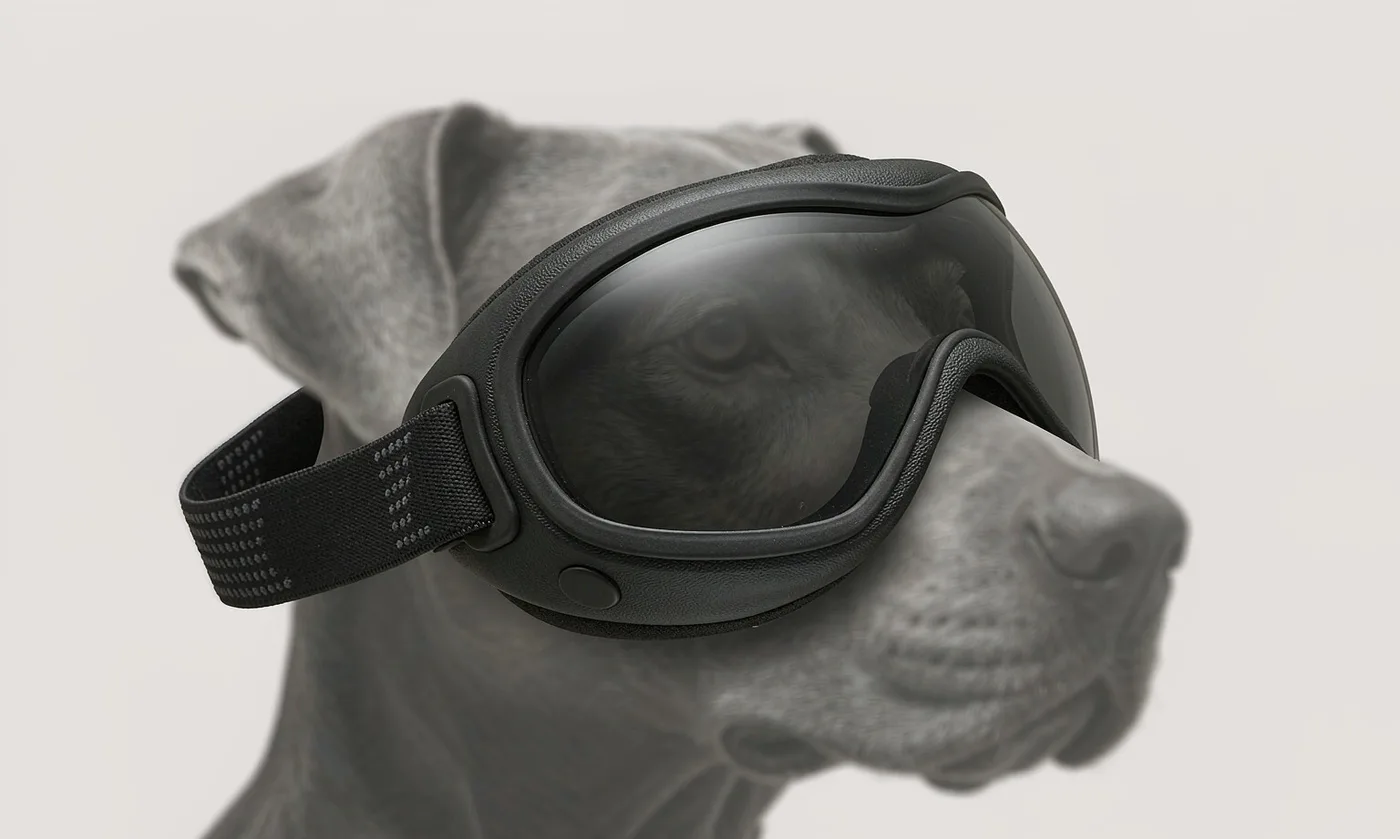
Polycarbonate at 1.5-1.8 mm with an integrated UV absorber is the reference build, giving 99-100% UV blocking, 85-90% visible transmission and a pass at 45-120 m/s.
Coating Stack: Anti-Fog, Hardcoat and Mirror
A bare polycarbonate lens is soft and fogs almost immediately, so the usable product is a stack of two to four functional layers applied in a defined order. The order matters, and getting it wrong is the most common cause of early failure in a low-cost programme.
The hardcoat goes on first and it is what makes the lens survive contact with a harness, a door frame or gravel. A polysiloxane hardcoat of 3-6 microns raises pencil hardness from roughly 2B to 2H-3H and cuts visible scratching in a Taber abrasion test from heavy haze at 100 cycles to light haze at 500-1,000 cycles. Applied after an anti-fog layer instead of before, it seals the hydrophilic treatment and destroys it.
Anti-fog is a hydrophilic top layer that spreads condensed water into a film rather than droplets. Two chemistries are used: a surfactant-loaded coating that is cheap but washes off in 20-60 cycles, and a covalently bonded hydrophilic network that survives 200-500 wipes. For a product that will be wiped by an owner daily, only the second is worth specifying, and the difference in unit cost is 0.12-0.35 USD.
| Layer | Deposition | Thickness | Function | Survives | Failure mode | Cost (USD) |
|---|---|---|---|---|---|---|
| Polysiloxane hardcoat | Dip or flow | 3-6 microns | Abrasion | 500-1,000 Taber cycles | Crazing at edges | 0.09-0.22 |
| Surfactant anti-fog | Dip | 1-2 microns | Wetting | 20-60 wipes | Washes off | 0.04-0.10 |
| Bonded hydrophilic anti-fog | Spray plus cure | 2-4 microns | Wetting | 200-500 wipes | Abrades with hardcoat | 0.16-0.45 |
| Mirror dielectric | Vacuum deposit | 0.05-0.3 microns | Glare cut | 150-400 wipes | Delamination | 0.35-0.90 |
| Hydrophobic topcoat | Dip | 0.1-0.3 microns | Water shedding | 60-200 wipes | Conflicts with anti-fog | 0.06-0.15 |
| Primer layer | Spray | 1-3 microns | Adhesion | n/a | Under-bonded stack | 0.03-0.09 |
The hydrophobic and anti-fog layers are mutually exclusive in one position, and this is a specification trap. A hydrophobic topcoat sheds water beautifully and fogs instantly, because it forces condensation into droplets that scatter light. If fog resistance is a product claim, the hydrophobic layer is removed from the inside face and retained only on the outside, where the cost is an extra masking step.
Cure control is where field failures originate. A hardcoat cured below its specified temperature or for less than its specified time is soft for the first two to four weeks, which means the scratches a customer sees in week one were put there in the factory. Our production team records cure temperature and dwell time per batch and measures hardness on one lens per fifty as a release check.
Verification of the finished stack is cheap and worth doing: a cross-hatch adhesion test at 3M 610 tape, a fog hold test at 40 degrees and 90% relative humidity for 60 seconds, and a Taber check at 500 cycles with a haze measurement. Three tests, 12-25 USD per batch, and they catch almost every coating defect that reaches a customer.
Hardcoat first, bonded hydrophilic anti-fog second, hydrophobic only on the outside face; a surfactant anti-fog at 20-60 wipes is not a specification for a daily-use product.
Impact, Debris and Environmental Test Protocol
Eye protection makes a performance claim and a performance claim needs a test. There is no mandatory animal-goggle standard in most markets, which means the test protocol is a commercial specification agreed between the brand and the manufacturer, and it should be written into the tech pack rather than assumed.
The impact test is the core. A 6 mm steel ball of 0.86 g is dropped from a height giving 45-120 m/s onto the lens mounted in its frame, at ambient, at minus 10 degrees and after a 4-hour ultraviolet pre-condition. Acceptance is no fracture, no penetration and no fragment released from the inner face. Test methods of this class are documented by ASTM International, and referencing the method rather than inventing one makes the result defensible.
Debris protection is a different failure and needs a different test: a projected-particle test using 2-4 mm quartz grit at 20-60 km/h, with acceptance measured as no perforation and no permanent optical defect larger than 0.5 mm. A lens that passes the ball drop but fails grit is common, because the ball spreads its load and a sharp particle does not.
| Test | Method summary | Sample size | Acceptance | Frequency | Cost (USD) |
|---|---|---|---|---|---|
| Drop-ball impact | 6 mm steel ball, 45-120 m/s | 6 per lot | No fracture, no fragment | Per production batch | 40-120 |
| Cold impact | Same at minus 10 degrees | 3 per lot | No fracture | Per colourway per season | 30-80 |
| Projected particle | 2-4 mm grit at 20-60 km/h | 4 per lot | No perforation | Per design | 60-150 |
| Lens retention | 50 N push from inner face | 5 per lot | Lens stays in frame | Per production batch | 20-50 |
| Strap tensile | Pull to failure at 100 mm/min | 5 per lot | 220-400 N minimum | Per material lot | 25-60 |
| Buckle release | 200 cycles then pull | 3 per lot | Releases at 40-90 N | Per hardware lot | 20-45 |
| UV pre-condition | 4 hours at 0.55 W/m2 | 2 per lot | No yellowing, Delta-E 2.0 | Per material lot | 70-180 |
| Salt fog on hardware | 24-48 hours, 5% NaCl | 3 per lot | No red rust | Per hardware lot | 50-130 |
Lens retention is the test most programmes omit and most returns trace to. A lens held only by a friction fit in a soft frame will eject inward under a 50 N push, and a lens in the eye is worse than no lens at all. The fix is a mechanical retention: a lens groove of 1.2-2.0 mm depth plus a retaining lip or three to six stitch points through a lens flange.
Environmental conditioning should not be skipped. Polycarbonate yellows and loses impact strength after prolonged ultraviolet exposure, and a lens stored on a retail shelf near a window for six months has already had a meaningful dose. A 4-hour accelerated pre-condition is a proxy for that and it costs less than one return.
Sampling frequency is the last decision and it should be risk-weighted. A running design with a stable material lot is tested at lens retention and strap tensile per batch and at full impact per quarter. A new colourway, a new lens supplier or a new frame tool resets everything to per-batch until three consecutive lots pass.
Impact alone is not enough: add projected-particle and lens-retention tests, and condition at minus 10 degrees and after ultraviolet exposure before declaring a pass.
Frame Geometry, Gasket and Breed Fit Grading
A goggle that protects on paper fails in the field if it does not seal. Animal faces vary far more than human faces in the region that matters — the bridge, the brow and the cheek — so fit is an engineering problem with a dimensional answer rather than a styling one.
The frame does three jobs: it holds the lens at a defined distance from the eye, it carries the gasket that seals to the face, and it transfers strap tension into even compression rather than point load. A frame made only from a soft thermoplastic does the second job well and the first badly; a rigid frame does the first well and bruises. The working answer is a rigid carrier of 65-85 Shore A with an overmoulded gasket of 25-40 Shore A.
Gasket compression is the number to specify. A seal needs 2-4 mm of compression against the face at a strap tension of 3-8 N, and it needs to hold that compression across a brow radius that varies from 22 mm on a small breed to 55 mm on a large one. Below 2 mm the goggle leaks dust; above 4 mm the pressure is uncomfortable and the animal removes it.
| Size | Head width (mm) | Muzzle circumference (mm) | Reference breeds | Brow radius (mm) | Gasket compression (mm) | Assembly mass (g) |
|---|---|---|---|---|---|---|
| XS | 62-78 | 110-150 | Chihuahua, Yorkshire Terrier | 20-26 | 2.0-2.6 | 28-42 |
| S | 76-96 | 145-195 | Pomeranian, Miniature Poodle | 24-32 | 2.2-2.9 | 38-56 |
| M | 94-120 | 190-250 | Cocker Spaniel, Border Collie | 30-40 | 2.5-3.3 | 52-78 |
| L | 118-150 | 245-320 | Labrador, Golden Retriever | 38-48 | 2.8-3.6 | 70-104 |
| XL | 148-186 | 315-410 | German Shepherd, Mastiff | 46-58 | 3.0-4.0 | 96-142 |
Coverage of the breed population is what decides whether five sizes is enough. Graded on head width and muzzle circumference, five sizes with the ranges above cover 92-96% of the common companion breeds, and the residual 4-8% is concentrated in two groups: extreme brachycephalic heads, where the brow is wide and the muzzle short, and extreme dolichocephalic heads, where the muzzle is long and narrow. Those two groups are served by optional bridge inserts rather than by adding a sixth size.
Brachycephalic fit deserves a specific note because it is the largest source of returns. A short-muzzle head needs a higher bridge and a shorter gasket run, and a standard frame will press on the nasal fold. An alternative bridge pad of 4-8 mm additional height, supplied as a spare part in the box, converts a return into a five-second adjustment.
Grading rules have to be consistent across the range or the fit breaks between sizes. The working rule is a head-width step of 18-24% and a brow-radius step of 15-20% between adjacent sizes, with gasket compression held constant. Jumping a size by 35% because a breed looks bigger is what produces a gap in the middle of the range.
Rigid carrier at 65-85 Shore A plus a 25-40 Shore A gasket, 2-4 mm compression, five sizes covering 92-96% of common breeds, and a bridge pad for brachycephalic heads.
Strap System: Webbing, Elastic and Retention Hardware
The strap is the safety-critical part of the assembly, because a goggle that comes off protects nothing and a strap that does not release under load becomes a hazard. Both failure directions have to be designed out, and they pull against each other.
Webbing width and construction set the baseline. A flat polyester webbing of 15-20 mm woven at 550-900 dtex with a plain or twill weave gives a breaking strength of 220-400 N and an elongation of 8-14% at 50% of break, which is the working range for this product. Narrower webbing at 10-12 mm feels lighter but concentrates load on the gasket and cuts comfort noticeably on sizes L and XL.
Elastic is added for fit tolerance, not for strength. A 20-40 mm elastic insert of 40-60% stretch compensates for the difference between a snug and a loose head and absorbs the shake load that a rigid strap transmits straight to the frame. Elastic that carries the whole strap is a mistake: it relaxes 8-18% in the first 200 hours and the goggle loosens over a season.
| Component | XS/S | M | L/XL | Material | Test | Acceptance |
|---|---|---|---|---|---|---|
| Webbing width | 15 mm | 16-18 mm | 20 mm | Polyester, 550-900 dtex | Tensile | 220-400 N |
| Webbing thickness | 0.9-1.1 mm | 1.0-1.3 mm | 1.2-1.5 mm | Polyester | Gauge | Plus or minus 0.08 mm |
| Elastic insert | 20 mm | 25-30 mm | 30-40 mm | Nylon or polyester rubber | Recovery after 200 cycles | 92-97% |
| Buckle | 15 mm side release | 18 mm side release | 20 mm side release | POM or nylon | Release force | 40-90 N |
| Adjuster | 15 mm ladderlock | 18 mm ladderlock | 20 mm ladderlock | POM | Slip at 80 N | Under 3 mm |
| Stitch | 8-10 spi, bonded nylon | 8-10 spi | 8-10 spi | Bonded nylon 69 or 40 | Seam strength | 180-320 N |
| Reflective trim | 10 mm | 12 mm | 15 mm | Retroreflective tape | Coefficient | 300-500 cd/lx/m2 |
Buckle release force is the number that resolves the two failure directions. A side-release buckle that releases below 40 N comes off during normal activity; one that needs more than 90 N will not release when the animal catches the strap on a branch or a fence, and the result is a strangulation hazard rather than a lost goggle. Specifying 40-90 N and testing it on every hardware lot is the control.
Stitch specification is the quiet failure point. A strap joined with 6 spi in a non-bonded thread loses 25-40% of its strength after the first wet-dry cycle, because the thread swells and the stitch geometry opens. Bonded nylon at 8-10 spi with a bar tack at each load transfer point holds 180-320 N and survives the cycle.
Reflective trim on the strap is worth including even on a daytime product, and it changes the product category in some markets. A retroreflective tape with a coefficient of 300-500 cd per lux per square metre adds 0.18-0.45 USD and makes the assembly visible at 80-150 m in a dipped headlight, which is the argument for it on any product sold alongside road walking.
15-20 mm polyester webbing at 220-400 N, a 20-40 mm elastic insert for tolerance only, and a side-release buckle specified and tested at 40-90 N release force.
Fogging, Ventilation and Thermal Load
Fogging is the complaint that ends a goggle programme, and it is a physics problem with a measurable answer. Fog forms when the inner lens surface falls below the dew point of the air trapped behind it, and the trapped air is warm and humid because it has just come off a breathing face.
The variables are the lens inner-surface temperature, the humidity of the cavity air and the air exchange rate. Raising the surface temperature by 2-4 degrees moves the dew point enough to stop fogging in most conditions, and reducing humidity by 15-25% does the same. Coating treats the symptom by forcing the condensate into a film; ventilation treats the cause.
Ventilation is therefore the primary control and it is geometric. A vent path of 40-90 square millimetres per eye, positioned at the top of the frame where warm air collects and shielded against direct water entry, gives an exchange rate that holds cavity humidity within 8-18% of ambient. Fully sealed goggles, which are sometimes requested for water and dust, will always fog unless the coating is specified at the premium level.
| Vent area (mm2/eye) | Shielding | Air exchange (1/h) | Time to fog (s) | Cavity humidity vs ambient | Dust ingress | Suits |
|---|---|---|---|---|---|---|
| 0 (sealed) | Full gasket | Under 2 | 25-70 | Plus 30-45% | None | Water, fine dust |
| 25 | Baffled | 6-12 | 90-180 | Plus 18-25% | Very low | Trail dust |
| 45 | Baffled | 14-24 | 180-320 | Plus 12-18% | Low | General use |
| 70 | Baffled | 22-38 | 320-600 | Plus 8-14% | Moderate | Active use |
| 95 | Open | 34-56 | Over 600 | Plus 5-10% | High | Hot climates |
| 45 plus bonded anti-fog | Baffled | 14-24 | Over 900 | Plus 12-18% | Low | Premium build |
Thermal load is the second constraint and it is often the reason an animal rejects a goggle before fogging does. A sealed cavity behind a dark lens in direct sun reaches 8-16 degrees above ambient in 10-20 minutes, and the face has no effective way to shed that heat. A lighter tint raises transmission losses elsewhere but drops cavity temperature by 4-8 degrees.
Tint and ventilation interact, and the combination has to be chosen together rather than separately. A dark lens with a small vent is the worst case: high solar gain and no exchange. A mid tint at 30-45% transmission with 45-70 square millimetres of baffled vent is the configuration that performs best across the range of conditions a companion animal actually meets.
The test is straightforward and belongs in the tech pack: mount the goggle on a heated head form at 34-36 degrees with a humidified air supply, hold the chamber at 20 degrees and 60% relative humidity, and record time to first visible fog on the inner surface. Acceptance of 300 seconds or better separates a usable product from a decorative one, and the same rig measures steady-state cavity temperature.
45-70 square millimetres of baffled vent per eye plus a bonded anti-fog coating gives over 900 seconds to fog onset; a fully sealed goggle fogs in 25-70 seconds without premium coating.
Labelling, Care Marking and Regional Documentation
A goggle sold into the EU, the UK and the US is a consumer product with documentation obligations, even though no animal-specific eyewear standard applies. The obligations attach to the product category, to the materials and to the claims made on the packaging, and they are easier to satisfy at design stage than at shipment.
In the European Union, the General Product Safety Regulation applies to consumer products placed on the market and requires a traceability label, an identification of the economic operator and instructions in the language of the market. A moulded or printed identifier on the frame plus a printed insert satisfies it, and the cost is the design time rather than the unit cost.
In the United States, the Consumer Product Safety Commission administers the consumer product safety framework and the substance restrictions that attach to children's products. A pet goggle is not a children's product, but it is frequently sold adjacent to them and packaged similarly, so the prudent specification limits lead and phthalates to the same thresholds and documents it. California's Proposition 65 warning requirement is separate and is governed by OEHHA, which publishes the listed substances and the safe-harbour levels.
| Item | EU | UK | US | Who issues | Lead time | Cost (USD) |
|---|---|---|---|---|---|---|
| Product traceability label | Required | Required | Recommended | Brand plus factory code | 0 days | 0.01-0.04 |
| Instructions in market language | Required | Required | Recommended | Brand | 3-8 days | 0.05-0.20 |
| Material declaration | Recommended | Recommended | Recommended | Supplier chain | 5-12 days | 0-120 |
| OEKO-TEX or equivalent textile test | Expected by retailers | Expected | Expected by retailers | Third-party lab | 10-25 days | 180-620 |
| Restricted substance screening | REACH | UK REACH | Prop 65 | Third-party lab | 8-20 days | 150-540 |
| Impact and optical test report | Voluntary, claim support | Voluntary | Claim support | Third-party lab | 12-30 days | 240-900 |
| Care and cleaning marking | Required where applicable | Required | Required | Brand | 1-3 days | 0.02-0.08 |
Substance declarations on the textile components are documented against OEKO-TEX criteria by most retailers, and the strap webbing and any fabric trim are in scope even though the lens and frame are not. Declaring the whole assembly against one criteria set avoids the argument about what counts as a textile.
Claims on the packaging are the highest-risk line in the whole document set. "Blocks 100% of UV" is defensible with a spectral transmission report; "protects against eye injury" is a medical claim that no manufacturer should print on an animal product. Our production team writes claim language for review by the brand's counsel rather than approving it on the factory side, and the standard wording is a measured performance statement with the test method named.
Care marking is the last item and it is what determines whether the coating survives. A goggle that can be wiped with a soft cloth but not washed, not solvent-cleaned and not dried above 50 degrees needs all three statements on the insert, because the alternative is a coating destroyed in the first week by an owner doing something reasonable.
Document traceability, market-language instructions and substance screening at design stage; state measured performance with the test method named, and keep any injury-prevention wording off the pack.
OEM Customisation: Colour, Marking and Packaging
A goggle is a high-tooling, low-fabric product, which shapes what customisation costs and how fast it can be done. The frame and lens tools are the fixed investment; colour, marking and packaging are the variable ones. Understanding which is which is what keeps a private-label budget predictable.
Tooling for a new frame shape is a 4,200-14,000 USD injection tool with a 25-45 day build, and it is the largest single decision in the programme. A new size on an existing tool family is cheaper, at 1,800-5,600 USD, because it reuses the carrier and changes only the gasket and bridge. Most private-label programmes start on an existing tool family with a custom colour and marking, and commission a new tool only after two or three seasons.
Colour is the cheapest route to a distinct product. A frame colour change costs 180-650 USD for a match plus a 90-260 USD setup, and needs 500 units because the first 80-150 are off-shade while the screw purges. A lens tint change needs an optical re-check at 90-240 USD.
| Route | Investment (USD) | First-unit lead time | Minimum | Reorder lead time | Durability | Best for |
|---|---|---|---|---|---|---|
| Existing tool, new colour | 180-650 | 14-24 days | 500 per colourway | 35-50 days | n/a | Launch |
| Existing tool, pad-print logo | 60-220 | 10-18 days | 500 | 35-50 days | 150-400 wipes | Brand mark |
| Existing tool, moulded logo in frame | 900-2,400 tool change | 28-48 days | 500-1,000 | 35-50 days | Permanent | Premium |
| Existing tool, strap embroidery | 60-140 digitising | 8-16 days | 500 | 35-50 days | 40-80 washes | Visible branding |
| Existing tool, woven strap label | 0-60 setup | 8-15 days | 500-1,000 | 35-50 days | 40-70 washes | Subtle branding |
| New gasket or bridge insert | 1,800-5,600 | 30-55 days | 1,000-2,000 | 35-50 days | n/a | Fit improvement |
| Full new frame tool | 4,200-14,000 | 55-95 days | 2,000-5,000 | 35-50 days | n/a | Platform change |
Marking method follows placement and required life. A strap mark is embroidered or labelled and survives 40-80 washes. A frame mark is pad-printed at 150-400 wipes or moulded in permanently with a tool change. Laser etching the lens degrades the optical surface and is not used inside the viewing area.
Packaging for this product has an unusual requirement: the lens must not be touched. A moulded PET blister with a lens clearance of 3-6 mm, or a fabric pouch plus a rigid carton, both protect the coating. A polybag alone is the cheapest option and it is also the most common cause of coating damage in transit, because the lens rubs against the frame under vibration.
Programme economics at the standard terms: MOQ 500 pieces per colourway, prototypes in 6-10 working days, bulk production 35-50 days after sample approval, final random inspection to AQL 2.5 with the lens and strap checks listed in the matrix above, T/T 30/70 and FOB Xiamen. Our production team runs goggle programmes through the SGS-verified production base under ISO 9001 and BSCI coverage, with 4,950 square metres, 137 staff and seven lines supporting a monthly output of 200,000 units across the accessory range. Start on an existing tool with a colour and a strap mark at 500 units, and commission a new frame tool only after two or three seasons of confirmed volume.
Why brands source here
- Pet carrier programs run since 2014; founding team in sewn goods since 2004
- SGS-verified production floor of 4,950 m² with 137 workers across 7 lines
- Monthly capacity of 200,000 units, audited to BSCI and ISO 9001
People Also Ask
What lens material is best for pet goggles?
Polycarbonate at 1.5-1.8 mm with an integrated UV absorber. It blocks 99-100% of UVA and UVB, transmits 85-90% of visible light and passes a 6 mm ball impact at 45-120 m/s.
Do pet goggles actually block UV?
A polycarbonate lens with an integrated absorber blocks 99-100% up to 400 nm. Cellulose propionate without an absorber blocks only 60-80% and should not carry a UV claim.
How do you stop pet goggles from fogging?
Ventilation first: 45-70 square millimetres of baffled vent per eye, plus a bonded hydrophilic anti-fog coating. That combination gives over 900 seconds to fog onset against 25-70 seconds for a sealed lens.
How many sizes does a pet goggle programme need?
Five, graded on head width and muzzle circumference, covering 92-96% of common companion breeds. Extreme brachycephalic and dolichocephalic heads are served by bridge inserts.
What is the correct strap strength for a pet goggle?
Webbing at 220-400 N breaking strength with a side-release buckle releasing at 40-90 N. Below 40 N it falls off; above 90 N it will not release under load.
How much does a custom pet goggle tool cost?
4,200-14,000 USD for a full frame tool with a 55-95 day first-unit lead time. A new size on an existing tool family is 1,800-5,600 USD at 30-55 days.
Frequently Asked Questions
Why does lens thickness matter beyond impact?
A 2.0 mm lens adds 1.6-3.4 g per eye and lengthens the lever arm on the strap, changing fit geometry. A 1.2 mm lens flexes and oil-cans in large sizes. Small and medium sizes sit at 1.5 mm, large at 1.8 mm.
What causes birefringence bands in a formed lens?
Forming stress that has not been relieved. The control is a post-form anneal at 110-125 degrees for 20-45 minutes plus a grid check limiting distortion to 0.1 dioptre across the central 40 mm.
Why must the hardcoat go on before the anti-fog layer?
A hardcoat applied over an anti-fog layer seals the hydrophilic treatment and destroys it. Order is primer, hardcoat, then bonded hydrophilic anti-fog, with a hydrophobic layer only on the outside face.
How long does a surfactant anti-fog coating last?
20-60 wipes, which is weeks on a daily-use product. A covalently bonded hydrophilic network survives 200-500 wipes and costs 0.16-0.45 USD against 0.04-0.10.
Why is a lens-retention test necessary?
A friction-fit lens in a soft frame ejects inward under a 50 N push, which is worse than no lens. The fix is a 1.2-2.0 mm lens groove plus a retaining lip or three to six stitch points through a flange.
What does ultraviolet pre-conditioning reveal?
Polycarbonate yellows and loses impact strength after UV exposure, including six months on a retail shelf near a window. A 4-hour accelerated pre-condition is a cheap proxy at 70-180 USD.
Why is a five-size range not enough for some breeds?
Extreme brachycephalic heads have a wide brow and short muzzle, and extreme dolichocephalic heads a long narrow muzzle. Both fall outside the standard grade and are better served by an optional bridge pad of 4-8 mm.
Should elastic carry the whole strap?
No. Elastic relaxes 8-18% in the first 200 hours and the goggle loosens over a season. Use a 20-40 mm insert for fit tolerance only, with rigid webbing carrying the load.
What thread specification holds a strap together?
Bonded nylon at 8-10 stitches per inch with a bar tack at each load transfer, giving 180-320 N. A non-bonded thread at 6 spi loses 25-40% of strength after one wet-dry cycle.
What reflective performance should strap trim have?
A coefficient of 300-500 cd per lux per square metre, giving visibility at 80-150 m in a dipped headlight. It costs 0.18-0.45 USD and widens the usable market.
Does tint choice affect thermal comfort?
Yes. A dark lens in direct sun raises cavity temperature 8-16 degrees above ambient in 10-20 minutes. A mid tint at 30-45% transmission drops cavity temperature by 4-8 degrees.
Should a pet goggle carry an injury-prevention claim?
No. State measured performance with the test method named, such as UV transmission or impact velocity. An injury-prevention claim on an animal product is not supportable and claim wording should be reviewed by the brand's counsel.
Why does polybag-only packaging damage goggles?
The lens rubs against the frame under transit vibration and abrades the coating. A moulded PET blister with 3-6 mm lens clearance, or a fabric pouch in a rigid carton, protects it.
Which customisation gives the fastest market entry?
An existing tool family with a new colour and a strap mark: 180-650 USD for the colour match, 10-18 days to first unit for a pad print, and 500 units per colourway.
Talk to QUANZHOU JUNYUAN BAGS about a pet carrier program: MOQ 500 pieces per colourway, samples in 6-10 working days, bulk production in 35-50 days under AQL 2.5 inspection.
Get a free quote Request a sample