Pet Carrier Slow Feeder: Anti-Bloat
A 20-millimetre ridge is a practical starting point for a small-dog travel slow feeder, with 28-40 millimetre channels and no trapped gap below 6 millimetres. The design should extend a baseline meal to roughly 1.8-3 times its original duration without blocking access, and any anti-bloat wording must be treated as a marketing claim requiring appropriate evidence rather than as an automatic property of the bowl.
A slow feeder is a pet-interface product before it is a moulded bowl. Ridge height, channel width, turn radius and food depth determine whether an animal takes smaller mouthfuls or simply cannot reach the ration. For travel use, those dimensions must also fit a carrier, resist sliding, clean completely and nest without fragile peaks carrying carton load. Development begins with representative head forms and a baseline meal-time protocol, then compares at least three maze geometries using the same food mass. Material selection covers exact PP or silicone grade, pigment, migration conditions and wash temperature. Tooling review addresses draft, rib-to-wall ratio, gate position and the risk of sink around the raised pattern. Performance statements should report measured meal-time change for the tested animal group and avoid presenting a feeder as treatment for a medical condition. Standard terms are MOQ 500 pieces per colourway, samples in 6-10 working days, bulk production 35-50 days after approval, and final random inspection to AQL 2.5. T/T 30/70 and FOB Xiamen apply. This article sets out a measurable engineering route from muzzle geometry through food-contact compliance, stability, sanitation, carton optimization and production control.
The economics of wholesale pet carriers move with carton cubage, so pet carrier accessory programmes are quoted both by unit price and by filled container.
Ridge Height and Channel Width by Muzzle Geometry
The maze must be scaled to the animal's muzzle rather than enlarged from a decorative pattern. A cat or flat-faced small dog needs low, broad features; a long-muzzled dog can work through deeper channels. If the ridge is too low, feeding speed barely changes. If it is too high or the channel too narrow, food remains inaccessible and the animal paws or overturns the bowl.
Useful starting dimensions are 8-14 millimetres of ridge height and 30-45 millimetres of clear channel for cats, 12-22 and 28-40 for toy or small dogs, and 20-35 and 38-58 for medium dogs. Every transition should have a radius of at least 2.5-4 millimetres. Narrow slots below 6 millimetres are avoided because they trap food and are difficult to inspect.
| User group | Ridge height | Channel width | Turn radius | Food depth | Target time ratio | Access criterion |
|---|---|---|---|---|---|---|
| Cat, broad dish | 8-14 mm | 30-45 mm | 4-8 mm | 15-25 mm | 1.4-2.0× | Under 8% remains |
| Flat-faced small dog | 10-16 mm | 34-48 mm | 5-9 mm | 18-28 mm | 1.5-2.2× | Under 8% remains |
| Toy or small dog | 12-22 mm | 28-40 mm | 3-7 mm | 22-35 mm | 1.8-3.0× | Under 6% remains |
| Medium dog | 20-35 mm | 38-58 mm | 4-9 mm | 30-48 mm | 1.8-2.8× | Under 6% remains |
Ridge spacing should be checked at the narrowest point after moulding tolerance, not on a rendering. A rounded probe representing nose width and a spoon or brush representing cleaning access can be used as simple gauges. The mountain top should be broad or domed, never sharp, with a minimum tip radius of 3 millimetres where facial contact is foreseeable.
Three interchangeable maze inserts can serve different populations without creating three complete bowl tools, provided the insert seam stays outside the food trap zone. A slow-feeder geometry is acceptable when it changes bite access without leaving more than 6-8% of the measured ration unreachable.
Meal-Time Testing and Responsible Performance Claims
Feeding speed cannot be inferred from the number of ridges. It must be measured against the same animal, ration, food form and starting hunger condition. A useful development protocol records three baseline meals in a plain bowl and three meals in each candidate geometry, then compares median duration, interruption, pawing, bowl movement and food remaining.
The target should be a range rather than the longest possible time. For small dogs, extending a 45-second baseline to 90-150 seconds may be useful; turning it into a ten-minute frustration task is not. A program target of 1.8-3.0 times baseline balances smaller access increments with continued engagement. Cats may need a milder ratio of 1.4-2.0 because whisker contact and cautious feeding change behaviour.
Food form changes the result. Dry kibble of 8-14 millimetres moves through channels differently from wet food, freeze-dried cubes or a mixed ration. Each food type claimed on pack should be tested separately at its stated portion mass. Deep wet food can bridge between ridges and defeat the maze, while small kibble can collect in tight internal corners.
Reports should show the tested population, bowl size, ridge geometry, food, portion, baseline and distribution of results. A statement such as measured median meal time was 2.2 times the plain-bowl baseline in a defined small-dog panel is more defensible than guaranteed anti-bloat. Digestive or disease-prevention claims require evidence and legal review beyond ordinary product testing.
Observation also identifies stress signals: repeated pawing, abandoning more than 6-8% of food, biting the ridges or overturning the feeder. These are rejection criteria, not proof that slowing is effective. The best slow feeder reaches a defined 1.8-3.0 times baseline while preserving access and calm engagement; maximum delay is not the engineering objective.
Food-Contact PP and Silicone Formulation
Rigid slow feeders are commonly injection-moulded in polypropylene, while flexible or collapsible versions use silicone. The exact formulation matters because pigment, slip additive, filler and cure system can change migration and odour. A purchase order should identify resin grade, supplier, colour masterbatch, recycled-content status and any processing aid for each food-contact component.
PP supports precise ridges, short cycles and light mass. A base wall of 2.0-2.8 millimetres with features proportioned to that wall limits sink and warpage. Copolymer PP improves impact at low temperature but may feel softer at tall ridges. A silicone design should nominate platinum cure, Shore A 50-65, post-cure time and volatile-content control; the phrase food-grade silicone is not a complete material specification.
Migration conditions follow intended food, temperature and repeated use. Dry kibble, aqueous food and fatty wet food may call for different simulants under the destination rule. The finished coloured article is the correct specimen because pigments and process residues are part of the product. A report on uncoloured raw polymer cannot qualify every commercial colour.
Restricted-substance screening covers colorants and elastomer ingredients even when the bowl has a separate insert. The European substance resources at ECHA and California lists published by OEHHA can inform a market matrix, while the responsible seller determines applicable requirements and exposure.
Change control must require approval before a new masterbatch, silicone catalyst, mould release or cleaner enters production. Retained resin and colour samples allow a complaint to be traced. Food-contact confidence comes from the exact finished formulation under intended use, not from a generic certificate attached to the base polymer family.
Moulding Ridges Without Sink, Flash or Weak Peaks
The maze creates thick and thin sections that challenge mould filling. A ridge built as a solid mountain may be three or four times the base wall, producing sink on the reverse, long cooling and internal voids. The efficient construction hollows or cores the ridge from beneath, uses ribs at 45-65% of nominal wall thickness and connects features with gradual radii.
Draft is required on both sides of every raised feature. One to two degrees per side works for polished PP; textured surfaces may need two to four. Insufficient draft scuffs the ridge and distorts the bowl during ejection. Excessive draft widens the channel at the top and narrows it at the food floor, so access dimensions must be called out where the kibble actually sits.
Gate position controls weld lines and balance. A central bottom gate fills radial patterns evenly but can leave a mark on the underside. Edge gates are easier to hide but may create weak weld lines at the final ridge. Flow analysis can screen locations, followed by short-shot studies during tool trial to confirm how the real resin advances.
Flash is a direct safety and cleaning issue. Parting lines should not run over mountain tops or through narrow channels where a thin fin could contact the muzzle. Visual limits should be supported by a measurable maximum, such as no accessible flash above 0.10 millimetres, plus a cotton-swab check. Manual trimming inside a maze is inconsistent and should not be the normal process.
Cavity identification lets the team connect warp or flash to one tool position. First-off checks include base flatness, ridge height, minimum channel, tip radius and unit mass. A slow-feeder tool should create hollow, drafted ridges with the parting line outside contact peaks; otherwise a decorative maze becomes a sink, flash and cleaning problem.
Cleanability at Corners, Junctions and Underside Ribs
Slow feeders have far more food-contact perimeter than plain bowls, so cleanability must be designed into every turn. Internal radii below 2 millimetres collect wet food and defeat common brushes. The working minimum is 2.5-4 millimetres at channel corners, with wider radii at three-way junctions. Surface texture should stay light below the fill line.
The underside matters because cored ridges create recesses. Those recesses should be open, drainable and wide enough to rinse; blind cells can hold dishwasher water and grow odour. If the underside is sealed by a second panel, the joint needs a validated continuous weld with no pathway for moisture. A decorative snap-on plate is not a sanitary seal.
A standard soil test applies a coloured protein-and-fat mixture into the deepest channels, dries it for a controlled period and follows the proposed wash instruction. Inspection under white and ultraviolet light after five cycles reveals residue. The acceptance should also include no retained water after a specified drain time and no visible cracking around ridge roots.
Dishwasher claims need defined rack position, detergent and maximum temperature. PP can warp when a broad base is unsupported; silicone can retain odour if an inappropriate filler or pigment is used. Dimensional and odour checks after 25, 50 and 100 cycles make the care instruction evidence-based.
Removable puzzle inserts can simplify cleaning if the interface is fully exposed, but narrow locking tracks add new traps. A large quarter-turn feature with 4-millimetre radii is better than many small snaps. No slow-feeding pattern should be approved until a visible soil can be removed from every channel, junction and underside recess by the labelled cleaning method.
Anti-Slip Base and Pawing Resistance
Animals interact more forcefully with a slow feeder than with a plain bowl. They push around ridges, change head angle and may paw when access becomes difficult. Stability must therefore be tested under horizontal and vertical disturbances, not inferred from the diameter. A broad support polygon and low food mass help, but friction is the principal control on a carrier floor.
A perimeter silicone ring gives continuous contact and damps noise. Discrete TPR pads use less material and drain well, but they can concentrate pressure on a soft liner. Targets can begin at a static coefficient above 0.65 dry, 0.45 wet and 0.32 under a light food-oil film on the specified floor material. Record normal load and pull speed.
Pawing resistance can be measured by applying a 12-18 newton upward-and-side force at the highest ridge and rim. The feeder may slide in a controlled way, but it should not flip or detach a bonded base. A carrier tether can provide secondary retention, provided the loop does not project into the animal area and releases for cleaning without a tool.
Wash ageing changes elastomer grip. Evaluate the base after 100 detergent cycles, 24 hours at warm humidity and 10,000 short sliding strokes. Look for tack, whitening, swelling, odour and bond lift, then repeat friction. Pale custom TPR colours may behave differently from black because their filler package differs.
The test should use the feeder at 25%, 50% and 100% of its portion rating. A heavy full bowl can hide an unstable base. A slow feeder earns a stable-base claim only after dry, wet and oily friction plus paw-force testing at the lightest realistic food load.
Carrier Fit, Portion Loading and Supervised Travel Use
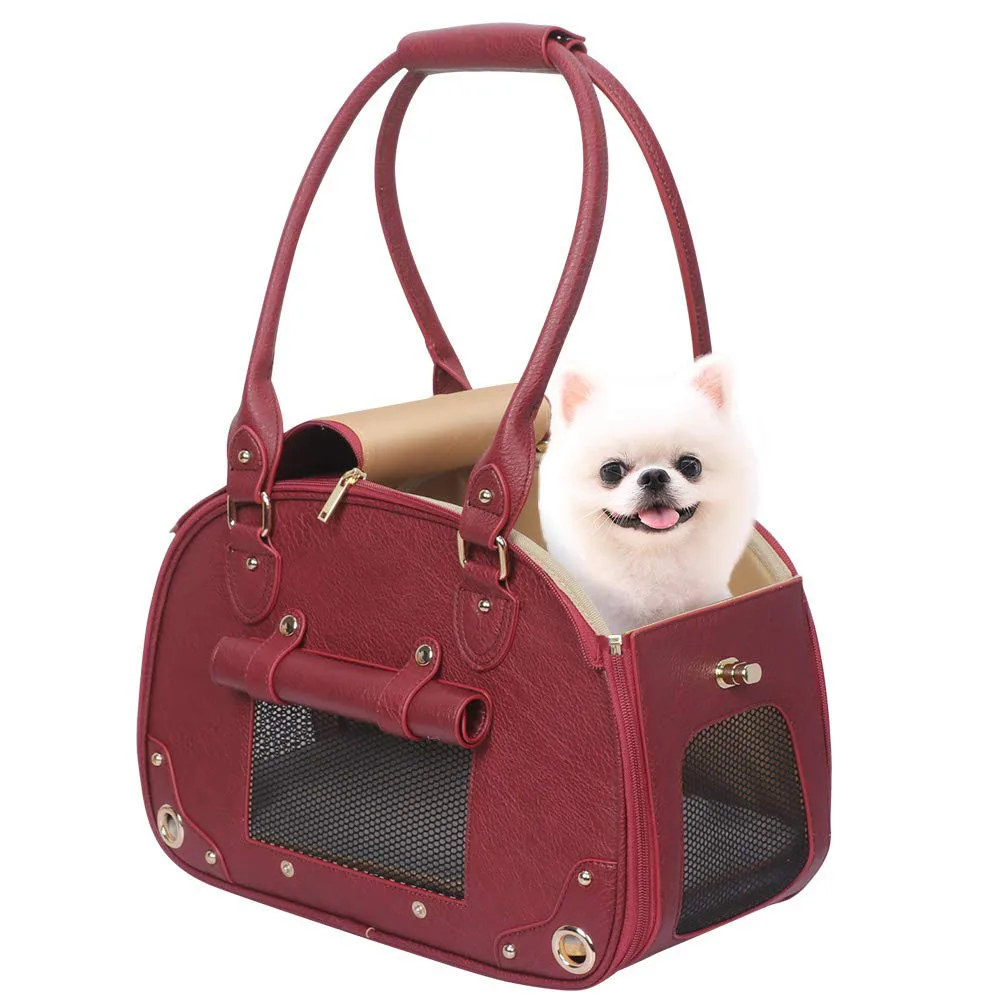
A travel slow feeder must fit through the carrier door, leave room for the animal to turn and remain reachable without pressing the neck against a wall. Overall footprint should be checked on the smallest nominated carrier, including seam allowances and a soft floor that may curl upward. A 20-millimetre clearance around the feeder is a useful minimum for removal and cleaning.
Portion loading needs a repeatable visual cue. A moulded line or separate scoop can identify 100, 200 or 300 grams for the intended kibble density, but volume-to-mass conversion changes by food. It is safer to mark volume and state that food mass varies. The highest approved fill should remain below the ridge tops so the maze still controls access.
The feeder should not remain loose in a moving vehicle with the animal. Options include a low-profile floor pocket, a short strap to an external anchor or use only while stationary. The product instruction must match the validated configuration. Calling an unsecured bowl travel safe creates a foreseeable misuse problem.
Supervised use language is especially relevant on first introduction. Animals differ in persistence and muzzle shape; any user that bites the ridges, flips the bowl repeatedly or cannot reach more than 92-94% of food needs another geometry. The instruction can advise a gradual transition without making behavioral or medical promises.
Carrier integration also affects cleaning. A detachable mount should release the complete bowl, and a fixed pocket should turn inside out or expose its seams. The travel design is successful when the feeder passes through the door, preserves turning space and can be removed completely after a supervised stationary meal.
Nesting, Ridge Protection and Carton Economics
Raised mountains make slow feeders inefficient to pack unless the profile is designed for stacking. A tapered wall and offset maze allow one bowl to nest without the upper bowl loading a ridge tip. Positive stops should transfer carton compression through the outer rim or dedicated underside bosses. Peaks should never carry the master-carton stack.
A rigid PP feeder standing 60 millimetres high can often reach a controlled stack pitch of 22-35 millimetres. Across 24 units, that can reduce carton cube by 28-42%. Silicone feeders may compress further but need shape-retaining sleeves so long storage does not leave a folded ridge. The pack trial should include warm conditioning before recovery is measured.
Surface contact can polish textured PP or transfer pigment between silicone colours. Thin paper rings at approved contact points are lower cube than individual boxes. If mixed colours share a carton, run rub tests under compression and humidity. A dark feeder marking a pale one is a batch defect even when each material separately passes migration.
Retail packaging should show the actual maze and user group without an oversized window. A folded board band or open-front carton can carry the portion, cleaning and supervision instructions while allowing nested master packing. The lot code should remain on the product after the band is discarded.
Distribution verification includes carton compression, vibration and drop, followed by stack separation, ridge-height, flatness and cosmetic checks. Test-method selection can use the resources of ASTM International, with method and severity named in the protocol. Positive rim stops protect the maze while a 22-35 millimetre stack pitch can remove 28-42% of freight cube.
Validation Gates, AQL and Production Release
Development should progress from printed or machined geometry samples to tool trials and then production material. Early models confirm muzzle access and meal-time direction, but they do not qualify migration, surface finish or final friction. The pre-production sample must come from the nominated cavity, resin, pigment, elastomer and pack.
The dimensional report includes brimful and usable capacity, base flatness, every critical ridge height, minimum channel width, tip radius, overall footprint and stack pitch. Functional data add meal-time ratio, percentage of food remaining, dry-wet-oily friction, pawing stability, soil removal and dishwasher ageing. Each result should identify sample count and user group.
Final random inspection to AQL 2.5 covers moulding appearance, dimensions, marks, assembly and packaging. Sharp flash, wrong food-contact material and blocked cleaning channels require separately agreed critical treatment. The process structure can align with ISO 9001, but the signed product specification remains the source of acceptance values.
MOQ 500 pieces per colourway supports production-grade colour and tool setup. Samples in 6-10 working days are scheduled after geometry input is complete; bulk production 35-50 days begins after written approval. T/T 30/70 and FOB Xiamen accompany the inspection and packaging terms.
Our production team keeps a golden feeder, a minimum-channel limit sample and the measured meal-time report through the SGS-verified production base. Reorders are checked against all three before release.
Production sampling should cover every mould cavity and each approved colour because a small shrink change can narrow a channel or tilt the base. At startup, five consecutive parts per cavity are measured for unit mass, the three highest ridges, the two narrowest channels and diagonal flatness. Once capability is established, frequency can move to timed checks, but any tool clean, resin-lot change or process interruption resets first-off approval. Inspectors should record actual values instead of ticking a visual box.
Colour change deserves its own purge and release procedure. Residual dark pigment can streak a pale food surface, and excessive purging compound can leave odour. The first acceptable pieces are retained, compared under standard light and included in the wash-and-odour check. Silicone batches need equivalent control through compound lot, catalyst ratio, post-cure record and hardness measurement. If a failure appears, affected production is isolated by cavity and time rather than blended into later cartons.
A final functional audit should take complete retail packs from sealed master cartons, not loose line samples. The audit verifies that nesting has not distorted the base, all instructions and lot marks are present, and the bowl still meets its side-pull and clean-drain targets after distribution handling. Measured findings are attached to shipment release so the next reorder starts with evidence rather than memory. A signed deviation list also prevents temporary trial settings from becoming undocumented production standards on later colour runs.
A slow feeder is ready for bulk only when its geometry produces measured slowing without inaccessible food, unsafe edges, hygiene traps or unstable travel behaviour.
Order and quality terms
- MOQ 500 pieces per colourway; samples in 6-10 working days
- Bulk production 35-50 days after approval; AQL 2.5 inspection standard
- T/T 30/70 terms, FOB Xiamen, full document set per shipment
People Also Ask
How high should slow-feeder ridges be?
Start around 8-14 mm for cats, 12-22 mm for toy or small dogs, and 20-35 mm for medium dogs, then verify access with representative muzzle forms.
How much should a slow feeder extend meal time?
A practical engineering range is about 1.8-3 times the same animal's plain-bowl baseline, provided less than 6-8% of food remains inaccessible.
Can a slow feeder prevent bloat?
Do not assume so. Report measured feeding-time results, while any disease-prevention or anti-bloat claim requires separate substantiation and market-specific legal review.
Which material is best for a travel slow feeder?
Rigid food-contact PP gives precise moulded ridges; platinum-cured silicone supports flexible or collapsible designs. Exact grade, pigment and intended-use migration evidence are required.
How is a slow feeder checked for cleanliness?
Apply a visible protein-and-fat soil to the deepest channels, wash by the labelled method, inspect under white and ultraviolet light, and repeat for five cycles.
Can slow feeders be nested for shipping?
Yes. A 22-35 mm controlled stack pitch with positive rim stops can reduce carton cube by roughly 28-42% without loading ridge tips.
Frequently Asked Questions
Why should channels not be extremely narrow?
Slots below about 6 mm trap food, defeat brushes and can leave an inaccessible ration. The minimum must be checked after moulding tolerance.
What tip radius is suitable for a feeding ridge?
Use at least 3 mm where facial contact is foreseeable, with 2.5-4 mm or more at internal channel transitions for cleaning.
Why test three baseline meals?
One meal is noisy data. Repeated plain-bowl and maze meals reduce the influence of hunger, distraction and novelty on the time ratio.
Does wet food need a different maze?
Often. Wet food can bridge between ridges, so channel width, food depth and cleaning validation must be tested separately from dry kibble.
Why are solid moulded mountains undesirable?
They create thick sections, sink, long cooling and void risk. Cored features with ribs at 45-65% of nominal wall are more stable.
Where should the mould parting line run?
Away from ridge tops and narrow food channels, because accessible flash is difficult to trim consistently and can contact the muzzle.
Can the underside be sealed with a snap plate?
A snap plate is not a sanitary seal. Use open drainable recesses or a validated continuous weld that prevents moisture entry.
What anti-slip targets are useful?
Start above 0.65 dry, 0.45 wet and 0.32 with controlled food oil on the actual carrier floor, then repeat after ageing.
Why test the feeder nearly empty?
A full ration adds stabilizing mass. The lightest realistic load reveals sliding or flipping hidden by a heavy bowl.
Should a slow feeder stay in a moving carrier?
Only in the validated restraint configuration. Many travel designs should be removed or used while stationary to avoid loose-object movement.
How are ridge tips protected in cartons?
Positive stacking stops transfer compression through the outer rim or dedicated bosses so no upper bowl rests on a maze peak.
What does the production limit sample show?
It represents the narrowest acceptable channel, edge and surface condition, giving inspectors a physical boundary alongside numerical drawings.
Talk to QUANZHOU JUNYUAN BAGS about a pet carrier program: MOQ 500 pieces per colourway, samples in 6-10 working days, bulk production in 35-50 days under AQL 2.5 inspection.
Get a free quote Request a sample