Pet Carrier Tracking Collar: GPS Location
A tracking collar is specified on four numbers: a module housing envelope of 40-90 by 30-55 by 15-28 millimetres, an ingress rating of IP67 or IP68 verified by test rather than by claim, an antenna exclusion zone of 20-50 millimetres clear of metal, and a lithium cell below 20 watt-hours per unit for air transport.
A tracking collar is a textile product with an electronic product inside it, and the two halves run on different lead times, different test regimes and different compliance frameworks. The textile side is cut, sewn and finished in 35-50 days; the electronic side is a module, a cell and a firmware build that can run to 60-110 days, and it is governed by radio, battery and chemical rules that the textile side is not. This page works through it in that order: how the module housing is engineered for serviceability, what the antenna environment requires and what breaks it, what an ingress rating actually commits to, and how the strap is specified around the electronics rather than independently of them. It then covers battery access and transport, the environmental and mechanical test regime, the electronic and chemical compliance set, and how the programme is scheduled when two supply chains have to converge. Commercial terms are standard: MOQ 500 pieces per colourway, prototypes in 6-10 working days, bulk production 35-50 days after sample approval, final random inspection to AQL 2.5, T/T 30/70 and FOB Xiamen.
Pet carrier OEM builds to your drawing, while pet carrier ODM adapts an existing pet carrier accessory platform and removes the tooling cost. Both start from the same tech pack.
Module Housing: Envelope, Interface and Serviceability
The housing is the interface between the two halves of the product and it is where most integration failures originate. It has to hold a module, protect it, and still let the collar be a collar.
Envelope is set by the module, not by the design. A typical GPS plus cellular tracking module occupies 40-90 by 30-55 by 15-28 millimetres including its cell, and the housing has to add 1.5-3.0 millimetres of wall plus a seal, which puts the external package at 48-100 by 38-64 by 22-38 millimetres.
Weight is the constraint that governs acceptance by the wearer. A module of 22-55 grams plus a housing of 8-22 grams puts 30-77 grams on the collar, and on an animal below 5 kilograms that is above the 1-1.5% of body mass where the collar starts to be felt.
Serviceability is the requirement that is forgotten until the first battery change. A housing that requires the collar to be removed and a tool to be found takes 3-8 minutes; one with a quarter-turn or a two-screw closure accessible with the collar on takes 30-90 seconds.
| Closure | Access time (s) | Tool | Seal type | Ingress achievable | Cost (USD) | Suits |
|---|---|---|---|---|---|---|
| Two-screw, captive | 30-90 | Coin or driver | O-ring, silicone | IP67 | 0.35-1.20 | Default |
| Quarter-turn bayonet | 15-45 | None | O-ring plus face | IP67 | 0.55-1.85 | Frequent access |
| Snap-fit, tooled | 10-30 | None | Integral lip | IP54-IP65 | 0.25-0.85 | Dry climates |
| Slide-in sleeve | 8-25 | None | Friction plus flap | IP54 | 0.18-0.65 | Module removal |
| Four-screw, gasketed | 60-180 | Driver | Flat gasket | IP68 | 0.65-2.20 | Immersion duty |
| Overmoulded, sealed | N/A | None | Potted | IP68 | 0.95-3.10 | Non-serviceable |
Seal material determines whether the rating holds after a year. A silicone O-ring at 40-70 Shore A holds its compression set for 2-5 years; a cheaper thermoplastic elastomer seal takes a compression set in 6-18 months and the rating is lost without any visible damage.
Mounting to the strap is a load question. A housing riveted or stitched to a 20-25 millimetre webbing at two points carries 150-450 newtons; a single-point mount rotates under load and eventually tears the webbing at the stitch line.
Internal retention of the module matters as much as the external seal. A module loose inside its housing by 1-3 millimetres impacts the housing wall on every jump and fails a connector in 2-8 months; a 0.5-1.5 millimetre foam pad or a locating rib removes it.
Two-point mount the housing to the strap, use a silicone seal at 40-70 Shore A, and pad the module internally to under 1.5 millimetres of movement.
Antenna Environment: Clearance, Orientation and Detuning
Positioning performance is decided by the antenna environment, and the antenna environment is decided by the collar design. This is the part of the product where a good module is made to perform badly by its surroundings.
Clearance is the first requirement. A GPS patch antenna needs a clear view of the sky through the housing, and a metal D-ring, a buckle, a name plate or a reflective foil within 20-50 millimetres detunes it and costs 20-60% of position accuracy.
Orientation is the second. A patch antenna works best facing upward, which on a collar means mounted on the dorsal aspect of the neck rather than at the throat; a unit under the jaw loses 25-55% of the sky view and its fix rate drops accordingly.
Housing material over the antenna is the third. A radio-transparent window of polycarbonate or ABS at 1.5-3.0 millimetres costs 0.5-2.5 decibels of signal; the same window metallised for appearance costs 8-25 decibels and effectively disables the receiver.
| Factor | Requirement | Penalty if ignored | Verification | Cost to fix at design | Cost to fix after tooling |
|---|---|---|---|---|---|
| Metal clearance | 20-50 mm from antenna | 20-60% accuracy loss | Fix-rate field test | 0 | Tooling, 120-450 |
| Orientation | Dorsal, sky-facing | 25-55% sky view loss | Fix-rate field test | 0 | Tooling, 120-450 |
| Radome material | Non-metallised polymer | 8-25 dB loss | Chamber measurement | 0 | Tooling, 120-450 |
| Radome thickness | 1.5-3.0 mm | 0.5-2.5 dB per mm over | Chamber measurement | 0 | Tooling, 120-450 |
| Cable routing | Internal, no exposed loop | Torn out in 1-3 events | Snag trial | 0.05-0.20 | Pattern change |
| Battery position | Below antenna, not over | 3-10 dB shadowing | Chamber measurement | 0 | Layout change |
Every one of these costs nothing to get right at the design stage and between 120-450 USD of tooling to fix afterwards, which is the argument for an antenna review before the housing is tooled rather than after the first samples fail.
Verification should be a field fix-rate test rather than a bench test. A unit measured in an open field for 30-120 minutes under a clear sky gives a fix-rate percentage and a position error in metres, which is the number a customer actually experiences.
Cellular and Wi-Fi positioning, where the module uses them as a fallback, have their own environment requirements. A cellular antenna detunes near a large metal surface in the same way, and the same 20-50 millimetre clearance rule applies to it.
Hold 20-50 millimetres of clearance, mount dorsally under a non-metallised window of 1.5-3.0 millimetres, and verify with a 30-120 minute field fix-rate test before tooling.
Ingress Protection: What IP67 and IP68 Actually Commit To
An ingress rating is the most quoted and least understood specification on an electronic pet product. The code is defined by a published standard, it describes two separate properties, and it says nothing at all about several things buyers assume it covers.
The code is defined in IEC 60529 and it has two digits. The first covers solid particle ingress on a 0-6 scale and the second covers water ingress on a 0-9 scale, with 6 meaning dust-tight and 7 meaning immersion to 1 metre for 30 minutes.
IP68 is not a single defined test. The second digit 8 means immersion under conditions agreed between manufacturer and user, which are always more severe than IP67 and must be stated in the specification — a depth and a duration, typically 1.5-3.0 metres for 60-240 minutes.
What the code does not cover is equally important: it does not cover water jets at an angle unless the second digit is 5 or 6, it does not cover salt water, it does not cover pressure washing, and it does not cover ageing of the seal.
| Rating | Solid | Water test | Duration | Suits | Test cost (USD) | Not covered |
|---|---|---|---|---|---|---|
| IP54 | Dust protected | Splash from any direction | 5 min | Urban, dry | 120-380 | Immersion |
| IP65 | Dust-tight | 6.3 mm jet, 30 kPa | 3 min per m2 | Rain, washing | 160-480 | Immersion |
| IP66 | Dust-tight | 12.5 mm jet, 100 kPa | 3 min per m2 | Heavy weather | 180-520 | Immersion |
| IP67 | Dust-tight | Immersion at 1 m | 30 min | Swimming, wading | 200-620 | Depth beyond 1 m |
| IP68 | Dust-tight | Agreed, stated depth | 60-240 min | Extended immersion | 240-780 | Salt, pressure wash |
| IP69K | Dust-tight | High-pressure hot jet | Per standard | Industrial wash | 320-980 | Immersion |
Seal ageing is the gap between the rating and the field experience. A rating is measured on a new unit; a silicone seal holds its compression for 2-5 years and a thermoplastic elastomer for 6-18 months, so the rating in year two depends entirely on the seal material.
Salt water is a separate failure mechanism that no IP rating addresses. Chloride ingress at a connector or at a seal interface corrodes in 2-12 weeks of marine exposure, and the controls are a conformal coating on the board and a rinse instruction for the user.
Test evidence should be requested with the depth and duration stated, not as a code alone. A report that reads "IP68" without a depth and a duration is not a specification; one that reads "IP68, 2 metres for 120 minutes" is.
Specify the rating with its depth and duration, require the seal material to be named, and add a conformal coating plus a fresh-water rinse instruction for marine use.
Strap and Webbing Specification Around the Electronics
The strap is not an afterthought to be chosen after the module; it carries the electronics, it determines the antenna environment, and it is what the customer touches every day. It also has its own load and durability specification.
Width is set by the housing and by the animal. A housing of 38-64 millimetres needs a strap of 20-32 millimetres to mount without overhang, and on a small animal a strap above 25 millimetres is disproportionate to the neck.
Webbing rating is a load specification. A polyester webbing at 20-25 millimetres with a breaking strength of 1,800-4,500 newtons is standard; the working load after a buckle and a stitch is 400-1,200 newtons, which is well above anything a collar sees in normal use.
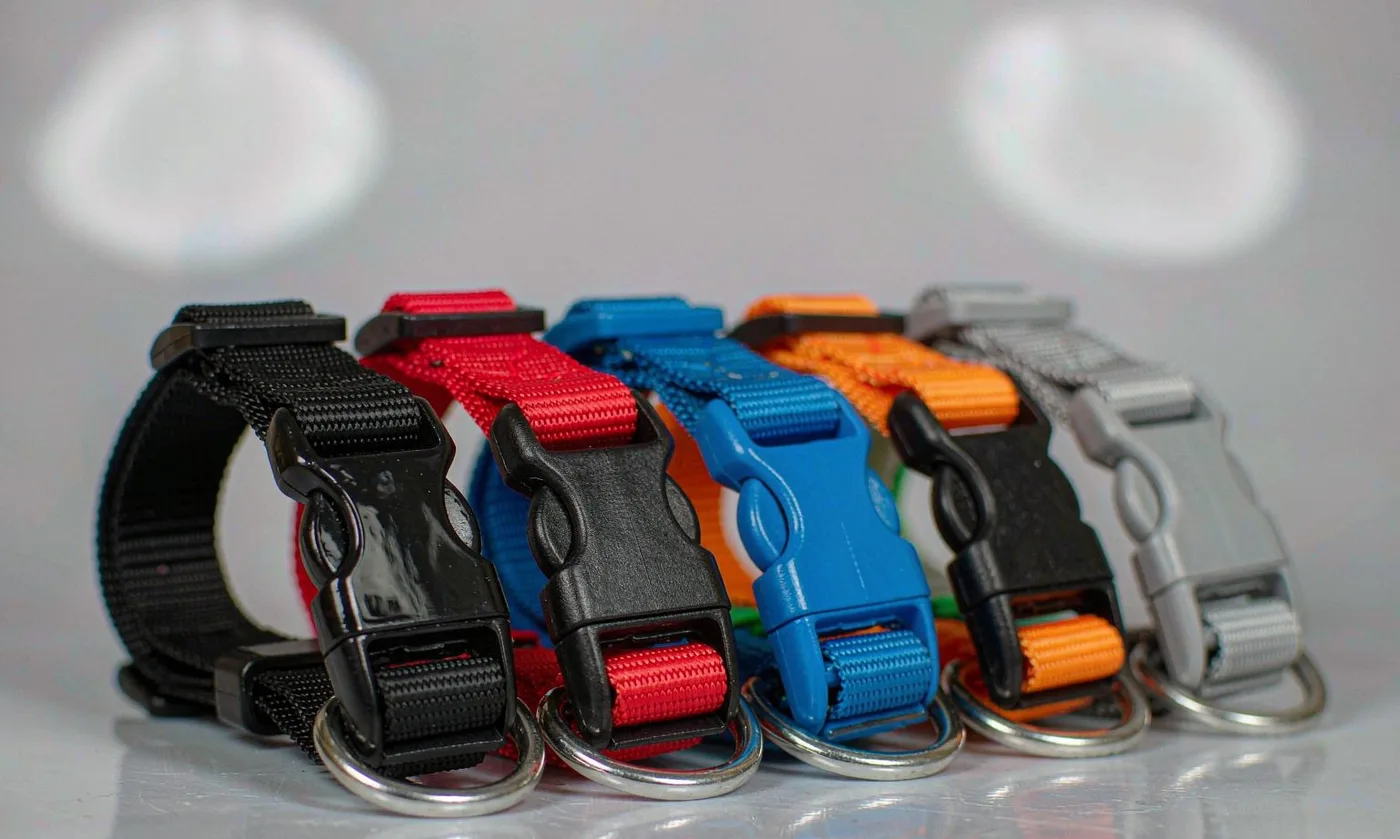
Metal content near the antenna is the design constraint that comes from the electronics. A strap with a metal D-ring, a name plate and a metal buckle within 20-50 millimetres of the housing needs the housing relocated rather than the hardware removed.
| Animal mass (kg) | Strap width (mm) | Neck range (mm) | Breaking strength (N) | Hardware | Reflective element | Webbing weight (g/m) |
|---|---|---|---|---|---|---|
| 2-5 | 15-20 | 180-320 | 1,200-2,800 | Polymer buckle | Piping, 8-12 mm | 18-30 |
| 5-12 | 20-25 | 260-440 | 1,800-3,600 | Polymer or alloy | Band, 15-25 mm | 24-42 |
| 12-25 | 25 | 360-580 | 2,400-4,200 | Alloy or steel | Band, 25 mm | 30-52 |
| 25-45 | 25-32 | 480-740 | 3,000-5,000 | Steel | Band, 25-50 mm | 38-68 |
| 45-70 | 32 | 620-920 | 3,800-6,200 | Steel, welded | Band, 50 mm | 48-86 |
Reflective integration is a visibility feature and a marketing one. A 25 millimetre band at 300-700 candela per lux per square metre on a collar is visible at 60-160 metres at night, and it costs 0.25-0.95 USD against a decorative trim that is visible at 20-50.
Adjustment range determines how many sizes the programme needs. A collar with 80-160 millimetres of adjustment covers three to four conventional size steps, which concentrates the MOQ and reduces the number of strap lengths to be cut.
Abrasion at the housing interface is a specific wear site. The housing edge rubs the webbing at every movement and cuts 20-60% of the webbing life at that point; a bound edge or a 200-300 gram backing patch under the housing is the fix at 0.08-0.30 USD.
Match strap width to the housing and the animal, relocate the housing rather than the hardware when clearance conflicts, and reinforce the webbing under the housing edge.
Battery: Capacity, Access, Cold Performance and Transport
The cell is the component with the most rules attached to it and the one most likely to delay a programme. Capacity, chemistry, access and transport each have a constraint that should be settled before the housing is designed.
Capacity and service interval are the commercial variables. A 300-900 milliamp-hour cell with a module drawing 15-80 milliamps in tracking mode gives 4-48 hours of continuous use and 3-14 days on a duty-cycled report interval, which is the number on the packaging.
Cold performance is the specification that is rarely published and often matters. A lithium polymer cell delivers 60-85% of its rated capacity at 0 degrees Celsius and 30-60% at minus 20, so a collar rated for winter use needs a 30-70% capacity margin.
Access and replacement is a design decision with a regulatory dimension. A sealed non-replaceable cell removes the user-service question and simplifies the ingress rating; a replaceable cell requires a tooled closure, a defined cell part number and a spare-parts plan.
| Cell | Capacity (mAh) | Mass (g) | Capacity at -20 C | Watt-hours | Air transport | Suits |
|---|---|---|---|---|---|---|
| Li-Po, small pouch | 300-600 | 8-18 | 30-55% | 1.1-2.3 | With equipment | Small breeds |
| Li-Po, standard | 600-1,200 | 16-34 | 35-60% | 2.3-4.6 | With equipment | General |
| Li-ion, 18650 | 2,000-3,500 | 42-52 | 45-70% | 7.4-13.0 | With equipment | Large breeds, long duty |
| Li-FeS2, primary | 1,500-3,000 | 15-30 | 60-85% | N/A | Simpler | Seasonal use |
| Li-Po, high rate | 500-900 | 14-26 | 40-65% | 1.9-3.5 | With equipment | Live tracking bursts |
Air transport is the constraint that surprises people. A lithium cell shipped installed in equipment follows one route and a cell shipped separately follows another, and both are governed by the dangerous-goods rules published by IATA, which set the state-of-charge limit, the packaging and the documentation.
State of charge at shipment is a specific rule rather than a preference. Cells are generally shipped at 30% or less of charge when travelling alone and the limit applies per cell rather than per consignment, so a production plan that charges units before packing creates a shipping problem.
Cell sourcing has the longest lead time in the chain. A specified cell from a named manufacturer takes 45-110 days against 20-45 for a generic, and it is the item that should be committed first in the programme rather than last.
Specify the cell by manufacturer and part number, size it with a 30-70% cold-weather margin, and commit it before anything else in the programme.
Environmental and Mechanical Testing
An electronic product on an animal sees a combination of conditions that no single consumer-electronics test covers: impact, vibration, temperature cycling, water and continuous flexing of the strap. The regime has to be built for that combination.
Drop testing is the obvious one and the height should match the use case. A collar worn by an animal falls from the animal's own height plus a jump, so a drop of 1.0-1.8 metres onto a hard surface over 6-12 orientations is the realistic specification rather than the 0.5-1.0 metre of a handheld device.
Vibration and shock cover transport and activity. A random vibration profile of 1-4 hours plus a shock test of 10-30 pulses at 50-300 g covers both the freight journey and a full-speed collision with a stationary object.
Temperature cycling is the test that finds seal and solder failures. Cycles between minus 20 and plus 60 degrees Celsius over 10-50 cycles reveal a seal that leaks at the low end and a cell that sags at the high end.
| Test | Profile | Duration | Acceptance | Common failure | Cost (USD) |
|---|---|---|---|---|---|
| Drop | 1.0-1.8 m, hard surface | 6-12 orientations | Functional after | Connector, housing crack | 180-620 |
| Random vibration | 5-500 Hz | 1-4 h per axis | Functional after | Solder joint | 240-860 |
| Mechanical shock | 50-300 g | 10-30 pulses | Functional after | Cell tab, crystal | 200-720 |
| Temperature cycling | -20 to +60 C | 10-50 cycles | Functional and sealed | Seal leak, cell sag | 320-1,100 |
| Ingress | IP67 or stated IP68 | 30-240 min | No ingress | Seal compression set | 200-780 |
| Salt fog on hardware | ASTM B117 | 96-240 h | No red rust | Plated hardware | 120-480 |
| Strap flex and abrasion | 5,000-20,000 cycles | At housing edge | No cut through | Webbing cut | 150-560 |
| Button and port cycle | 5,000-20,000 cycles | Per interface | Functional after | Cover fatigue | 120-450 |
Strap flex at the housing edge is the test unique to this product and it is the one most programmes skip. The housing edge acts as a cutting edge against the webbing under repeated flexing and cuts through in 5,000-20,000 cycles without a reinforcement patch.
Functional verification after each test matters more than cosmetic inspection. A unit that looks intact and no longer acquires a fix has failed, and the check is a fix-rate measurement rather than an appearance check.
Sample size should be stated in the plan. Three to eight units per test is typical for a development qualification and one to three per batch for a production verification, and the distinction should be written down so nobody argues about it later.
Drop from 1.0-1.8 metres, cycle the temperature range, and include a strap flex test at the housing edge with functional verification after every test.
Electronic and Chemical Compliance
An electronic product carries a compliance set that a textile product does not, and the two sets have to be satisfied simultaneously on the same unit. Missing either one stops the shipment rather than the sale.
Radio is the first. A module with a cellular or a short-range transmitter has to be authorised in each market it is sold in, and the practical route is to use a module that already carries a modular approval and to verify that the approval covers the antenna configuration actually used.
Electromagnetic compatibility and safety are the second. The applicable framework in the United States is administered by the Consumer Product Safety Commission for product safety, with radio authorisation handled separately, and in the European Union the CE marking covers both under a single declaration.
Chemical compliance applies to the whole article, electronics included. Restrictions on substances in electrical equipment, and REACH obligations on the textile and metal components, both apply, and the declaration has to cover the assembled product rather than the parts.
| Area | Requirement | Market | Evidence | Cost (USD) | Lead time (days) | Owner |
|---|---|---|---|---|---|---|
| Radio authorisation | Module approval plus antenna | US, EU, others | Grant or declaration | 0-4,500 | 0-90 | Module maker |
| EMC | Emissions and immunity | US, EU | Test report | 800-4,200 | 15-45 | Supplier plus lab |
| Product safety | General safety, cell safety | US, EU | Test report | 600-3,200 | 15-45 | Supplier plus lab |
| Cell transport | UN 38.3 test summary | Global | Test summary | 0-1,800 | 0-60 | Cell maker |
| Substance restriction | RoHS or equivalent | EU, others | Declaration | 200-1,400 | 10-30 | Supplier |
| REACH | SVHC declaration | EU | Declaration | 100-700 | 7-25 | Supplier |
| Textile limits | OEKO-TEX or equivalent | Voluntary | Certificate | 350-1,300 | 15-45 | Supplier |
| Marking and labelling | Origin, disposal symbol | Global | Artwork | Included | 3-10 | Supplier |
The module decision is the biggest lever in this table. A pre-approved module removes radio authorisation from the critical path entirely; a custom radio design puts 45-135 days and 2,000-12,000 USD onto it, and it is rarely worth it for this product.
The cell transport document is the item that holds a shipment at the airport. A UN 38.3 test summary from the cell manufacturer, plus packaging that follows the applicable dangerous-goods packing instruction, is what a carrier checks before accepting the consignment.
Textile and electronic declarations have to be combined at article level. A buyer receiving two separate certificates — one for the webbing and one for the module — cannot answer a retailer's question about the finished product, and the assembled-article declaration is the one that closes the review.
Use a pre-approved module, obtain the cell transport summary before the first shipment, and issue one declaration for the assembled article rather than two for the parts.
Programme Structure: Two Supply Chains, One Delivery Date
The scheduling problem on this product is that the electronic half and the textile half have different lead times and they cannot be joined until both arrive. The plan has to be built backwards from the delivery date with the longer chain driving it.
A cell and a module at 45-110 days is the critical path; webbing, hardware and sewing at 20-45 days is not. Assembly, test and packing take 5-15 days after both halves are present, and inspection to AQL 2.5 with a functional check takes 3-8.
Working backwards from a delivery date, the cell commitment sits 110-165 days out, the module 90-140, the textile components 55-95, and the artwork and specification lock ahead of all of them. Programmes that commit the textile first and the electronics second arrive late by the difference.
Prototyping follows the same asymmetry. A textile prototype is 6-10 working days; an electronic prototype with a firmware build is 25-70 days, and the first integrated sample can only exist after the longer of the two.
| Step | Duration | Start before delivery (days) | Critical path | Slippage allowance |
|---|---|---|---|---|
| Specification and artwork lock | 10-25 days | 165-190 | No | Included |
| Cell commitment | 45-110 days | 150-175 | Yes | 8-15% |
| Module commitment | 40-95 days | 140-165 | Yes | 8-15% |
| Textile and hardware | 20-45 days | 95-120 | No | 5-10% |
| Integrated prototype | 25-70 days | 70-110 | Yes | 10-20% |
| Sample approval cycle | 5-15 days | 55-70 | No | Included |
| Bulk production | 35-50 days | 35-50 | No | 8-15% |
| Assembly, test and packing | 5-15 days | 12-25 | No | Included |
| Inspection and release | 3-8 days | 3-8 | No | Included |
After-sales policy has to be written for an electronic product rather than for a strap. A dead-on-arrival rate of 0.4-2.5% is normal for a consumer electronic assembly and the policy should state the replacement window, the return route and who carries the freight, before the first shipment.
Cell transport restrictions affect the returns route as much as the outbound one. A unit returned with a cell inside is a dangerous-goods shipment, and a policy that requires the cell to be removed before return, or that routes returns through a domestic facility, avoids the problem.
Programme terms are standard: MOQ 500 pieces per colourway, textile prototypes in 6-10 working days and integrated electronic samples in 25-70 days, bulk production 35-50 days after sample approval, final random inspection to AQL 2.5 including a functional check, T/T 30/70 and FOB Xiamen. Production runs through the SGS-verified production base under ISO 9001 and BSCI coverage, with 4,950 square metres, 137 staff and seven lines. Commit the cell first, use a pre-approved module, and write the returns policy for a lithium product rather than for a strap.
Why brands source here
- Pet carrier programs run since 2014; founding team in sewn goods since 2004
- SGS-verified production floor of 4,950 m² with 137 workers across 7 lines
- Monthly capacity of 200,000 units, audited to BSCI and ISO 9001
People Also Ask
How is a GPS module mounted on a pet collar?
Two-point mounted to 20-32 millimetre webbing on the dorsal aspect, with 20-50 millimetres of clearance from any metal hardware. A single-point mount rotates under load and tears the webbing.
What does IP67 mean on a tracking collar?
Dust-tight plus immersion at 1 metre for 30 minutes, defined in IEC 60529. IP68 is not a fixed test; its depth and duration must be stated in the specification.
Why does a tracking collar lose position accuracy?
Usually the antenna environment. Metal within 20-50 millimetres costs 20-60% of accuracy and a metallised radome costs 8-25 decibels.
How long does a tracking collar battery last?
4-48 hours of continuous tracking from a 300-900 mAh cell, or 3-14 days on a duty-cycled report interval. Cold costs 30-60% of capacity at minus 20.
Can a product with a lithium cell be shipped by air?
Yes, under the dangerous-goods rules published by IATA, which set the state of charge, the packaging and the documentation. Cells usually ship at 30% charge or less when travelling alone.
What drop height should a collar electronics test use?
1.0-1.8 metres over 6-12 orientations, which reflects the animal's own height plus a jump rather than the 0.5-1.0 metre of a handheld device.
Should the tracking module be custom or pre-approved?
Pre-approved. A custom radio design adds 45-135 days and 2,000-12,000 USD to the critical path, which is rarely justified for this product.
What is a normal dead-on-arrival rate for this product?
0.4-2.5% for a consumer electronic assembly. The replacement window, return route and freight responsibility should be agreed before the first shipment.
Frequently Asked Questions
Why mount the module on the dorsal aspect rather than the throat?
A patch antenna needs a sky view. A unit under the jaw loses 25-55% of the sky view and its fix rate drops accordingly.
What radome material should cover the antenna?
A non-metallised polycarbonate or ABS window at 1.5-3.0 millimetres, costing 0.5-2.5 decibels. A metallised window for appearance costs 8-25 decibels.
How much does the housing add to the module size?
1.5-3.0 millimetres of wall plus a seal, taking a 40-90 mm module to an external package of 48-100 mm.
Why silicone rather than thermoplastic elastomer for the seal?
Compression set. Silicone at 40-70 Shore A holds for 2-5 years; a thermoplastic elastomer takes a set in 6-18 months and the rating is lost with no visible damage.
What is the risk of a loose module inside its housing?
A gap of 1-3 millimetres lets the module impact the wall on every jump and fails a connector in 2-8 months. Pad it to under 1.5 millimetres.
Does the IP rating cover salt water or pressure washing?
No. Neither is addressed by IEC 60529. Chloride ingress corrodes a connector in 2-12 weeks, and the controls are a conformal coating and a rinse instruction.
How should an IP68 report read?
With the depth and duration stated, such as 2 metres for 120 minutes. A report reading only IP68 without them is not a specification.
What webbing strength is needed?
A 20-25 millimetre polyester webbing at 1,800-4,500 newtons breaking strength, giving a working load of 400-1,200 newtons after the buckle and stitch.
Why reinforce the webbing under the housing?
The housing edge acts as a cutting edge under flexing and cuts 20-60% of webbing life at that point. A bound edge or backing patch costs 0.08-0.30 USD.
How much adjustment should a tracking collar have?
80-160 millimetres, which covers three to four conventional size steps and concentrates the MOQ into fewer strap lengths.
What capacity margin suits winter use?
30-70%. A lithium polymer cell delivers 60-85% of rated capacity at 0 degrees Celsius and 30-60% at minus 20.
Which test is unique to this product?
Strap flex at the housing edge over 5,000-20,000 cycles. It is the one most programmes skip and it finds the cut-through that a drop test does not.
Why verify function rather than appearance after each test?
A unit that looks intact and no longer acquires a fix has failed. The check is a fix-rate measurement, not a visual inspection.
Why should returns policy address the lithium cell?
A unit returned with a cell inside is a dangerous-goods shipment. Requiring cell removal before return, or routing returns domestically, avoids the problem.
Talk to QUANZHOU JUNYUAN BAGS about a pet carrier program: MOQ 500 pieces per colourway, samples in 6-10 working days, bulk production in 35-50 days under AQL 2.5 inspection.
Get a free quote Request a sample