Pet Carrier Water Bottle: Portable Hydration
A portable hydration bottle for a carrier programme runs 300-750 ml, dispenses at 0.8-1.6 ml per second through a trough valve, and holds 0.3 bar without weeping. Specify a 38 mm neck for cleanability, a wall of 0.45-0.70 mm in Tritan or PET, and a 1.2 m drop test on the filled bottle before tooling sign-off.
A hydration bottle is the accessory with the highest return rate in the category, and almost every return traces to one of three measurable failures: a closure that loses torque after thermal cycling, a valve that drips in a bag, or a body that cracks on the first drop. This page writes the specification that prevents all three. It sets out how bottle volume is constrained by the carrier pocket envelope rather than by marketing preference, why neck finish determines whether the bottle can be cleaned at all, what flow rate a trough valve has to deliver for a small dog or cat to drink without flooding, and which leak test protocol actually predicts field performance. It also covers the material decision between Tritan, PET and stainless on drop resistance and taste neutrality, and the closure torque retention testing that separates a bottle that seals for a year from one that seals for a month. Commercial terms follow the standard accessory programme: MOQ 500 pieces per colourway, prototypes in 6-10 working days, bulk production 35-50 days after sample approval, final random inspection to AQL 2.5, T/T 30/70 and FOB Xiamen.
A pet carrier manufacturer is judged on three numbers in this category - MOQ per colourway, sample turnaround and the AQL level applied at final inspection. Ours are 500 pieces, 6-10 working days and AQL 2.5.
Capacity Against the Carrier Pocket Envelope
Bottle capacity on a carrier programme is not chosen from a catalogue; it is constrained by the pocket envelope that the bag can accept. A bottle of 500 ml in a 68 mm diameter body stands 195-215 mm tall including the cap, which exceeds the depth of most side pockets and forces the bottle into the main compartment. The specification process starts from the pocket, not the bottle.
The relationship is fixed by cylinder geometry. Volume equals cross-section times height, so at a 68 mm diameter every 100 ml costs roughly 27 mm of height. Going from 500 ml to 750 ml at the same diameter adds 68 mm of height, which is the difference between fitting a side pocket and not fitting it. Widening the diameter instead costs pocket width, which usually conflicts with the panel seam.
Water weight is the constraint that designers forget. A litre of water is a kilogram, and a carrier side panel carrying 1 kg of water at a 120 mm lever arm puts measurable peel load on the panel seam. Most carrier programmes cap the bottle at 500-600 ml for that reason, and offer 750 ml only as an external clip-on item.
| Volume (ml) | Body diameter (mm) | Height with cap (mm) | Filled weight (g) | Panel peel load (N) | Fits side pocket |
|---|---|---|---|---|---|
| 300 | 58 | 158-172 | 342-368 | 11-16 | Yes, most models |
| 400 | 63 | 172-188 | 448-482 | 15-21 | Yes, most models |
| 500 | 68 | 195-215 | 556-598 | 19-27 | Yes, large pockets |
| 600 | 72 | 208-228 | 664-712 | 23-33 | Sometimes |
| 750 | 76 | 228-252 | 828-888 | 29-41 | Rarely |
| 1,000 | 82 | 258-286 | 1,096-1,180 | 38-54 | No, external only |
Panel peel load is calculated from the filled weight at the pocket's lever arm, and it drives a specification on the bag side rather than the bottle side. Above 30 N, the pocket needs a bar-tacked webbing reinforcement at the mouth or the seam will creep under repeated fill-and-empty cycles. Our production team specifies reinforcement above 25 N as a matter of policy.
Practical hydration need is the other input, and it is smaller than buyers assume. A 10 kg dog needs roughly 40-60 ml per kilogram per day in total, so a single walk of one to two hours consumes 60-180 ml. A 400 ml bottle covers two to four outings before refill, which is why 400 ml is the volume most programmes settle on once the pocket constraint is applied.
Start from the pocket depth, not the volume: at 68 mm diameter, 400 ml fits where 600 ml does not, and 400 ml covers two to four outings for a mid-size dog.
Body Material: Tritan, PET, PP and Stainless
Four materials dominate portable hydration, and they differ on drop resistance, taste neutrality, clarity retention and cost. Tritan copolyester is the premium option and the default for a bottle that will be dropped. PET is the volume option and is limited to single-use-adjacent durability. Polypropylene is the cheap option and is opaque. Stainless is the durable option and costs two to three times more.
Drop resistance is measured, not asserted. A filled 500 ml bottle dropped from 1.2 m onto concrete at a 45-degree angle onto the shoulder of the base: Tritan survives 12-20 drops, PET survives 4-8, PP survives 6-12 and stainless survives indefinitely but dents and the dent breaks the seal. Tritan's advantage comes from its notched impact strength, which is 6-10 times that of general-purpose PET.
Taste neutrality matters more for a pet product than for a human one. Animals refuse water from a bottle that carries a plastic note, and the note comes from residual acetaldehyde in PET or from a moulded-in additive in PP. Tritan and 304 stainless are both neutral; PET is acceptable if the resin is a low-acetaldehyde grade and the preform is dried correctly.
| Material | Drops to failure (1.2 m, filled) | Taste neutral | Clarity after 500 washes | Max fill temp | Unit cost (USD) |
|---|---|---|---|---|---|
| Tritan copolyester | 12-20 | Yes | 94-98% | 90 degrees | 1.10-2.30 |
| PET, low acetaldehyde | 4-8 | Marginal | 86-92% | 60 degrees | 0.42-0.85 |
| Polypropylene | 6-12 | No | Opaque | 100 degrees | 0.38-0.72 |
| 304 stainless, single wall | No failure, dents | Yes | n/a | Boiling | 2.60-4.80 |
| 304 stainless, vacuum | No failure, dents | Yes | n/a | Boiling | 4.20-7.60 |
Wall section follows from the material. An injection stretch blow moulded PET bottle runs 0.30-0.45 mm; an injection blow moulded Tritan bottle runs 0.55-0.70 mm because Tritan is processed at a lower stretch ratio. Below those figures the bottle ovalises when squeezed, which is a problem for a trough valve that depends on deformation to dispense.
Process route is tied to the material. PET is injection stretch blow moulded at high volume with a tool cost of 8,000-18,000 USD and a cycle of 8-14 seconds per cavity. Tritan is extrusion or injection blow moulded at a lower rate with a tool cost of 5,500-12,000 USD. For a 500-piece first order, stock bottles with custom decoration are usually the correct route, and custom geometry waits for the second season.
Tritan at 0.60 mm wall survives 12-20 filled drops from 1.2 m and stays taste neutral; PET is a third of the cost and survives four to eight.
Dispensing Geometry: Trough Depth, Valve and Flow Rate
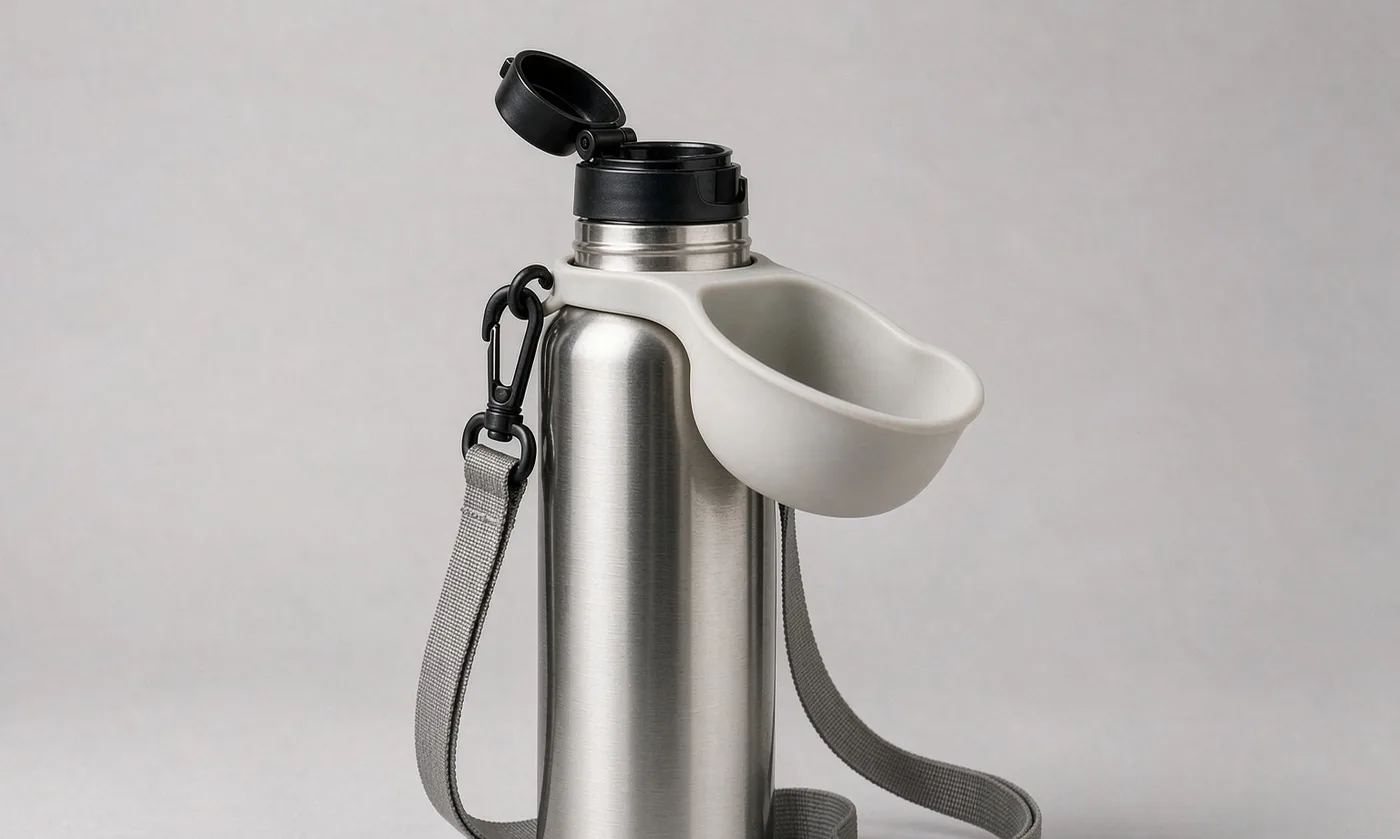
The dispensing end is where a pet bottle differs from a human bottle, and it is the part most often copied badly. A dog or cat cannot suck from a narrow spout at useful volume; it laps from a surface. The dispenser therefore has to present a shallow trough of standing water, hold it without draining, and retract it without spilling the remainder.
Trough geometry is the controlling variable. A trough of 55-75 mm width, 30-40 mm depth and 18-25 mm internal depth at the water line holds 25-45 ml of standing water, which is the volume a cat or small dog takes in two to four laps. A trough deeper than 30 mm floods the muzzle; one shallower than 15 mm requires refilling every two laps.
Flow rate into the trough is set by the valve orifice and by the squeeze deformation of the body. The measured target is 0.8-1.6 ml per second at a squeeze force of 12-20 N, which replenishes the trough at roughly the rate an animal drinks. Above 2.5 ml per second the trough overflows; below 0.5 ml per second the animal gives up and the bottle is returned.
| Animal | Trough width (mm) | Standing volume (ml) | Flow rate (ml/s) | Squeeze force (N) | Drink time per session (s) |
|---|---|---|---|---|---|
| Cat, 3-6 kg | 45-55 | 18-28 | 0.6-1.0 | 8-14 | 25-60 |
| Small dog, 4-10 kg | 55-65 | 25-38 | 0.9-1.4 | 11-18 | 30-75 |
| Medium dog, 10-22 kg | 65-78 | 38-55 | 1.3-2.0 | 14-22 | 40-95 |
| Large dog, 22-40 kg | 78-95 | 55-85 | 1.8-2.8 | 18-28 | 45-110 |
Valve type decides whether the bottle drips in a bag. A gravity ball valve drips at 0.2-0.6 ml per minute and is unacceptable inside a carrier. A silicone duckbill slit valve holds to 0.3 bar and drips less than 0.05 ml per minute, and it is the standard for bag-carried hydration. A screw-operated shut-off is the safest and requires two-handed operation.
Return flow is the detail that separates a usable dispenser from a frustrating one. When the squeeze is released, air has to re-enter the bottle or the trough sucks back and the animal licks an empty surface. A 0.8-1.4 mm air return passage at the top of the trough, or a vented cap, solves this and costs nothing in tooling.
A 60 mm trough holding 30 ml, fed by a duckbill slit valve at 1.1 ml per second with a 1.0 mm air return, is the configuration that works across cats and small dogs.
Leak Testing: Inversion, Pressure and Thermal Cycling
Leak performance is the single largest driver of returns in this category, and it is entirely predictable in the laboratory if the test protocol matches field conditions. Three tests are required and they are not interchangeable: a static inversion test, a pressure test, and a thermal cycling test that runs the first two again after ageing.
The static inversion test fills the bottle to 70%, closes it to the specified torque, and inverts it for 60 minutes with the dispensing end down over a weighed absorbent pad. Acceptance is mass loss under 0.5 g. This test catches closure defects and will pass a bottle that still leaks in an aircraft.
The pressure test fills the bottle to 70%, seals it, and holds it at 0.3 bar for 10 minutes submerged. Acceptance is no continuous bubble stream. This is the test that predicts cabin performance, because a carrier in an aircraft hold or cabin sees a real pressure differential, and it is the test most suppliers skip.
| Test | Condition | Duration | Acceptance | Sample size | Detects |
|---|---|---|---|---|---|
| Static inversion | 70% fill, inverted | 60 min | Under 0.5 g loss | 20 per 500 | Closure defects |
| Pressure hold | 0.3 bar, submerged | 10 min | No bubble stream | 20 per 500 | Seal geometry |
| Thermal cycle | 5 to 45 degrees, 6 cycles | 24 h | Retest passes | 12 per 500 | Torque loss |
| Drop then invert | 1.2 m drop, then invert | 30 min | Under 1.0 g loss | 8 per 500 | Cap-to-body fit |
| Vibration | 5-50 Hz, 60 min | 60 min | Under 0.5 g loss | 8 per 500 | Transport handling |
Thermal cycling is the test that catches the failure nobody expects. A bottle filled cold and carried into a warm vehicle expands its headspace and pushes past a closure that sealed perfectly at ambient. Six cycles between 5 and 45 degrees, followed by a repeat of the inversion and pressure tests, reproduce a summer of use in 24 hours.
Torque retention is the number to record from the thermal test. A closure applied at 1.4-2.0 Nm should retain at least 70% of that torque after cycling; below 55% the bottle will leak within a season. Torque retention is a property of the liner material: a foamed polyethylene liner retains 78-88%, an EVA liner 62-74%, and a liner-less polypropylene cap 45-60%.
Run thermal cycling before pressure testing: a closure that holds 0.3 bar at ambient loses 30-45% of its torque after six thermal cycles and fails the same test.
Closure and Neck Finish: Thread, Torque and Cleanability
The neck finish is the least visible and most consequential specification on the bottle. It sets the closure options, the cleanability, and the ability to source a second supplier without re-tooling. Three finishes dominate: 28/410 for small bottles, 38/400 for the 400-750 ml range, and a wide 53 mm screw finish for anything that has to accept a brush or ice.
Cleanability is the reason to go wide. A 28 mm neck will not accept a standard bottle brush, which means the bottle cannot be properly cleaned and will develop biofilm in four to eight weeks of daily use. A 38 mm neck accepts a brush. A 53 mm neck accepts a brush and ice, and it is the correct choice for a product marketed as reusable.
Thread geometry controls torque retention and cross-threading. A three-start thread engages in 180 degrees of rotation and is fast to close but cross-threads more easily at 28 mm. A single-start thread needs 360-450 degrees and is slower but almost impossible to cross-thread. For a pet product operated one-handed while holding a lead, three-start at 38 mm is the practical compromise.
Liner selection is where cost and performance separate. A foamed polyethylene induction-sealed liner gives the best torque retention and a tamper-evident seal, at 0.05-0.11 USD. A co-extruded EVA liner is cheaper at 0.02-0.05 USD and adequate for a bottle sold without a tamper claim. A liner-less design depends on a moulded sealing ring in the cap and is the cheapest and weakest option.
Attachment of the cap to the body is a small feature with a large effect on returns. A captive tether moulded into the cap collar eliminates lost caps at 0.03-0.08 USD. A separate silicone tether ring is 0.06-0.14 USD and can be replaced. Either is cheaper than the replacement rate on an untethered cap, which runs 4-9% per year in this category.
Specify a 38 mm three-start finish with a foamed polyethylene liner: it accepts a bottle brush, retains 78-88% of applied torque, and cross-threads rarely at one-handed operation.
Carrier Interface: Sleeve, Pocket and Clip-On
A bottle is only useful if it travels with the bag, and there are three interface options with different cost and different performance. An elastic side pocket is the cheapest and the one most likely to eject the bottle. A moulded or stitched sleeve is the middle option. A clip-on cradle using a carabiner is the most secure and the most expensive.
An elastic pocket has to be sized to the body diameter with a negative ease of 3-6 mm to retain the bottle under motion. Negative ease below 2 mm ejects the bottle on a 1.0 m drop of the bag; above 8 mm the pocket is difficult to load and the elastic fatigues in 300-600 cycles. The elastic band itself should be 20-25 mm wide and UV-stabilised, because an unstabilised band loses 30-40% of its recovery in one summer.
A stitched sleeve is the better solution for a bottle carried externally. Two layers of 420D nylon with a 3 mm closed-cell foam interlayer hold the bottle, protect it from drop impact, and add thermal insulation worth 2-4 degrees over 60 minutes. The sleeve costs 0.65-1.35 USD and turns a bottle into a bag feature.
| Interface | Retention on 1.0 m bag drop | Load cycles | Added cost (USD) | Insulation gain | Best application |
|---|---|---|---|---|---|
| Elastic side pocket | 62-78% | 400-900 | 0.18-0.42 | None | Light day use |
| Stitched sleeve with foam | 94-99% | 1,800-3,600 | 0.65-1.35 | 2-4 degrees | Daily walking |
| Moulded cradle plus carabiner | 97-100% | 3,000-6,500 | 0.95-2.10 | 1-3 degrees | Travel, hiking |
| Internal dedicated compartment | 99-100% | n/a | 0.55-1.10 | None | Airline-compliant bags |
| Magnetic dock on panel | 48-66% | 700-1,500 | 0.80-1.60 | None | Premium presentation only |
Placement follows the same logic as any hung accessory: keep it out of the swing arc. A bottle on a shoulder strap swings at walking cadence and, filled, delivers 4-9 N of impulse to the wearer's hip with each step. A bottle on a side panel 120-200 mm above the base does not.
Spare and replacement logic matters for a bottle programme more than for other accessories, because bottles are lost in quantity. A reorder against an existing tool starts at 300 pieces; a sleeve reorder starts at 200. Holding 10-15% bottle overage on the first run is the cheapest way to service warranty claims, and it costs less than the freight on a separate 300-piece reorder. Related detail: accessory spare component planning.
A stitched sleeve at 0.65-1.35 USD raises drop retention from 62-78% to 94-99% and adds 2-4 degrees of insulation, which no pocket can do.
Compliance: Food Contact, BPA and Labelling
A bottle is a food-contact article in every market and it carries a documentation set that has to be produced per batch. Three documents are standard: a food-contact declaration on the finished article, a restricted-substance test report, and a declaration on bisphenol content, because BPA-free claims are actively enforced in the US.
BPA-free is a claim with legal weight. In the US, the consumer product safety framework is administered by the CPSC, and a BPA-free claim on a product that contains a bisphenol-based polycarbonate is a misbranding. Tritan, PET and polypropylene are all bisphenol-free by chemistry; polycarbonate is not, and it should not be specified for this product at all.
For the EU, restrictions on substances in articles are maintained by ECHA under REACH, and the specific migration limits for food-contact plastics are set under the EU plastics regulation. A bottle intended for the EU needs an overall migration test and, where the polymer requires it, a specific migration test, both on the finished article with a food simulant.
California adds a separate requirement. A product sold in California with a detectable listed substance needs a Prop 65 warning, and the substance list is maintained by OEHHA. Most Tritan and PET bottles require no warning, but a coloured pigment system or a recycled-content resin can introduce a listed metal and change the answer.
Labelling closes the file. A bottle with a volume claim needs the volume marked in metric and US customary units. A bottle with a dishwasher claim needs the claim tested to the number of cycles stated. A bottle sold with a BPA-free claim needs the declaration on file before the artwork is printed, not after.
Tritan, PET and polypropylene are bisphenol-free by chemistry; the exposure is in the pigment system and in any recycled-content resin, so test the finished coloured article rather than the base polymer.
Production Route: Stock Decoration, Custom Tool and MOQ Mix
Three production routes are available and the right one depends on order size and on whether the geometry is new. Stock bottle with custom decoration is the fastest and cheapest route and covers most first orders. Semi-custom, using a stock preform with a custom shoulder or base, is the middle route. Full custom with a new blow mould is the third, and it only makes sense above roughly 20,000 units a year.
Stock decoration applies a printed or sleeved graphic to an existing bottle. Screen print at one to three colours costs 0.08-0.28 USD per unit with a 60-140 USD setup; a full-body shrink sleeve costs 0.22-0.55 USD with a 280-650 USD plate cost and gives 360-degree artwork. Sampling on a stock bottle takes 4-7 working days because there is no tool to cut.
Custom tooling changes the economics entirely. A single-cavity PET injection stretch blow mould is 8,000-18,000 USD and produces 6,000-9,000 bottles per day; a Tritan injection blow tool is 5,500-12,000 USD at 2,500-4,500 per day. Amortised over 500 units the tool adds 11-36 USD per bottle, which is why custom geometry is not viable on a first order.
| Route | Tooling (USD) | At 500 units | At 3,000 units | At 20,000 units | Sampling (days) |
|---|---|---|---|---|---|
| Stock bottle, screen print | 0 | 0.94 | 0.90 | 0.88 | 4-7 |
| Stock bottle, shrink sleeve | 280-650 | 1.42 | 1.15 | 1.08 | 6-10 |
| Semi-custom, stock preform | 1,800-4,200 | 2.66 | 1.28 | 1.02 | 10-16 |
| Full custom, new blow mould | 5,500-18,000 | 16.40 | 3.10 | 1.24 | 22-38 |
Mixed colourway rules are what make a small bottle order work. MOQ 500 pieces per colourway applies when the colour requires a resin change and a purge. When the colour is applied by decoration rather than by resin, the minimum is 200 per colourway against a 500-piece total, so a three-colour launch runs at 600 units. That rule applies to printed decoration and to sleeve decoration, and it is the main reason most programmes decorate rather than colour the resin.
Gift set assembly is the highest-value structure here. A bottle, a bowl and a waste bag dispenser share one carton and one freight charge, and the set carries a price point 2.2-3.1 times the cheapest component. Sets are assembled at pack-out so each component is inspected separately under AQL 2.5, and the set inherits the worst result of its parts, which keeps the quality logic honest.
Decorate a stock bottle on the first order and cut custom tooling only after volume passes 20,000 units a year; at 500 units the tool alone adds 11-36 USD per bottle.
Order and quality terms
- MOQ 500 pieces per colourway; samples in 6-10 working days
- Bulk production 35-50 days after approval; AQL 2.5 inspection standard
- T/T 30/70 terms, FOB Xiamen, full document set per shipment
People Also Ask
What size water bottle is best for a pet carrier?
400 ml is the practical answer for a side pocket, because at 68 mm diameter a 400 ml bottle stands 172-188 mm and fits, while 600 ml stands 208-228 mm and usually does not. 400 ml covers two to four outings for a mid-size dog before refill.
How do I stop a pet water bottle leaking in a bag?
Use a silicone duckbill slit valve rather than a gravity ball valve, and specify a foamed polyethylene liner that retains 78-88% of applied torque. Validate with a 0.3 bar submerged hold for 10 minutes after six thermal cycles between 5 and 45 degrees.
Is Tritan better than PET for a pet water bottle?
Yes on durability: Tritan survives 12-20 filled drops from 1.2 m against 4-8 for PET, and it stays taste neutral where low-grade PET carries an acetaldehyde note. PET costs roughly a third as much and is adequate for a promotional or short-life product.
What flow rate should a pet bottle dispenser deliver?
0.8-1.6 ml per second at a squeeze force of 12-20 N for small to medium animals, rising to 1.8-2.8 ml per second for large dogs. Above 2.5 ml per second the trough overflows; below 0.5 ml per second the animal gives up drinking.
Can a pet water bottle be cleaned properly?
Only if the neck accepts a brush, which means 38 mm or wider. A 28 mm neck cannot be brushed and will develop biofilm in four to eight weeks of daily use. Specify 38/400 with a three-start thread for one-handed operation.
Does a bottle need a thermal sleeve?
A stitched sleeve with a 3 mm closed-cell foam interlayer adds 2-4 degrees of retention over 60 minutes and raises drop retention from 62-78% to 94-99%. At 0.65-1.35 USD it is the highest-value option on the bill of materials.
Frequently Asked Questions
What is the MOQ for a custom hydration bottle?
MOQ 500 pieces per colourway applies when the colour is in the resin. When colour is applied by print or sleeve, the minimum drops to 200 per colourway against a 500-piece order total, so a three-colour launch runs at 600 units.
How long does sampling take?
Samples are produced in 6-10 working days for a stock bottle with custom decoration, 10-16 days for a semi-custom build on a stock preform, and 22-38 days where a new blow mould is required.
What is the bulk production lead time?
Bulk production runs 35-50 days after sample approval. Decorated stock bottles sit at the short end of that range, and a full custom tool with a new blow mould sits at the long end.
Which inspection standard applies?
Final random inspection is to AQL 2.5, with a separate functional leak check on 20 pieces per 500 units and a torque retention check on 8 pieces per 500.
Are samples leak tested before approval?
Yes. Every sample set is run through static inversion, a 0.3 bar pressure hold and six thermal cycles, and the measured torque retention and mass loss are reported with the sample. The numbers are the approval criterion.
Can the bottle carry a BPA-free claim?
Yes, if the body is Tritan, PET or polypropylene, which are bisphenol-free by chemistry. The claim must be supported by a declaration on the finished coloured article, because pigments and recycled resin can introduce a listed substance.
What closure torque should be specified?
1.4-2.0 Nm at application for a 38 mm finish with a foamed polyethylene liner. The specification should also state a retention floor of 70% after six thermal cycles, which is the number that predicts a season of field performance.
Is a stainless option available?
Yes, in 304 single wall at 2.60-4.80 USD and vacuum insulated at 4.20-7.60 USD. Stainless does not fail a drop test but it dents, and a dented body breaks the cap seal, so the drop test is replaced by a dent-and-retest protocol.
How is the bottle decorated?
Screen print at one to three colours for simple marks, at 0.08-0.28 USD per unit, or a full-body shrink sleeve for 360-degree artwork at 0.22-0.55 USD. Debossing is not available on a blow moulded body.
What is the warranty exposure on a bottle programme?
Lost caps run 4-9% per year and are eliminated by a captive tether at 0.03-0.08 USD. Leak claims run 1-3% on a valve-specified bottle and 8-15% on a gravity ball valve, which is the single largest quality lever in the category.
Can a bottle be matched to an existing carrier pocket?
Yes, and it is the recommended route. Provide the pocket's internal width, depth and mouth dimension and the bottle is specified to a 3-6 mm negative ease, which is the range that retains the bottle without making it hard to load.
What is the reorder minimum?
300 pieces for a bottle against an existing tool and an existing artwork setup, and 200 pieces for a sleeve. Artwork plates and screens are retained for 24 months at no charge.
What payment and shipping terms apply?
T/T 30/70, FOB Xiamen, with a full document set per shipment. Tooling is invoiced 100% in advance, is owned by the brand once paid, and is retained for reorders.
Can a bottle ship with liquid or wet?
No. Bottles ship empty and dry, with the closure applied at 40-60% of final torque to prevent liner compression set during transit. Final torque is applied at destination or specified as a user instruction on the label.
Talk to QUANZHOU JUNYUAN BAGS about a pet carrier program: MOQ 500 pieces per colourway, samples in 6-10 working days, bulk production in 35-50 days under AQL 2.5 inspection.
Get a free quote Request a sample