Pet Carrier Travel Bowl: Collapsible Design
A collapsible travel bowl packs from a 70-90 mm open height down to 18-28 mm, a 4:1 to 5:1 ratio, and holds 350-1,000 ml. Specify a 1.2-1.8 mm wall in platinum-cured silicone, a rim load of 1.0-1.4 kg, and a lid that holds 0.2 bar without weeping. Confirm 5,000 collapse cycles before tooling sign-off.
A travel bowl looks like the simplest item on an accessory programme, and it is the one most often re-tooled, because collapse geometry and wall section interact in a way that no drawing fully captures. This page treats it as a moulded part: how the concertina ring count sets both the packed height and the fold memory, why wall thickness below 1.2 mm inverts under load while above 1.8 mm the bowl refuses to stay folded, and which food-contact grades hold up to folding without crazing. It also covers the attachment question that decides whether the bowl travels with the carrier or stays at home, the seal performance of a snap lid after compression set, and the migration and heavy-metal testing a food-contact SKU has to clear for the US and EU markets. Commercial terms follow the standard accessory programme: MOQ 500 pieces per colourway, prototypes in 6-10 working days, bulk production 35-50 days after sample approval, and final random inspection to AQL 2.5. Mixed colourways inside one 500-piece order are accepted on moulded accessories, which is how most gift sets are assembled.
Working as a pet carrier manufacturer on pet carrier accessory ranges means the technical file is shared before any quotation: pattern, bill of materials, test report and packing specification.
Collapse Geometry: Ring Count, Pitch and Packed Height
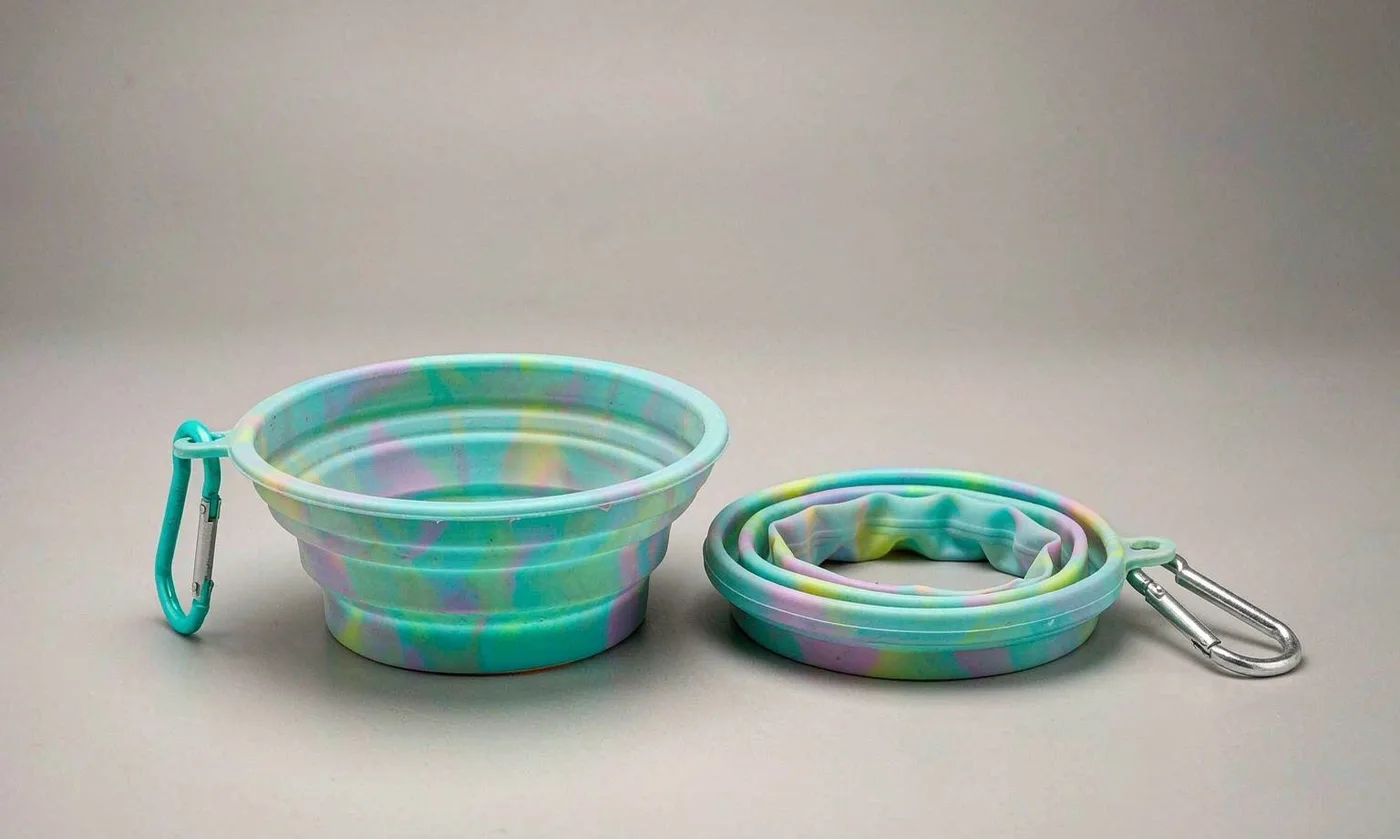
A collapsible bowl is a thin-wall vessel that has to invert its own geometry several thousand times without cracking, and the entire design problem sits in the relationship between collapsed height, wall section and rim stiffness. A bowl that folds from an open height of 70-90 mm down to 18-28 mm delivers a 4:1 to 5:1 packing ratio and disappears into a front pocket. A bowl that opens to 90 mm but only folds to 45 mm is not a collapsible product at all; it is a shallow dish with a claim printed on the hangtag.
The mechanism is a set of concentric concertina rings, and three variables govern it: ring count, ring pitch and ring wall thickness. Three rings give the lowest packed height and the sharpest fold line, but they concentrate strain at a small radius and crack earliest. Five rings spread the strain and fold smoothly, at the cost of a taller stack and more material. For a 500 ml bowl, four rings at a 12-15 mm pitch with a 1.4 mm nominal wall is the working default that our production team starts from.
Wall section is the variable that fails first in sampling. Below 1.2 mm the ring inverts under its own filled weight and the bowl folds shut while the animal is drinking. Above 1.8 mm the wall will not hold a fold and springs back 8-15 mm, which means it no longer fits the pocket it was designed for. The usable window is narrow, and it widens slightly with higher durometer material.
| Capacity (ml) | Open height (mm) | Collapsed height (mm) | Ratio | Ring count | Wall (mm) | Weight (g) |
|---|---|---|---|---|---|---|
| 350 | 62-70 | 16-20 | 3.9:1 | 3 | 1.2-1.4 | 62-78 |
| 500 | 72-82 | 18-24 | 4.2:1 | 4 | 1.3-1.5 | 88-105 |
| 750 | 82-92 | 22-28 | 3.8:1 | 4 | 1.5-1.7 | 126-148 |
| 1,000 | 90-102 | 26-34 | 3.4:1 | 5 | 1.6-1.8 | 168-195 |
| 1,500 | 104-118 | 32-42 | 3.1:1 | 5 | 1.8-2.1 | 232-268 |
Rim stability is the second half of the geometry problem and it is usually ignored until the first sample. An open rim carries the hoop load of the water inside; if the rim section is the same thickness as the wall, the bowl ovalises when lifted one-handed and spills. A rolled rim of 2.5-3.5 mm diameter, or a flat rim with a 4-6 mm flange, gives enough second moment of area to hold shape at full capacity.
The base is the third geometry decision. A bowl with a base narrower than 55% of the rim diameter tips under a 250 g lateral nudge from a muzzle. For travel use the base-to-rim ratio should sit at 0.62-0.72, and the base should carry a 0.4-0.6 mm recessed pad so it does not rock on a moulded seam.
A 500 ml bowl with four rings at 13 mm pitch and a 1.4 mm wall folds to 20 mm, holds shape one-handed at full capacity, and survives 5,000 collapse cycles in validation.
Material Selection: Silicone, TPE and Coated Fabric
Three material families compete for this part, and the choice is a trade between fold memory, food-contact paperwork and unit cost. Platinum-cured silicone is the default for anything above a mid retail price point; peroxide-cured silicone is cheaper but carries a peroxide by-product odour that fails sensory panels. Thermoplastic elastomer over-moulded on a polypropylene ring is the mid option. Silicone-coated polyester fabric is the low-cost option and the weakest on fold life.
Durometer decides fold behaviour more than chemistry does. At 40 Shore A the bowl folds easily but the rim collapses under water load. At 70 Shore A the bowl holds shape but the fold requires 12-18 N of force and springs back. The practical window for a collapsible bowl is 50-60 Shore A, and within that band lower durometer suits smaller capacities.
Food-contact status is not optional and it is not inherited from the material supplier's general certificate. The finished moulded part, in its final pigment and with its final cure schedule, has to be tested. For the US market the relevant framework sits under CPSC oversight for articles intended for children and under FDA food-contact substance rules for the polymer itself; for the EU, framework regulation and REACH restrictions are administered through ECHA. Silicone intended for repeated food contact should additionally be checked against LFGB sensory and migration criteria if the destination is Germany or Austria.
| Material | Durometer (Shore A) | Fold cycles | Food contact | Unit cost (USD) | Tool cost (USD) | Suits |
|---|---|---|---|---|---|---|
| Platinum-cured silicone | 50-60 | 8,000-15,000 | FDA / LFGB | 1.60-3.40 | 2,400-4,800 | Premium, gift sets |
| Peroxide-cured silicone | 50-65 | 5,000-9,000 | FDA, weak sensory | 1.10-2.10 | 2,200-4,200 | Volume retail |
| TPE over PP ring | 55-70 | 3,000-6,000 | FDA, EU 10/2011 | 0.85-1.70 | 3,100-6,200 | Mid tier, rigid rim |
| Silicone-coated polyester | n/a fabric | 1,500-3,000 | Coating only | 0.55-1.20 | 850-1,600 | Promotional |
Pigment is the hidden risk in silicone. A supplier can hold a food-contact certificate for natural or white compound and still supply a pigmented masterbatch that pushes extractables over the limit. The specification has to name the pigment system and require migration testing on the pigmented, post-cured part, not on the base polymer.
Post-cure is the other process control that matters. A silicone part that is moulded and shipped without a 2-4 hour post-cure at 180-200 degrees carries volatiles that show as surface bloom and as a failed sensory test three weeks later. Post-cure adds 0.06-0.14 USD per unit and removes the single most common cause of a rejected food-contact batch.
Platinum-cured silicone at 55 Shore A with a named pigment system and a 3-hour post-cure is the only combination that reliably clears both fold life and EU migration testing.
Tooling: Cavities, Gate Position and Flash Control
A collapsible bowl is compression or injection moulded, and the tool decides the scrap rate more than the operator does. Compression moulding in solid silicone gives the best fold memory because there is no weld line; injection moulding of liquid silicone rubber gives tighter tolerances and lower labour but introduces a knit line where the two flow fronts meet.
Where that knit line lands is a design instruction, not an accident. If it lands at a fold ring, the ring cracks at 1,500-2,500 cycles. The gate should be positioned so the knit line falls in the base pad or in the upper rim, both of which are low-strain areas. On a four-ring bowl that means a single centre gate in the base or a ring gate at the rim.
Flash is the cosmetic defect that dominates inspection on this part. Silicone flashes at 0.02-0.05 mm, and on a fold ring that flash becomes a visible ridge that catches dirt. Tool fit has to be held so that flash is trimmed to under 0.1 mm at the ring, and the trimming method matters: cryogenic deflashing gives the cleanest ring line, hand trimming gives a 4-9% cosmetic reject rate.
Cavity count sets the piece price. A four-cavity compression tool on a 500 ml bowl gives 1,100-1,600 pieces per shift; a sixteen-cavity LSR tool gives 6,000-9,000. Against a 500-piece colourway, a four-cavity tool finishes a run in under one shift, which means the tooling decision is about future volume rather than the first order.
Tool steel choice follows the same logic. For a first programme at 500-2,000 units, a pre-hardened steel tool at 2,400-4,800 USD is correct and will run 30,000-60,000 shots. For a programme expected to exceed 20,000 units a year, hardened tool steel at 1.8-2.4 times the price runs 300,000-500,000 shots and the amortisation is lower after the first year.
Put the knit line in the base pad, not the fold ring: the same tool and the same compound move from 2,000 cycles to 8,000 purely on gate position.
Cycle Fatigue: Validating 5,000 Fold Repetitions
Fold life is the claim that separates a real collapsible bowl from a moulded dish, and it is the test most often skipped. A bowl that survives 500 folds in a showroom will crack at the ring root at 2,000-4,000 folds in the field, which is roughly six to eighteen months of daily use.
The test itself is simple and needs a fixture rather than a laboratory: clamp the base, compress the rim to 10% over the collapsed height, release, repeat on a 3-5 second cycle. Inspection intervals are set at 500, 1,000, 2,500, 5,000 and 10,000 cycles. The failure criterion is a crack longer than 3 mm at the ring root, or a permanent set greater than 8% of the open height.
Test method discipline matters because the number is meaningless without it. Standardised conditioning and tensile procedures are published by ASTM International, and a production specification should cite the conditioning period and the temperature, because silicone tested at 23 degrees and silicone tested at 5 degrees give different results. A bowl used outdoors in winter folds at low temperature, so validation should include a cold branch at 0-5 degrees.
| Compound | Wall (mm) | Cycles to 3 mm crack | Permanent set at 5,000 | Cold branch (5 degrees) | Verdict |
|---|---|---|---|---|---|
| Platinum silicone, 50 A | 1.3 | 11,400 | 3.1% | Pass at 8,200 | Exceeds spec |
| Platinum silicone, 55 A | 1.4 | 9,600 | 3.6% | Pass at 7,400 | Pass |
| Platinum silicone, 60 A | 1.6 | 7,900 | 4.4% | Pass at 5,900 | Pass |
| Peroxide silicone, 55 A | 1.4 | 6,200 | 5.8% | Fail at 3,100 | Marginal |
| TPE over PP, 60 A | 1.5 | 4,100 | 7.2% | Fail at 2,300 | Fail for daily use |
| Silicone-coated fabric | 0.5 coating | 2,300 | 11.4% | Fail at 1,200 | Fail |
Sampling for the test should be drawn across cavities, not from one cavity. On a four-cavity tool, take four parts per cavity per interval, because a cavity with a slightly different vent depth will produce a systematically weaker ring and will not be caught by testing one cavity.
The correlation worth recording is between fold life and wall thickness within one compound. Going from 1.3 mm to 1.6 mm in the same 55 A platinum material drops cycle life by roughly 18%, because a thicker wall puts more strain at the fold radius. Designers asking for a thicker wall for durability are doing the opposite of what the data says.
Validate to 5,000 cycles across all cavities with a cold branch: platinum silicone passes, peroxide silicone is marginal, and coated fabric fails at 2,300.
Seal Performance: Lid Fit, Compression Set and Fluid Retention
Most travel bowls ship with a lid, and the lid is where returns originate. A snap lid on a silicone bowl seals by interference between the lid skirt and the rim flange, and that interference is a live dimension: silicone takes a compression set, and the lid that sealed at 0.25 bar on day one may seal at 0.08 bar after four months.
Compression set is measurable and should be specified. A platinum silicone gasket at 55 Shore A held at 25% compression for 22 hours at 70 degrees should recover to a set of 8-15%. Above 20% the lid will visibly loosen within a season. The number belongs in the material specification, not in the hope that the compound is good enough.
The seal test that matches real use is an inverted hold plus a pressure hold. Fill the bowl to 70% capacity, fit the lid, invert for 30 minutes, and record mass loss; acceptance is under 1.0 g. Then pressurise the sealed bowl to 0.2 bar and hold for five minutes under water; acceptance is no continuous bubble stream. A lid that passes the inversion test and fails the pressure test will leak in an aircraft cabin, where pressure differential is real.
Lid material is usually polypropylene or Tritan, and it does not need to be silicone. What matters is the skirt geometry: a skirt depth of 6-9 mm with a 0.3-0.5 mm interference gives a seal that survives 3,000-5,000 open-close cycles. A shallower skirt seals well on the first fit and loses half its interference after 500 cycles.
Venting is the detail that makes the difference between a lid that is easy to remove and one that fights the user. A sealed lid on a warm bowl creates a partial vacuum; a 1.2-1.8 mm vent hole or a lift tab that breaks the seal before the skirt disengages removes the problem entirely and costs nothing.
A 7 mm skirt at 0.4 mm interference, a compression set under 15%, and a vented lift tab give a lid that passes 0.2 bar after four months of use.
Attachment to the Carrier: D-Ring, Tab and Pocket Geometry
A bowl that is not attached to the carrier is a bowl that is left on the kitchen counter, so the interface between bowl and bag is a design decision with a measurable outcome. Three methods are in production use: a moulded loop through a D-ring, a webbing tab captured in a bar-tack, and a dedicated slip pocket sized to the collapsed height.
The moulded loop is the cheapest and the weakest. A silicone loop of 4 mm section carries a static load of 1.0-1.4 kg before tear propagation starts at the loop root, which is fine for carrying an empty bowl and marginal for a bowl with 500 ml of water hanging off a strap. If the loop method is used, the root radius should be at least 2.5 mm and the loop should be moulded, not cut.
The webbing tab is the strongest and the standard for anything sold as a travel system. A 20 mm polyester webbing tab bar-tacked over 25 mm of surface carries 45-90 kg of static load, which is far beyond what the bowl will ever see, so the failure moves to the bag side of the interface — which is where it should be, because the bag is replaceable and the bowl is not.
| Method | Static load (kg) | Cycles to failure | Added cost (USD) | Detachable | Best application |
|---|---|---|---|---|---|
| Moulded silicone loop | 1.0-1.4 | 1,200-2,600 | 0.00-0.08 | Yes | Empty bowl on a strap |
| Moulded loop plus carabiner | 3.5-6.0 | 2,400-4,800 | 0.18-0.55 | Yes | Full bowl, external carry |
| 20 mm webbing tab, bar-tacked | 45-90 | 18,000-35,000 | 0.10-0.22 | No | Integrated pocket systems |
| Dedicated slip pocket | n/a | n/a | 0.35-0.90 | Yes | Collapsed bowl storage |
| Magnetic dock on panel | 0.4-0.9 | 600-1,400 | 0.65-1.35 | Yes | Premium gift sets |
Pocket geometry is the other half of the interface, and it is where most programmes fail because the pocket is designed before the bowl is specified. A slip pocket for a collapsed bowl needs an internal clearance of 3-5 mm over the collapsed height and a mouth at least 8 mm wider than the collapsed diameter. Design the pocket in the same drawing revision as the bowl, not afterwards.
Placement on the bag matters more than the method. A bowl hung on a shoulder strap swings and hits the wearer's hip at walking cadence; a bowl on the side panel or the base panel does not. The recommended position is a side panel webbing ladder 120-200 mm above the base, which keeps the bowl out of the swing arc.
A 20 mm bar-tacked webbing tab on a side panel ladder keeps a full bowl out of the wearer's swing arc and moves the failure point to the replaceable bag.
Compliance: Migration, Heavy Metals and Labelling
A bowl is a food-contact article and an animal product, and it carries a documentation burden that a fabric accessory does not. Three document sets are required for a clean import into the US and EU: a food-contact declaration for the polymer and pigment, a restricted-substance test report covering heavy metals and, where applicable, phthalates, and a labelled country of origin and material identification.
Migration testing is performed on the finished article with a food simulant, at a defined temperature and contact time. For a bowl used with water and dry food at ambient temperature, the relevant simulants are distilled water and 3% acetic acid, tested at 40 degrees for 10 days or by an accelerated schedule agreed with the laboratory. Overall migration limits are expressed per surface area, which is why a small bowl is easier to pass than a large one.
Heavy metals and restricted substances are tested under CPSIA in the US and under REACH Annex XVII in the EU. The EU chemical inventory and restriction list is maintained by ECHA, and the US consumer product framework is administered by the CPSC. Both require a test report from an accredited laboratory on the actual production batch, not a supplier generic certificate.
Platinum-cured silicone passes all three sets comfortably. Peroxide-cured silicone can fail on volatile organic content. TPE over polypropylene can fail on plasticiser content if the TPE is a soft grade blended with process oil, which is common at the low end of the market. Coated fabric almost always fails on the coating if the coating is a cheap solvent-based system.
Labelling is the final piece. A food-contact article sold in the EU needs a material identification and, where a symbol is used, the glass-and-fork mark. A bowl sold in the US with a capacity claim needs the capacity marked in both metric and US customary units. These are artwork items, and artwork items are free to get right and expensive to fix after a container ships.
Require a batch-level migration report and a batch-level restricted-substance report on the finished, pigmented, post-cured article; a supplier certificate on the base polymer is not evidence.
Kitting Strategy: MOQ, Mix Rules and Gift Set Composition
The commercial problem with a small moulded accessory is that 500 pieces of one colourway is a very small production run, and freight and setup dominate the landed cost. The solution used across the accessory line is mixed colourway within one order, and it works because the tooling is shared.
The rule is straightforward: MOQ 500 pieces per colourway applies when the colourway requires a material change and a machine purge, because the purge generates 3-8 kg of scrap and 40-70 minutes of downtime. When the colourways share a base compound and differ only in pigment added at the press, the minimum drops to 200 pieces per colourway against a 500-piece order total. That single rule is what makes a four-colour gift set viable at 800 units.
| Structure | Minimum total | Per colourway | Unit price index | Setup cost (USD) | Suits |
|---|---|---|---|---|---|
| Single colourway | 500 | 500 | 1.00 | 0 | First order, market test |
| Two colourways, same base | 600 | 300 | 1.06 | 45-90 | Core range |
| Four colourways, same base | 800 | 200 | 1.14 | 120-210 | Gift set, seasonal |
| Custom Pantone match | 1,000 | 1,000 | 1.28 | 180-320 | Brand programme |
| Existing tool, reorder | 300 | 300 | 0.94 | 0 | Replenishment |
A gift set is the highest-margin structure in this category because it solves the attachment problem commercially rather than mechanically. A bowl, a dispenser and a small pouch packed as one set gives the buyer a reason to accept a higher price point, and it lets three small moulded programmes share one carton and one freight cost. Sets are assembled at pack-out, which means each component can be inspected separately and the set inherits the highest AQL result of its parts.
Packaging for a set needs its own specification. A folded carton with a die-cut window holds a collapsed bowl at 20 mm without crushing it; a vacuum-formed tray holds three components in fixed positions and survives a 1.0 m drop test. The tray costs 0.22-0.48 USD more per set and removes the scuffing claim that dominates returns on gift items.
Spare parts deserve a line of their own on the purchase order. Lids are the component that goes missing, and a lid reorder at 300 pieces against an existing tool costs far less than a lid re-tool. Ordering 8-12% lid overage on the first run and holding it as spare stock is the cheapest service programme available in this category. See also spare component planning for how this is structured across the accessory range.
A four-colour gift set at 800 units total and 200 per colourway is the structure that makes a small moulded accessory economically viable on the first order.
Production capability
- SGS-verified production space of 4,950 m², 149 machines, 7 assembly lines
- Pet carrier and pet bag output since 2014 from a 137-person team
- 200,000 units shipped monthly under BSCI and ISO 9001 systems
People Also Ask
What is a good collapse ratio for a pet travel bowl?
A collapse ratio of 4:1 to 5:1 is the practical target, meaning a bowl that opens to 72-90 mm should fold to 18-24 mm. Below 3.5:1 the folded bowl is too tall to disappear into a carrier pocket; above 5:1 the wall has to be under 1.2 mm and will invert when filled.
How many fold cycles should a collapsible bowl survive?
Specify 5,000 full collapse cycles with no crack longer than 3 mm at the ring root and permanent set under 8% of open height. Platinum-cured silicone at 55 Shore A reaches 9,000-11,000 cycles; silicone-coated fabric fails at roughly 2,300.
Is silicone or TPE better for a collapsible pet bowl?
Platinum-cured silicone is better on every performance axis: 8,000-15,000 fold cycles against 3,000-6,000 for TPE, and it clears EU migration testing more easily. TPE is 35-45% cheaper and gives a rigid rim when over-moulded, which suits a mid-tier bowl that will not be folded daily.
What wall thickness prevents a collapsible bowl from collapsing in use?
1.3-1.6 mm in a 50-60 Shore A compound. Below 1.2 mm the ring inverts under the weight of the water; above 1.8 mm the wall springs back 8-15 mm and no longer fits the pocket. Within the usable band, a thinner wall gives longer fold life, not shorter.
Can a travel bowl go in the dishwasher?
Platinum-cured silicone is dishwasher safe on the top rack up to 70 degrees for 500-800 cycles. A printed logo will not survive that: specify a moulded or debossed mark if the bowl is marketed as dishwasher safe, since a heat-transfer print fails at 20-40 cycles.
How much weight can a silicone hanging loop carry?
A moulded 4 mm silicone loop carries 1.0-1.4 kg static before tear propagation starts at the root, which suits an empty bowl. For a full bowl, either add a carabiner rated to 3.5-6.0 kg or move to a 20 mm bar-tacked webbing tab rated to 45-90 kg.
Frequently Asked Questions
What is the MOQ for a custom collapsible travel bowl?
MOQ is 500 pieces per colourway when the colourway needs a material change and machine purge. When colourways share a base compound and differ only in press-side pigment, the minimum is 200 per colourway against a 500-piece order total, which is how multi-colour gift sets are built.
How long does sampling take for a new bowl design?
Prototypes are produced in 6-10 working days from a signed drawing, using a single-cavity sample tool or a soft tool. That sample is used for fold-cycle validation and fit checks against the carrier pocket before the production tool is cut.
What is the bulk production lead time?
Bulk production runs 35-50 days after sample approval. Tooling is cut in parallel with sample approval where the schedule is tight, which removes 12-18 days but commits the programme to the geometry before validation is complete.
Which inspection standard applies to the finished shipment?
Final random inspection is to AQL 2.5 on major defects and AQL 4.0 on minor defects, with a separate functional check on seal performance at a 20-piece sample drawn per 500 units.
Do you charge for a new mould?
Yes. A pre-hardened steel compression tool for a 500 ml bowl costs 2,400-4,800 USD and runs 30,000-60,000 shots. The tool is owned by the brand once paid, and it is retained for reorders at a 300-piece minimum.
Can the bowl be produced in a custom Pantone colour?
Yes, at 1,000 pieces for a custom match. The match adds 180-320 USD of setup and 2-4 days for a lab dip approval. Standard colourways from the existing pigment library have no match charge and no added lead time.
What food-contact documentation is supplied?
Each shipment carries a batch-level food-contact declaration on the finished pigmented article, plus a restricted-substance test report covering heavy metals and phthalates from an accredited laboratory. Migration testing is quoted separately and is recommended once per pigment system.
Will a printed logo survive folding and washing?
A heat-transfer print lasts 20-40 wash cycles and will craze at the fold rings within 300-600 folds. For a bowl marketed on durability, use a moulded debossed mark or a pad print inside the base pad, where strain is lowest.
What sizes are available without new tooling?
350 ml, 500 ml, 750 ml and 1,000 ml exist as standard geometries with sample tools available. Using a standard geometry removes tooling cost entirely and cuts sampling to 4-6 working days, because only the colour and the mark are new.
How is the bowl packed for shipment?
Standard packing is one polybag per unit, 60-120 units per export carton depending on capacity, with a carton drop test to 1.0 m. Gift sets are packed in a folded carton with a die-cut window or a vacuum-formed tray at 0.22-0.48 USD additional per set.
What causes a collapsible bowl to crack at the rings?
Two causes dominate: a knit line or weld line landing in the fold ring, and a wall thickness above 1.8 mm in a high-durometer compound. Moving the gate so the knit line falls in the base pad typically doubles cycle life with no change to the material.
Can the bowl be attached to an existing carrier design?
Yes, three ways. A dedicated slip pocket needs 3-5 mm clearance over the collapsed height and is the cleanest solution. A 20 mm webbing ladder on a side panel accepts a carabiner. A bar-tacked webbing tab is added at 0.10-0.22 USD per bag.
What payment and shipping terms apply?
T/T 30/70, FOB Xiamen, with a full document set per shipment. Tooling is invoiced 100% in advance and is transferable. Air freight on a 500-piece bowl run adds 4-9 USD per kg and is rarely economic above 300 units.
Is a lid included, and can it be reordered separately?
A snap lid in polypropylene or Tritan is quoted as a separate line item at 0.28-0.75 USD. Lids are the most frequently lost component, so 8-12% overage is recommended on the first run, and reorders against an existing tool start at 300 pieces.
Talk to QUANZHOU JUNYUAN BAGS about a pet carrier program: MOQ 500 pieces per colourway, samples in 6-10 working days, bulk production in 35-50 days under AQL 2.5 inspection.
Get a free quote Request a sample