Pet Carrier Wheels: Replacement and Upgrade
Replacement wheels are specified by diameter, bore, tread material, durometer and load rating. A 50 mm, 78 Shore A polyurethane wheel on a 6 mm axle carries 25 kg and survives about 20 km of rolling; TPR at 85A runs quieter and wears 30% faster. Match bore to axle exactly.
Wheels are the most replaced mechanical part on a wheeled carrier and the most satisfying to specify, because the parameters are measurable and the field result is immediate. This page covers the wheel as a component: how tread material, diameter, durometer and bearing type combine into rolling resistance, noise and service life, why the two dominant failure modes come from completely different causes, and what the correct axle and bore tolerance is for a replacement to fit without modification. It sets out the load and heat behaviour that governs how small a wheel can be, the noise and floor-damage question that decides durometer in the field rather than in the laboratory, and three distinct upgrade paths — larger diameter, softer tread, sealed bearing. Supply covers fitting kits, MOQ and inspection. Programme terms: MOQ 500 pieces per colourway, prototypes in 6-10 working days, bulk production 35-50 days after sample approval, final random inspection to AQL 2.5, T/T 30/70 and FOB Xiamen.
Most pet carrier accessory buyers choose between pet carrier OEM and pet carrier ODM on one question: who owns the pattern and the tooling once the programme is approved.
Wheel Failure: Tread, Bearing and Axle
Wheels fail in three ways and each has a distinct signature, which matters because the replacement differs. Diagnosing correctly is the difference between shipping a wheel and shipping a wheel kit.
Tread failure is the visible one. The tread wears through to the core, tears in chunks, or develops a flat spot. Wear-through is a material and load question; chunking is usually a bond failure between tread and core, which is a manufacturing defect rather than wear; and flat-spotting is a storage behaviour, not a use behaviour — a wheel left under load in a hot container for weeks takes a permanent flat that no amount of rolling removes.
Bearing failure presents as a wheel that stops turning freely or that starts to squeal. In a plain-bore wheel the bore itself wears oval, and the symptom is a wheel that wobbles visibly on its axle. In a ball-bearing wheel the usual cause is contamination: pet hair and grit work past the shield, the grease dries, and the bearing seizes. Seizure appears early in service life and is therefore the failure most likely to be reported as a defect rather than as wear, and it is the one that a sealed bearing prevents almost entirely.
Axle failure is the least common and the most consequential, because a sheared axle drops the carrier. It happens where the axle is undersized for the bending moment, where the wheel is mounted outboard of its support with a long overhang, or where the axle is a rivet rather than a bolt and has worked loose. The design rule is that the wheel should sit as close to its support as the geometry allows, and that a bolted axle on a loaded platform is preferable to a riveted one because it can be inspected and retightened.
Two of the three are prevented at specification and one is prevented at storage. Flat-spotting in particular is worth calling out to anyone holding wheeled inventory: store the carrier unloaded, off its wheels, and the problem disappears.
Wheel Materials: Polyurethane, TPR, Rubber and EVA
Four tread materials appear on carrier wheels, and they are not variations of each other — they have genuinely different behaviour on load, on noise and on wear.
Polyurethane is the default for a load-bearing wheel. It is cast or injection-moulded onto a polypropylene or polyamide core, it takes a high load for its size, and it has the best abrasion resistance of the four. Durometer range in service is 70-95 Shore A, with 78-85A being the working band for a carrier. Below 75A it grips well and wears faster; above 90A it rolls easily and transmits every crack in the pavement into the carrier.
Thermoplastic rubber is cheaper, softer in feel and noticeably quieter. It absorbs high-frequency vibration better than polyurethane, which is why it is the right material for a wheel that runs on hard indoor floors. It wears roughly 30% faster than a comparable polyurethane tread and it has a lower load rating per unit size, so a TPR wheel is usually specified a size larger for the same duty.
Solid rubber is the quietest and the grippiest and the heaviest. It appears on premium platforms and it has one specific advantage: it does not flat-spot as readily as the thermoplastics, because its recovery at room temperature is better. Its disadvantage is mass and cost.
EVA foam wheels are light, very quiet and cheap, and they are the correct choice only for low loads and smooth floors. An EVA wheel carries less than half the load of a polyurethane wheel of the same diameter, it wears fast on abrasive surfaces, and it takes a permanent flat under storage load more readily than anything else in the list.
The core matters as much as the tread. A polypropylene core is cheap and adequate; a polyamide core is stiffer and holds a pressed bearing more securely; a glass-filled core is used where the wheel is small and the load high. The tread-to-core bond is the failure point that produces chunking, and it is verified by a pull-off test on the moulded assembly rather than by a wear test.
| Tread | Durometer | Load per 50 mm wheel | Rolling resistance | Noise on hard floor | Abrasion volume loss | Relative cost |
|---|---|---|---|---|---|---|
| Polyurethane | 78A | 25 kg | Medium | 62 dB | 55 mm³ | 1.0 |
| Polyurethane | 88A | 30 kg | Low | 68 dB | 38 mm³ | 1.0 |
| Thermoplastic rubber | 85A | 18 kg | High | 56 dB | 78 mm³ | 0.8 |
| Solid rubber | 70A | 22 kg | High | 52 dB | 90 mm³ | 2.1 |
| EVA foam | 55A | 11 kg | Medium | 48 dB | 210 mm³ | 0.5 |
Abrasion volume loss is measured by the rotating-drum abrasion method published by the ISO standards for rubber and thermoplastic materials, and lower is better. The spread from 38 to 210 mm³ is a factor of five in service life, which is the whole economic argument for polyurethane on a loaded platform.
Diameter, Durometer and Rolling Resistance
Diameter and durometer are the two parameters a specifier actually chooses, and they do different jobs.
Diameter governs obstacle crossing and rolling effort. A larger wheel rolls over a crack, a cable or a kerb instead of into it, and the effort saved is substantial: rolling resistance falls roughly in inverse proportion to diameter, so moving from 50 mm to 75 mm reduces the force needed at the handle by close to a third on a rough surface. The penalty is bulk and a higher centre of gravity, which is why a wheeled carrier rarely exceeds 75 mm and why small platforms stay at 40-50 mm.
Rolling resistance is measured as the force required to maintain a steady speed on a defined surface at a defined load. The test used in the programme runs a loaded carrier on a drum at 4 km/h with 15 kg applied and records the tangential force; a well-specified 50 mm polyurethane wheel returns 6-9 N, and a poorly specified one with a worn plain bore returns 18 N or more, which the customer experiences as "this thing is heavy".
Durometer governs grip, noise and wear. A soft tread deforms around surface texture and grips, but it has more hysteresis and therefore more rolling resistance and more heat. A hard tread rolls easily, transmits vibration and wears slowly. For a carrier used indoors on smooth floors, 78-82A is the quiet and grippy choice; for one used outdoors on pavement, 85-90A rolls better and lasts longer.
The interaction is where specification errors come from. A small, soft wheel combines the worst of both: high rolling resistance and high wear. A large, hard wheel on a smooth floor is noisy and skids. The balanced combinations are a 50 mm wheel at 78-82A for indoor use and a 60-75 mm wheel at 85-90A for outdoor use.
Durometer is measured by the indentation method published by ASTM for rubber and plastic hardness, and a tread quoted without a durometer figure is a tread that cannot be compared with anything.
Bearings, Axles and Fitting Geometry
Most wheel replacements fail to fit for one of three dimensional reasons, and all three are avoidable if the specification is written down.
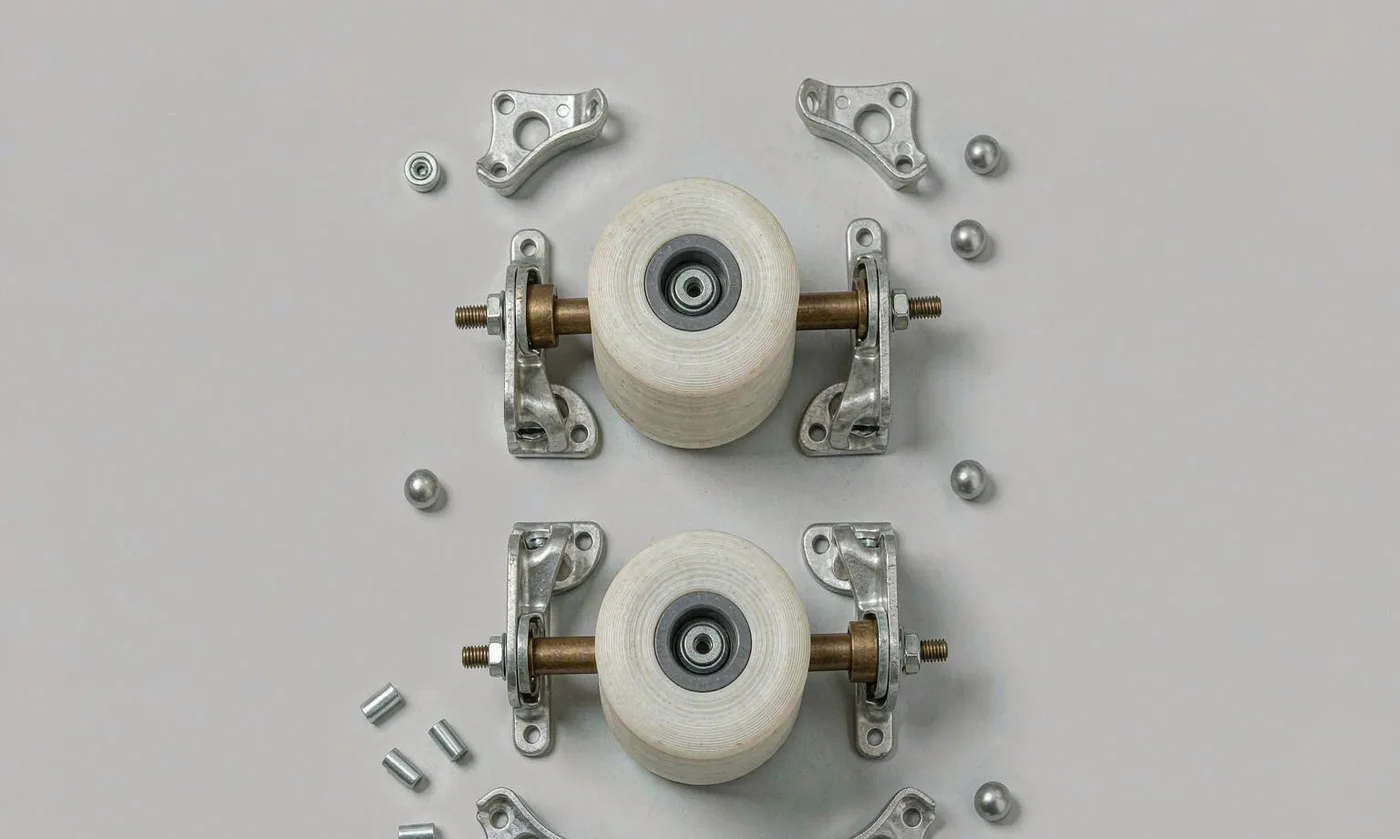
Bore. The bore is the hole through the wheel, and the two standards are a plain bore sized to the axle or a bearing recess sized to a 608-series ball bearing, which is 8 mm bore, 22 mm outside diameter and 7 mm wide. A replacement must match the bore exactly: a plain-bore wheel will not accept a bearing wheel and the reverse is worse. Bore tolerance is H8 on the axle diameter, which for a 6 mm axle means a hole between 6.000 and 6.018 mm. A bore cut at 6.05 mm produces a wheel that rattles on its axle within weeks.
Axle. Carrier axles are 6 mm or 8 mm. 6 mm suits wheels to 50 mm and loads to about 25 kg; 8 mm is used above that, and where the wheel is mounted with a long overhang. The axle material matters as much as the diameter: a mild steel axle rusts inside the bore and seizes, which is why stainless or zinc-plated with a sealer is specified for any carrier that will see rain.
Width and offset. Wheel width is 18-25 mm and the hub offset — how far the wheel centre sits from the mounting face — decides whether the wheel fouls the carrier body. A replacement with a different offset can fit its axle perfectly and still rub, which is the commonest "wrong part" return in the category and the reason a fitting kit should include a spacer set.
Retention. Four methods are used: an E-clip in a groove, a nut on a threaded axle, a push-on cap, and a rivet. The first two are serviceable and the third and fourth are not. A replacement programme should standardise on the E-clip or the nut, because a wheel that cannot be removed without destroying its fastener turns a five-minute repair into a workshop job.
Bearing type. A plain bore is a polymer-on-metal bearing: cheap, quiet, tolerant of dirt, and it wears. A shielded ball bearing rolls better and wears far less, but once contaminated it fails completely. For a carrier that will be rolled through grit and hair, a sealed 2RS bearing is the correct specification and it costs a few cents more than a shielded ZZ one.
Load Rating, Speed and Heat Build-Up
Load rating on a small wheel is not simply a static figure, because a polymer wheel generates heat as it rolls and the heat limits the duty.
Static rating is the load a wheel carries without permanent deformation, and for a 50 mm polyurethane wheel at 78A it is 25 kg. The rating is per wheel, and a four-wheel platform is never rated at four times the figure because load distribution is never even — a carrier tipped onto two wheels puts the full dynamic load on each. The design figure used is 1.5 times the rated animal mass divided by two wheels, not by four.
Hysteresis and heat. Every time the tread deforms at the contact patch and recovers, some energy is lost as heat. The loss is larger for a soft tread, for a small wheel, and at higher speed. At walking pace on a small wheel the heat is negligible; rolled quickly across an airport terminal, a 50 mm wheel at 78A can build enough internal heat to soften the tread, and a softened tread wears several times faster and can debond from the core.
The practical limit is therefore stated as a speed as well as a load: a 50 mm polyurethane wheel is rated to 4 km/h continuous, and above that the specification should move to a larger diameter or a harder durometer, both of which reduce the deformation per revolution.
Dynamic amplification. A wheel hitting an obstacle sees a load spike several times the static figure. Dropping a loaded carrier off a kerb can put 4-6 times the static load through one wheel for a few milliseconds, which is what cracks a core rather than wears a tread. Cores are therefore specified for impact as well as for load, and a polyamide core is chosen over polypropylene on any platform rated above 12 kg.
Noise and Floor Damage
Two field complaints dominate wheel feedback and neither of them appears in a strength test: the carrier is noisy, and it marks the floor.
Noise comes from three sources. Tread slap is the impact of the tread on the surface and it is controlled by durometer and by tread pattern — a soft, smoothly radiused tread is quiet. Bearing noise is a squeal or a grind and it is controlled by the bearing and by its lubrication. Structure-borne noise is the carrier shell resonating and it is controlled by the mount rather than by the wheel: a wheel bolted hard to a thin base panel turns the whole panel into a speaker, and a resilient mount or an EVA isolator between the mount and the panel removes it.
Measured at one metre on a hard floor at 4 km/h, the spread across materials is roughly 48 to 68 dB. That is a large difference in perceived quality for a component that costs less than a dollar, which is why noise is worth specifying on a premium platform.
Floor marking is caused by a tread that migrates plasticiser or that is simply too soft to resist abrasion on a hard surface, leaving a dark line. Polyurethane marks less than thermoplastic rubber and far less than solid rubber; EVA marks least of all but wears fastest. Where a carrier is sold for indoor use on light floors, a non-marking compound is specified, which is a formulation choice rather than a durometer choice and has to be requested explicitly.
Tread pattern sits between noise and grip and is usually chosen last. A smooth tread is quietest and picks up the least grit, but it skids on a wet surface; a ribbed or siped tread drains water and grips, at a cost of two to four decibels and of trapping small stones in the grooves. For a carrier used in a wet climate, a shallow siped tread at 82A is the balanced choice, and the sipes should be shallow enough that they do not close and trap grit on a dry surface.
Contact pressure is the other half of floor damage. A narrow, hard, heavily loaded wheel concentrates pressure and will dent a soft floor or damage a timber one. Widening the tread from 18 mm to 25 mm reduces contact pressure by roughly a quarter for the same load, which is cheaper than softening the compound and does not cost wear life.
Upgrade Paths: Larger, Softer or Sealed
Three upgrades exist and they solve different complaints. Selling the right one requires asking what the customer is actually unhappy about.
Larger diameter is the answer to "it is hard to pull" and to "it catches on everything". Moving from 50 mm to 75 mm cuts rolling effort by about a third on rough ground and lets the wheel climb instead of stop. The constraints are the mount geometry and the resulting height change: a 25 mm diameter increase raises the platform by 12.5 mm, which usually requires a longer or repositioned mount and can affect the stability of the standing carrier. Where the mount cannot move, a 60 mm wheel is a partial improvement and usually fits without modification.
Softer tread is the answer to noise and to vibration. Dropping from 88A to 78A on polyurethane, or moving to thermoplastic rubber, cuts measured noise by 6-12 dB and noticeably reduces the buzz transmitted into the carrier. The cost is wear: TPR wears about 30% faster, so the upgrade is best sold as a comfort option on a carrier used indoors rather than as a general replacement.
Sealed bearing is the answer to "the wheel stopped turning" and it is the upgrade with the best ratio of benefit to cost. A sealed 2RS bearing resists the hair and grit that kill a shielded bearing, and on a carrier used outdoors it typically triples the interval before a wheel needs attention. The constraint is that the wheel must be built for a bearing recess — a sealed bearing cannot be retrofitted to a plain-bore wheel without a machined adapter, which is why the bearing decision belongs to the original platform design.
Combining two of the three is normal: a 60 mm polyurethane wheel at 80A with a sealed bearing is the standard premium upgrade and it addresses effort, noise and service life in one part.
Replacement Wheel Supply: Fitting Kits, MOQ and Inspection
Wheels are supplied as complete assemblies — tread, core, bearing and sometimes axle — and the commercial design question is what goes in the bag beside the wheel.
Fitting kit. A bare wheel is the cheapest option and generates the most "wrong part" returns. A fitting kit containing two wheels, two axles, four washers, two E-clips and a spacer set costs roughly 0.40 USD more per pack and removes most of the fitting errors, because the axle and the spacers are the parts that actually differ between platforms. Kits are the recommended format for any retail or after-sales channel.
MOQ. 500 pieces per colourway, interpreted per specification — diameter, durometer and bore. A range offering 50 mm and 60 mm in the same black meets the commitment together. Sampling takes 6-10 working days and bulk production 35-50 days after approval; a wheel with a non-standard bearing recess runs to the upper end.
Inspection. AQL 2.5 applies. Wheel-specific defect definitions: a bore outside H8 is critical, a visible tread-to-core separation is critical, a durometer deviation beyond 5 points is major, and a cosmetic flash line under 0.3 mm is minor. Rolling resistance is verified on three wheels per lot on a drum at 4 km/h under 15 kg, with an acceptance ceiling of 10 N, and abrasion is verified on one wheel per lot by the drum method with a maximum volume loss of 90 mm³ for polyurethane.
Packing and storage. Wheels ship in a carton that does not compress them, and inventory is stored unloaded — a carton of wheels stacked five high under other stock for a season will flat-spot the bottom layer. That one instruction protects more wheel inventory than any other measure. Our production team sources wheel assemblies from qualified component partners and inspects them at the SGS-verified production base, on T/T 30/70 and FOB Xiamen terms.
Production capability
- SGS-verified production space of 4,950 m², 149 machines, 7 assembly lines
- Pet carrier and pet bag output since 2014 from a 137-person team
- 200,000 units shipped monthly under BSCI and ISO 9001 systems
People Also Ask
What size wheels does a pet carrier need?
50 mm for indoor and small platforms, 60-75 mm for outdoor use or above 12 kg. Rolling resistance falls roughly with diameter, so going from 50 to 75 mm cuts the pull force by about a third on rough ground.
What is the best wheel material for a pet carrier?
Polyurethane at 78-88 Shore A for loaded platforms; it carries 25-30 kg per 50 mm wheel and loses only 38-55 mm³ in abrasion testing. Thermoplastic rubber is quieter but wears about 30% faster and carries less.
How do I know what replacement wheel will fit?
Match four things: diameter, bore (plain or 608 bearing recess), axle diameter at 6 or 8 mm, and hub offset. A wheel with the wrong offset fits the axle perfectly and still rubs the body.
Why did my carrier wheel stop turning?
Usually bearing contamination from hair and grit, or a plain bore worn oval. A sealed 2RS bearing typically triples the interval before attention is needed, but it must be built into the wheel rather than retrofitted.
Can I put bigger wheels on my carrier?
Often yes, if the mount and the height change allow it. A 25 mm diameter increase lifts the platform 12.5 mm, which usually needs a longer mount and can affect standing stability.
Why does my wheeled carrier make so much noise?
Tread slap from a hard tread, bearing squeal, or the shell resonating because the mount is bolted hard to a thin panel. A softer tread cuts 6-12 dB; a resilient mount fixes structure-borne noise.
How much weight can a carrier wheel carry?
25 kg static for a 50 mm polyurethane wheel at 78A, but design on 1.5 times the animal mass across two wheels rather than four, because a tipped carrier puts the whole dynamic load on two.
Frequently Asked Questions
What is the minimum order for replacement wheels?
MOQ 500 pieces per specification, meaning diameter, durometer and bore. Offering 50 mm and 60 mm in the same black meets the commitment once for both sizes.
How long does wheel sampling take?
6-10 working days, and bulk production 35-50 days after approval. A wheel built for a non-standard bearing recess normally runs to the upper end of the window.
What bore tolerance is used?
H8 on the axle diameter, so a 6 mm axle takes a bore between 6.000 and 6.018 mm. A bore cut at 6.05 mm produces a wheel that rattles within weeks.
Should I use a plain bore or a ball bearing?
A plain bore is cheap, quiet and tolerant of dirt but it wears oval. A shielded bearing rolls better but fails completely once contaminated. For outdoor use a sealed 2RS bearing is the correct specification.
What causes a wheel to develop a flat spot?
Storage under load, especially warm storage. A wheel left supporting a loaded carrier in a hot container takes a permanent flat that rolling will not remove. Store inventory unloaded and off its wheels.
How fast can a small wheel run?
A 50 mm polyurethane wheel is rated to about 4 km/h continuous. Above that, internal heat from tread hysteresis softens the tread, accelerates wear and can debond it from the core.
Why does a wheel chunk rather than wear?
Because the tread-to-core bond failed. It is a manufacturing defect rather than wear, and it is verified by a pull-off test on the moulded assembly rather than by an abrasion test.
How is rolling resistance measured?
By running a loaded carrier on a drum at 4 km/h with 15 kg applied and recording tangential force. A well-specified 50 mm polyurethane wheel returns 6-9 N; above 18 N the carrier feels heavy to pull.
What durometer should I choose?
78-82 Shore A for indoor use on smooth floors, 85-90A for outdoor use on pavement. Durometer is measured by the ASTM indentation method and should always appear on the specification.
Do wheels mark indoor floors?
Thermoplastic rubber and solid rubber can leave a dark line; polyurethane marks less and EVA least, but EVA wears fastest. A non-marking compound is a formulation choice and has to be requested explicitly.
What should a fitting kit contain?
Two wheels, two axles, four washers, two E-clips and a spacer set. It costs about 0.40 USD more than bare wheels and removes most fitting errors, because axle and spacers are what differ between platforms.
How are wheel lots inspected?
To AQL 2.5, with a bore outside H8 and visible tread-to-core separation classified as critical, a durometer deviation beyond 5 points as major. Rolling resistance is checked on three wheels and abrasion on one per lot.
Talk to QUANZHOU JUNYUAN BAGS about a pet carrier program: MOQ 500 pieces per colourway, samples in 6-10 working days, bulk production in 35-50 days under AQL 2.5 inspection.
Get a free quote Request a sample