Dog Carrier Backpack Design Trends 2026: A Manufacturing View
The economics of wholesale pet carriers move with carton cubage, so dog carrier backpack programmes are quoted both by unit price and by filled container.
Semi-Rigid Shells Replace Soft-Sided Sag
The clearest structural change for 2026 is the move from a fully soft shell to a semi-rigid one. A carrier that collapses when set down looks cheap on a shelf photograph and, more importantly, reduces the internal volume available to the animal. The engineering answer is a formed panel: 3-5 mm EVA sheet laminated to the lining, or an injection-moulded PP frame captured in a fabric sleeve.
Formed panels change the assembly sequence. The panel must be cut to a pattern that matches the shell geometry within 1-2 mm, and the seam allowance has to absorb the panel thickness without pleating. Our production team specifies a 5 mm radius on all formed corners, because a square corner on a laminated panel telegraphs through the face fabric within a few hundred units of handling.
- EVA sheet at 3 mm holds shape at low weight and costs less than moulded PP at 500 units
- Injection-moulded PP frames suit volumes above roughly 3,000 units per tooling set
- Corner radii under 5 mm telegraph through laminated face fabric
- Panel thickness must be added to the seam allowance, not absorbed by it
- Compression set is checked after 72 hours at elevated temperature before approval
The trade-off is packability. A semi-rigid shell does not fold flat, so the foldable sub-category keeps a soft construction and accepts the shape penalty. Brand owners choosing between the two should decide from the retail format: hanging display favours the formed panel, flat-pack e-commerce favours the soft shell.
Our production team requests a collapse test on the first article, measuring internal height before and after a 5 kg top load applied for 24 hours. A retention above 85 percent of nominal height is the working threshold we quote against.
Weight is the second consequence of forming. A 3 mm EVA panel adds 120-180 g depending on coverage area, which matters on a carrier already specified near a weight target. Our production team reports formed-panel weight separately from shell weight so the brand can see the trade before approving the sample rather than discovering it on the specification sheet after bulk fabric has been booked.
Ventilation Sized by Open Area, Not Panel Count
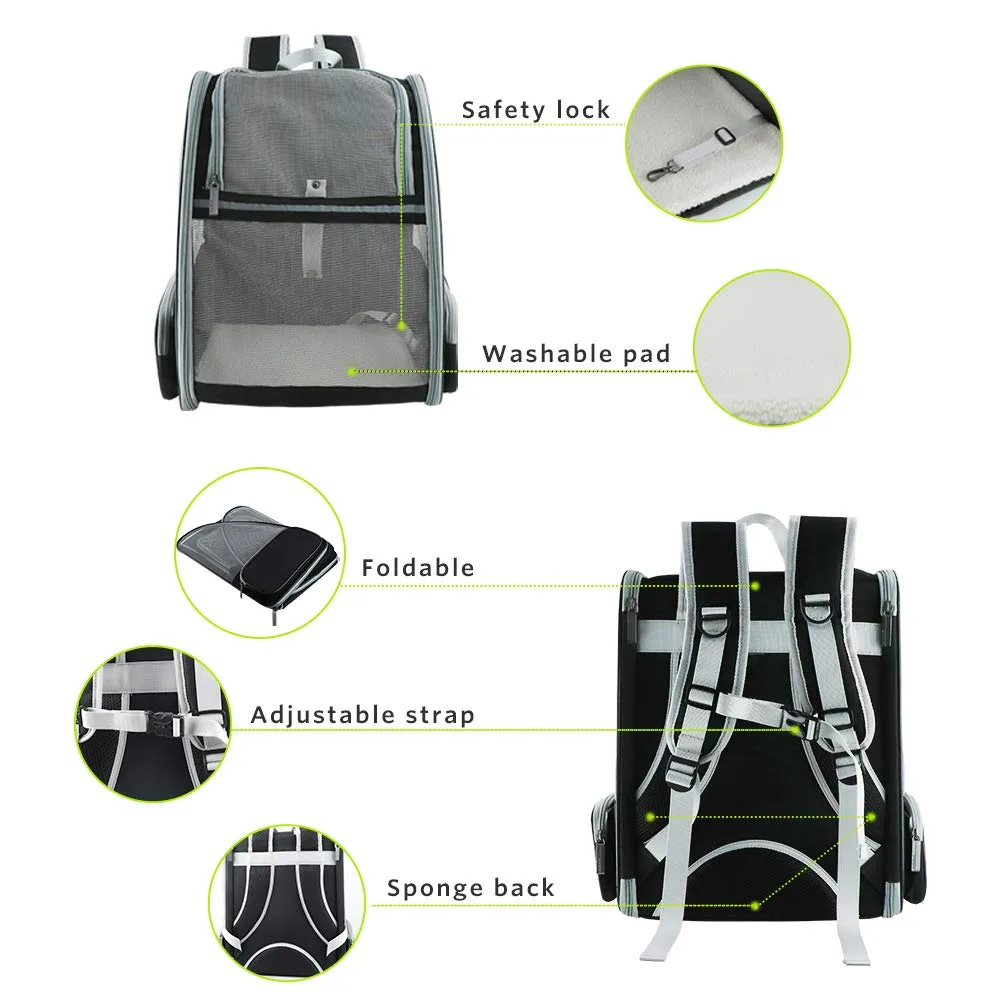
Ventilation claims in this category are usually decorative. The measurable parameter is open area: the percentage of the shell surface that actually passes air. A design with four mesh panels can have less open area than one with two, because the backing fabric, binding tape and logo patch all block flow. The 2026 specifications being written by serious brands state a target, typically 18-28 percent open area on the combined side and front surfaces.
Mesh selection follows the target. A monofilament polyester knit at 1.2 mm aperture gives high open area with poor snag resistance; a tricot knit at 0.6 mm gives the reverse. Airflow and claw resistance pull in opposite directions, so the engineering decision is where each mesh type is placed rather than which one wins overall.
- State open area as a percentage on the tech pack rather than counting panels
- Large-aperture mesh belongs on upper panels away from claw contact
- Fine tricot mesh belongs on lower and front panels where scratching occurs
- Binding tape and logo patches reduce effective open area by 3-6 percent
- A 25 mm unmeshed border is needed for seam strength around every opening
Measurement is simple and worth doing. Photograph the panel against a light source and compute the lit fraction, or weigh a cut sample against a solid control of the same yarn. Our production team records the measured figure on the sample report so a later cost-down on mesh does not quietly reduce airflow.
Airflow testing itself is standardised through organisations such as ASTM, and textile chemical safety is commonly verified against OEKO-TEX criteria. Both are referenced on the sample report when a brand sells into regulated channels.
Placement also governs noise and sightlines. A mesh panel positioned at the animal s eye line reduces the stress behaviour that generates returns, while one placed low on the shell mostly moves air across the floor of the compartment. Our production team marks mesh zones on the pattern rather than leaving placement to the line, because a panel shifted 30 mm during assembly changes both the airflow path and the visual balance of the finished unit.
Recycled rPET Moves Into Mainstream Specifications
Recycled polyester has moved from a marketing line to a default specification request. The engineering question is whether the recycled yarn meets the same mechanical numbers as virgin yarn at the same denier, and the honest answer is that it comes close but not identical. Tensile strength typically runs 5-10 percent lower for post-consumer feedstock, and shade consistency between lots is harder to hold.
The practical response is to specify one denier higher, or to accept a slightly heavier coating to compensate. A 600D virgin specification translated to recycled is often written as 600D rPET with a marginally higher PU coating weight, which restores abrasion performance without changing the pattern.
- Post-consumer rPET runs roughly 5-10 percent lower on tensile than virgin at equal denier
- Lot-to-lot shade variation is wider, so colour tolerance must be set at approval
- Chain-of-custody documentation is required if the claim appears on packaging
- Coating weight can be raised slightly to recover abrasion performance
- Recycled content claims should match the documented percentage, not the aspiration
Documentation is the part that trips programs. A recycled claim on a hangtag needs a transaction certificate tying the fabric lot to the recycled feedstock, and that certificate has to be requested at fabric purchase, not at shipment. Our production team flags the requirement in the bill of materials so the mill books the certificate with the order.
Cost premium for rPET has narrowed to a modest per-metre delta at 500-unit volume. The bigger risk is availability: recycled yarn lots are smaller, so a repeat order in the same shade may need a fresh dye lot and a fresh approval sample.
Our production team handles that by booking the full season requirement against a single dye lot wherever storage allows. Where a brand cannot commit to the volume, the fallback is to approve a shade tolerance band rather than a single reference, so a second lot can be accepted without re-sampling. Both approaches cost less than a mid-season re-approval, which typically consumes the equivalent of a full sampling window. Where neither is possible, our production team recommends holding a buffer stock of the approved fabric at the material stage rather than at finished-goods stage, since fabric storage is cheaper per unit and protects against a lot being unavailable at the repeat order.
High-Frequency Welding on Load Paths
High-frequency welding is replacing stitching on two classes of seam: those that must be waterproof, and those that carry load into a rigid panel. The process uses a radio-frequency field to melt a thermoplastic coating between two plies, producing a bond with no needle holes. Dwell time, electrode pressure and power setting are the three parameters that define bond strength.
Welding only works on materials with a suitable thermoplastic content. PU-coated polyester welds well; PVC welds very well; uncoated nylon does not weld at all. Where the design calls for a welded seam on a mixed-material assembly, the weldable ply has to be brought to the interface, which usually means adding a TPU film strip.
- Dwell time typically runs 2-5 seconds depending on coating weight and ply count
- Electrode geometry must match the seam, so each seam profile needs its own tooling
- Peel strength is verified on the sample, not assumed from the machine setting
- Uncoated nylon and cotton canvas cannot be welded without an added film
- Welded seams cannot be repaired on the line; a failed weld scraps the panel
The failure mode is distinctive. A well-made weld fails by tearing the fabric beside the bond; a weak weld peels apart at the interface. Our production team peel-tests five samples per setup at the start of a run and again after any material lot change, and the results are filed with the inspection record.
From a program-planning view, welding adds a tooling line and a setup time per seam profile. At 500-piece volume the amortised cost is visible but manageable; the main constraint is that welded construction removes the option of a quick line repair, so first-pass yield must be high.
Welding also changes the aesthetic of the seam itself. A welded joint is flat and slightly glossy, while a sewn seam shows a stitch line and a thread colour. Brands moving to welded construction often keep one or two sewn seams deliberately, because a fully welded carrier can read as a technical product rather than a pet product. Our production team samples both finishes side by side so the decision is made on a physical unit.
Hardware Shifts: Magnetic Closures and Cam Buckles
Plastic side-release buckles dominated the category for a decade and are now being displaced on premium programs by two alternatives: magnetic closures on accessory pockets, and aluminium or zinc cam buckles on load-bearing straps. Both are heavier and more expensive, and both are specified because they read as durable to the buyer.
The engineering constraint is different for each. A magnetic closure has no mechanical engagement, so it resists only the force the magnet produces; it suits a pocket flap but never a strap that carries load. A cam buckle carries high load but requires the webbing to be threaded correctly and to have a controlled thickness.
- Magnetic closures suit low-load flaps and pockets, never load-bearing straps
- Cam buckles need webbing thickness held within about 0.2 mm to grip consistently
- Zinc alloy cam hardware is plated, which adds a coating test line to compliance
- Plastic side-release buckles remain the lightest option at 8-12 g per unit
- Hardware cycle testing is run to 5,000 open-close cycles on premium programs
Weight matters more than it appears. Replacing four plastic buckles with metal cams adds 60-90 g to a carrier, which is a meaningful fraction of a 900 g base weight. Our production team reports the delta at sample stage and lets the brand decide whether the perceived quality gain justifies it.
Cycle testing is the gate for this decision. A buckle that survives 5,000 cycles on the bench will generally survive the service life of the carrier, while one that fails at 2,000 will generate warranty claims. The test is cheap relative to the hardware cost difference.
Corrosion is the second gate for metal hardware, particularly on carriers sold into coastal or humid markets. A salt-spray check on plated parts exposes plating thickness problems that a visual inspection will miss, and the failure appears in the field as surface pitting within a season. Our production team specifies plating thickness numerically rather than by appearance for exactly this reason.
Colour Systems Built on Solution-Dyed Yarn
Solution dyeing, where pigment is added to the polymer before extrusion rather than applied in a dye bath, is gaining share for two measurable reasons: colourfastness to light and water consumption in production. A solution-dyed polyester typically grades one to two points higher on light fastness than a piece-dyed equivalent in the same shade family.
The constraint is palette. Solution-dyed yarn is economical in high-volume shades, and a custom shade carries a minimum production run at the yarn stage that can exceed the fabric requirement for a 500-piece program. The practical path is to build the range on available solution-dyed shades and use piece dye only for accent panels.
- Solution-dyed yarn grades roughly one to two points higher on light fastness
- Custom solution-dyed shades carry yarn-stage minimums above most carrier programs
- Accent panels and linings can stay piece-dyed without affecting the fastness claim
- Rubbing fastness is checked on both wet and dry scales at sample approval
- Shade tolerance must be agreed numerically, not by eye, before bulk dyeing
Fastness testing is where the claim is proved. Light fastness, washing fastness and rubbing fastness are graded on standard scales, and a brand selling into outdoor channels should specify minimums at the tech-pack stage rather than accepting a mill default.
Our production team holds a shade reference card per approved colourway, signed at sample approval and retained at the production base. Bulk lots are compared under standardised lighting before cutting, which prevents the most common dispute in this category: a shade that is technically within tolerance but visibly different from the sample.
Lighting conditions are part of the specification. A shade matched under showroom lighting can shift noticeably under daylight or under warehouse fluorescent light, which is why the standardised viewing condition has to be named on the approval sheet. Our production team records the light source used at approval alongside the signed reference card so a later dispute can be settled under the same conditions.
What Each Trend Costs in Tooling and Lead Time
Trends are not equal in their effect on a program budget. Cosmetic trends such as a new print or a colourway change cost nothing beyond artwork and a screen. Structural trends such as a formed panel, a welded seam profile or a custom buckle require tooling, and tooling requires both money and calendar time before a sample can be produced.
The rule of thumb our production team applies is that tooling adds roughly two to three weeks to the sampling window on top of the standard 6-10 working days, and adds a fixed cost that amortises over the program volume. At 500 pieces that fixed cost is a visible per-unit addition; at 5,000 pieces it is negligible.
| Trend | Tooling required | Added sampling time | Cost behaviour at 500 units |
|---|---|---|---|
| New colourway or print | Screen or transfer artwork only | 0 days | Negligible per-unit impact |
| 3 mm EVA formed panel | Cutting die and forming jig | 7-10 days | Low fixed cost, amortises quickly |
| Injection-moulded frame | Production mould | 21-30 days | High fixed cost, needs volume |
| HF welded seam profile | Electrode per seam shape | 7-14 days | Moderate, scales with seam count |
| Custom metal cam buckle | Die-casting mould | 21-30 days | High fixed cost plus hardware price |
| rPET shell fabric | None, but lot approval needed | 3-5 days | Small per-metre premium |
Planning consequence: a program that combines an injection-moulded frame with a custom buckle can add five weeks before the first sample exists. Our production team sequences tooling in parallel with fabric booking so that the bulk window of 35-50 days starts as soon as the sample is approved rather than waiting for a second tooling cycle.
The alternative is a staged program: launch on stock tooling with a cosmetic differentiation, then move to owned tooling once the volume justifies it. That path keeps the first season inside the standard schedule and still builds toward a differentiated product.
Tooling ownership should be settled in the same conversation. A mould paid for by the brand can be moved between production partners; one paid for by the supplier generally cannot. Our production team states ownership, expected mould life in cycles and storage responsibility on the quotation, because those three items determine whether a second-season re-order is genuinely portable.
How to Write a 2026 Specification That Survives Cost-Down
The failure mode for trend-led design is the cost-down meeting. A feature specified qualitatively, such as good ventilation or a rigid shape, is the first thing removed when the landed cost target tightens, because nobody wrote down what it meant. A feature specified numerically survives, because removing it requires an explicit decision.
Our production team therefore writes every trend as a parameter with a tolerance: open area percentage, panel thickness in millimetres, mesh aperture in millimetres, coating weight in grams per square metre, hardware cycle count, colourfastness grade. The tech pack then has a specification section that can be costed line by line.
- Every trend feature gets a numeric parameter and a tolerance on the tech pack
- Parameters are verified on the pre-production sample and recorded
- Any later reduction is logged as a specification change with a new cost
- Cosmetic features are separated from structural ones in the quotation
- Approved samples are retained as the physical reference for the bulk run
The discipline pays off at repeat order. A program with a numeric specification can be re-quoted, re-sourced or re-run without a redesign, because the requirement exists in writing rather than in a photograph of the previous sample.
Our production team issues the specification sheet with the quotation rather than after it, so the brand sees exactly which parameters drive the price. That single document prevents most of the disputes that arise when a second season is quoted against a first season built on verbal agreements.
The last element is a revision rule. Every numeric parameter needs a stated tolerance and a stated consequence when a later change moves outside it, whether that is a re-test, a re-quote or a re-sample. Our production team writes that rule into the specification sheet so both sides know what a change costs before it is requested rather than negotiating it after the bulk run has started.
Order and quality terms
- MOQ 500 pieces per colourway; samples in 6-10 working days
- Bulk production 35-50 days after approval; AQL 2.5 inspection standard
- T/T 30/70 terms, FOB Xiamen, full document set per shipment
People Also Ask
What is the biggest structural change in 2026 carrier design?
The shift from fully soft shells to semi-rigid construction using 3-5 mm EVA or moulded PP frames. It improves shelf appearance and preserves internal volume under load, at the cost of fold-flat packability.
How should ventilation be specified?
As open area percentage of the shell surface rather than panel count. Typical targets run 18-28 percent on combined side and front surfaces, measured with binding and patches included.
Does recycled rPET perform the same as virgin polyester?
Close but not identical. Tensile strength typically runs 5-10 percent lower for post-consumer feedstock, so brands either specify one denier higher or raise coating weight to recover abrasion performance.
When does high-frequency welding make sense?
On waterproof seams and on load paths into rigid panels. It requires thermoplastic coating content and a dedicated electrode per seam profile, and it cannot be repaired on the line.
Are metal cam buckles worth the added weight?
They add 60-90 g across four buckles and improve perceived durability. The decision should be gated on 5,000-cycle hardware testing and on whether the weight penalty affects the target market.
Which 2026 trends require new tooling?
Formed panels, welded seam profiles and custom hardware. Each adds roughly two to three weeks to the sampling window and a fixed cost that amortises over program volume.
Frequently Asked Questions
How much open area is enough for a carrier shell?
Targets in current specifications run 18-28 percent on combined side and front surfaces. Measure including binding tape and logo coverage, because both reduce effective airflow.
What thickness of EVA panel is standard?
3 mm is the common default for shape retention at acceptable weight; 5 mm appears on larger carriers. Above 5 mm the panel begins to dominate the packable volume.
Can a semi-rigid carrier still fold flat?
No. Formed panels resist folding by design. Brands needing flat-pack shipping should stay with soft construction and accept reduced shape retention.
How is welded seam quality verified?
By peel testing. A sound weld tears the fabric beside the bond; a weak one peels at the interface. Five samples per setup is the working minimum, repeated after material lot changes.
Which materials cannot be high-frequency welded?
Uncoated nylon and cotton canvas lack thermoplastic content. A TPU film strip can be introduced at the interface to make the joint weldable.
What is the lead-time impact of a custom buckle?
Die-casting tooling typically adds 21-30 days before a sample exists. Plan it in parallel with fabric booking to protect the bulk schedule.
Does rPET require extra documentation?
Yes. A recycled content claim on packaging needs a transaction certificate tying the fabric lot to the feedstock, requested at fabric purchase rather than at shipment.
Why do solution-dyed shades have minimums?
Pigment is added at extrusion, so a custom shade carries a yarn-stage production minimum that often exceeds the fabric quantity for a 500-piece program.
How is colourfastness graded?
On standard scales for light, washing and rubbing fastness. Outdoor-channel programs should state minimum grades in the tech pack instead of accepting mill defaults.
What happens to trend features during cost-down?
Qualitatively specified features are removed first. Writing each trend as a numeric parameter with tolerance forces an explicit decision and protects the design intent.
Is injection moulding viable at 500 units?
Rarely. Moulded frames become economical above roughly 3,000 units per tooling set; below that, formed EVA sheet gives similar shape at lower fixed cost.
How is shape retention measured on a sample?
Internal height is recorded before and after a 5 kg top load applied for 24 hours. Retention above 85 percent of nominal height is the working threshold.
Talk to QUANZHOU JUNYUAN BAGS about a pet carrier program: MOQ 500 pieces per colourway, samples in 6-10 working days, bulk production in 35-50 days under AQL 2.5 inspection.
Get a free quote Request a sample