Cat Carrier for Kittens: Safe and Cozy
A kitten carrier should measure 300-380 mm in interior length for a 0.9-2.8 kg animal, with mesh apertures no wider than 6 mm across the flats, floor deflection under 8 mm at a 25 N point load, and a lining delivering 0.35-0.55 clo of thermal resistance. Closures need a positive lock because a ten-week kitten passes any gap its 48-58 mm head fits through.
This page specifies a kitten carrier as a small-animal containment product rather than a scaled-down adult one, because the two problems are different. A kitten is not simply a small cat: its surface-area-to-mass ratio is roughly 1.6 times an adult's, its head passes apertures an adult cannot use, its claws are sharper per unit of force, and it soils four to eight times a day. Each of those produces a separate engineering requirement, and they pull against each other — thermal insulation wants a closed shell while escape containment wants strong mesh, and a removable floor pad wants a seam while liquid containment wants a weld. The resolution is in the material and geometry choices below rather than in a compromise specification. Commercial terms follow the standard programme: MOQ 500 pieces per colourway, prototypes in 6-10 working days, bulk production 35-50 days after sample approval, final random inspection to AQL 2.5, T/T 30/70 and FOB Xiamen.
Pet carrier OEM and ODM work on cat carrier platforms splits at the pattern - OEM builds to your drawing, ODM adapts an existing platform and removes the tooling cost.
Kitten Anthropometrics: Weight Bands and Interior Dimensions
Sizing a kitten carrier begins with growth, not with the animal in front of you. A carrier bought for an eight-week kitten is used through the fastest growth phase in the animal's life, and a specification written to today's measurements will be too small in six weeks. The practical approach is to specify to a weight band with a defined growth margin and then verify that the smallest animal in the band is still contained.
The four bands used in production are: neonatal 0.1-0.5 kg, which is a veterinary and rescue case rather than a retail one; eight to twelve weeks at 0.9-1.6 kg; three to five months at 1.6-2.8 kg; and five to eight months at 2.8-4.2 kg. Crown-rump length runs 180-260 mm at ten weeks and 260-340 mm at four months; shoulder width 70-100 mm and then 100-140 mm; standing height 140-180 mm rising to 190-250 mm.
Interior dimensions follow from those with a defined allowance. Length is crown-rump plus 100-140 mm so the animal can turn and lie in lateral recumbency; width is shoulder width multiplied by 1.6-2.0; height is standing height plus 40-70 mm so the animal can stand without its back contacting the roof. Applied to the ten-week band that gives roughly 320-400 mm by 150-200 mm by 190-250 mm.
Volume is the figure that gets a small carrier wrong. A single-kitten compartment should be 12-22 litres. Under 12 litres the compartment is too small for adequate air exchange with a warm body inside: measured carbon dioxide in a sealed 10-litre compartment with a 1.2 kg kitten rises from ambient to 1,200-1,800 ppm in twenty minutes, which is the level at which animals become visibly lethargic. Sizing up costs less than the returns it prevents.
| Age band | Weight (kg) | Crown-rump (mm) | Interior L x W x H (mm) | Volume (L) |
|---|---|---|---|---|
| Neonatal to 4 weeks | 0.1-0.5 | 110-170 | 280 x 160 x 170 | 7.6 |
| 8-12 weeks | 0.9-1.6 | 180-260 | 340 x 180 x 210 | 12.9 |
| 3-5 months | 1.6-2.8 | 260-340 | 420 x 220 x 250 | 23.1 |
| 5-8 months | 2.8-4.2 | 340-410 | 480 x 260 x 290 | 36.2 |
| Adult reference | 3.5-6.5 | 410-510 | 540 x 300 x 330 | 53.5 |
Empty weight matters in this category more than it looks. A carrier carried with a 1.2 kg animal should not exceed 1.4 kg empty, which puts the total carried mass under 2.6 kg; beyond that the product stops being a kitten product and becomes a general carrier that happens to be small.
Welfare handling guidance for very young animals is normally cross-checked against published material from the American Veterinary Medical Association, particularly on transport duration and thermal support. A kitten carrier is specified to a growth band with a defined margin, and the minimum volume is set by air exchange rather than by the animal's footprint.
Escape Containment: Aperture Limits and Closure Geometry
Kittens escape through openings an adult cat cannot use, and the limiting dimension is the head rather than the body. A ten-week kitten's head is 48-58 mm wide and 38-46 mm high at the widest point; a kitten can pass any rigid aperture that admits its skull, and it can enlarge a flexible one by pushing. The design rule that follows is a maximum rigid gap of 25 mm anywhere on the shell and a flexible aperture that does not deform past 35 mm under a 30 N push.
Mesh specification is the first place this is decided. A woven mesh with a 2-4 mm aperture is the safe answer and costs 1.20-2.60 USD per carrier; a hexagonal mesh of 6 mm across the flats is acceptable and marginally cheaper; anything above 8 mm across the flats fails the skull template at the young end of the band. Mesh also has to resist claw snagging, which for a kitten is a sharper load than for an adult: specify a grab tear strength of at least 200 N in both directions and run a snag test in which a loaded claw-shaped probe is drawn across the mesh forty times and the aperture is re-measured.
Zipper geometry is the second decision. Use a covered chain: a fabric flap of 20-30 mm over the coil keeps the chain clean and removes the chain gap as an escape route. Slider pull force should sit at 50-80 N so it is deliberate without being difficult, and for the kitten band a double slider with an interlocking nose plus a secondary clip is worth the 0.40-0.90 USD because it removes the single-point failure of one slider walking open.
Corner gussets are the third and most commonly missed. Where a zip run terminates at a corner, the geometry opens a triangular gap under load even with the zip closed; a bound gusset of 20-25 mm with a storm flap closes it. In audit terms this is the most frequent non-conformance found on small carriers, because it is invisible until the closure is loaded.
Verification is a template test rather than a judgement. A rigid elliptical template of 58 mm by 44 mm is applied at every aperture, seam junction and corner at 30 N; no aperture may admit it. Separately, a 50 N outward push is applied at eight points around the shell for sixty seconds and no gap may exceed 25 mm during or after loading.
The closure cycle requirement closes the item: 1,000 open-close cycles with a dimensional check at 250-cycle intervals, and a re-test of the template at the end. Containment for a kitten is a head-template problem, and the corner gusset is the point where most designs fail it.
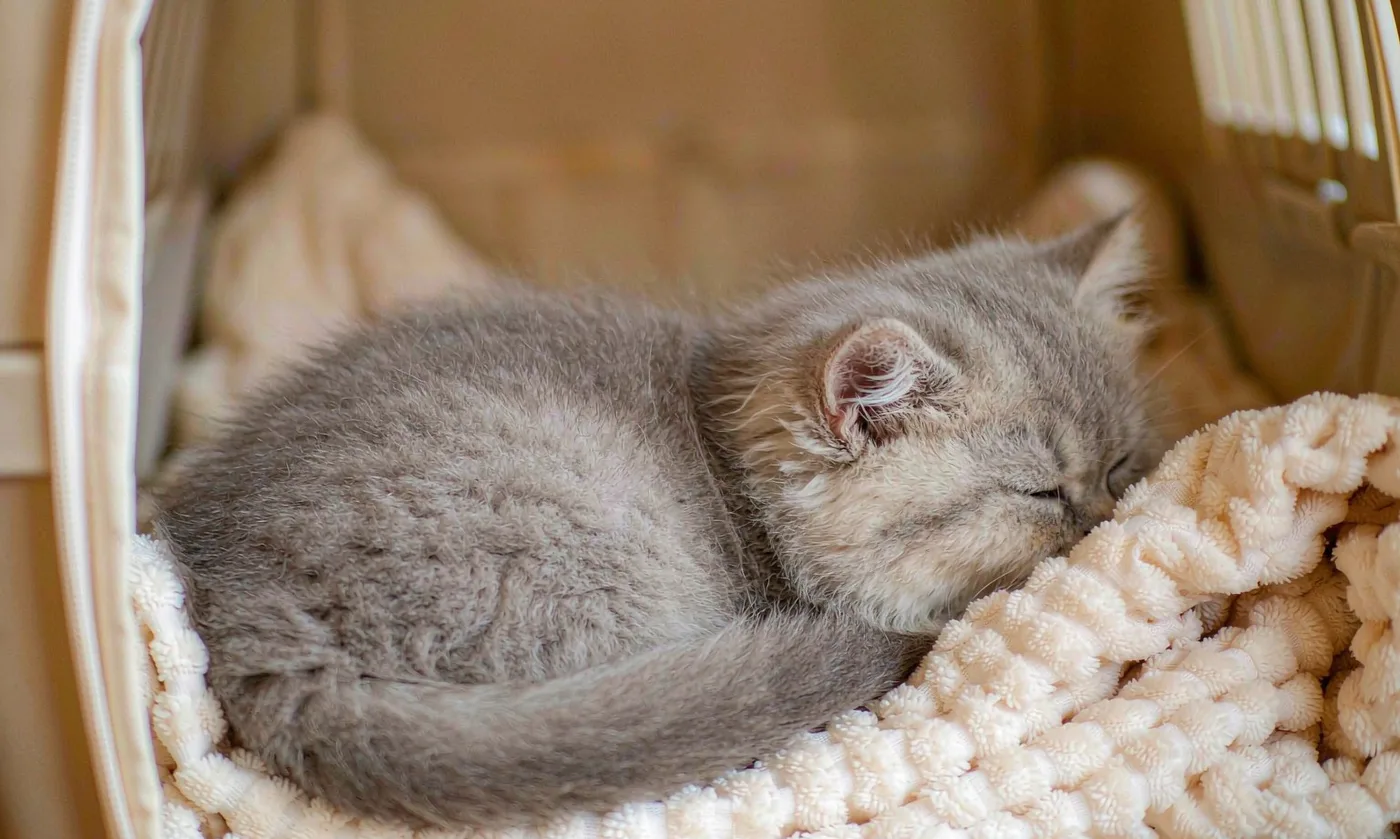
Thermal Regulation: Insulation Values and Draft Control
A kitten loses heat faster than an adult cat because its surface-area-to-mass ratio is around 0.09-0.13 m² per kilogram against 0.06-0.08 for an adult. That single number is why a kitten carrier needs a thermal specification and a summer adult carrier may not. It is also why insulation cannot be achieved by closing the shell, since closing the shell breaks the air exchange requirement set in the sizing section.
Insulation is specified in clo, the textile unit, with a working target of 0.35-0.55 for the floor and lower walls and 0.20-0.35 for the upper walls and roof. In SI terms that is a thermal resistance of roughly 0.055-0.085 m²K/W for the floor assembly. The usual construction is a 6-12 mm needled or lofted wadding at 120-260 g/m² behind a face fabric, or a 4-8 mm closed-cell foam laminate at 45-70 kg/m³ where the floor also has to carry structure.
Draft control is where the thermal and ventilation requirements are reconciled, and the mechanism is baffling rather than closing. An unbaffled aperture directly opposite the animal produces a local air velocity of 0.3-0.8 m/s at the animal's position, which is felt as a draught and drives convective heat loss even when the compartment air temperature is acceptable. A baffled aperture — a mesh panel set behind an offset shell opening, or a fabric lip of 25-40 mm over the panel — reduces local velocity to 0.05-0.15 m/s while preserving most of the exchange area.
A low-emissivity layer is the cheap addition that pays back out of proportion to its cost. An aluminium-metallised film of 12-25 microns, or a reflective print on the inner facing, adds 0.08-0.12 clo of effective insulation by suppressing radiative loss, at 0.20-0.55 USD. It is worth specifying on the floor assembly and the roof, where the temperature difference to the outside is greatest.
The acceptance test is a temperature-hold test rather than an insulation measurement, because the measurement requires equipment most programmes do not have. The compartment is conditioned to 22 °C, a thermal mass representing a 1.2 kg animal at 38 °C is placed inside, the assembly is moved to a 5 °C chamber, and the time to reach 15 °C inside is recorded. Acceptance is no less than forty-five minutes with the standard lining and no less than thirty minutes with the lining removed, which gives a measurable margin for the liner's contribution.
Conditioning and thermal practice follow published standards work at ASTM International. Kitten thermal comfort is bought with loft and a reflective layer, and the aperture that preserves air exchange has to be baffled rather than closed.
Floor Structure: Deflection, Claw Resistance and Slip
The floor of a kitten carrier carries three simultaneous loads: the static weight of the animal, the concentrated point load of a single paw, and the penetration load of claws that are proportionally finer and sharper than an adult's. It also has to be cleanable, which pushes toward a removable assembly, and stiff enough not to sag, which pushes toward a bonded one.
Deflection is specified first. A floor panel spanning 300-400 mm should deflect no more than 8 mm under a 25 N point load applied at mid-span on a 100 mm diameter foot, and it should recover to within 1 mm within sixty seconds of unloading. That is met by a 4-6 mm polypropylene honeycomb panel, a 3-5 mm EVA sheet at 55-75 kg/m³, or a 4 mm corrugated polypropylene panel faced at 500 g/m² — all at 1.10-3.20 USD.
Claw penetration is the second load and the one with no adult equivalent. A kitten's claw tip radius is 0.10-0.25 mm, so the penetration pressure at a modest 10 N of paw force is high; the test is a 1.0 mm radius hardened steel pin at 30 N held for ten seconds, with acceptance of no penetration of the face fabric into the structural layer. A 600D polyester with a polyurethane coating passes; a 420D without coating and most non-woven facings do not.
Abrasion closes the material selection. A kitten kneads and scratches the floor for minutes at a time; the face fabric should be specified at no fewer than 20,000 Martindale cycles to breakdown, with a pilling rating of 4 or better at 7,000 cycles. Below that, the floor looks worn within a season even though it is structurally sound, and in this segment appearance drives returns as much as function does.
Slip is the fourth requirement and it interacts with the pad. The interface between floor panel and removable pad should have a coefficient of friction of at least 0.40 measured by a horizontal pull method, otherwise the pad travels under the animal and bunches at one end. A printed silicone dot pattern on the underside of the pad, at 3-6 mm dots on a 12-18 mm pitch, achieves this at 0.15-0.40 USD and is more durable than a mechanical fastener.
Compression set is the long-term check: the padding layer should recover to at least 90% of its original thickness after twenty-two hours at 25% compression and 23 °C, and at least 85% after the same test at 40 °C, which represents a carrier left in a warm vehicle. A kitten floor is a stiffness and penetration specification, and the claw tip radius is what makes it harder than the adult case.
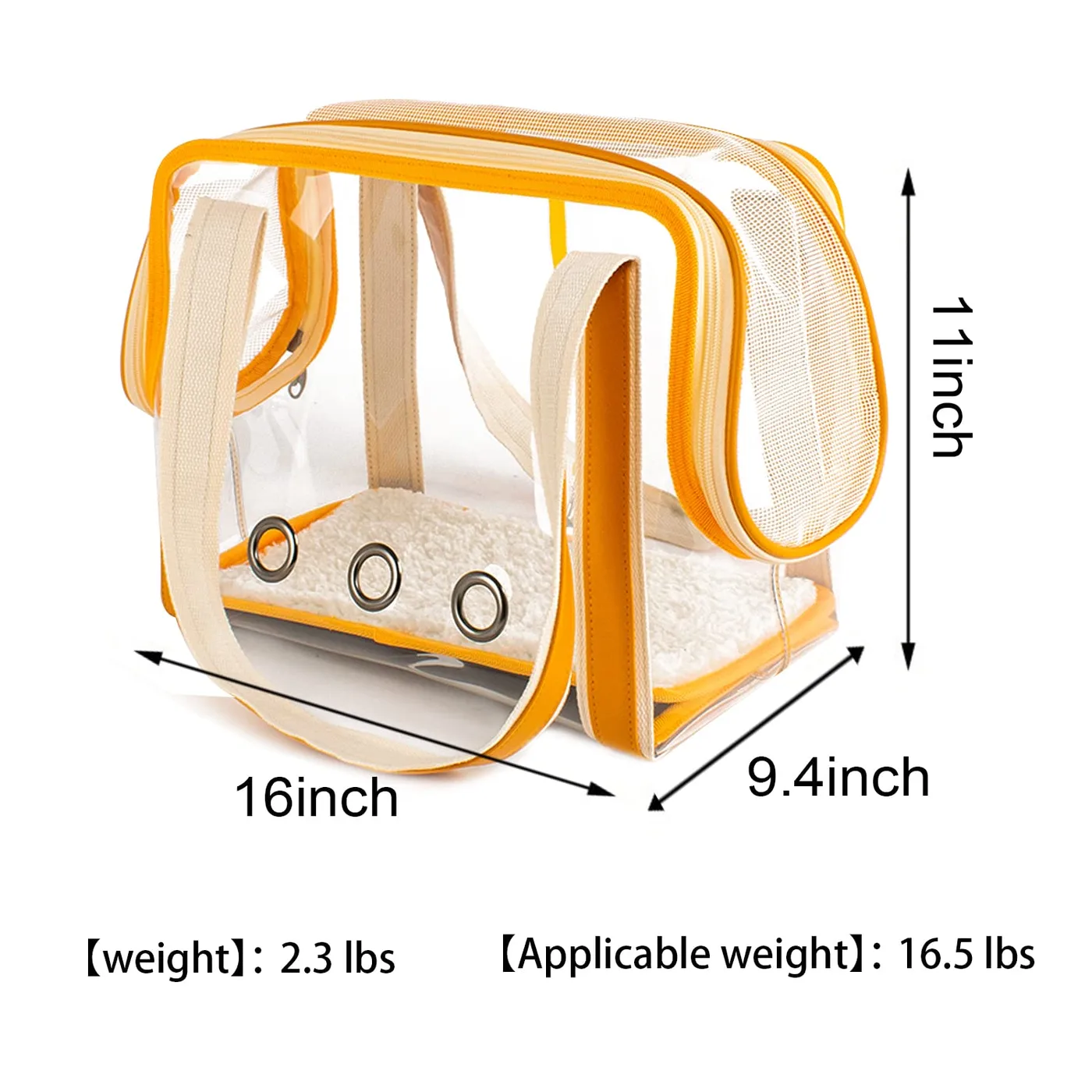
Hygiene: Soiling Frequency, Absorbency and Clean-Down Chemistry
Soiling frequency is the load that most clearly separates a kitten product from an adult one. A kitten urinates four to eight times a day at 10-25 ml per event, compared with two to four times for an adult, and it is far less reliable about where. A kitten carrier is therefore a liquid-management product and should be specified as one.
Absorbency is the first requirement. The floor pad should take up 40-80 ml of saline within sixty seconds with a strike-through time under twenty seconds, and it should hold it under a 15 N load without expressing liquid back to the surface. That is a two-layer construction: a hydrophobic top sheet at 30-60 g/m² for strike-through and a needled or airlaid core of 200-400 g/m² for retention. A single-layer felt pad meets the capacity figure but fails the rewet figure, which is what the animal actually feels.
Containment is the second requirement and it argues for a welded tray. A high-frequency-welded liner with formed corners and a corner radius of 25-40 mm contains liquid, rinses clean and can be emptied; a sewn liner leaks at every stitch line. Where a sewn pad is required for washability, it should sit inside a welded tray so the shell itself never sees liquid.
Chemistry is the third requirement and it is more demanding than it appears. Fresh urine is pH 6.0-7.5, but urea hydrolysis raises it to pH 8.5-9.5 within hours, and that is before any cleaning agent is applied. An interior surface in this category has to tolerate repeated exposure across pH 6-10, which excludes PVC coatings whose plasticiser is extracted at the alkaline end and points to thermoplastic polyurethane at 30-40 g/m² or a polyolefin coating.
Cleaning agent compatibility follows: quaternary ammonium and accelerated hydrogen peroxide disinfectants at label dilution, applied after a surfactant clean, for 300 cycles. Acceptance is no coating cracking or delamination, colour change no worse than grey scale 4, and no loss of the welded seam's integrity measured by a water-hold test of 300 ml.
Chemical screening closes the item. Every textile, coating and adhesive in contact with a young animal is declared against OEKO-TEX criteria, and the thermal lining's binder is declared for residual formaldehyde below 20 mg/kg. A kitten interior is a liquid-handling assembly: welded containment, a two-layer pad, and a coating that survives urea at pH 9.
Acoustic, Visual and Vibration Loads on a Young Animal
Startle response is measurably stronger in kittens than in adult cats, and the three loads that trigger it in a carrier are sound, vibration and visual exposure. None of them is a structural requirement, so none of them appears in a specification written by a structural engineer, and all three affect whether the product is described as cozy enough to use again.
Sound is the first. Kittens show a clear behavioural response to transients above 65 dB(A), and the sources inside a carrier are the zipper chain, the buckle hardware and the shell fabric itself. The practical specification is a materials one: a covered zip chain, moulded rather than stamped metal hardware, and a shell fabric with a sound absorption coefficient of at least 0.15 at 1,000 Hz. Together these produce 6-12 dB(A) of attenuation in the 500-2,000 Hz band, which is the band where kitten hearing is most sensitive.
Vibration is the second and it is a vehicle load. Idle engine vibration sits at 8-15 Hz at 0.2-0.5 g, and a lightweight carrier transmits it almost unattenuated. The pad and floor assembly is the damping element, and it is specified as a transmissibility of no more than 1.6 at 10 Hz with the pad-animal system's resonant frequency placed at 6-9 Hz — below the excitation band rather than in it. A closed-cell EVA of 45-60 kg/m³ at 6-10 mm places the resonance correctly; a soft open-cell foam places it at 4-6 Hz and transmits less but bottoms out under load.
Visual exposure is the third and it is the cheapest to address. A partial occlusion panel covering 40-60% of the visual field reduces arousal without isolating the animal, and it should be removable so the same carrier can be used where the owner wants visibility. Interior illuminance is the companion figure: 5-40 lux inside the compartment is calming, against 300-800 lux in direct sunlight or a brightly lit vehicle, so a tinted or layered mesh panel is doing measurable work rather than decorative work.
Odour is the fourth and often overlooked load. Residual volatile organic compounds from a fresh shell are a stressor for an animal with a far more sensitive olfactory system than the owner's; specifying a finished-goods ventilation period of 48-72 hours before packing, and a total aldehyde screen on incoming fabric, removes most of it at no unit cost.
Measurement is straightforward: a calibrated sound level meter at 300 mm, an accelerometer on the floor panel during a standardised thirty-minute road course, and a lux meter at the animal's head position. Cozy is an acoustic, vibration and illuminance specification, and each has a number that can be measured before tooling.
Verification Protocol from Incoming Material to Release
A kitten programme needs a verification protocol tighter than a general-purpose one, because the failure modes are dimensional and the tolerance bands are narrow. The protocol runs in four stages and every stage has a numeric acceptance limit rather than a visual judgement.
Incoming material is the first stage. Fabric areal weight is checked to plus or minus 5% of nominal on three samples per roll; coating thickness to plus or minus 8%; mesh aperture is measured on ten samples per lot with no single value above 6 mm across the flats; and the reflective film's emissivity is verified by a spot radiometric comparison against a retained reference. Any lot outside band is quarantined rather than re-graded.
In-process is the second. Seam strength is pull-tested at three points per line per 500 pieces with a minimum of 180 N for a structural seam and 120 N for a non-structural one; weld integrity on liners is checked by a 300 ml water-hold on one unit per hundred; and the head template is applied to the first five units of each colourway and then one per hundred thereafter.
Finished-goods testing is the third. Dimensional tolerance is plus or minus 5 mm on interior length and width; empty weight plus or minus 8% of nominal; closure function at 1,000 cycles with a template re-test at the end; and a drop test from 300 mm onto a steel plate with a 2 kg distributed load, six orientations, with acceptance of no seam opening and no closure release.
Release is the fourth stage and it is a statistical one. Final random inspection runs to AQL 2.5 on major defects and AQL 4.0 on minor, using the general inspection level II sample size for the lot quantity. Major defects in this category are defined specifically: any aperture admitting the 58 by 44 mm template, any seam below the strength limit, any closure that releases under 50 N, and any liner that fails the water-hold.
Traceability closes the protocol. Every unit carries a lot code linking it to the fabric roll, the coating batch, the liner weld date and the inspection record, retained for three years. Where a market requires children's-product style small-parts or sharp-point screening on hardware, the screening reference commonly used is published by the U.S. Consumer Product Safety Commission. The protocol is what makes the containment claim defensible: a template, a number and a retained record, not an inspection opinion.
Cost, Tooling and Programme Planning for a Kitten Line
A kitten carrier is the lowest unit cost in the cat range but not the simplest to tool, because the containment requirements concentrate in small components. A typical build lands at 8.40-16.80 USD depending on whether the liner is welded and whether a reflective layer is included.
The breakdown: shell fabric and coatings at 2.20-4.60 USD, fine-aperture mesh at 1.20-2.60 USD, the floor panel assembly at 1.10-3.20 USD, the thermal lining and reflective layer at 0.90-2.30 USD, the closure package including the interlocking double slider and secondary clip at 1.40-3.10 USD, the removable pad at 0.80-1.90 USD, and hardware and labelling at 0.40-1.20 USD.
Tooling is modest but should be budgeted honestly. Cutting dies run 180-420 USD, a high-frequency electrode for the welded liner 700-1,600 USD on a two to three week path, and a heat-seal or press tool for the floor panel laminate 600-1,400 USD. Where a moulded tray is wanted instead of a welded liner, the tool is 9,000-20,000 USD on nine to fourteen weeks, which is difficult to amortise at one colourway and is usually justified only across a size family.
Size families are the main programme decision. Three sizes — the 12.9, 23.1 and 36.2 litre interiors in the table — cover 0.9-4.2 kg with contiguous coverage and share the mesh, closure, hardware and liner platform. Sharing those components recovers 0.60-1.40 USD per unit across the family and, more importantly, means the containment test result transfers between sizes with only a dimensional re-check.
Colourway planning is the second decision, because MOQ 500 pieces per colourway applies per size as well as per colour. A three-size launch in three colours is nine production runs; consolidating to one launch colour per size and adding colours on reorder keeps the opening order at three runs.
Our production team builds kitten programmes through the SGS-verified production base under ISO 9001 and BSCI coverage, with prototypes in 6-10 working days, bulk production 35-50 days after sample approval, final random inspection to AQL 2.5, T/T 30/70 and FOB Xiamen. The right opening order is one colour per size across a shared platform, and the containment test result is what travels between them.
Production capability
- SGS-verified production space of 4,950 m², 149 machines, 7 assembly lines
- Pet carrier and pet bag output since 2014 from a 137-person team
- 200,000 units shipped monthly under BSCI and ISO 9001 systems
People Also Ask
What size carrier does a kitten need?
340 x 180 x 210 mm for the 0.9-1.6 kg band and 420 x 220 x 250 mm for 1.6-2.8 kg. Never below 12 litres, because carbon dioxide reaches 1,200-1,800 ppm in twenty minutes in a smaller sealed compartment.
Why do kittens escape from carriers that hold adult cats?
The limiting dimension is the skull, not the body: a ten-week kitten's head is 48-58 mm wide and it passes any rigid aperture that admits it. The rule is a 25 mm maximum rigid gap and no flexible aperture deforming past 35 mm at 30 N.
What mesh aperture is safe for a kitten carrier?
2-4 mm woven, or at most 6 mm across the flats for hexagonal. Above 8 mm across the flats the mesh fails the skull template at the young end of the band.
How much insulation does a kitten carrier need?
0.35-0.55 clo on the floor and lower walls and 0.20-0.35 clo above, roughly 0.055-0.085 m²K/W. A reflective film adds 0.08-0.12 clo for 0.20-0.55 USD.
Why is a welded liner better than a sewn one for kittens?
Soiling runs four to eight events a day at 10-25 ml each. A welded tray contains liquid and rinses clean, while a sewn liner leaks at every stitch line.
How is escape containment actually tested?
With a rigid 58 x 44 mm elliptical template applied at 30 N to every aperture, seam junction and corner, plus a 50 N outward push at eight points for sixty seconds with no gap exceeding 25 mm.
What floor stiffness should a kitten carrier have?
No more than 8 mm deflection under a 25 N point load at mid-span, with recovery to within 1 mm in sixty seconds. A 4-6 mm polypropylene honeycomb or 3-5 mm EVA at 55-75 kg/m³ meets it.
Frequently Asked Questions
What is the lightest acceptable empty weight for a kitten carrier?
Under 1.4 kg, so the animal plus carrier stays below 2.6 kg. Above that the product stops being a kitten product and becomes a small general carrier.
Why is a corner gusset required at zip terminations?
Loaded zip geometry opens a triangular gap at the corner even when the zip is closed. A bound gusset of 20-25 mm with a storm flap closes it, and its absence is the most common non-conformance found on small carriers.
What slider pull force should the zipper have?
50-80 N, with a double slider and interlocking nose plus a secondary clip at 0.40-0.90 USD. That removes the single-point failure of one slider walking open.
How is claw penetration tested?
A 1.0 mm radius hardened steel pin at 30 N held for ten seconds. A 600D polyester with polyurethane coating passes; a 420D uncoated fabric and most non-woven facings do not.
What abrasion rating should the floor fabric carry?
No fewer than 20,000 Martindale cycles to breakdown with a pilling rating of 4 or better at 7,000 cycles, because kneading and scratching wear the floor visually long before it fails structurally.
How is pad slip prevented?
A silicone dot pattern on the pad underside, 3-6 mm dots on a 12-18 mm pitch, giving a coefficient of friction of at least 0.40 against the floor panel at 0.15-0.40 USD.
What compression recovery is required of the padding?
At least 90% thickness recovery after twenty-two hours at 25% compression and 23 °C, and at least 85% after the same test at 40 °C, which represents a carrier left in a warm vehicle.
What absorbency should the removable pad have?
40-80 ml of saline within sixty seconds with strike-through under twenty seconds and no rewet under a 15 N load, using a hydrophobic top sheet at 30-60 g/m² over a core of 200-400 g/m².
Why must the coating tolerate pH 10 rather than pH 7?
Urea hydrolysis raises fresh urine from pH 6.0-7.5 to pH 8.5-9.5 within hours before any cleaner is applied. PVC coatings lose plasticiser at the alkaline end, so TPU at 30-40 g/m² or polyolefin is specified.
How much sound attenuation should a kitten carrier provide?
6-12 dB(A) in the 500-2,000 Hz band, from a covered zip chain, moulded hardware and a shell fabric with a sound absorption coefficient of at least 0.15 at 1,000 Hz.
What vibration damping is specified for car use?
Transmissibility of no more than 1.6 at 10 Hz with the pad-animal resonance at 6-9 Hz, below the 8-15 Hz idle excitation band. Closed-cell EVA at 45-60 kg/m³ and 6-10 mm places it correctly.
How much of the visual field should be occluded?
40-60%, with the panel removable so the carrier can also be used where the owner wants visibility. Interior illuminance of 5-40 lux is calming against 300-800 lux in direct sun.
Why is a post-production ventilation period specified?
Residual volatiles from a fresh shell are a stressor to a far more sensitive olfactory system. A 48-72 hour ventilation period before packing plus an incoming aldehyde screen removes most of it at no unit cost.
What defines a major defect at final inspection?
Any aperture admitting the 58 x 44 mm template, any seam below 180 N structural or 120 N non-structural, any closure releasing under 50 N, and any liner failing the 300 ml water-hold.
Talk to QUANZHOU JUNYUAN BAGS about a pet carrier program: MOQ 500 pieces per colourway, samples in 6-10 working days, bulk production in 35-50 days under AQL 2.5 inspection.
Get a free quote Request a sample