Cat Carrier OEM: Manufacturing Process
A soft cat carrier runs through nine stations with 21-29 minutes of total labour content, of which sewing is 13-17. Marker yield is 78-88%, seam strength targets 350-600 N on load-bearing seams, and one balanced line of 24-26 operators converts 380-420 units per eight-hour shift.
This page documents the OEM process as a routing rather than as a description: nine stations, each with a cycle time, an operator count and an in-process check, from fabric roll to sealed carton. The distinction that matters commercially is between conversion time and calendar time — a 5,000-unit order consumes 12-14 line-days of actual work, while the 35-50 day quotation is dominated by material procurement, queue and inspection, not by making. Understanding that split is what lets a buyer negotiate a realistic date instead of asking for a miracle. The technical content covers marker efficiency and panel control, weld and seam parameters with measured strengths, line balancing and takt, hardware installation torque and pull values, in-process defect Pareto, and cartonisation with container loading arithmetic. Quality gates are inline and final, with final random inspection to AQL 2.5. Commercial terms: MOQ 500 pieces per colourway, prototypes and pre-production samples in 6-10 working days, bulk production 35-50 days after sample approval, T/T 30/70 and FOB Xiamen.
Pet carrier OEM builds to your drawing, while pet carrier ODM adapts an existing cat carrier platform and removes the tooling cost. Both start from the same tech pack.
Process Route: Nine Stations From Roll to Carton
An OEM cat carrier programme is executed on a fixed routing. Writing the routing down with cycle times converts a production quotation from a promise into a schedule that can be checked, and it tells a buyer which station to ask about when a date slips.
Station one is incoming material control: fabric rolls are checked for width, shade against the approved standard, and coating weight; hardware is counted and sampled for plating and function. Station two is cutting. Station three is welding or pre-assembly of the panels that are joined without thread. Station four is sewing. Station five is hardware installation. Station six is frame and structure insertion. Station seven is in-process inspection. Station eight is finishing and cleaning. Station nine is packing and cartonisation.
Total labour content for a mid-specification soft carrier is 21-29 minutes, distributed unevenly: sewing carries more than half, cutting and packing carry less than a tenth each. That distribution is what determines the line balance and, therefore, the achievable output.
Work in progress is deliberately held low between stations — 30-90 minutes of buffer — because a soft carrier is bulky and a line with large buffers runs out of floor space before it runs out of orders. That constraint is physical rather than procedural and it is one reason a carrier line cannot simply be sped up by adding operators.
Two process variants exist and the routing differs between them. A sewn construction runs stations two, four, five, six and nine. A welded construction replaces part of station four with a high-frequency weld at station three, which removes 3-6 minutes of sewing content and adds 1.5-3.0 minutes of welding content — a net saving of 1.5-3.0 minutes and a gain in water resistance.
The SGS-verified production base running this routing operates a quality system certified to ISO 9001 and covers 4,950 m² with seven lines, 137 people and 149 machines, which is the scale that allows a 500-piece order and a 20,000-piece order to run in the same month without either displacing the other. The routing is nine stations and 21-29 minutes of content, and knowing the distribution is what makes a production date negotiable in specifics rather than in general.
Cutting: Marker Yield, Nesting and Panel Control
Cutting is where material cost is won or lost, and it is decided before a blade moves — by the marker. Marker efficiency on a soft carrier panel set runs 78-88%, which means 12-22% of the fabric purchased becomes waste, and the difference between a good marker and a careless one is 1.20-3.40 USD per unit on a 500-piece run.
A carrier panel set is awkward to nest because the pieces are large and irregular: a front panel of 420-480 mm, a base panel with a radius, two side panels, and a set of small parts — binding strips, pocket pieces, handle wraps, label plackets. The large pieces drive the marker length and the small pieces fill the gaps; a marker that is 88% efficient is one where the small parts have been used deliberately rather than placed where they fit.
Cutting method is selected by volume and by material. A straight-knife or band-knife cutting through a lay of 20-60 plies suits long runs and gives dimensional accuracy of 1-2 mm. A die-cut press suits high-volume small parts at 0.5-1.0 mm accuracy and a cycle of 6-15 seconds per stroke. A laser or oscillating knife suits samples and low volumes with no tooling at 0.3-1.0 mm accuracy and a cutting speed of 200-600 mm per second.
| Method | Plies or speed | Accuracy mm | Tooling USD | Best above | Waste share |
|---|---|---|---|---|---|
| Band knife, manual | 20-60 plies | 1.0-2.0 | None | 200 units | 14-22% |
| Straight knife, manual | 30-80 plies | 1.5-3.0 | None | 500 units | 16-24% |
| Die press | 6-15 s per stroke | 0.5-1.0 | 180-650 | 2,000 units | 10-16% |
| Oscillating knife, digital | 200-600 mm per s | 0.3-1.0 | None | Samples | 12-18% |
| Laser | 300-900 mm per s | 0.2-0.6 | None | Coated synthetics | 12-20% |
Directional control is the quality issue that separates a professional marker from an efficient one. Fabric with a weave direction, a print direction or a nap has to be cut in one orientation, which typically costs 3-7 points of marker efficiency. Accepting that cost is mandatory: panels cut off-grain produce a carrier that twists, and a printed panel cut off-direction produces a mismatch at the seam.
Shade control is the second. Fabric is received in rolls and rolls vary; a carrier assembled from two rolls with a visible shade difference is a reject. The control is to bundle by roll number and to issue cutting tickets that keep one carrier's panels inside one roll where possible, which for a 500-unit run means 6-14 rolls and a bundling discipline at station one.
Panel identification closes the station: every bundle carries a ticket with style, revision, size, roll number and piece count, and the ticket travels with the bundle to station four. Marker efficiency of 78-88% is a design decision made before cutting, and directional control costs 3-7 points that cannot be recovered elsewhere.
Welding and Seaming: Parameters and Measured Strength
A seam on a cat carrier is either sewn or welded, and the choice is a strength, cost and waterproofing decision rather than a stylistic one. Both have measurable parameters and both have a defined failure mode.
A sewn seam on a 600D polyester shell with a bonded polyester thread of 40-60 tex gives a seam strength of 350-600 N on a straight seam and 280-480 N on a curved one, at 8-12 stitches per 25 mm. Stitch density below 8 per 25 mm reduces strength faster than most buyers expect — roughly 12-18% per two stitches — and above 14 it begins to perforate the fabric and reduce it.
Seam type matters as much as density. A plain seam is adequate for non-structural joins; a French or bound seam is required where the seam is exposed to a cat's claws; and a lap seam with a bar tack at each end is required where the seam meets a handle or strap anchor, because that is where the load concentrates.
A high-frequency weld joins thermoplastic-coated fabrics by dielectric heating: 27.12 MHz, 0.4-0.8 MPa electrode pressure, 1.5-4.0 seconds dwell and 1.5-4.0 kW depending on electrode area. A correctly parameterised weld gives a peel strength of 30-60 N per 25 mm and a watertight join with no needle holes. The parameter window is narrow: 0.5 seconds too little dwell produces a cold weld that peels at 8-15 N, and 1.0 second too much burns the coating.
| Construction | Strength N | Cycle time s | Water hold | Cost per m USD | Failure mode |
|---|---|---|---|---|---|
| Sewn plain, 10 spi | 350-520 | 18-30 | Leaks | 0.06-0.14 | Seam slippage |
| Sewn bound, 10 spi | 400-600 | 30-52 | Leaks | 0.14-0.30 | Binding wear |
| Sewn plus tape | 400-620 | 40-70 | Holds | 0.22-0.46 | Tape delamination |
| HF weld, TPU coating | 280-460 | 2-5 | Holds | 0.10-0.22 | Cold weld |
| HF weld plus tape | 320-520 | 8-16 | Holds | 0.20-0.40 | None typical |
The cost column is per metre of seam and it reverses the usual assumption: welding is faster and cheaper per metre than sewing once the electrode is paid for, which is why a welded interior liner is both cheaper in production and better in service than a sewn one.
Electrode cost is the barrier and it is real: 900-2,400 USD and 14-24 days. That is why welding appears on a private label or OEM programme and not on a white label one, and why a welded component is a tier-defining decision rather than a detail.
Verification is a pull test on the seam, in both the warp and weft direction, run to the textile test methods maintained by ASTM International, on production samples taken at the start, middle and end of a run — three points per 500 units, five per 5,000. Seam selection is a strength-and-water decision with a narrow weld parameter window, and a welded liner is both faster and cheaper per metre than a sewn one once the electrode exists.
Line Balance and Takt: Converting Minutes Into Output
Output is not a function of effort; it is a function of balance. A line is balanced when each operator's assigned work is close to the takt time, and the achievable output follows arithmetically from that.
Takt time is available time divided by required quantity. For a 500-unit order on a single eight-hour shift with 450 minutes of effective working time after breaks, takt is 0.90 minutes per unit. Total labour content of 25 minutes divided by that takt gives 27.8 operators — call it 28, deployed across the sewing and assembly stations with the cutting and packing stations fed by separate teams.
At 5,000 units across 10 shifts, takt is unchanged if the run is laid out the same way, because quantity and time scale together. What changes is the number of line-days: 5,000 units at 380-420 units per line per shift is 12-14 line-days of actual conversion.
| Station | Content min | Cycle s | Operators | Utilisation | Check |
|---|---|---|---|---|---|
| Panel prep and fuse | 1.8 | 30-45 | 2 | 90% | Shade, grain |
| Weld, liner and pocket | 2.4 | 40-75 | 3 | 88% | Peel sample |
| Sewing, shell assembly | 9.2 | 120-240 | 10 | 92% | Stitch density |
| Sewing, binding and trim | 4.4 | 90-180 | 5 | 88% | Binding width |
| Hardware installation | 3.2 | 60-140 | 4 | 85% | Pull test |
| Frame and structure | 1.9 | 45-100 | 2 | 86% | Squareness |
| Inspection and repair | 1.1 | 30-70 | 1 | 80% | Pareto |
| Finishing and pack | 1.0 | 35-80 | 1 | 82% | Carton count |
| Total | 25.0 | 28 | 88% |
Balance efficiency of 85-92% is the realistic target on a soft goods line; above 95% the line becomes fragile because any absence or material delay stops it. The 8-15% of unused time is not waste, it is the buffer that lets the line recover, and a buyer who demands 100% utilisation is asking for a schedule that will slip.
The arithmetic gives the key commercial fact: conversion of a 5,000-unit order is 12-14 line-days, and with seven lines available that is roughly two calendar days of network capacity. The 35-50 day quotation is therefore almost entirely procurement, queue, inspection and documentation. Procurement is 7-28 days, queue before the line is 10-25 days in a busy season, and inspection and documentation are 6-14 days.
Waiting is the largest single component of a quoted lead time and it is the one a buyer can influence by booking early rather than by negotiating harder. Takt of 0.90 minutes needs 28 operators at 25 minutes of content; conversion is 12-14 line-days for 5,000 units, and the rest of the 35-50 days is procurement and queue.
Hardware Installation: Zipper, Buckle and Frame
Hardware is a small share of cost and a large share of returns. Installing it correctly is a set of measurable operations rather than a set of instructions, and each has a verification value.
Zipper installation is the highest-volume operation. The chain is sewn to the panel with two passes at 8-12 stitches per 25 mm, with the tape edge held at 3-5 mm from the stitch line and the ends finished with a bar tack of 10-14 mm. The verified value is chain-to-tape strength, tested at 250-400 N, and the functional value is slider cycles: 3,000-8,000 open-close cycles for a standard coil and 8,000-15,000 for a premium one.
Slider and pull attachment is the second. A pull is fitted with a split ring or a cord of 2-4 mm; the ring is proof-tested to 70 N and the cord to 150-250 N. A pull that detaches is the single most common warranty claim on a soft carrier and it is entirely a specification failure rather than a manufacturing one.
Buckles and adjusters are the third, and they are installed with a webbing specification rather than by feel. Webbing of 20-25 mm at 1.1-1.6 mm thickness, threaded with a return of 40-60 mm and bar-tacked over 12-18 mm, gives an assembly strength of 600-1,400 N — comfortably above the 300-500 N that a cat can apply in a lunge and above the 1,000 N that a car seat anchorage path should hold.
| Component | Installation | Verified value | Test method | Units per hour |
|---|---|---|---|---|
| Zipper chain | 2 passes, 8-12 spi | 250-400 N | Chain-to-tape pull | 40-90 |
| Slider and pull | Ring or 2-4 mm cord | 70 N ring, 250 N cord | Proof pull | 120-260 |
| Buckle and webbing | 40-60 mm return, bar tack | 600-1,400 N | Assembly pull | 90-180 |
| Base frame | Sleeve insertion, 3-5 mm wire | Flat within 3 mm | Surface plate | 60-140 |
| Mesh panel | Bound, 10-12 spi | 180-320 N | Seam pull | 50-110 |
| D-ring anchor | Box and X, 12-18 mm | 400-800 N | Proof pull | 100-200 |
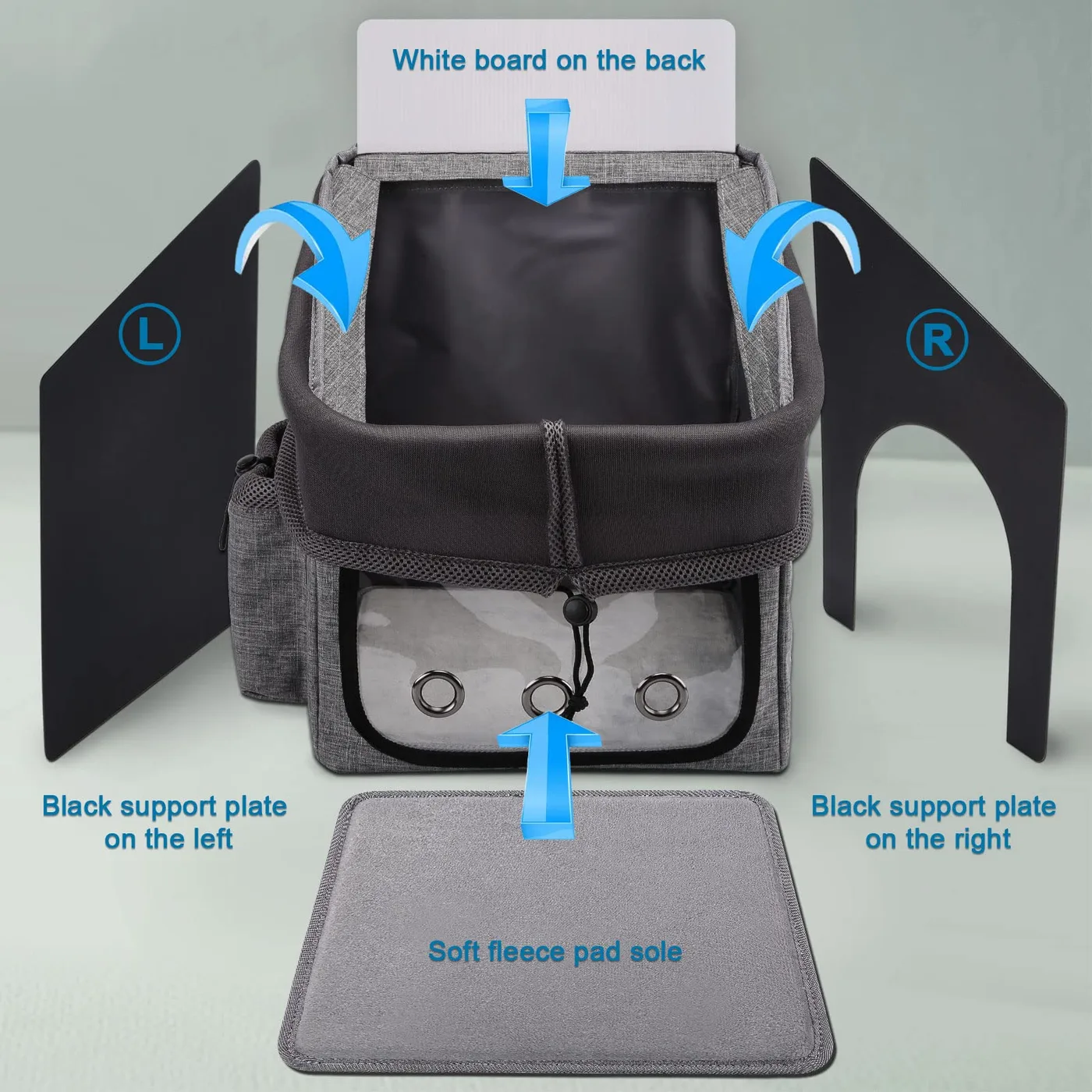
The frame is the component that determines whether the carrier holds its shape, and its insertion is a dimensional operation. A wire frame of 3-5 mm diameter is inserted into a bound sleeve and the assembly is checked for flatness on a surface plate: acceptance is within 3 mm over the base, because a base that is out of flat rocks and a rocking base is what makes a cat refuse to enter.
Units per hour matter to the schedule because hardware installation is a bottleneck station. At 40-90 zippers per hour, a 5,000-unit order is 55-125 hours of zipper work, which is 7-16 operator-days — meaning this station alone needs 7-16 operators running in parallel to hold the takt. That is the practical reason the station appears as four to ten operators in the loading table rather than one. Hardware is verified by pull values, not by appearance, and the zipper station at 40-90 units per hour is the bottleneck that sets the operator count.
In-Process Inspection and the Defect Pareto
Inspection happens at three points — incoming, in-process and final — and each catches a different population of defects. Knowing the Pareto tells a buyer what will actually be found and, more usefully, what will not.
In-process inspection is station seven and it is a 100% check on function plus a visual check on appearance, at 30-70 seconds per unit. It catches the defects that are created by assembly: skipped stitches, misaligned binding, untrimmed thread, hardware fitted backwards, and panels assembled off-shade. Those five account for 62-78% of all in-process findings.
The remaining findings are material defects that escaped incoming control — coating marks, weave faults, plating blemishes — and they account for 12-22%. The rest are design-related: a panel that will not sit flat, a pocket that binds, a strap that twists. Those are the expensive ones, because they are found at the end of the line and they usually indicate that the sample was not representative.
| Defect class | Share | Detected at | Reworkable | Cost to fix USD |
|---|---|---|---|---|
| Stitch defects | 24-32% | In-process | Yes | 0.10-0.40 |
| Binding and trim | 14-20% | In-process | Yes | 0.15-0.55 |
| Hardware fit | 10-16% | In-process | Yes | 0.20-0.80 |
| Shade mismatch | 8-14% | In-process | Sometimes | 0.60-2.40 |
| Material faults | 12-22% | Incoming or in-process | No | Scrap |
| Dimensional | 6-12% | Final | Sometimes | 0.40-1.60 |
| Function | 4-9% | Final | Yes | 0.30-1.20 |
The cost column is the point of the table. Reworking a stitch defect costs 0.10-0.40 USD; scrapping a unit for a material fault costs the full material and labour content, 6-14 USD. That ratio is why incoming material control at station one earns its place, and why a buyer should not push for it to be skipped to save two days.
Final inspection is sampling, not 100%, and it is where AQL 2.5 applies: at a 500-unit lot, 50 units are inspected with 3 majors accepted and 4 rejected; at 5,000 units in a single lot, 200 are inspected with 10 and 11. Critical defects — anything that could injure the animal or the handler — are at zero tolerance regardless of lot size.
The defect Pareto is also a specification tool. A buyer whose first run shows 20% hardware-fit defects does not have a quality problem; they have a hardware specification that is hard to install correctly, and the fix is at the drawing stage rather than on the line. Assembly-created defects are 62-78% of findings and cost 0.10-0.80 USD to rework; material faults cost a full unit, which is why incoming control is not optional.
Finishing, Packing and Container Loading Arithmetic
The last two stations determine whether the product arrives sellable and whether the freight makes sense. Both are arithmetic and both are decided long before the goods are finished.
Finishing is thread trimming, surface cleaning, hardware wipe and a final shape check: 35-80 seconds per unit. Cleaning is specified rather than assumed — a carrier is wiped with a damp cloth and dried, and any adhesive residue from tape or label backing is removed, because residue on a coated shell attracts dust in transit and produces returns that look like material faults.
Packing method is the first commercial decision. A folded polybag pack gives a carton volume of roughly 0.028-0.042 m³ per unit; a retail box adds 0.004-0.010 m³. For a 500-unit order that is 14-21 m³ folded and 16-26 m³ boxed. At 5,000 units it is 140-210 m³ folded, which is two to three 40HQ containers.
Container arithmetic is worth stating precisely because it is where freight estimates are made or lost. A 40HQ has a usable internal volume of 67-76 m³ and a practical loading efficiency of 82-90% for bagged soft goods, giving 55-68 m³ of loaded volume. At 0.035 m³ per unit that is 1,570-1,940 units per 40HQ folded, and 1,260-1,570 boxed.
| Container | Usable m³ | Load efficiency | Loaded m³ | Units folded | Units boxed |
|---|---|---|---|---|---|
| 20GP | 28-33 | 82-90% | 23-30 | 660-850 | 520-690 |
| 40GP | 58-67 | 82-90% | 48-60 | 1,370-1,710 | 1,090-1,400 |
| 40HQ | 67-76 | 82-90% | 55-68 | 1,570-1,940 | 1,260-1,570 |
| LCL, per m³ | 1 | 100% | 1 | 28-34 | 23-28 |
The commercial conclusion is that a 500-unit first order is an LCL or air decision, not a container decision: 14-21 m³ fills less than a third of a 20GP, so paying for a full container is paying for 60-70% air. Above roughly 700-900 units folded, a 20GP becomes efficient; above roughly 1,600-1,900, a 40HQ does.
Carton specification closes the station: a double-wall carton with a bursting strength of 1,200-1,800 kPa, gross weight held under 18-22 kg so it can be handled manually, and a shipping mark printed at 40-60 mm readable at 3 m. Carton count is verified 100% at sealing, because a carton short by two units is the most common cause of a receiver-side query that takes days to resolve.
Weight and measure are declared on the packing list to the carton, not to the order, which is what lets a customs broker clear a partial shipment without re-measuring. A 500-unit order is 14-21 m³ and does not fill a container; the break-even to a 20GP is about 700-900 units folded and to a 40HQ about 1,600-1,900.
Capacity Planning and Where Schedule Actually Goes
A production quotation of 35-50 days is a calendar statement, and decomposing it is the single most useful thing a buyer can do before negotiating. The decomposition is stable across programmes and it is not what most buyers assume.
Material procurement is the first block at 7-28 days. Fabric at 300-800 m dye-lot minimum is the longest item; hardware is 10-20 days; labels and printed packing are 6-18 days. Procurement runs in parallel with tooling where tooling exists, so the block is the longest of its components rather than their sum.
Queue is the second block and the least discussed: 10-25 days in a full season. A line is scheduled by booking, and an order that arrives without a booking waits. This is the block that a buyer can eliminate entirely by confirming and depositing early, and it is larger than the conversion block.
Conversion is the third block and the smallest: 12-14 line-days for 5,000 units, 2-3 line-days for 500. With seven lines the network absorbs this quickly, which is why the quoted window barely moves between a 500-unit and a 5,000-unit order.
Inspection, documentation and booking are the fourth block at 6-14 days: one to two days for final inspection and report, three to seven for documentation and booking, two to five to vessel cut-off.
| Block | Days | Share of window | Buyer influence | Reduction available |
|---|---|---|---|---|
| Material procurement | 7-28 | 20-56% | Medium | 3-10 days |
| Sample approval | 2-9 | 4-18% | High | 2-7 days |
| Production queue | 10-25 | 20-50% | High | 10-25 days |
| Conversion | 2-14 | 4-28% | Low | 0-2 days |
| Inspection and docs | 6-14 | 12-28% | Medium | 2-5 days |
| Total | 35-50 | 100% | Up to 30 days |
The right-hand column is the actionable one: up to 30 days of the quoted window is buyer-influenced rather than supplier-influenced. Approving samples in one round instead of three removes 2-7 days; booking a slot at deposit rather than at sample approval removes 10-25; and having final artwork and packing specification ready removes 3-10 from procurement.
Capacity is the constraint behind the queue block and it should be stated honestly. Seven lines at 380-420 carrier-equivalent units per shift is roughly 2,700 units per day across the network, against a monthly network output of 200,000 pieces across a product mix that includes far lighter items. A carrier consumes 25 minutes of content; a flat pouch consumes 4. The queue exists because the mix competes for the same lines.
The planning rule that follows is simple: confirm and deposit at the point the specification is frozen, not at the point the sample is approved, because sample approval is a gate in the middle of the window rather than the start of it. Queue is 20-50% of a quoted lead time and it is the largest buyer-controlled block — up to 30 of the 35-50 days is influenceable by confirming early.
Why brands source here
- Pet carrier programs run since 2014; founding team in sewn goods since 2004
- SGS-verified production floor of 4,950 m² with 137 workers across 7 lines
- Monthly capacity of 200,000 units, audited to BSCI and ISO 9001
People Also Ask
How long does it take to manufacture a cat carrier?
21-29 minutes of labour content per unit, of which sewing is 13-17. A balanced line of 28 operators converts 380-420 units per eight-hour shift at a 0.90 minute takt.
What is marker efficiency in carrier cutting?
78-88% on a soft carrier panel set, and the spread is worth 1.20-3.40 USD per unit at 500 pieces. Directional control on a woven or print costs 3-7 points that cannot be recovered elsewhere.
Is a welded seam stronger than a sewn seam?
A sewn seam is stronger in absolute terms at 350-600 N against 280-460 N for a weld, but a weld is watertight, faster at 2-5 seconds and cheaper per metre at 0.10-0.22 USD.
How many units fit in a 40HQ container?
1,570-1,940 folded at 0.035 m³ per unit, or 1,260-1,570 in retail boxes. Usable volume is 67-76 m³ and practical loading efficiency is 82-90%.
What is the most common defect on a carrier line?
Stitch defects at 24-32% of findings, then binding and trim at 14-20%. Assembly-created defects together are 62-78% and cost 0.10-0.80 USD to rework.
Why does bulk production take 35-50 days if conversion is only a few days?
Because the window is dominated by material procurement at 7-28 days and production queue at 10-25 days. Conversion of 5,000 units is only 12-14 line-days.
How strong does a zipper chain need to be on a cat carrier?
250-400 N chain-to-tape, sewn in two passes at 8-12 stitches per 25 mm with the ends bar-tacked over 10-14 mm. Slider life should be 3,000-8,000 cycles.
What determines whether a carrier base sits flat?
The frame insertion. A 3-5 mm wire in a bound sleeve, checked on a surface plate to within 3 mm over the base, because a base that rocks is what makes a cat refuse to enter.
Frequently Asked Questions
What is MOQ for an OEM cat carrier programme?
500 pieces per colourway. The constraint is fabric and trim procurement rather than line capacity, so it applies equally to white label, private label and full OEM.
How many operators does a 500-unit order need?
28 at a 0.90 minute takt with 25 minutes of content. Takt is 450 effective minutes divided by 500 units, and content divided by takt gives the operator count.
What balance efficiency should a carrier line run at?
85-92%. Above 95% the line becomes fragile, because any absence or material delay stops it — the unused 8-15% is the buffer that lets the line recover.
What are the parameters for a high-frequency weld?
27.12 MHz, 0.4-0.8 MPa electrode pressure, 1.5-4.0 seconds dwell and 1.5-4.0 kW by electrode area. Half a second too little gives a cold weld peeling at 8-15 N.
Why is welding not used on white label programmes?
Electrode cost and lead time. At 900-2,400 USD and 14-24 days, an electrode is a tier-defining decision rather than a detail, and white label inherits existing geometry.
How much waste does cutting generate?
12-22% by marker, which is why the spread between a good and a careless marker is 1.20-3.40 USD per unit at 500 pieces.
How is final inspection sampled at 5,000 units?
AQL 2.5 at general level II gives 200 units inspected with 10 majors accepted and 11 rejected. Critical defects are zero tolerance at any lot size.
What is the break-even volume for shipping a full container?
About 700-900 units folded for a 20GP and 1,600-1,900 for a 40HQ. Below that, an LCL or air decision is cheaper than paying for air in a container.
Why is a carton gross weight held under 18-22 kg?
So it can be handled manually at the receiving end. Above that, receivers need mechanical handling and a proportion of cartons arrive damaged.
How is shade variation controlled between fabric rolls?
By bundling by roll number at cutting and keeping one carrier's panels inside one roll where possible. A 500-unit run consumes 6-14 rolls, so bundling discipline at station one is what prevents visible mismatch.
What is the fastest way to shorten a quoted lead time?
Book the production slot at deposit rather than at sample approval. That removes the 10-25 day queue block, which is larger than the conversion block itself.
How much does a material fault cost compared to a stitch defect?
A stitch defect is reworked at 0.10-0.40 USD; a material fault scraps the unit at 6-14 USD of material and labour. That ratio is why incoming control is not skipped.
What cleaning is done before packing?
Thread trimming, a damp wipe, hardware wipe and removal of any adhesive residue from label backing. Residue on a coated shell attracts dust in transit and produces returns that look like material faults.
Can a 500-unit and a 20,000-unit order run in the same month?
Yes. Seven lines with 137 people and 149 machines allow a small and a large order to run concurrently without either displacing the other, provided both are booked.
Talk to QUANZHOU JUNYUAN BAGS about a pet carrier program: MOQ 500 pieces per colourway, samples in 6-10 working days, bulk production in 35-50 days under AQL 2.5 inspection.
Get a free quote Request a sample