Dog Carrier Backpack for Shiba Inus: Japanese Breed
A Shiba Inu carrier is specified around shed management rather than around load. The 7-14 kg class takes a 300-360 mm interior with a 20-30 mm seasonal loft allowance, a 4 mm board, a 600D shell at 640-820 g/m², a two-stage intake filter capturing above 70% of particles over 10 micrometres, a hair-shielded #5 zipper with covered garage, and an anti-static welded lining below 10^11 ohms surface resistivity.
This page treats a heavily coated spitz-type breed as a filtration and serviceability problem. The animal is small, so structure is easy; what defeats a generic carrier is the volume of undercoat it sheds, which blocks mesh, packs zipper sliders, adheres to linings and accumulates in the floor. Every significant decision below follows from that one fact: filter specification, service access intervals, zipper protection, lining surface energy and the seasonal allowance on interior dimensions. Commercial terms follow the standard program: MOQ 500 pieces per colourway, prototypes in 6-10 working days, bulk production in 35-50 days after sample approval, final random inspection at AQL 2.5, T/T 30/70 payment and FOB Xiamen loading. Textile compliance is screened to OEKO-TEX criteria, zipper methods follow ASTM International, and production is executed by our production team at an SGS-verified production base.
Private label pet bags and dog carrier backpack lines share one packaging standard here, so a mixed order does not add handling cost or a second carton size.
Shiba Mass, Coat Volume and the Seasonal Dimension Allowance
The Shiba Inu is a compact spitz-type breed. Males run 9-14 kg and females 7-11 kg, standing 35-43 cm at the withers with a body length of 40-52 cm and a chest depth of 20-26 cm. The body is square to slightly long, with a deep chest, a level back and a tightly curled tail, and the whole animal is denser than its mass suggests because of coat volume.
Structure is trivial at this size. Taking 14 kg plus 1 kg of gear at a dynamic factor of 2.2 gives a design load of 0.32 kN, which a 4 mm laminated board carries with a very large margin. The interesting specification content is elsewhere.
The coat is a stiff, straight outer layer of 30-50 mm over a dense undercoat of 20-35 mm, and it changes materially between seasons. Standing loft at the ruff and breech measures 60-90 mm in winter condition and 40-60 mm in summer, a difference of 20-30 mm per side that has to appear in the interior dimension or the animal will be compressed in winter.
The specification therefore quotes interior dimensions as a seasonal pair rather than a single figure: 300-360 mm wide, 540-620 mm long and 460-520 mm high in summer condition, with a documented winter allowance of a further 40-60 mm on width and 30-40 mm on height for the largest size. In practice that is delivered by a compression allowance in the panel patterning rather than by two different products, because a compressible coat tolerates a close fit far better than a rigid one does.
The curled tail is a smaller but real geometric constraint. It sits high and adds 40-60 mm to the effective height at the rear, so the rear upper panel is patterned with a 50 mm rise rather than a flat line, which removes the pressure point that otherwise falls exactly on the tail base when the animal sits.
Undercoat Shed: Quantifying the Hair Load
Shed is the defining service condition. The undercoat is shed twice a year in a heavy blow lasting two to four weeks, plus a continuous low-level loss throughout the year. Quantifying it was the first step in the development program, because without a number every downstream decision is guesswork.
Measurement was made by brushing animals in blow condition for five minutes daily and weighing the collected material, then by weighing the material recovered from carrier interiors after a defined period of use. Blow-season collection ran 4-9 g per brushing session, equivalent to 30-60 g per week, and carrier interiors accumulated 12-22 g over 40 hours of use in that season. Outside the blow season the same interiors accumulated 2-4 g over the same period.
Those figures set the filter capacity requirement. A filter that captures 70% of incoming hair will hold 8-15 g over 40 hours in blow season, and it must do so without losing more than 25% of its permeability, or the airflow figure collapses exactly when the animal most needs cooling. That is the acceptance in one sentence, and it is the reason the filter is sized by mass rather than by area.
The second consequence is that hair does not only arrive through the air. It is deposited directly from the coat onto the floor, the mat and the lower panels, so the specification includes a floor-level capture feature: a 30 mm hook-and-loop-retained strip of loop-pile fabric across the front of the floor, which collects deposited hair and can be peeled off and cleaned. This is a cheap item at 0.30-0.60 USD and it removes most of the material before it reaches the filter.
The third consequence is that the service interval has to be stated. The specification defines cleaning at every 20 hours of use in blow season and every 60 hours otherwise, and it is printed on the care label with the method: filter rinsed, floor strip peeled and vacuumed, mat removed and washed, zipper brushed.
Filtration Architecture and Service Access
Filtration is two-stage. Stage one is the intake mesh itself, a monofilament at 1.2-1.6 mm aperture which blocks the bulk of the material by size. Stage two is a laminated non-woven of 60-90 g/m² behind the intake, with filtration efficiency above 70% for particles over 10 micrometres, held in a rigid frame that slides out from the exterior.
The frame is the important detail. Filters that are bonded in place cannot be cleaned, and a blocked filter is worse than no filter because it looks intact while passing no air. The specified frame is polypropylene, 2 mm section, with a 15 mm pull tab and a 25 mm hook-and-loop retention, removable in under ten seconds without tools. Two frames are supplied per unit so one can be drying while the other is in service.
Permeability retention is the acceptance measure rather than efficiency. A fresh filter at 60-90 g/m² passes 900-1200 l/m²/s at 100 Pa; the same filter loaded with 12 g of hair must still pass above 700 l/m²/s, which is the 25% loss ceiling stated earlier. Loading is done in the laboratory with a weighed quantity of collected undercoat introduced into an air stream at 1.5 m/s, which reproduces field loading closely enough to be useful.
Exhaust is not filtered, which is deliberate: a filtered exhaust accumulates humidity and raises interior temperature, and the material leaving the interior is a small fraction of what arrives. The exhaust instead carries a coarse guard of 2.5 mm aperture moulded mesh, purely to prevent a paw or a nose from reaching the panel.
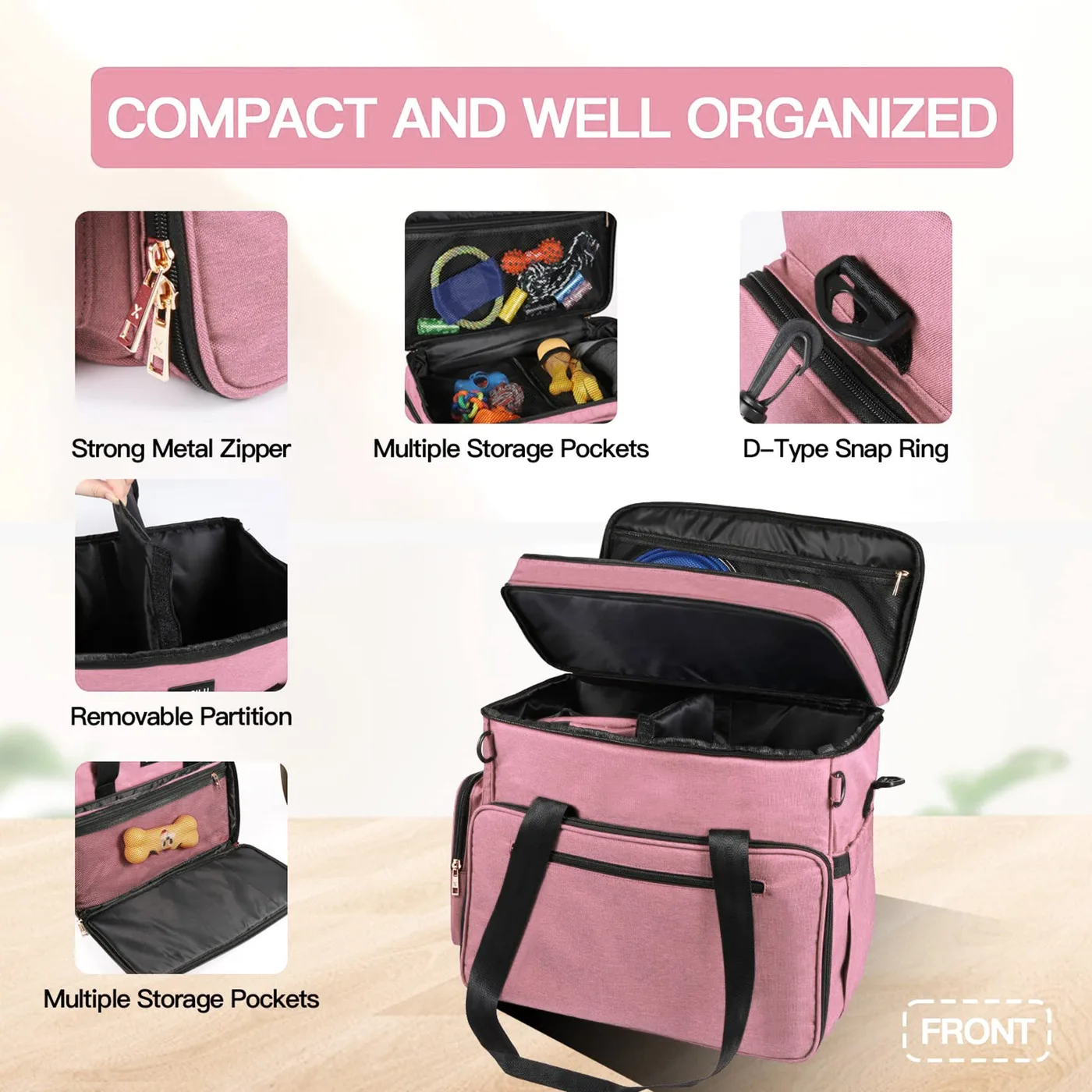
Service access is designed for a user standing behind the carrier. The filter frame slides from the rear, the floor strip peels from the front after the door is opened, the mat lifts from a full-perimeter tape, and the zipper brush is accessible at the door head. No service operation requires turning the unit upside down or removing the frame.
Zipper and Hardware Protection Against Hair Packing
Hair packing in a slider is the single most common hardware failure in this class. Short, stiff guard hairs are carried along the chain by the slider, mixed with the slider's own lubricant, and compacted into the pawl seat. The slider then appears to lock but releases under load, which is the same silent failure described for the barkless breed and is equally dangerous.
Three defences are specified. The first is tape selection: a tightly woven tape with a closed, calendered surface rather than a standard woven tape, which reduces hair pickup at the chain line by roughly half in cycling tests. The second is a 10 mm brush strip of 6 mm pile bonded along the chain interior, which the slider passes through on every cycle. The third is a covered garage at the chain head, which prevents hair from entering at the parked position.
The closure is a #5 reverse-coil chain with two sliders, one positive-locking, chain cross-wise strength above 450 N and slider pull-off above 400 N, tested to the ASTM zipper method. Slider force is 10-20 N. The specification requires a discernible detent on locking rather than friction alone, for the same reason as in the agile-small classes.
Cycling acceptance with hair present is 600 cycles at 12 cycles per minute with a 1 kg lateral load and 8 g of collected undercoat introduced at the start, which is a heavier charge than the 5 g used for the fine-coated breed because the material here is coarser and packs differently. Acceptance is full locking function at the end, no slider walk above 5 mm and no audible or tactile change in the detent.
Buckles and trim are specified to be cleanable: side-release buckles with an open frame rather than a box section, so hair can be blown out rather than picked out, and no velvet or brushed loop tape anywhere near a mechanism, since loop tape is the most effective hair collector in the entire component catalogue and should be restricted to the floor strip where it is wanted.
Shell, Lining and Anti-Static Treatment
Shell specification is unremarkable for the mass: 600D polyester at 640-820 g/m² with a TPU coating at 25-35 g/m², abrasion acceptance of 15,000 Martindale cycles at 12 kPa to ISO 12947-2. The interesting work is on the interior.
Hair adhesion to a lining is largely an electrostatic problem. A standard polyester lining charges under the triboelectric effect as the animal moves, and charged hair is held to the surface against gravity and against a vacuum nozzle. The specification therefore requires a permanent anti-static finish on the interior face with a surface resistivity below 10^11 ohms, measured to the standard surface-resistivity method, and held after twenty laundering cycles rather than only when new.
The lining itself is a welded TPU film at 0.15-0.20 mm, chosen for the same reason as in the other small classes: it is smooth, it is wipe-clean, and it has no stitch holes for hair to anchor into. Weld peel acceptance is 30 N per 25 mm after seven days at 70 C and 95% relative humidity.
Surface energy is specified alongside resistivity, at below 34 mN/m, which is the practical threshold for release with a dry cloth or a vacuum nozzle. Together, the resistivity and surface energy figures reduce the measured hair retained on the lining after a standardised contact test by 55-70% against an untreated polyester lining.
Colour selection has a service dimension here: mid-tone colourways are recommended because both very light and very dark linings show hair, and the specification offers a heather-style printed lining which disguises residual material between cleans. This is a commercial consideration rather than an engineering one, but it materially affects returns in this class.
Floor, Board, Interior Geometry and the Parameter Set
The floor board is 4 mm laminated: 1.5 mm EVA over a 2 mm PP honeycomb core and a 0.5 mm skin, with a deflection limit of 2.5 mm under the 0.32 kN design load and no impulse requirement, since this breed does not produce the vertical bolt load of the agile hounds. The board is bonded on two edges and located in a sleeve on the other two, which is adequate here and is cheaper than the full bond used on the impulse classes.
The floor mat is a moulded EVA piece at 3-4 mm with a 0.8 mm cross-hatch, retained by full-perimeter hook-and-loop tape so it can be lifted for cleaning. Behind it sits the deposited-hair capture strip described earlier, a 30 mm band of loop pile across the front of the floor, retained by the same tape and separately removable.
The frame is 2.0 mm HDPE perimeter with glass-filled nylon corners, or 12 mm aluminium tube where the client prefers metal. At this mass the HDPE option is the default and saves 0.25-0.40 kg.
| Parameter | Heavy-coated spitz (Shiba) | Barkless agile (Basenji) | Short-coated lean (Vizsla) |
|---|---|---|---|
| Design mass and load | 15 kg, 0.32 kN | 13 kg, 0.28 kN | 32 kg, 0.69 kN |
| Interior W x L x H (summer) | 300-360 x 540-620 x 460-520 mm | 300-340 x 560-640 x 480-540 mm | 340-400 x 680-760 x 560-620 mm |
| Seasonal loft allowance | 20-30 mm per side | not applicable | not applicable |
| Floor board | 4 mm, two-edge bond | 4 mm, four-edge bond | 5 mm |
| Shed load over 40 h (blow season) | 12-22 g | under 3 g | under 5 g |
| Intake filter | 60-90 g/m², two-stage, removable | not specified | not specified |
| Permeability retention when loaded | above 700 l/m²/s at 12 g | not applicable | not applicable |
| Lining resistivity | below 10^11 ohms | not specified | not specified |
| Zipper hair charge in cycling | 8 g | 5 g | 5 g |
| Service interval (blow season) | every 20 hours | every 60 hours | every 60 hours |
| BOM cost FOB | 12-22 USD | 11-20 USD | 17-29 USD |
The rear upper panel carries the 50 mm rise for the curled tail, and the interior restraint is a 15 mm tether with a 450 N snap hook anchored at 300-360 mm above the floor, retracting into a flush housing.
Thermal Position and Airflow with a Heavy Coat
A Shiba carries a double coat with substantial insulating value and is comfortable across a wide temperature range, which makes the thermal problem one of moderation rather than of heating or cooling. The animal will overheat in a sealed box and will be entirely comfortable in air that a short-coated breed would find cold.
The specification therefore maximises airflow and fits no insulation at all. Open area is 36-42%, permeability of the finished panel above 900 l/m²/s at 100 Pa, and the layout is a low intake at the front and both sides with a high exhaust at the rear, producing a stack path. With a 20 W source representing the animal, chamber testing recorded a steady-state interior rise of 1.8-2.8 C at 24 C and 3.4-4.6 C at 32 C.
The coat itself is the insulation, and that has a dimensional consequence already covered: a winter-condition Shiba inside a carrier sized for a summer-condition one will be compressed, and compression reduces the coat's insulating value while increasing contact pressure. The seasonal allowance is what prevents that.
Solar gain is managed with a near-infrared reflective pigment on dark colourways, which lowers surface temperature by 7-12 C under 900 W/m² irradiance, and with a roof overhang of 40-60 mm. Interior contact surface is limited to 46 C, the lower figure used for the thin-skinned classes, because the animal will lie against the floor and the coat compresses there.
One thermal feature is specific to this class: because the undercoat is dense and holds moisture, a wet Shiba dries slowly and the interior humidity rises. The exhaust is therefore unfiltered and generously sized, and the floor mat is hydrophobic closed-cell EVA with 2 mm drainage channels, so water moves away from the lying surface rather than being held against the coat.
Verification Protocol: Seam Slippage, Zipper Reciprocation, Static Load and Drop
The matrix adds a filtration loading test and a hair-ingress zipper cycle to the standard four. Sampling is three units per size per colourway from the first lot and one unit per 6,000 pieces thereafter.
Seam slippage runs to ISO 13936-2 with acceptance under 5 mm opening at 90 N on shell seams and under 4 mm at 110 N on the frame and board seams. Welds on the lining are peel-tested at 30 N per 25 mm after seven days at 70 C and 95% relative humidity, which is the hydrolysis check carried across the set.
Filtration testing measures permeability before and after loading. A fresh filter must pass 900-1200 l/m²/s at 100 Pa, and the sample loaded with 12 g of collected undercoat must still pass above 700 l/m²/s. Efficiency is separately checked at above 70% for particles over 10 micrometres on a fresh sample, and the frame is cycled 200 times in and out of its housing with no deformation of the retention tabs.
Zipper reciprocation follows the ASTM method at 600 cycles for the main opening and 200 for the access port, at 12 cycles per minute with a 1 kg lateral load and 8 g of undercoat introduced at the start. Acceptance is full locking function at the end, no slider walk above 5 mm, and no change in the detent. The anti-static finish is verified on the lining at below 10^11 ohms after twenty laundering cycles.
Static load is a 24-hour proof at 1.5 times design mass, 22.5 kg, accepting permanent deflection under 3 mm, no seam opening above 2 mm and full zipper function. Drop testing is a six-face sequence from 250 mm onto concrete with a 15 kg water ballast in an ISTA-style protocol, accepting no rupture, no hardware release, no filter frame ejection and full closure function.
Cost Bands, Tooling and Production Scheduling
Unit cost lands at 12-22 USD FOB Xiamen. Shell and cutting account for 4-7 USD, frame and board 2-5 USD, hardware 3-6 USD, the filtration package 2-4 USD, and closing labour 2-4 USD. The filtration and service package is the class-specific increment at 2.10-3.90 USD and includes the second filter frame, which is supplied with the unit rather than sold separately because a single frame makes the cleaning interval unachievable in practice.
Tooling is low. Profiling dies run 700-1,600 USD per size, sewing and welding jigs 700-1,300 USD, the filter frame is a bought-in injection moulding at 900-1,800 USD for the tool, and print set-up is 250-600 USD per colourway. A three-size program is tooled under 9,500 USD.
Cutting efficiency is 87-92%, with small panels nesting two or three up on a 1,500 mm table. The anti-static finish is applied at the fabric mill rather than in the cutting room, which is the correct place for it because a post-application would not survive twenty laundering cycles.
Timing follows the standard cycle. Prototypes are delivered in 6-10 working days from confirmed specification, covering patterning, first-cut samples and a fit check. Bulk production runs 35-50 days after sample approval, with fabric lead time the variable; the anti-static finished lining fabric is a mill-order item adding 10-14 days against a standard lining, and the filter non-woven adds a further 4-6 days if a non-stock grammage is specified. Final random inspection is to AQL 2.5 under general inspection level II, payment is T/T 30/70 and loading is FOB Xiamen. Monthly capacity across the network is 200,000 pieces, and this class uses roughly 3-5% of a line per 10,000 units.
Order and quality terms
- MOQ 500 pieces per colourway; samples in 6-10 working days
- Bulk production 35-50 days after approval; AQL 2.5 inspection standard
- T/T 30/70 terms, FOB Xiamen, full document set per shipment
People Also Ask
How much undercoat does a heavy-coated spitz breed shed?
30-60 g per week in blow season, measured by weighing brushed material, with carrier interiors accumulating 12-22 g over 40 hours of use. Outside the blow season the same interiors accumulate 2-4 g over the same period.
Why is the filter sized by mass rather than by area?
Because the acceptance is permeability retention when loaded, not efficiency when new. A filter holding 70% of incoming hair will carry 8-15 g over 40 hours and must still pass above 700 l/m²/s at 100 Pa, a loss ceiling of 25%.
How is hair stopped from packing the zipper slider?
Three defences: a tightly woven calendered tape that halves pickup, a 10 mm brush strip of 6 mm pile along the chain that the slider passes through every cycle, and a covered garage at the chain head to prevent entry at the parked position.
Why does the lining need an anti-static finish?
A standard polyester lining charges triboelectrically and holds hair against a vacuum nozzle. A permanent finish below 10^11 ohms, held after twenty laundering cycles, plus a surface energy below 34 mN/m, reduces retained hair by 55-70%.
What is the seasonal dimension allowance?
20-30 mm per side between summer and winter coat condition, delivered as a compressible allowance in the panel patterning. A winter-condition animal in a summer-sized carrier is compressed, which both reduces coat insulation and raises contact pressure.
How often does the carrier need cleaning in blow season?
Every 20 hours of use against every 60 hours otherwise: filter rinsed, floor strip peeled and vacuumed, mat removed and washed, zipper brushed. Two filter frames are supplied so one can dry while the other is in service.
Why is the exhaust left unfiltered?
A filtered exhaust accumulates humidity and raises interior temperature, and only a small fraction of the material leaving the interior is hair. The exhaust carries a coarse 2.5 mm guard purely to keep a paw or nose off the panel.
Frequently Asked Questions
What interior dimensions suit a 14 kg Shiba Inu?
300-360 mm wide, 540-620 mm long and 460-520 mm high in summer condition, with a documented winter allowance of a further 40-60 mm on width and 30-40 mm on height for the largest size.
Why is the rear upper panel patterned with a rise?
The tightly curled tail sits high and adds 40-60 mm to the effective height at the rear. A 50 mm rise in the panel removes the pressure point that otherwise falls on the tail base when the animal sits.
Is an impulse load case required for this breed?
No. The breed does not produce the vertical bolt load of the agile hounds, so the board is bonded on two edges and located in a sleeve on the other two rather than fully bonded, which is adequate at 0.32 kN and cheaper.
What is the floor-level hair capture feature?
A 30 mm band of loop-pile fabric across the front of the floor, retained by the same full-perimeter hook-and-loop tape as the mat and separately removable, at 0.30-0.60 USD. It removes most deposited hair before it reaches the filter.
How is filter loading reproduced in the laboratory?
A weighed quantity of collected undercoat is introduced into an air stream at 1.5 m/s until the sample has taken up 12 g, then permeability is re-measured. This reproduces field loading closely enough to be a useful acceptance.
What happens to the filter frame during drop testing?
It must not eject. Frame retention is by 25 mm hook-and-loop plus a 15 mm pull tab, cycled 200 times in and out with no deformation of the tabs, and drop testing at 250 mm explicitly requires no filter frame ejection.
Why are open-frame buckles specified?
Hair can be blown out of an open frame rather than picked out of a box section. For the same reason, loop tape is banned near any mechanism and restricted to the floor strip where hair collection is wanted.
What thermal acceptance applies with the coat present?
A steady-state interior rise under 2.8 C at 24 C and under 4.6 C at 32 C with a 20 W source, and no interior contact surface above 46 C, which is the lower limit used for thin-skinned and heavily coated classes.
How is moisture from a wet coat handled?
The exhaust is unfiltered and generously sized, and the floor mat is hydrophobic closed-cell EVA with 2 mm drainage channels, so water moves away from the lying surface rather than being held against dense undercoat.
What Abrasion figure applies to the shell?
15,000 Martindale cycles at 12 kPa to ISO 12947-2 at 600D and 640-820 g/m², which is adequate for the mass. Tear propagation is not a live failure mode at this size, so no ripstop grid is specified.
Does the anti-static finish survive cleaning?
Yes, it is applied at the fabric mill rather than post-applied in the cutting room, and the acceptance is below 10^11 ohms after twenty laundering cycles rather than when new.
What colourways are recommended and why?
Mid-tone and heather-style printed linings, because both very light and very dark linings show residual hair between cleans. This is a commercial consideration that materially affects returns in this class.
What is the drop height for this class?
250 mm onto concrete, six faces, with a 15 kg water ballast, accepting no rupture, no hardware release, no filter frame ejection and full closure function.
Which fabric items extend the production schedule?
The anti-static finished lining at 10-14 days and a non-stock filter non-woven grammage at a further 4-6 days. Both sit inside the 35-50 day bulk window but should be planned for on a first program.
Talk to QUANZHOU JUNYUAN BAGS about a pet carrier program: MOQ 500 pieces per colourway, samples in 6-10 working days, bulk production in 35-50 days under AQL 2.5 inspection.
Get a free quote Request a sample