Cat Carrier Backpack: Design and Features
A cat carrier backpack succeeds or fails on four numbers: centre of mass within 120 mm of the wearer's spine, empty weight under 1.4 kg against a 4-8 kg animal, sway under 15 degrees when the animal shifts, and 22-30% ventilated open area delivered through the top and sides rather than the back panel. Strap width is 50-70 mm.
Backpack geometry for a live animal behaves differently from any other load a pack is designed to carry, and the difference is not primarily one of weight. A cat moves, shifts position unpredictably, reacts to motion by bracing against a panel, and must be kept in a fixed relationship to the wearer's body while doing so. Every design decision in this category follows from that behaviour rather than from suspension hardware. Eight sections follow, covering load transfer to the spine, harness geometry, the problem of delivering ventilation when one face is permanently occupied by the wearer, access orientation and escape control, the internal structure needed to stop the enclosure deforming around a moving animal, the weight budget that governs everything, and finally the test protocol specific to a worn animal carrier. Commercial terms are standard: MOQ 500 pieces per colourway, prototypes in 6-10 working days, bulk production 35-50 days after golden sample approval, final random inspection at AQL 2.5, T/T 30/70 and FOB Xiamen.
Working as a pet carrier manufacturer on cat carrier ranges means the technical file is shared before any quotation: pattern, bill of materials, test report and packing specification.
Why a Wearable Animal Enclosure Is Not a Rucksack Problem
A conventional load behaves predictably: its mass is fixed, its centre sits where the designer put it, and it does not push back. An animal violates all three assumptions, which changes what the structure has to do and invalidates much of the intuition carried over from ordinary packs.
The first difference is that the load redistributes. A cat standing at the front of the compartment puts perhaps 70% of its mass on one half of the floor, which rotates the assembly and pulls the whole pack away from the wearer's back. Whichever way the animal then steps, the rotation reverses, and this happens continuously rather than once. Ordinary suspension is designed for a static centre; a design that tolerates a moving centre within a defined envelope is required here.
The second difference is that the animal braces. When the wearer steps, the mass accelerates, and the animal responds by pressing against whichever contact surface it can find, adding a lateral load component that no static calculation predicts. These loads arrive through the panels rather than through the base alone, so panel-to-frame attachment carries far more importance than in a bag carrying equipment.
The third difference concerns stiffness. A rucksack's contents form part of its structure to some degree. An animal does not: it remains separate, and it actively resists any deformation that presses inward on its space. This means the enclosure has to hold its own shape completely, because it cannot borrow stiffness from the load.
There is also a behavioural constraint that has no analogue elsewhere. The enclosure must remain a safe space even while it is being deformed slightly by the wearer's gait, and motion that is uncomfortable for a person is alarming for a cat. Sway is therefore not merely an ergonomic issue but a welfare one, and it gets an acceptance criterion rather than a preference.
Finally there is the separation requirement: the animal cannot be permitted to press directly against the wearer's back, both for hygiene and because transmitted body heat and movement are disturbing. A rigid dividing element with defined thickness is mandatory, and it sits between the load and the spine, exactly where it interferes most with pack design convention.
Centre of Gravity and the Distance-to-Spine Rule
The single most consequential geometric figure in this category is the horizontal distance between the animal's centre of mass and the wearer's spinal column. Weight matters, but this distance multiplies it: carried load acting through a lever arm produces a moment the wearer resists continuously with the lower back, and the effort cost of that resistance rises steeply with distance.
The working limit is 120 mm from the spine to the animal's centre of mass at full load, measured in the sagittal plane with the pack standing upright. Below that, most wearers carry 6-8 kg for thirty minutes without complaint. Beyond roughly 180 mm the same load becomes uncomfortable in under ten minutes regardless of how well the harness is padded, and no amount of suspension refinement recovers it.
Two constructions compete for this figure. The front-carry arrangement, sometimes called reverse carry, places the animal against the wearer's chest, which is excellent for the moment arm but moves the animal's view into the wearer's own motion and can be more alarming for the animal. The back-carry arrangement is conventional and calmer for the animal but pushes the centre further out unless the compartment is shallow.
Compartment depth is therefore limited by geometry rather than by the animal's size. A cat needs width and height more than it needs fore-aft depth, since it sits rotated rather than facing forward. The standard solution is a wide, shallow box with the animal's nominal width running across the wearer's shoulders, keeping depth to roughly 220-280 mm measured from back panel.
Height relative to the wearer matters too, and it is frequently ignored. The top of the enclosure should sit below the wearer's shoulder line for most of its width, because anything higher interferes with head movement and becomes unstable when the wearer turns. This limits usable height to roughly 380-450 mm on a mid-size adult frame, which in turn constrains how much headroom the animal can be given.
Harness Geometry: Width, Foam and Load Distribution
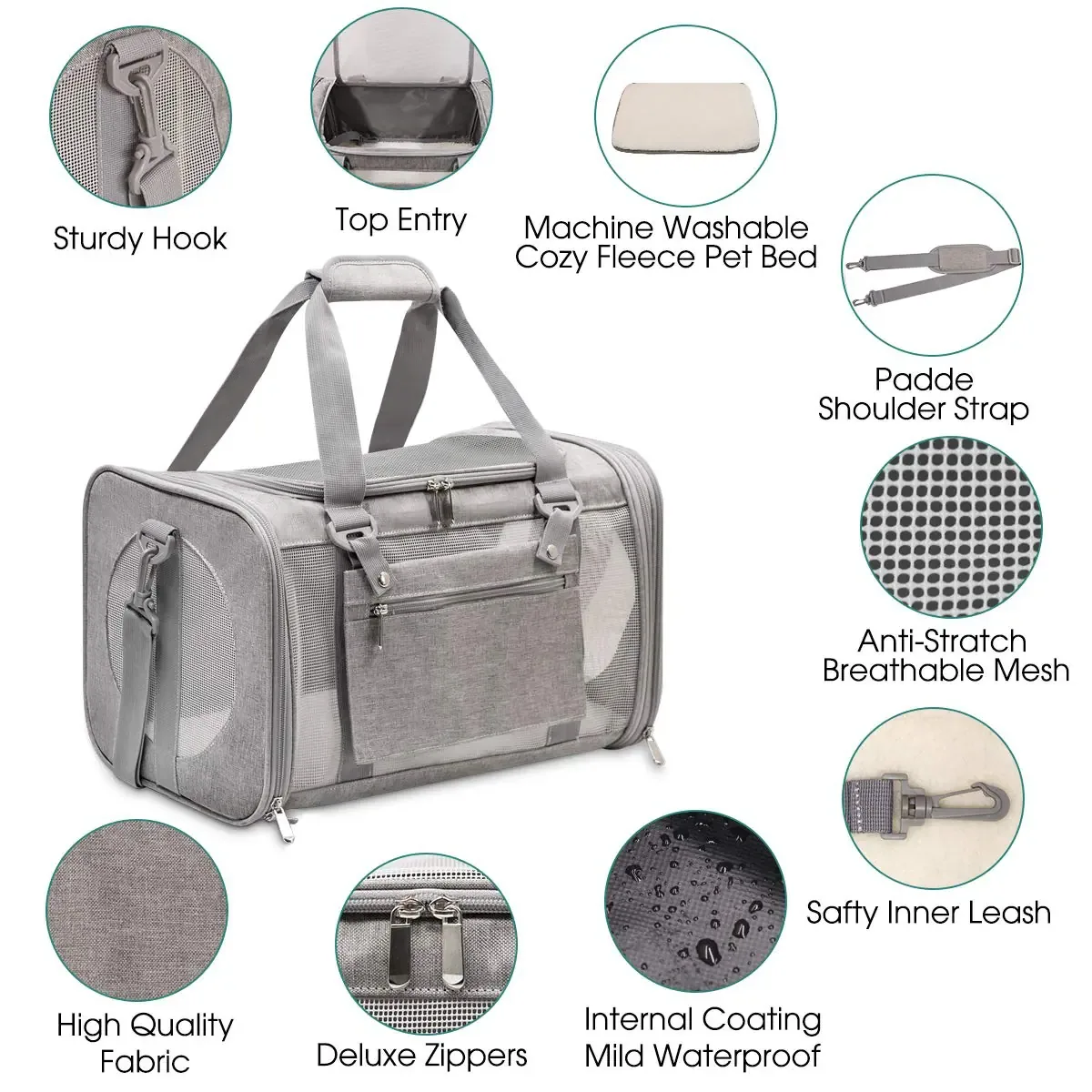
Straps for this category are specified differently from ordinary pack straps because of skin contact duration and because the load is dynamic. Three variables do the work: width, foam construction and the presence of a sternum connection.
Width sets contact pressure. Under a 6-8 kg total load, a strap narrower than about 40 mm produces contact pressures that become uncomfortable within twenty minutes and visibly compress soft tissue. The specification range is 50-70 mm measured flat, with the wider end used for anything above 6 kg of animal, and the strap must keep that width through the shoulder region rather than tapering at the point where it matters most.
Foam construction determines how well pressure distributes. Closed-cell EVA or polyethylene from 8 to 12 mm thickness is standard, laminated rather than loose inside the sleeve so it cannot migrate or bunch. Density between 45 and 70 kilograms per cubic metre gives good recovery without compressing to nothing; softer foams feel good in the showroom and collapse after twenty minutes, which is a common field complaint.
The sternum strap is mandatory here and optional in ordinary packs, because animal-induced sway has to be restrained laterally as well as vertically. Placed on the strap webbing rather than the pad, with vertical adjustability of 80-120 mm to suit different torsos, and tested for slip resistance under repeated load, it converts a load that rotates away from the body into one that stays put.
Load lifters - webbing from the top of the straps to the top of the pack - are genuinely useful in this category because they pull the enclosure toward the spine and directly reduce the moment arm discussed above. A modest allowance of 30-50 mm of adjustment is enough and the cost is small, making them one of the better value additions available.
Padding on the strap should also be shaped rather than straight. A contoured S-curve matching an average shoulder is measurably more stable than a straight strap because it resists rolling off the shoulder edge. A harness that spreads pressure, resists rotation and pulls the load toward the spine costs under two dollars to add and changes how heavy the product feels more than any other single feature.
Ventilation When One Face Is Permanently Blocked
In a worn animal pack, the panel against the wearer's back is unavailable for ventilation for the whole duration of use. This is the defining constraint of the format, and products that ignore it meet every nominal open-area target and still run hot.
The calculation has to be made excluding that face. If the enclosure is a box, the back panel is between a fifth and a quarter of its total surface area, so nominally delivering 25% open area across all faces delivers materially less effective ventilation once one face is sealed. The specification should therefore state effective open area during carry, calculated across available faces only, with the same 22-30% band applied to those.
Top and side placement does the remaining work. Apertures high on both side panels and across the top panel produce cross flow driven by the wearer's motion as well as by buoyancy, and because motion-driven exchange is substantial while walking, top placement performs better than theory suggests during actual use.
A separation gap behind the back panel helps more than it appears to. If a standing geometry permits 25-40 mm of air between the enclosure and the wearer, some degradation of the blocked face is recovered and, more importantly, body heat conducted into the compartment is reduced. A spacer mesh and a stiffened panel produce that gap; a soft product pressed flat against the wearer does not.
Insulation and radiant heat need a note. A dark shell in direct sun runs hot, and the roof takes the most exposure, so a reflective upper finish plus 4-8 mm of closed-cell insulation in the roof is standard for warm markets. The measurement that closes the specification is a two-hour static test at 30 °C with acceptance below 5 °C interior rise, run with the back panel against a simulated torso rather than in free air.
Access Orientation and Escape Control in a Worn Format
Access design in this format is driven by a constraint no other carrier family has: the handler is wearing the product, so both hands are available only if the pack stays stable, and any escape has a human plus an animal occupying the same small volume moving at walking speed.
Rear entry - the animal loaded through a panel facing away from the handler's body while the pack is not worn - is the safest arrangement. It keeps the largest opening away from the wearer while being carried, it allows the pack to be placed upright on a surface for loading, and it avoids the animal being lifted over a tall panel.
Front or top entries are common because they are convenient for the handler, and both create problems. A top entry means lifting over the tallest dimension while wearing the pack, which is awkward and risky for the back. A front-facing entry puts the largest closure on the side away from the wearer's control while in motion, which is precisely where an escape would be least visible.
Whatever the orientation, the closure must be escape-resistant in the worn orientation, which is different from the static one discussed elsewhere. A zipper running across the top in the carry direction experiences different loads when the pack is being worn than when it is standing, so testing has to include the loaded-and-worn case with the closure under body-induced panel tension.
Two further features belong here. A secondary catch preventing slider travel is mandatory rather than optional in this format, and an interior tether point is more valuable than in any other family: it lets the handler clip the animal before opening, which is the single most reliable operational control available during loading and unloading.
Internal Structure That Holds Shape Around a Moving Animal
An enclosure that deforms under its own animal feels unsafe to the animal and looks poor in use. Three elements keep the shape: a rigid back panel, a semi-rigid base, and a defined corner structure.
The back panel does double duty as structure and as the separating element required earlier. A moulded polypropylene sheet of 2.0-2.5 mm, or a laminated assembly with an equivalent flexural stiffness, spans the full height and is captured into the shell rather than floating in a sleeve. Its stiffness sets how much the whole assembly resists bending forward under animal weight.
Base stiffness follows the requirement set elsewhere in this range: a die-cut board of 4 mm or a moulded tray with a formed upstand, giving a floor that does not sag when the animal stands at one side. Deflection under rated load below 8 mm is the acceptance figure, and in this format it should be measured asymmetrically, since the animal will not always sit centrally.
Corner structure is what separates a good product from a poor one. Soft enclosed volumes tend to round off under load, and a rounded corner reduces usable interior space exactly where the animal wants it. Options are moulded corner inserts, sewn-in stay rods, or a frame made from fibreglass or aluminium rod running the perimeter, with rod diameters of 5-8 mm being typical. The frame route adds cost but holds the box shape under every load case.
Damping is the last internal requirement and the least specified. Panels that drum or buzz under transmitted road and footstep vibration are distressing for an animal whose hearing extends far above human range, and a product that seems quiet to the wearer can be very noisy internally. Closed-cell foam laminated into the roof and side panels, plus a non-rattling floor mat interface, measurably reduces transmitted content. Welfare framing for animal sensitivity to noise during transport is commonly cross-checked against guidance published by the American Veterinary Medical Association.
Weight Budget and Where Grams Actually Come From
Empty weight is the hidden determinant of how heavy the product feels, because it is added directly to the animal and it never changes. A target of 1.4 kg maximum for the cat class is realistic with disciplined selection, and products above 1.9 kg are noticeably worse to carry with a 6 kg animal inside.
Shell fabric is the first lever, contributing perhaps 350-600 g depending on construction. A 600D fabric over the whole enclosure is heavier than necessary for the upper panels, and specifying 300D or 420D above the mid-height while retaining 600D below is an easy saving that preserves abrasion resistance where the animal actually contacts.
Structure is the second lever and the most expensive in grams. A full perimeter rod frame may add 200-400 g; switching to moulded corner inserts plus a stiffened back panel delivers most of the shape stability for half that. A moulded base tray is usually lighter than an equivalent flat board of the same stiffness, which surprises people and is the reason trays are worth their tooling.
Hardware is the third lever, contributing 150-350 g. Zinc alloy hardware is heavy, and replacing decorative elements with engineering plastic equivalents saves real weight with no functional loss provided any load-bearing part is tested. Conversely, downsizing structural hardware purely to save grams is a false economy that shows up later as field failures at load-bearing points.
Additions then subtractions is the working discipline, and it is worth stating because it prevents the common failure where a programme adds feature after feature and discovers the weight target only at the end of development. Writing the budget table first, allocating every element a gram allowance, and then requiring that any added element displaces something else keeps the target honest and keeps the review conversations short.
Padding is the last lever. The temptation is to reduce pad thickness in the floor and back, precisely where it serves both the wearer and the animal. A better approach removes padding from areas with no functional role - decorative quilting and unnecessary side panel padding are typical offenders - and retains it where it damps and insulates.
| Element | Typical mass (g) | Saving lever | Risk if over-trimmed |
|---|---|---|---|
| Shell fabric and lining | 350-600 | Lighter denier above mid-height | Abrasion and tear at lower panels |
| Structural frame and back panel | 250-450 | Corner inserts instead of full frame | Loss of box shape, reduced space |
| Base board or moulded tray | 180-320 | Tray instead of thick flat board | Floor deflection, poor containment |
| Hardware and closures | 150-350 | Engineering plastic for decorative parts | Failure if applied to load-bearing parts |
| Suspension and padding | 200-380 | Remove non-functional padding only | Pressure points, poor damping |
Test Protocol for a Worn Animal Carrier
Testing a product intended to be worn while carrying a live animal requires additions to the standard structural protocol, because most failure modes only appear under motion. Five additions cover the gaps.
Sway testing is the primary one. The unit is loaded to rated with a mass that can be shifted laterally by a defined distance inside the compartment, worn on a test form and walked at a defined pace; the angular deflection of the assembly is measured at the top. Acceptance is sustained sway below 15 degrees and recovered return to vertical within two seconds of the load settling.
Dynamic strap testing follows. Rather than only pulling straps statically, the assembly is cycled with the load bouncing through 20-30 mm of vertical travel for several thousand cycles, simulating gait, then re-tested statically at five times rated. This catches stitching patterns that survive static tension and fail under repeated peak loading.
Closure testing in the worn orientation is the third addition. With the unit loaded and the panels under the tension induced by the harness, the standard internal pry and push-out tests are repeated, because a closure that passes unstressed may behave differently once the shell is pulled out of plane.
Back panel separation is measured rather than asserted: the loaded unit is worn, and the clearance between panel and wearer is checked at several heights, with acceptance above 20 mm at the centre. This preserves the small amount of ventilation available through that face and limits conducted heat.
Finally, a comfort and heat soak test at 30 °C for two hours with a simulated animal load logs both interior temperature and contact temperature at the wearer's back. Closing the programme, everything routes through the usual terms: prototypes in 6-10 working days, bulk 35-50 days, final random inspection at AQL 2.5, T/T 30/70, FOB Xiamen. Method references for seam and closure testing follow practices catalogued by ASTM International. A pack that passes every static test can still be unpleasant to carry, which is why the sway and gait tests belong in the protocol rather than in a focus group.
Production capability
- SGS-verified production space of 4,950 m², 149 machines, 7 assembly lines
- Pet carrier and pet bag output since 2014 from a 137-person team
- 200,000 units shipped monthly under BSCI and ISO 9001 systems
People Also Ask
Why must the cat sit close to the wearer's spine?
Carried mass acting through a lever arm creates a moment the lower back resists continuously. Up to about 120 mm is comfortable for 6-8 kg over half an hour; past roughly 180 mm the same load is uncomfortable in ten minutes.
How wide should carrier backpack straps be?
50-70 mm measured flat, held through the shoulder region rather than tapering, since anything under about 40 mm produces contact pressures that become painful within twenty minutes at this load.
How much sway is acceptable while carrying a cat?
Sustained angular deflection below 15 degrees with the assembly returning to vertical within two seconds of the load settling, measured at the top of the unit during a paced walk on a test form.
How much should a cat carrier backpack weigh empty?
Under 1.4 kg for the cat class. Above 1.9 kg the product is noticeably worse to carry with a 6 kg animal inside, since empty weight is added directly to the animal every time.
Where does ventilation come from if the back panel is blocked?
Top and both side panels, plus a 25-40 mm air gap behind the back panel. Specify effective open area across available faces only, since the excluded face is a fifth to a quarter of the total.
Does the cat need a tether point inside a backpack?
It is more valuable here than anywhere else, because it lets the handler clip the animal before opening the closure, which is the most reliable control available during loading and unloading.
How much back panel clearance should there be?
Above 20 mm at the centre under load. It recovers some airflow through that face and substantially reduces heat conducted from the wearer's body into the compartment.
Frequently Asked Questions
Why cannot an animal then borrow stiffness from its load?
A conventional load is packed tight and forms part of the pack's structure. A cat remains separate and actively resists inward deformation, so the enclosure must hold its own shape entirely.
What limits compartment depth?
The distance-to-spine rule. A cat sits rotated rather than facing forward, so usable width runs across the shoulders and depth is kept to roughly 220-280 mm measured from the back panel.
What limits compartment height?
The wearer's shoulder line. Anything above it interferes with head turning and destabilises the pack, which caps usable height at about 380-450 mm on a mid-size adult frame.
What foam density suits the shoulder straps?
Closed-cell EVA or polyethylene at 45-70 kilograms per cubic metre, 8-12 mm thick, laminated rather than loose. Softer foam collapses within twenty minutes under this load.
Why is a sternum strap mandatory for this format?
Animal movement creates rotation away from the body that a padded harness alone cannot restrain. The sternum connection converts a rotating load into one that stays against the spine.
Do load lifters earn their cost?
Yes. They pull the enclosure toward the spine and directly reduce the moment arm, with 30-50 mm of adjustability sufficing at very low cost for a measurable improvement in comfort.
Which entry orientation is safest?
Rear entry, loaded through a panel facing away from the handler while the pack is not worn. It keeps the largest closure away from the wearer's control and lets the pack stand upright during loading.
Must the closure be tested in the worn orientation?
Yes. Panel tension induced by the harness pulls the shell out of plane, so the standard pry and push-out tests should be repeated with the unit loaded and harness tensioned.
What separates the animal from the wearer's back?
A rigid element of defined thickness, typically a 2.0-2.5 mm moulded polypropylene sheet captured into the shell and spanning the full height, so it contributes stiffness as well as separation.
How is the box shape held under asymmetric load?
Moulded corner inserts, sewn-in stays or a perimeter rod frame of 5-8 mm. Without them the enclosure rounds off and loses exactly the interior space the animal wants most.
Why does panel damping matter so much?
Cat hearing extends far beyond human range, so transmitted road and footstep vibration that seems quiet to the wearer can be loud internally. Laminated closed-cell foam reduces the transmitted content.
Where can shell fabric weight be saved safely?
Above mid-height, where the animal does not contact it. Dropping from 600D to 300-420D up there saves real grams while retaining abrasion resistance on the lower panels.
Is a moulded tray lighter than a board?
Usually yes, for equal stiffness, because ribs add section depth without adding mass. Combined with better containment it is why trays justify tooling even where the product is nominally soft.
What does the dynamic strap test reveal?
It catches stitching patterns that survive static tension but fail under repeated peak loading, because vertical travel simulating gait concentrates stress at the bar-tack interface rather than distributing it.
Talk to QUANZHOU JUNYUAN BAGS about a pet carrier program: MOQ 500 pieces per colourway, samples in 6-10 working days, bulk production in 35-50 days under AQL 2.5 inspection.
Get a free quote Request a sample