Cat Carrier with Backpack Straps: Convertible Design
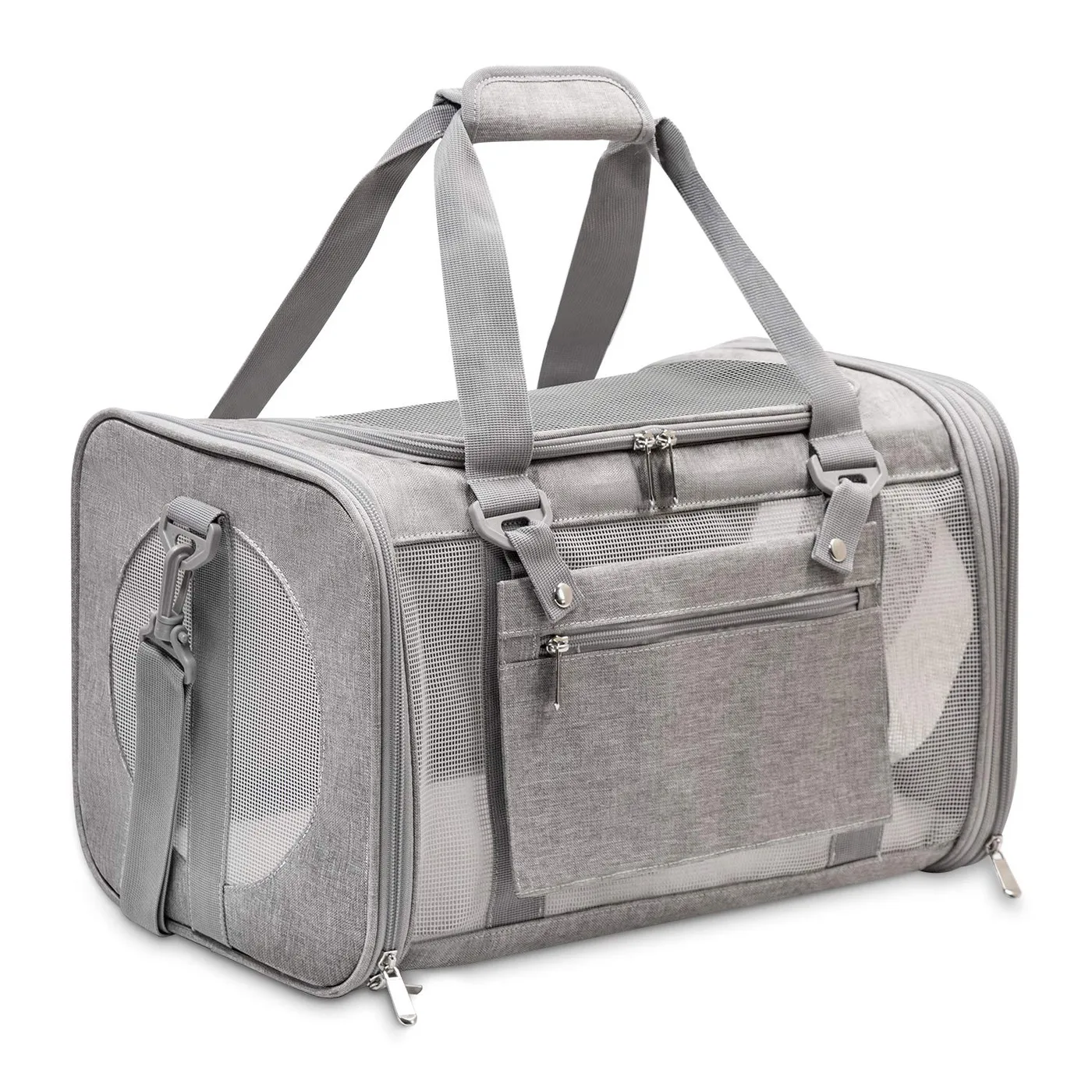
A convertible cat carrier carries a 5 kg cat plus 1.2-1.6 kg of product through two shoulder straps of 45-65 mm width, anchored to the shell at points rated to 600 N each and padded to keep contact pressure under 4 N/cm². The straps must convert to shoulder and hand carry without any anchor being re-loaded in a direction it was not designed for.
This page treats the strap system of a convertible cat carrier as what it is: the structure that transfers the entire carried load from a moulded or sewn chassis into a human shoulder. The engineering questions are where the load enters the strap, how it is spread into the shell without tearing out, how the strap itself manages contact pressure, and how the same anchors behave when the product is used in its other configurations. Each has a measurable answer, and the answers interact — a wider strap lowers contact pressure but adds mass, and a stronger anchor adds stiffness that changes how the carrier sits against the back. Commercial terms follow the standard programme: MOQ 500 pieces per colourway, prototypes in 6-10 working days, bulk production 35-50 days after sample approval, final random inspection to AQL 2.5, T/T 30/70 and FOB Xiamen.
The economics of wholesale pet carriers move with carton cubage, so cat carrier programmes are quoted both by unit price and by filled container.
Load Path Engineering: From Carrier Shell to Shoulder Contact
A carried load travels from the cat, into the floor, up through the shell, out through the strap anchors, along the webbing, through the padding and into the trapezius and clavicle region of the wearer. Every interface in that chain is a place where load can be concentrated badly, and the two that matter most are the anchor and the shoulder contact.
The load case is small in absolute terms and awkward in direction. A 5 kg cat plus a 1.4 kg carrier gives roughly 63 N of static load, but walking introduces a vertical oscillation of 1.5-2.5x static at the wearer's step frequency, and a stumble or a step off a kerb produces transients of 3-5x. Design to 4x static — about 250 N total, 125 N per strap — and test to 6x, which is where the anchors separate if they are going to.
Direction is the part that gets missed. A shoulder strap on a backpack pulls down and slightly back at the top anchor and down and slightly forward at the bottom anchor; a strap on a shoulder bag pulls almost vertically; a hand-carry handle pulls down at two points with the load between them. A convertible product asks one set of anchors to serve all three, which means the anchors have to be specified for the worst direction rather than for the primary one.
The shell's role is to distribute the anchor load. Load entering a fabric panel at a single stitched point produces a stress concentration that tears at 150-300 N; the same load entering through a stiffened panel, a moulded spreader or a webbing harness that wraps the chassis reaches 600-900 N before failure. The cheap and effective answer is a harness: continuous webbing of 25 mm running from one anchor, around or through the chassis structure, to the opposite anchor, so the load path is webbing-to-webbing rather than webbing-to-fabric.
Where the chassis is moulded, the anchor should land on a boss or a rib intersection rather than on a flat panel, and the fastener should be a through-bolt with a backing plate rather than a self-tapping screw. The strap system is only as strong as the weakest interface in its load path, and in practice that interface is the anchor-to-shell joint.
Strap Geometry: Width, Curvature and Padding Compression Set
Strap geometry is an ergonomics problem with a mass constraint. The variables are width, curvature, padding thickness and padding resilience, and they trade against each other in ways that are easy to get wrong because the comfortable direction is not always the obvious one.
Width sets contact pressure directly. At a 63 N load shared between two straps, a 38 mm strap gives roughly 2.1 N/cm² over its effective contact length and a 50 mm strap gives 1.6 N/cm² — both acceptable. The complication is that a strap wider than 65 mm starts to bind at the neck and rides onto the trapezius in a way that is uncomfortable for shorter wearers, so the working band is 45-65 mm for the adult range and 32-45 mm where the product is sized for smaller frames.
Curvature is more important than width and more often ignored. A strap that runs straight from the top anchor to the bottom anchor leaves the shoulder blade and cuts into the neck; an S-curve that brings the strap's upper section inward by 25-40 mm over its first 200 mm keeps it on the trapezius and off the brachial plexus. The curve has to be built into the strap rather than expected to form on its own, which means a pre-formed padding core or a curved webbing lay.
Padding thickness has a limit and the limit is lower than designers expect. Above 12-15 mm of foam the strap becomes a tube that rolls on the shoulder and shifts under load; the working range is 8-12 mm of closed-cell EVA or a laminated foam at 45-60 kg/m³ density. Padding that is too soft bottoms out under load and provides no pressure reduction at all, which is why density matters more than thickness.
Compression set is the specification that determines whether the strap still works after a year. A foam that loses more than 15% of its thickness after 100,000 compression cycles at 40% deflection has effectively stopped padding. Closed-cell EVA of 45-60 kg/m³ typically loses 6-12%; low-density open-cell polyurethane loses 20-35% and should not be specified. The test is a compression set rig rather than a visual check.
Breathability at the contact surface is the last variable. A strap carrying a warm load against a shoulder for 30 minutes will sweat, and a non-woven spacer fabric of 3-5 mm over the padding costs 0.20-0.50 USD per strap and changes the perceived comfort more than any other single addition. Strap comfort is a pressure and geometry problem, and curvature buys more of it than padding does.
Anchor Detail: Webbing, Bar-Tacks and Load-Spreader Patches
Anchors fail by tear-out, by stitch shear or by hardware pull-off, and each failure has a specific remedy that costs very little if it is applied at design and a great deal if it is applied as a running change. The specification should name the construction, the stitch pattern and the acceptance load.
Webbing choice comes first. A 25 mm polyester webbing at 1.2-1.6 mm thickness has a breaking strength of 4-8 kN, which is far above any load the strap will see — so webbing strength is never the issue. The issue is how that webbing is joined to the shell. A webbing end stitched onto a single fabric panel with a straight stitch tears out at 150-300 N; the same end with a load-spreader patch reaches 500-700 N; the same end wrapped around a structural member and bar-tacked reaches 700-1,000 N.
| Construction | Stitch pattern | Pull-out load (N) | Added cost (USD) |
|---|---|---|---|
| Webbing end, straight stitch to panel | 2 rows, 8 spi | 150-300 | 0.00 |
| Plus load-spreader patch 80 x 80 mm | 2 rows + perimeter | 450-650 | 0.12-0.25 |
| Plus box-X bar-tack over 20 mm | Box-X, 42 stitches | 600-850 | 0.05-0.10 |
| Wrapped around structural member | Box-X + perimeter | 700-1,000 | 0.15-0.35 |
| Through-bolt to moulded boss | Bolt M5, backing plate | 900-1,400 | 0.30-0.70 |
Stitch pattern matters as much as construction. Straight rows of stitching load sequentially and the first row takes most of the load; a box-X pattern loads all its stitches together and is worth 25-40% on pull-out for no material cost. Stitch density should be 8-10 stitches per inch — higher density perforates the fabric and reduces its tear strength, which is the opposite of what is intended.
Load-spreader patches should be specified by area and grammage rather than left to the sample maker. A patch of 200-300 g/m² coated fabric at 80 x 80 mm minimum, with its edges bound or turned rather than raw, spreads the anchor load across a panel area large enough that the fabric's tear strength governs rather than the stitch line's.
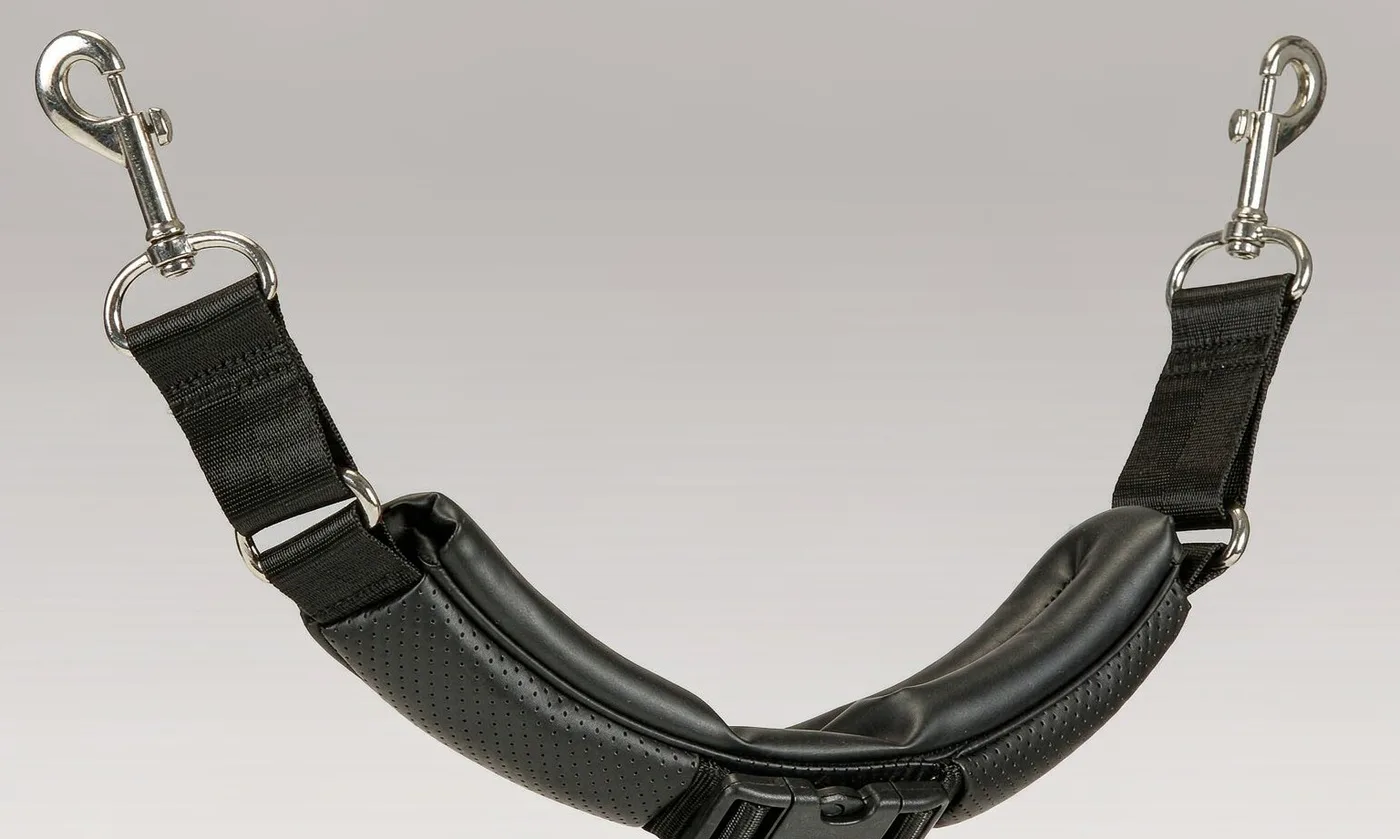
Hardware at the anchor — D-rings, triglides, ladderlocks — should be rated above the stitch construction, because there is no value in a 1,000 N D-ring on a 400 N seam. A 25 mm steel or alloy D-ring rated to 1.5-2.5 kN costs 0.25-0.70 USD and is the correct partner for a bar-tacked anchor. Polymer hardware rated to 0.8-1.2 kN is adequate only where the anchor construction itself is below that.
Verification is a pull test in the wearing direction rather than in line with the webbing. A fixture applying 250 N at 45 degrees to the panel for 60 seconds, with acceptance of no stitch elongation above 2 mm and no tear initiation. An anchor is a system of webbing, stitch pattern, spreader and hardware; specifying one without the others produces a number that does not survive contact with a real load.
Sternum Strap, Load Lifters and Adjustment Range
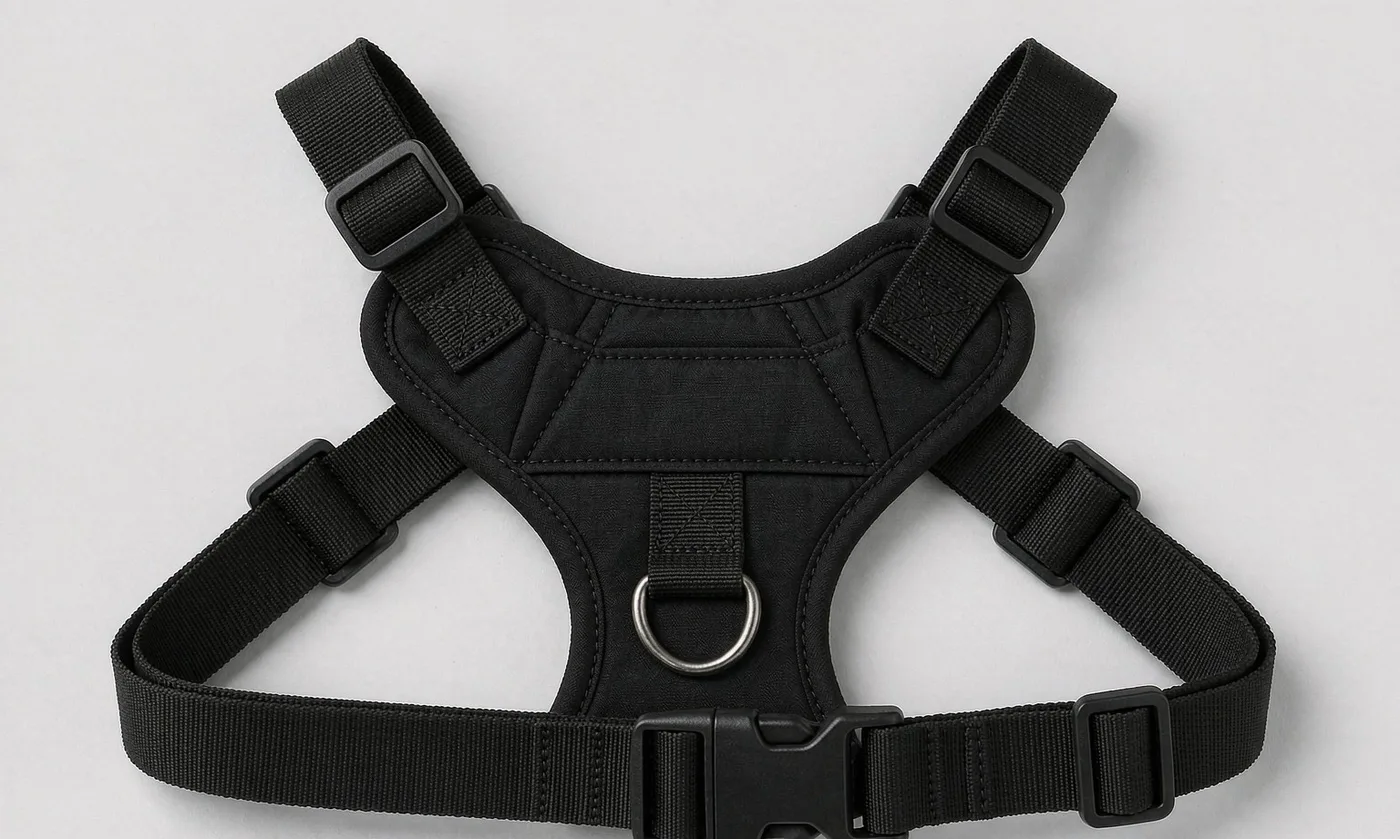
A two-strap system on a soft or semi-rigid chassis behaves differently from one on a framed backpack, because the chassis does not hold the straps apart. Without a sternum strap and load lifters, the straps slide outward and off the shoulders; with them, the system carries like a pack and the difference is immediately perceptible.
The sternum strap is the primary control. It ties the two shoulder straps together across the chest at a height of 100-180 mm below the clavicle, and it is what keeps the straps on the trapezius. Specification is a 15-20 mm webbing with a ladderlock or a side-release buckle, adjustable over 80-140 mm of range so it suits different chest depths, and attached to the shoulder straps by a sliding sleeve rather than a fixed stitch so its height can be adjusted.
Load lifters are the second control and the one usually omitted on cost grounds. A strap of 15 mm webbing running from the top of each shoulder strap forward and up to the chassis pulls the load back toward the wearer's centre of mass, which reduces the moment on the lower back. On a pet carrier the benefit is smaller than on a hiking pack because the load is low and close, but it is still measurable: 10-20% reduction in perceived effort over a 20-minute carry.
Adjustment range should be specified against a population rather than chosen by eye. A shoulder strap with 350-500 mm of usable adjustment covers the 5th to 95th percentile adult torso range for a carrier worn on the back; below 300 mm the product will not fit both a small and a large wearer. Buckle placement matters too: a ladderlock positioned where the wearer's hand cannot reach while wearing the carrier is a strap that never gets adjusted.
Quick-release is a safety requirement rather than a convenience one. A wearer who needs to put the carrier down quickly — because the cat is panicking, or because they are losing balance — must be able to do it with one hand. A side-release buckle on the sternum strap and a quick-release ladderlock on at least one shoulder strap gives that, at 0.30-0.90 USD.
Webbing end treatment closes the section and is a repeated defect source. Ends should be hot-knife sealed and folded back 25-30 mm before stitching, and every adjuster should have a keeper loop to control the loose tail. The sternum strap and load lifters turn two straps into a carrying system; without them the product is a bag with straps on it.
Convertible Interfaces: Backpack, Shoulder and Hand-Carry in One Chassis
Convertible means one set of anchors serving several configurations, and the engineering risk is that a configuration the designer did not draw gets used anyway. Every anchor on a convertible product should be evaluated in every configuration, not just in the advertised one.
The common conversions are backpack to shoulder bag, backpack to hand-carry, and shoulder bag to hand-carry. Backpack-to-shoulder is achieved either by clipping the two shoulder straps together into a single sling strap, or by unclipping one strap entirely and stowing it. The clipping route is cheaper and keeps a spare strap hanging; the unclipping route gives a cleaner result and needs a stowage solution for the detached strap — a zip pocket or a hook-and-loop wrap — or the loose strap becomes a snag hazard.
Hand-carry is where convertible products are weakest. A carrier designed as a backpack usually has its handle on the top edge, which is fine for lifting and poor for carrying: the chassis hangs at an angle that puts the cat against the wearer's leg and puts the load on one hand at a poor leverage. A second handle on the side or end, at 120-160 mm length with a padded wrap, costs 0.60-1.40 USD and makes the hand-carry configuration genuinely usable.
Anchor re-loading is the specific risk. In backpack mode the top anchors are loaded downward and backward; in shoulder-bag mode the same anchor is loaded almost vertically and at a different angle; in hand-carry mode it may be loaded sideways. An anchor built for the first case can fail in the third at 40-60% of its rated load, which is why the test protocol should include a diagonal and a lateral pull on each anchor and not only an axial one.
Stowage of the unused configuration is a real design item. Straps that cannot be stowed get dragged, catch on doors and are reported as defects. A stowage pocket sized at 1.5x the packed strap volume, with a closure that will not open under the strap's own spring, costs 0.40-1.00 USD and removes an entire class of complaint.
Label and instruction clarity is the closing requirement. A convertible product should carry a small diagram on a permanent label showing the three configurations and which anchors are loaded in each, because the configuration that fails is usually the one the owner improvised. Convertibility adds configurations, and each configuration is a new load case on anchors that were designed for one.
Fit Range, Pressure Mapping and Ergonomic Validation
Ergonomic validation is the step most carrier programmes skip, and it is the only way to know whether a strap system actually works. Two instruments carry most of the information: a pressure mapping mat at the shoulder and a simple perceived-exertion protocol with real wearers.
Pressure mapping measures interface pressure between strap and shoulder across a sensor array. The acceptance criterion for a carried load of this size is a mean contact pressure under 4 N/cm² and a peak under 8 N/cm², with no single sensor cell above 10 N/cm². Those figures are derived from sustained-comfort work on loaded straps and they are achievable: a 50 mm S-curved strap with 10 mm of 50 kg/m³ EVA typically maps at 2.4-3.4 N/cm² mean.
Hot spots are diagnostic. A peak at the neck end of the strap indicates insufficient curvature; a peak at the lower edge indicates the strap is too narrow or the padding is bottoming out; a broad high-pressure band across the whole strap indicates the load is not being shared with the sternum strap or the hip region. Each has a different remedy, which is why a map is more useful than a single number.
Fit range testing uses a panel rather than a single wearer. Five to eight subjects spanning the 5th to 95th percentile torso length carry the loaded carrier for 15 minutes and report perceived exertion on a standard scale, with the strap adjustment recorded for each. Acceptance is no subject reporting a hot spot, no subject unable to achieve a stable fit, and the full adjustment range used across the panel rather than concentrated at one end.
Dynamic testing completes the set. Walking on a treadmill at 4-5 km/h for 15 minutes with the loaded carrier, logging shoulder pressure continuously, shows whether the load oscillates in a controlled way or slams: peak-to-mean pressure ratio should stay under 2.5. A ratio above that indicates the chassis is moving relative to the wearer, which is usually a compression strap or load lifter problem rather than a padding one.
Occupational and welfare framing for carried loads is commonly cross-checked against published guidance from the American Veterinary Medical Association, and textile components in contact with skin are screened against OEKO-TEX criteria. Ergonomics is measurable; a strap system validated by pressure map and wearer panel is a different product from one validated by opinion.
Static and Dynamic Load Testing of the Strap System
Strap systems are tested in two regimes because they fail in two ways: statically by tear-out at the anchor, and dynamically by fatigue at the stitch line and by hardware wear. Both are cheap tests and both should be on the release protocol.
Static testing applies load in the wearing configuration rather than in line with the webbing. The carrier is loaded to 10 kg, suspended from a fixture by its straps, and held for 60 seconds at 4x — roughly 400 N total. Acceptance is no stitch elongation above 2 mm, no tear initiation at any anchor, no hardware deformation, and no permanent set in the chassis.
A diagonal and a lateral set are run at 60% of the axial figure, because those are the directions an improvised configuration produces. An anchor that passes axially and fails laterally at 150 N is a product that will fail in a customer's hands, not in the lab.
Dynamic testing runs a cyclic load representing walking: 1.5x static at 1.5-2 Hz for 20,000 cycles, which is roughly ten hours of continuous wear. Acceptance is no stitch breakage, no elongation above 3 mm, no foam compression set above 15%, and no hardware wear that changes adjustment behaviour. A second set is run with the load increased to 3x at 1 Hz for 2,000 cycles to represent stairs and uneven ground.
Hardware-specific tests close the protocol: a slider slip test in which each adjuster is loaded to 200 N and must not slip more than 3 mm; a buckle release force test with acceptance between 20 and 60 N, so a buckle is neither accidentally released nor impossible to open; and a webbing abrasion test at the adjuster contact, since that is where webbing wears through in service.
Conditioning follows the pattern used elsewhere in the category — a wet set, because a strap gets rained on and wet webbing behaves differently at an adjuster, and a cold set at -10 °C, because some coatings and foams stiffen. Method references for textile and conditioning practice follow published standards work at ASTM International.
Cost, Tooling and Programme Notes
A convertible strap system adds 4.20-11.80 USD to unit cost, and the spread is driven almost entirely by hardware and padding quality rather than by the webbing, which is cheap in every configuration. The breakdown: webbing at 0.60-1.40 USD, padding and spacer fabric at 1.20-3.20 USD, hardware including buckles, adjusters, D-rings and the sternum strap at 1.60-4.60 USD, load-spreader patches and reinforcements at 0.30-0.90 USD, and added assembly labour at 0.50-1.70 USD.
Tooling is minimal. Strap systems are sewn assemblies using bought webbing and hardware, so the only tooling items are cutting dies at 300-900 USD and, where padding is pre-formed, a moulding or pressing tool at 1,500-4,500 USD. That low barrier is why strap design is the most iterated part of a carrier programme and why it should be settled late enough to benefit from wearer feedback but early enough to freeze before bulk.
The best value decisions in the assembly are, in order: a box-X bar-tack instead of straight stitching, which costs nothing in material and adds 25-40% to pull-out; a sealed bearing in the wheel analogue — here, a spacer fabric over the padding, at 0.20-0.50 USD and the largest single comfort improvement; and a sternum strap, at 0.40-1.10 USD, which converts two straps into a system. The worst value is decorative hardware and over-thick padding, both of which add cost and mass without improving either strength or comfort.
Inspection additions for convertible programmes: a pull test on one anchor per lot to destruction is too aggressive, so use a proof load at 60% of the rated figure on two samples per lot, plus an adjuster slip check and a visual check that every box-X bar-tack is complete — an incomplete bar-tack is the most common sewing defect in this assembly. Our production team builds convertible programmes through the SGS-verified production base under ISO 9001 and BSCI coverage, with prototypes in 6-10 working days, bulk production 35-50 days after sample approval, final random inspection to AQL 2.5, T/T 30/70 and FOB Xiamen. A convertible carrier is three products sharing one set of anchors, and the anchors have to be specified for all three.
Order and quality terms
- MOQ 500 pieces per colourway; samples in 6-10 working days
- Bulk production 35-50 days after approval; AQL 2.5 inspection standard
- T/T 30/70 terms, FOB Xiamen, full document set per shipment
People Also Ask
How wide should cat carrier backpack straps be?
45-65 mm for the adult range. A 50 mm strap gives about 1.6 N/cm² contact pressure at a 6.4 kg total load; above 65 mm the strap binds at the neck and rides onto the trapezius for shorter wearers.
Why is an S-curved strap better than a straight one?
A straight strap leaves the shoulder blade and cuts into the neck. Bringing the upper section inward by 25-40 mm over its first 200 mm keeps the load on the trapezius and off the brachial plexus.
How thick should strap padding be?
8-12 mm of closed-cell EVA at 45-60 kg/m³ density. Above 12-15 mm the strap becomes a tube that rolls on the shoulder, and padding that is too soft bottoms out and provides no pressure reduction.
How much load can a strap anchor take?
150-300 N for a webbing end straight-stitched to a panel, rising to 600-850 N with a load-spreader patch and box-X bar-tack, and 900-1,400 N for a through-bolt to a moulded boss.
Why is a box-X stitch pattern specified?
Straight rows load sequentially and the first row takes most of the load. A box-X pattern loads all its stitches together, worth 25-40% on pull-out at no material cost.
Is a sternum strap necessary on a pet carrier?
Yes. The chassis does not hold the straps apart the way a framed pack does, so without a sternum strap the straps slide outward and off the shoulders. Specify 15-20 mm webbing adjustable over 80-140 mm.
How is strap comfort measured?
By pressure mapping at the shoulder: mean contact pressure under 4 N/cm², peak under 8 N/cm² and no single sensor cell above 10 N/cm², plus a wearer panel spanning the 5th to 95th percentile torso range.
What is the dynamic test for a strap system?
1.5x static load at 1.5-2 Hz for 20,000 cycles, accepting no stitch breakage, elongation under 3 mm, foam compression set under 15% and no hardware wear affecting adjustment.
Frequently Asked Questions
What load case should a cat carrier strap system be designed to?
4x static, roughly 250 N total or 125 N per strap, tested to 6x. Walking adds 1.5-2.5x static at step frequency and a stumble produces transients of 3-5x.
Why is a webbing harness preferred over stitched anchors?
It makes the load path webbing-to-webbing rather than webbing-to-fabric. Continuous 25 mm webbing running between opposite anchors raises failure load from 150-300 N to 600-900 N.
Where should an anchor land on a moulded chassis?
On a boss or a rib intersection rather than a flat panel, with a through-bolt and backing plate rather than a self-tapping screw.
How much compression set is acceptable in strap foam?
Under 15% thickness loss after 100,000 cycles at 40% deflection. Closed-cell EVA at 45-60 kg/m³ typically loses 6-12%; low-density open-cell polyurethane loses 20-35% and should not be used.
What stitch density should be specified?
8-10 stitches per inch. Higher density perforates the fabric and reduces its tear strength, which is the opposite of the intent.
How should a load-spreader patch be specified?
By area and grammage: 200-300 g/m² coated fabric at a minimum of 80 x 80 mm, with edges bound or turned rather than raw.
Should anchor hardware be rated above the seam?
Not meaningfully. A 1,000 N D-ring on a 400 N seam buys nothing. Match a bar-tacked anchor with a 25 mm ring rated to 1.5-2.5 kN, and use polymer hardware only where the seam itself is below 0.8 kN.
What do load lifters add on a pet carrier?
A 10-20% reduction in perceived effort over a 20-minute carry. Less than on a hiking pack because the load is low and close, but still measurable and worth 0.30-0.80 USD.
How much strap adjustment range is needed?
350-500 mm of usable adjustment to cover the 5th to 95th percentile adult torso range. Below 300 mm the product will not fit both a small and a large wearer.
Why is a second handle recommended on a backpack carrier?
The top handle is fine for lifting and poor for carrying — the chassis hangs at an angle that puts the cat against the wearer's leg. A side or end handle of 120-160 mm with a padded wrap costs 0.60-1.40 USD.
Why should anchors be tested diagonally and laterally?
Because owners improvise configurations. An anchor built for the backpack load case can fail at 40-60% of its rating when loaded sideways in hand-carry mode.
How should detached straps be stowed?
In a pocket sized at 1.5x the packed strap volume with a closure that will not open under the strap's own spring. Straps that cannot be stowed get dragged and caught.
What peak-to-mean pressure ratio is acceptable while walking?
Under 2.5, measured over 15 minutes at 4-5 km/h. A higher ratio means the chassis is moving relative to the wearer, which is a load-lifter or compression problem rather than a padding one.
What does a convertible strap system add to unit cost?
4.20-11.80 USD, dominated by hardware at 1.60-4.60 and padding at 1.20-3.20. Webbing is cheap in every configuration; decorative hardware and over-thick padding are the worst value.
Talk to QUANZHOU JUNYUAN BAGS about a pet carrier program: MOQ 500 pieces per colourway, samples in 6-10 working days, bulk production in 35-50 days under AQL 2.5 inspection.
Get a free quote Request a sample