Dog Carrier Factory: Production Capability Checklist
A capable dog carrier factory is verified by five numbers, not by photos: fabric GSM held to ±5% per lot, strap-root pull strength above 900 N, a baseboard that survives 1.5x rated load for 24 hours without permanent set, a documented defect library with root cause, and final random inspection at AQL 2.5. Ask for the test report behind each number before you release a deposit. Working terms here: MOQ 500 pieces per colourway, samples in 6-10 working days, bulk production 35-50 days.
Executive Summary. This page is written for sourcing and quality managers who already know what they want to buy and now have to judge whether a production partner can actually make it. The checklist below follows the order in which a carrier is built: fabric goods-in, hardware acceptance, load-bearing structure, ventilation and thermal behaviour, the choice between sewing and high-frequency welding, the test protocol and its acceptance criteria, the defect library with corrective actions, and finally the line-scheduling arithmetic that decides whether your delivery date is real.
Programme terms across the QUANZHOU JUNYUAN BAGS production network are fixed and published: MOQ 500 pieces per colourway, samples in 6-10 working days from tech pack sign-off, bulk production 35-50 days after sample approval, and final random inspection to AQL 2.5 against a written critical/major/minor defect list. Capacity sits at 200,000 units per month across 7 partner production lines running 149 machines with a 137-person team inside an SGS-verified production base of 4,950 m2. Pet carrier programmes have run since 2014, with the founding team in sewn goods since 2004. Systems are audited to BSCI and ISO 9001. Commercial terms are T/T 30/70, FOB Xiamen. Everything else on this page is the engineering detail that sits inside that frame - and it is where two suppliers quoting the same unit price stop being equivalent.
What Production Capability Actually Means on a Carrier Line
Capability in this category is not a wide photograph of a sewing floor. It is the set of measurable limits a dog carrier factory can hold while running: how tightly it holds fabric weight from lot to lot, what pull force its strap roots survive at the bartack, how many units a line can release per day before the defect rate moves, and whether the same pattern returns the same dimensions on a reorder placed nine months later. All four are testable, and a production partner worth a deposit should produce the record for each in an afternoon.
The line breaks into seven stations, each with a failure mode that surfaces in the field rather than in the factory. Cutting decides panel geometry and whether a printed logo lands in the same place on every unit. Skiving prepares the edges that will later be bound or welded; a skive 0.3 mm too deep removes the coating and turns a seam into a wick. Printing and embroidery generate the most common cosmetic rejection in the category when registration drifts 2 mm across a curved panel. Sub-assembly builds pockets, mesh windows and strap roots before they disappear inside the shell, which is why a defect made here is never caught later. High-frequency welding joins coated panels where water resistance is specified. Main assembly closes the shell and sets the baseboard channel. Finishing trims, presses, inserts the board and packs to the carton specification that fixes your freight cost per unit.
Quality is gated between those stations rather than at the end. Gate one is goods-in, where fabric, webbing and hardware are checked against the tech pack before release to cutting. Gate two is in-process, where the first ten pieces off the line are measured against the approved sample and the line is released or stopped. Gate three is final random inspection before carton close. Gates one and two are where a dog carrier factory either controls its output or merely inspects it; a supplier with only gate three finds the defect after ten thousand units are already cut.
Capacity claims deserve the same scepticism. Monthly output is only meaningful with the product mix stated, because a structured backpack-style carrier consumes roughly three times the line minutes of a simple tote. The 200,000-unit monthly figure assumes a blended mix across 7 lines and 149 machines; a programme made entirely of structured welded carriers should plan on less. Product context sits on the dog carrier backpack hub.
One more capability signal is boring and reliable: pattern retention. Ask how long the graded pattern and cutting die stay on file with mill lot references attached. A dog carrier manufacturer that can pull a two-year-old pattern card and a signed bulk swatch will match your reorder; one that redevelops the pattern drifts, and the drift arrives as a fit complaint.
Checklist takeaway: judge a dog carrier factory on the four numbers it can document - GSM tolerance, strap-root pull force, daily output at a stated product mix, and pattern retention period.
Fabric Goods-In: Denier, GSM and Coating Verification
Denier is the number buyers ask for and the number that tells you the least, because it describes the yarn, not the cloth. Two fabrics both sold as 600D polyester can differ by 25% in finished weight and by a factor of three in abrasion life: one is a plain weave at 235 gsm with a 0.30 mm PU back-coat, the other a looser weave at 180 gsm with a 0.18 mm coat. What the tech pack needs is all three variables - yarn denier, weave construction and finished GSM with a stated tolerance.
For soft pet carriers the working range is 300D to 900D. Below 300D the face fabric snags on claws, print registration distorts across a curved panel, and the shell creases permanently in carton. Above 900D the cloth becomes stiff enough to fight the pattern at tight corner radii, adds 90-130 g to a product where weight is often a marketing claim, and resists the folding a collapsible design depends on. 600D remains the default because it is the point where tear strength, weight and cost stop pulling against each other.
| Parameter | 300D polyester | 600D polyester | 900D polyester |
|---|---|---|---|
| Finished weight | 150-175 gsm | 210-245 gsm | 285-330 gsm |
| Typical coating | PU 0.18-0.22 mm | PU 0.28-0.35 mm | PU 0.35-0.45 mm + DWR |
| Hydrostatic head | 300-500 mm | 800-1,200 mm | 1,500-3,000 mm |
| Martindale abrasion | 8,000-12,000 cycles | 20,000-28,000 cycles | 35,000-50,000 cycles |
| Tear strength, warp | 25-35 N | 40-55 N | 60-85 N |
| Best application | Light linings, small-pet shells | General dog carrier shells | Large-dog and hiking platforms |
| Cost index (600D = 100) | 72 | 100 | 138 |
Coating chemistry is the second half of the decision and the half more often wrong. PU coating is flexible, light and reasonably breathable, but it hydrolyses: in a hot humid warehouse a polyester-based PU coat can break down within 12-24 months, presenting first as a tacky surface, then flaking, then a powdery residue through the carton. PVC is cheaper and highly abrasion resistant but carries plasticiser scrutiny under EU chemical rules and stiffens below 5 °C. TPU laminate is the premium answer - it resists hydrolysis, stays flexible cold and welds cleanly - but roughly doubles fabric line cost. Restricted-substance screening follows the ECHA candidate list for EU-bound goods, and many buyers also require OEKO-TEX certification.
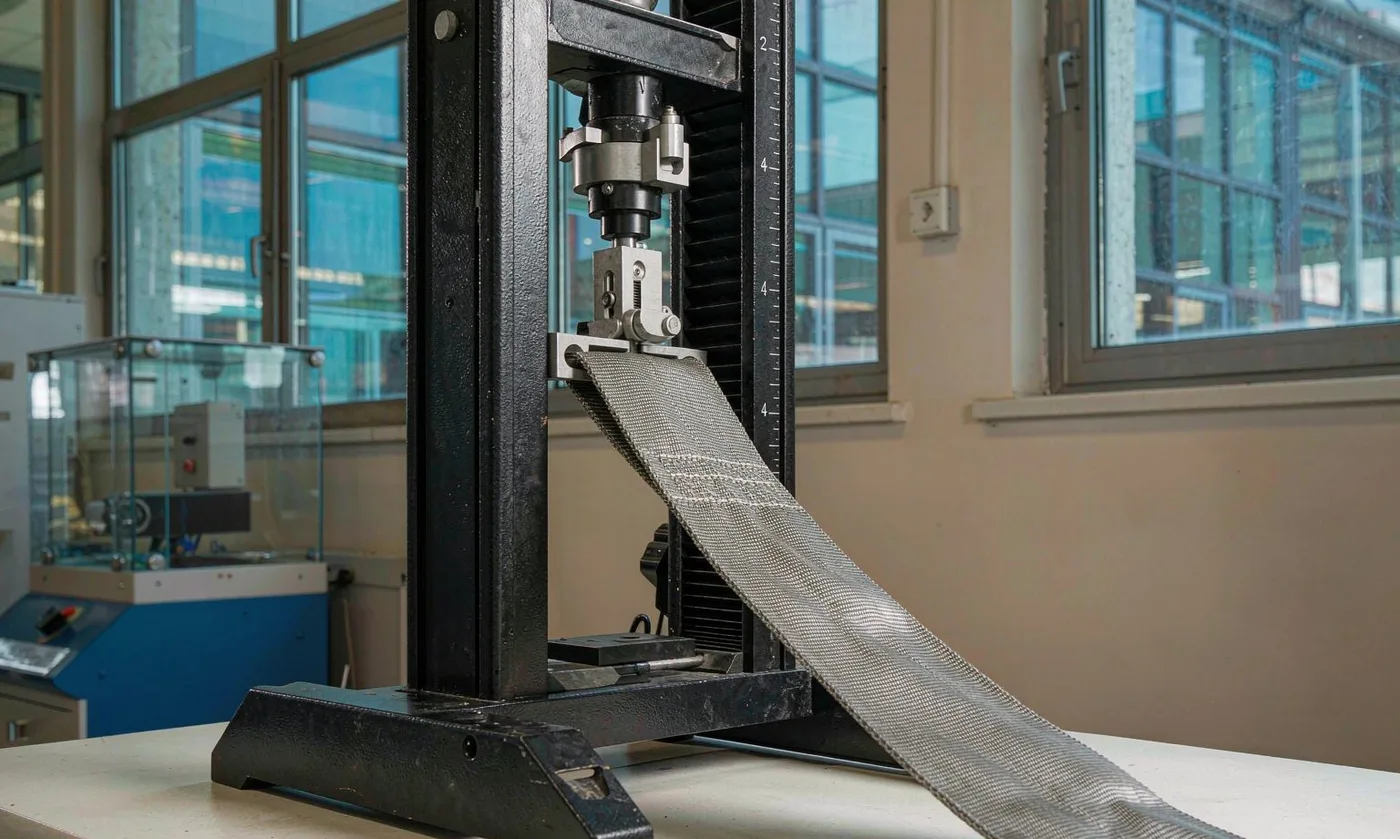
Goods-in procedure should be written, not implied. Receiving inspection for fabric is: verify the mill lot against the purchase order; weigh three swatches cut from different positions across the roll width and reject outside ±5% of the specified GSM; run a hydrostatic head check per roll end; and retain a signed swatch from the bulk lot beside the approved sample in the tech pack file. Fabric is typically 22-30% of FOB and is the line item most often silently substituted between sample and bulk, so that retained swatch is the only cheap insurance available.
Any dog carrier factory that treats fabric as a catalogue pick rather than a specification will eventually ship a carrier that looks identical and fails at month nine. A pet bag supplier running this discipline retains swatches from every bulk lot, which is what makes a shade or weight dispute resolvable months later. The shell options are compared in the materials comparison guide; what matters on the line is that the incoming roll matches the number written in the pack.
Checklist takeaway: specify denier, weave and GSM together, hold weight to ±5%, and retain a signed bulk swatch per lot - fabric substitution between sample and bulk is the most common silent downgrade in this category.
Hardware Specification: Zippers, Buckles and Webbing
Hardware is 8-14% of FOB cost and it generates a disproportionate share of field complaints, because hardware failures are binary. A strap that is 20% too weak still works for months; a slider that slips or a buckle that cracks fails on the first outing, in public, with the customer's dog inside. Treat every hardware item as a tested component with a written acceptance value rather than a description.
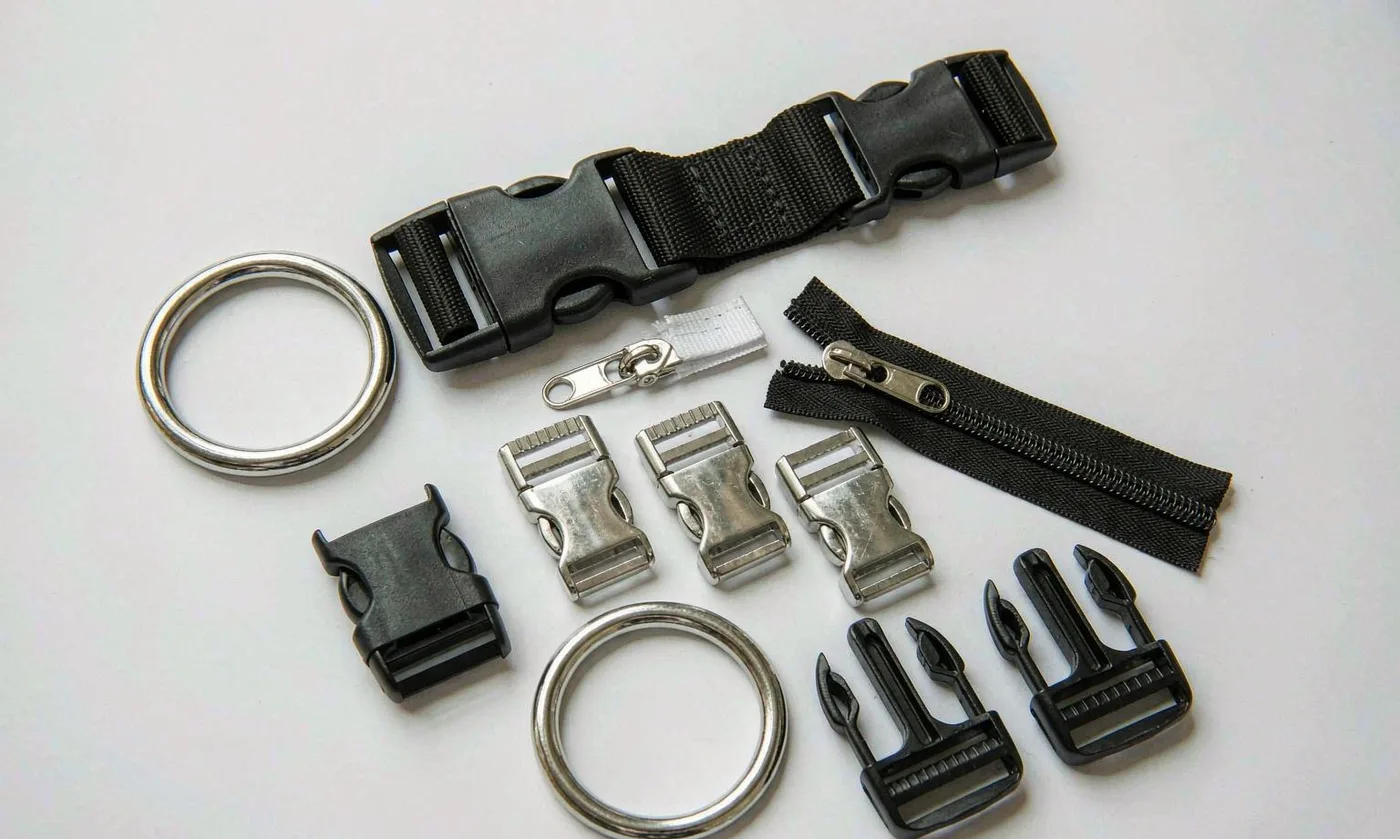
Zippers are specified by chain type, gauge and tape. For a pet carrier main opening, #5 coil is the minimum and #8 the sensible default; #8 reverse coil is used where a water-resistant tape is specified, because it hides the chain and lets a storm flap seal against the tape rather than against the teeth. Metal chain looks premium but is heavier, jams on hair and lining fabric, and conducts heat. Sliders need a pull and, where the entry panel is a claw zone, an auto-lock or garage so the dog cannot nose it open. Acceptance testing is a reciprocating cycle test to several thousand open-close cycles plus a lateral pull on the closed chain; durability methods for textile hardware are published by ASTM.
| Component | Entry specification | Core specification | Test and acceptance |
|---|---|---|---|
| Main zipper | #5 coil, polyester tape | #8 reverse coil, water-resistant tape | 3,000-5,000 cycles, no chain separation; lateral pull >300 N |
| Side-release buckle | POM acetal, 25 mm | POM acetal, 32-38 mm | Engagement pull >500 N; 500 open-close cycles |
| Load-path hardware | Zinc alloy die-cast | Aluminium or steel at 38-50 mm | Pull >900 N; salt spray 24-48 h, no red rust |
| Webbing | Polyester 25 mm, 600 daN | Polyester 38 mm, 900 daN | Tensile break >900 daN; elongation <6% at working load |
| D-rings / triglides | Zinc alloy, 2.5 mm section | Zinc alloy, 3 mm section | Pull >400 N; salt spray 24 h |
| Thread | Bonded polyester Tex 40 | Bonded polyester Tex 70 | Seam efficiency >80% of shell tear strength |
Buckle material is a genuine engineering choice rather than a price signal. Acetal (POM) side-release buckles are self-lubricating, quiet and cold-tolerant, and they are correct for 25-32 mm positions. At 38 mm and above, particularly on the shoulder load path of a large-dog carrier, die-cast zinc or aluminium resists creep better, though it needs a plating specification and a salt-spray acceptance line or it will bloom in a coastal warehouse. Nylon webbing has a softer hand but stretches 8-12% at working load, which changes how a loaded carrier sits after twenty minutes of walking; polyester holds its width and is the default for any load path.
Webbing width is the cheapest structural upgrade available. Moving from 25 mm to 38 mm on a shoulder strap adds roughly $0.18 of material, spreads pressure across the wearer's shoulder, and roughly triples the load at which the strap root becomes the weak link. That is why any dog carrier backpack manufacturer building for the 15 kg and above band should be quoting 38-50 mm webbing on the load path as standard rather than as an upgrade.
The finishing step most often skipped is edge treatment. Cut webbing ends must be heat-sealed or folded back and bartacked; a raw cut end frays, and a frayed end eventually pulls out of a ladderlock. A dog carrier factory should carry this on the inspection sheet as a critical defect, not a cosmetic one.
Checklist takeaway: every hardware item gets a gauge, a material, a test method and a numeric acceptance value; anything specified as "reinforced" or "heavy duty" is untestable and will be value-engineered.
Load-Bearing Structure: Baseboard, Webbing Width and Frame
Structure is where the load case meets the bill of materials. A pet carrier is a suspended platform: the animal's mass presses on a base panel supported only at its perimeter, while the reaction is carried up through a webbing path to the wearer's shoulders. Both halves need engineering, and the failure modes differ - the base sags, the webbing path tears out.
Baseboard selection runs from 4 mm EVA through 8 mm PE board to 10 mm honeycomb polypropylene. The decision is stiffness against weight against cost, and the useful test is deflection under a stated load rather than material name. For the 3-8 kg band, 4-5 mm EVA with a perimeter frame is adequate and keeps the unit packable. For 8-15 kg, 6-8 mm PE board is the cost-effective answer, still paired with perimeter reinforcement. For 15 kg and above, 8-10 mm honeycomb PP gives the best stiffness-to-weight ratio, costs roughly 2.4x an 8 mm PE board, and needs a sewn channel with a bound edge rather than a slip pocket.
Perimeter reinforcement is the cheapest structural control in the whole product and the one most often skipped. Folding the shell over an internal 25 mm webbing band and sewing it into the base seam converts the perimeter from a hinge into a beam. It costs under $0.20 in material and roughly doubles the load at which the panel starts to dish; upgrading the board without it means paying for stiffness the product never receives.
Webbing width on the load path follows the mass band: 25 mm for small pets, 32 mm for the 8-15 kg band, 38-50 mm for large dogs. Width matters twice - for tensile capacity, which is rarely the limiting factor, and for wearer comfort, which usually is. A 25 mm strap carrying 12 kg concentrates roughly 1.4 N/mm2 on the trapezius; at 38 mm that drops below 0.6 N/mm2, which is the difference between a carrier that gets used and one that lives in a cupboard.
Verification is straightforward and belongs in the protocol. The static load test applies 1.5x the rated pet mass to the base panel for 24 hours, then measures residual deflection after a 30-minute recovery: acceptance is under 5 mm of permanent set and no delamination at the board edges. The dynamic test drops the loaded carrier from 0.9 m onto concrete in three orientations - base, side and corner - accepting no strap-root separation, no buckle fracture and no seam opening above 10 mm. Where a carrier is marketed for vehicle travel, add a restrained-transport test; the methodology published by the Center for Pet Safety is the reference most US retailers recognise. Base options are covered further in the bottom reinforcement notes.
Checklist takeaway: specify board material and thickness per mass band, always pair it with a perimeter frame, and ask a dog carrier manufacturer to accept lots only on measured residual deflection after a 1.5x static load - not on how stiff the sample feels in your hand.
Ventilation Geometry, Airflow and Thermal Testing
Ventilation is sold as a percentage of mesh area, but the number that governs thermal comfort is the convective path. A carrier with 38% open area split into six small panels can run hotter than one with 24% arranged as two large panels on opposing walls, because cross-flow needs an inlet and an outlet at different pressures and heights. The practical rule is an inlet low on the front or lower side wall, an outlet high on the opposite wall, and a clear internal air path of at least 60 mm that the baseboard does not block.
Mesh selection is a durability problem more than a comfort one. Standard polyester tricot at 60-80 gsm claws out within weeks of contact with an anxious dog. Air mesh at 180-260 gsm resists claws and holds shape but restricts flow by roughly 30% at equal open area, because the knit structure is denser. The compromise used on most well-built carriers is a 210 gsm air mesh below the claw line with a lighter mesh above it, or a single 3D spacer mesh at 250 gsm with 3 mm loft, which delivers airflow and cushioning in one component. Specify mesh by gsm and claw-snag rating, not by colour.
Smoke testing is the cheapest way to see the convective path, and it belongs on the development line rather than in a laboratory. A smoke pencil held 30 mm from the lower inlet shows within seconds whether air crosses the cabin or merely swirls at the inlet; if the smoke hugs the wall and drifts back out, the panel layout is wrong regardless of the stated open-area percentage. Repeat with the outlet covered to simulate a carrier pushed against a car seat or a wearer's back, since that is the configuration in which most complaints occur.
Thermal load should be estimated rather than guessed. A 10 kg dog at rest dissipates roughly 35-45 W; confined in a carrier with limited convection, internal air temperature can rise 6-11 °C above ambient within twenty minutes in direct sun. That is why dark shells are a liability on a product marketed for warm climates and why a light-coloured top panel is an engineering control rather than a styling preference. Heat-risk wording for animals in confined carriers should follow the veterinary guidance published by the American Veterinary Medical Association, written into the tech pack rather than added at the last minute.
Two further acceptance items belong here. Fastener access: any mesh panel that opens must close with a mechanism a dog cannot work from inside, and the pull test on that closure is a safety test. Sightline: mesh on only one wall leaves a dead zone behind the animal's head, so require at least two opposing ventilated faces.
Checklist takeaway: specify inlet and outlet positions, a 60 mm minimum internal air path, and mesh by gsm plus claw resistance; have a dog carrier factory verify the convective path with a smoke pencil in the blocked-outlet configuration before the sample is approved.
Joining Process: Sewing Versus High-Frequency Welding
The choice between needle and electrode is the most consequential process decision on a modern pet carrier, and it is usually made by default rather than by analysis. Sewing is flexible, forgiving of material variation and cheap to set up. High-frequency welding fuses thermoplastic-coated faces into a continuous bond with no perforations, the only way to make a seam genuinely watertight - but it works only on materials that respond to a radio-frequency field and it locks the design to a specific electrode.
Where High-Frequency Welding Earns Its Cost
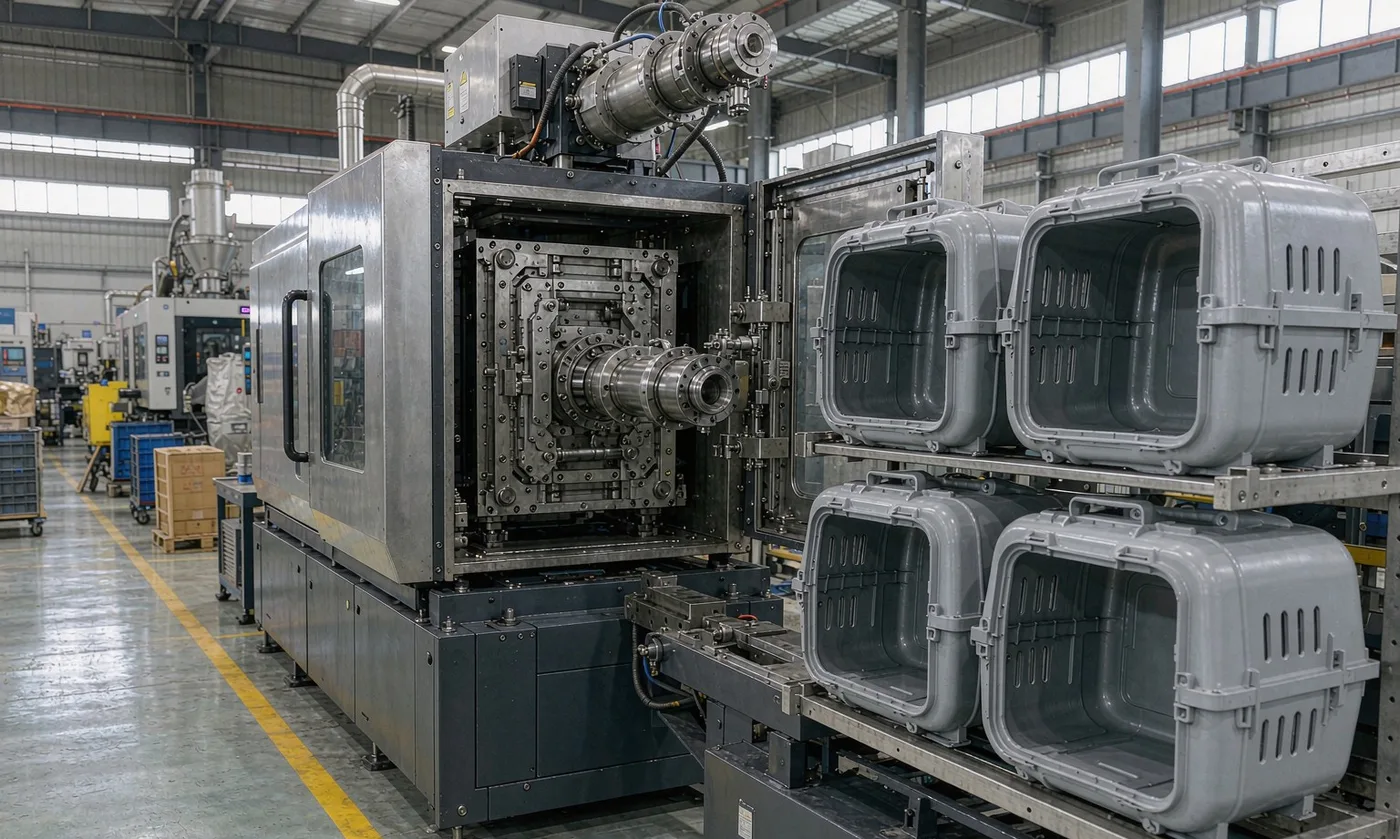
HF welding places the coated faces between a shaped electrode and a ground plate and applies a 27.12 MHz field for a controlled dwell of 0.6-1.4 seconds. The PVC or TPU coating melts, the faces fuse, and the bond is continuous. It applies wherever liquid ingress is specified: the lower 120-150 mm of a shell set down on wet ground and the seam around a removable washable liner.
The economics are specific. Welding removes the needle perforations that are the usual leak path and the seam tape sewing would otherwise require, and produces a flat joint that reads as premium. Against that: each seam geometry needs its own electrode, a cost and lead-time item; the process window is narrow, so coating variation beyond about 0.05 mm across a lot changes bond quality; and PE and PP do not weld at all. A dog carrier factory running welded seams should show a peel or shear bond-strength record from the production lot, not only from the development sample.
Where the Needle Still Wins
Sewing remains correct for structural joints, for anything three-dimensional, and for any seam that must be repairable or adjustable. A strap root carries load in shear and peel, and a sewn box stitch with a bartack at the load corner distributes that load across the panel, whereas a welded bond concentrates it at the bond line and fails progressively. Corners, gussets and channel closures are three-dimensional problems a flat electrode handles badly, and a worn electrode yields a bond that looks correct and peels in the field.
When sewing is specified, the stitch is a parameter: bonded polyester at Tex 70 for structural seams, Tex 40 for binding, at 8-10 stitches per inch. Below 7 spi there is enough perforation to weaken the shell and let water track the seam; above 11 spi the needle cuts the base yarns. Bind the interior seams, turn them at the base, and bartack wherever load enters a panel.
Most programmes use both: weld the lower shell seams and the liner pocket, sew the load path and the baseboard channel, and bind every internal raw edge. Make the decision at tech pack stage and draw it, because a line that discovers the requirement after cutting defaults to whatever is on the bench. Then record the parameters - weld dwell and electrode identity, or thread ticket and SPI - since those are what let a dog carrier factory reproduce a lot later.
Checklist takeaway: weld for watertightness on flat, coated, low-stress seams; sew for structure, corners and load entry; never leave the joining method implicit in the tech pack.
Test Protocol and Acceptance Criteria
A test protocol is only useful when every line has a method, a numeric acceptance value, a sample size and a frequency. "Passes inspection" is not a protocol. What follows is the set a pet carrier manufacturer should be able to run or commission, and the values that separate a defensible product from a hopeful one. Methods referenced to ISO and ASTM standards should cite the specific standard number in the tech pack rather than the organisation, because the number is what the laboratory will quote against.
| Test | Method summary | Acceptance criterion | Frequency |
|---|---|---|---|
| Static load, base | 1.5x rated mass on the base panel, 24 h | Residual deflection <5 mm after 30 min recovery; no board delamination | Per development, then per 10,000 units |
| Drop test | Rated mass, 0.9 m onto concrete, base/side/corner | No strap-root separation, no buckle fracture, seam opening <10 mm | Per development, then quarterly |
| Strap-root pull | Tensile to failure at the bartack | >900 N on the load path; failure in webbing, not in stitch | Per lot, 3 pieces |
| Zipper cycle | Reciprocating open-close on the main chain | 3,000-5,000 cycles with no chain separation or slider slip | Per hardware lot |
| Salt spray | Neutral salt spray on metal hardware | No red rust after 24-48 h | Per hardware lot |
| Coating hydrolysis | 70 °C at 95% RH, 7-14 days | No tackiness, no flaking, no loss of hydrostatic head >15% | Per fabric lot, annually |
| Colour fastness to rubbing | Dry and wet crock | Grade 4 minimum on shell, grade 3-4 on prints | Per fabric lot |
| Hydrostatic head | Water column on coated face | ≥800 mm for light rain claim, ≥1,500 mm for waterproof claim | Per roll end |
| Weld bond strength | Peel or shear across the welded seam | Bond strength ≥80% of base fabric tear strength | Per production lot, 3 pieces |
| Final random inspection | AQL 2.5 general level II | Majors and minors within acceptance numbers; zero criticals | Per shipment, before carton close |
Two items on that list deserve emphasis because they are the ones buyers drop. Hydrolysis testing is slow and therefore unpopular, but it is the only test that predicts the failure your customer actually experiences - a carrier that has sat in a garage or a container for a year and comes out of the box tacky. Seven days at 70 °C and 95% RH is a reasonable accelerated screen; a pet carrier manufacturer that has never run it cannot know whether its coating survives your distribution chain.
The second is the strap-root pull, specifically the failure mode. The pull test is only informative if the failure location is recorded: if the webbing breaks, the stitch is stronger than the strap and the joint is correctly engineered; if the stitch tears out of the panel, the bartack or the panel reinforcement is undersized and no heavier webbing will fix it. Record the failure mode, not just the number.
Documentation closes the loop. Each shipment leaves with a lot-referenced test pack: fabric mill report with lot number, hardware pull and salt-spray records, first-piece measurement sheets, and the final inspection report with the defect list and actual accept/reject counts. The full framework is set out in the quality assurance reference.
Checklist takeaway: a protocol without method, number, sample size and frequency is a wish list; a dog carrier factory should be required to produce the hydrolysis result and the strap-root failure mode in particular.
Defect Library: Root Cause and Corrective Action
Every recurring defect in this category has a known root cause and a known corrective action, and the value of writing them into a defect library is that the line can classify what it sees instead of guessing. What follows is the set that accounts for the large majority of returns and rejections on soft pet carriers, and it is the document a dog carrier manufacturer should be asked to produce during any technical audit.
| Defect | Root cause | Corrective action |
|---|---|---|
| Baseboard collapses into a hammock | Board thickness under-specified for the mass band and no perimeter frame, so the panel is supported only at the seam line | Move to 8 mm PE or 10 mm honeycomb PP; fold a 25 mm webbing band into the base seam to turn the perimeter into a beam |
| Webbing curls along its length | Nylon stretched under load, or polyester cut off-grain and heat-sealed too hot | Specify polyester on load paths; cut on grain; lower sealing temperature and check edge curl after 24 h conditioning |
| Coating turns tacky, then flakes | Hydrolysis of polyester-based PU in hot humid storage, accelerated by cartons packed before the coating has cured | Move to TPU laminate or polyether-based PU; extend cure time before packing; add desiccant for sea freight |
| Zipper slips open under load | Slider without a lock, chain gauge under-specified for panel tension, or tape stretched during assembly | Auto-lock sliders; #8 reverse coil on entry panels; set a tape-tension limit and add a lateral pull check in-process |
| Seam leaks at the lower shell | Needle perforations in a sewn seam with no tape and no tape-compatible coating | Convert the lower 120-150 mm to high-frequency welding, or specify tape with an adhesion test after washing |
| Mesh claws out within weeks | Tricot mesh at 60-80 gsm used in the claw zone | Replace with 210 gsm air mesh below the claw line; add a claw-snag rating to the fabric spec |
| Colour shading between panels | Panels cut from different rolls or roll positions; print run at inconsistent temperature | Nest all panels of one unit from a single roll; hold print temperature within ±3 °C; check shade under D65 lighting |
| Strap root tears out of the shell | Insufficient bartack coverage, or stitch density above 11 spi cutting the base yarns | Box stitch with bartack at the load corner, Tex 70 bonded polyester, 8-10 spi, plus a reinforcement patch |
| Print cracks at fold lines | Ink film thicker than the coating can flex, or folding below the cold-flex temperature | Reduce ink deposit, switch to a flexible ink system, add a cold-fold check at 0 °C |
The pattern worth noticing is that most of these are specification failures rather than workmanship failures. A line sews whatever it is given; if the board is 4 mm and the brief says 15 kg, the operator is not the problem. That is why the corrective action column mostly changes the tech pack, and why a dog carrier factory that maintains a defect library is easier to work with than one that only maintains a reject bin - the library moves the fix upstream, to the specification, instead of sorting it out at final inspection.
Escalation discipline matters as much as the list. Critical defects - anything that could release an animal, a sharp point, a failed load-path joint - are zero-tolerance and trigger a full lot sort regardless of the AQL arithmetic. Major defects are counted and reworked; minor defects are counted and usually shipped. Mixing those categories is how a structural problem ships as a cosmetic one.
Reorder control closes the loop. Every corrective action should produce a tech pack change, a new approved sample and a revision note on the pattern card. A dog carrier backpack manufacturer that cannot show the revision history of a pattern has no mechanism to stop a corrected defect from returning on the next order.
Checklist takeaway: classify defects by root cause rather than by appearance, fix them in the specification rather than at inspection, and keep zero tolerance for anything on the load path.
Capacity Planning, Line Scheduling and Inspection Sampling
Delivery dates are arithmetic. The 35-50 day bulk window is the sum of dependent steps: fabric and lining 10-15 days, depending on whether the base cloth is stock or a made-to-order weave; hardware 12-18 days, longer with a custom finish, since plating and moulding sit outside the sewing operation; cutting 2-3 days; main assembly 8-12 days, because a simple tote runs in a fraction of the line minutes of a framed backpack with welded seams; finishing and packing 3-5 days; inspection and carton close 2-3 days. These run in sequence, so the critical path is the longest chain.
Two levers shorten it. Booking fabric and hardware against a forecast before sample approval starts the clock at approval rather than at purchase order, and standardising on a stock hardware specification removes the plating step entirely. Both are design-stage decisions and both are cheaper than expediting.
MOQ exists for the same reason. The 500-piece minimum per colourway is not a commercial preference; it is the point at which a dye lot, a cutting nest and a line setup become efficient. Below roughly 300 pieces the mill's minimum dye lot dominates cost, the marker wastes material on small nests, and the line loses more minutes to changeover than to sewing. Consolidating sizes into one colourway is how buyers reach an effective minimum below the headline number - a pet bag supplier holding 7 lines can mix sizes inside a single cutting window.
Capacity allocation is seasonal, and buyers who ignore it pay for it. The peak booking window for Northern Hemisphere spring and summer programmes runs roughly October to January; by February the stronger lines are committed and what remains sits on lines with less experience in structured product. Place peak-season orders with fabric booked before the sample is finished, because fabric - not sewing capacity - is what becomes scarce.
Final inspection sampling should be stated precisely. Under AQL 2.5 at general inspection level II, an order of 501-1,200 pieces draws 80 units with acceptance 5 and rejection 6; an order of 3,201-10,000 draws 200 units with acceptance 10 and rejection 11. Critical defects are zero-tolerance at any sample size and override the arithmetic. Those numbers belong in the purchase order alongside the defect classification list, so inspection is a defined procedure rather than a negotiation at carton close. Payment terms are T/T 30/70, FOB Xiamen.
Reorders behave differently. With the pattern, dies and mill references retained, a repeat order skips development and compresses to the component-lead path, typically 30-40 days. The risk is not time but shade: matching a colour six months later requires the original mill lot reference, or you approve a new lot against a faded sample. Keep signed swatches from every bulk shipment - a dog carrier factory that archives them makes reorder matching routine. Timeline detail sits in the production lead time reference.
Checklist takeaway: plan against the longest component lead, book fabric before sample approval in peak season, and write the AQL sample size and accept/reject numbers into the purchase order itself.
SGS-verified production base
- SGS-verified production floor of 4,950 m², 149 machines, 7 assembly lines
- 137-person team running pet carrier programmes since 2014
- 200,000 units monthly, audited to BSCI and ISO 9001
People Also Ask
What does a dog carrier factory actually do?
It converts a tech pack into a finished, tested product: fabric and hardware sourcing with goods-in verification, cutting, welding or sewing, assembly, and final inspection to a stated AQL. The differentiator is not the machine list but the documented limits - GSM tolerance, pull-test values and defect classifications.
How is airflow in a pet carrier tested on the line?
Development lines use a smoke pencil held at the lower inlet with the outlet open, then repeat with the outlet blocked to simulate the carrier pressed against a seat or a back. If smoke does not cross the cabin, the panel layout is wrong regardless of the stated open-area percentage.
What width of webbing should carry a 15 kg dog?
38 mm polyester is the minimum and 50 mm is better. Width matters less for tensile capacity - webbing rarely breaks - and more for wearer comfort, since 25 mm under 12 kg concentrates roughly 1.4 N/mm2 on the shoulder while 38 mm drops it below 0.6 N/mm2.
Why does PU coating go sticky on stored carriers?
Polyester-based PU hydrolyses in heat and humidity, breaking down into a tacky surface that then flakes. Accelerated screening runs 7-14 days at 70 °C and 95% RH; TPU laminate or a polyether-based PU resists it, and cartons should not be packed before the coating has fully cured.
Should a pet carrier be sewn or high-frequency welded?
Both, in different places. Weld flat, coated, low-stress seams where watertightness is specified - typically the lower 120-150 mm of the shell. Sew structural joints, corners and load-entry points, because a sewn box stitch distributes load across a panel where a welded bond concentrates it at the bond line.
What is high-frequency welding in bag production?
Two thermoplastic-coated faces are placed between a shaped electrode and a ground plate and exposed to a 27.12 MHz field for 0.6-1.4 seconds. The coating melts and fuses with no needle perforations. It requires PVC or TPU coatings; PE and PP do not respond to the field.
Frequently Asked Questions
What is the minimum order quantity for a custom dog carrier?
MOQ is 500 pieces per colourway. Below roughly 300 pieces the fabric mill's minimum dye lot dominates unit cost and the cutting marker wastes material on small nests, so 500 is the point where fabric, cutting and line setup all become efficient.
Can several sizes be combined to reach the 500-piece minimum?
Yes. Sizes within one colourway are routinely consolidated into a single cutting window, which also holds the dye lot consistent across the whole order. Several colourways can share one fabric lot for the same reason.
How long does bulk production take after sample approval?
Bulk production runs 35-50 days from sample approval. The range reflects component lead times: fabric 10-15 days, hardware 12-18 days, cutting 2-3 days, assembly 8-12 days, finishing and packing 3-5 days, inspection and carton close 2-3 days.
What is included in the sample development stage?
A sewn sample is returned in 6-10 working days from tech pack sign-off, with the pattern graded, the bill of materials costed and a first-piece measurement sheet. Welded or custom-tooled constructions take longer because electrodes have to be cut.
Is there a charge for samples?
Sampling is charged and normally credited against the first bulk order. Custom hardware, custom-dyed fabric and welded tooling are quoted separately because they cannot be reused across programmes.
Which payment terms apply?
T/T 30/70: a 30% deposit releases materials and books line capacity, and the 70% balance is due against documents before shipment. Shipment is FOB Xiamen. Other Incoterms can be quoted on request.
Which certifications cover the production base?
The production base is audited to BSCI and ISO 9001, with the 4,950 m2 facility and its 7 lines verified by SGS. Material compliance screening follows the ECHA candidate list for EU-bound goods, and OEKO-TEX certification can be specified on fabrics.
What does AQL 2.5 mean for my shipment?
It is the acceptance quality limit applied at final random inspection. At general inspection level II an order of 501-1,200 pieces draws 80 units with acceptance 5 and rejection 6; 3,201-10,000 pieces draws 200 units with acceptance 10 and rejection 11. Critical defects are zero-tolerance at any sample size.
Can a rejected lot be reworked?
Yes for major and minor defects, which are sorted, reworked and re-presented for inspection. Critical defects - a failed load-path joint, a sharp point, anything that could release an animal - trigger a full lot sort and are not reworked under the AQL arithmetic.
What documents ship with each order?
Each shipment leaves with a lot-referenced test pack: fabric mill report with lot number, hardware pull and salt-spray records, in-process first-piece measurement sheets, and the final random inspection report with actual accept and reject counts, plus commercial and packing documents.
How is colour matched on a reorder placed months later?
Through the retained mill lot reference and signed bulk swatches from the original shipment. Matching depends on dye-lot control rather than on visual approval against a sample that has itself faded, so swatch retention is part of the specification.
Who owns the pattern and tooling?
The buyer owns the brand, the artwork and any custom tooling paid for; the production team holds the graded pattern on file for repeat orders. Design files are treated as confidential and NDA terms are standard before a tech pack is shared.
Talk to QUANZHOU JUNYUAN BAGS about a pet carrier programme: MOQ 500 pieces per colourway, samples in 6-10 working days, bulk production in 35-50 days under AQL 2.5 inspection.
Get a free quote Request a sample